

By Ken Hall.
Michelle Yeoh has developed a significant repertoire of roles as a maternal character…like those of mothers or stepmothers in fairy tales, [it’s] not always nurturing….”
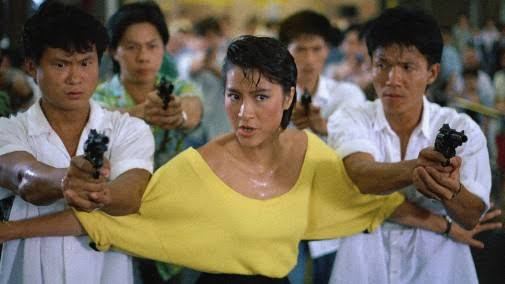
After her early appearances as a martial arts heroine in films such as Yes, Madam!,[1] Michelle Yeoh has developed a significant repertoire of roles as a maternal character. Her maternal persona, like those of mothers or stepmothers in fairy tales, is not always nurturing in the often-accepted sense of the ‘maternal.’ Her nurturing persona, which resonates with her biographical history, appears prominently in films including Crouching Tiger, Hidden Dragon, the Marvel Comics adaptation Shang-Chi, and, with some additional nuance, in the Netflix series The Brothers Sun.[2] One of her richest and most complex performances in the maternal vein is her dual characterization in the television series Star Trek: Discovery (2017–24), in which she plays a mirror or looking-glass pair of leaders, one of whom is a ‘good mother’ (Captain Philippa Georgiou of the starship Discovery) and the other, a fairy-tale ‘wicked stepmother,’ Emperor Georgiou of the viciously aggressive Terran Empire. The complexities of the Georgiou character increase when the Emperor crosses over to the universe of the Federation, where she assumes the identity of the deceased Captain Georgiou. Analysis of the fairy tale and folklore content of the characters played by Yeoh focuses particularly here on the Grimm fairy tale ‘Snow White’ and its multiple adaptations. In addition to fairy tale connections, the repeated references to the work of Lewis Carroll in Star Trek: Discovery connect not only to the character of Michael Burnham (Sonequa Martin-Green), the ‘daughter’ figure, but also to the ‘wicked’ aspect of the Emperor Georgiou persona and to the irrational complexities introduced by the mirror motif in the Discovery series.[3]
Maternal themes feature prominently—but not always positively—in fairy tales. The benevolent Fairy Godmother of the Cinderella tale type is countered by the evil, or at best negligent, mothers of the Snow White, Hansel and Gretel, and Little Red Riding Hood tales. The mother figure is sometimes replaced or suppressed by an evil stepmother, as in the more well-known of the Grimm Snow White tales.[4] The stepmother in the Snow White tales is typically configured as envious of the stepdaughter’s youth and beauty, falling into a narcissistic obsession which leads her to attempt to destroy the stepdaughter as a threat to her own putative supremacy as ‘the fairest of them all.’ Snow White tales meld together the motifs of youth, aging, death, rebirth, and the powerfully insidious double or doppelgänger element, present in the form of the ‘mirror, mirror on the wall’ figure. The Snow White tale type is so insistent on the importance of the double or the reflection that even the mechanism providing the reflection is verbally doubled in the incantation cited above.
The importance of the Snow White complex for Discovery is paired, through its mirror image, as well as through its youthful protagonist, with the Lewis Carroll novels Through the Looking Glass and Alice in Wonderland,[5] both of which feature bewildering mirror images, unpredictable characters (especially the Queen of Hearts from Alice in Wonderland), and generally illogical plot elements. Michael Prime still possesses the Lewis Carroll book which her benevolent human stepmother Amanda Grayson (Mia Kirshner) used to read to her when she was a child on Vulcan. Michael was adopted by Amanda and her Vulcan husband Sarek (James Frain) when Michael lost her parents in a Klingon attack. The Carroll works are particularly relevant to Michael’s topsy-turvy situation as a presumably orphaned human child trying to adapt to an alien culture on Vulcan, and to her bizarre experience on Discovery when the ship enters the mirror (looking-glass) universe. The family situation for Michael becomes even more complex when she learns, later in the series, that her birth mother Gabrielle (Sonja Sohn) had in fact survived the Klingon attack. Additionally, Michael reconnects with her missing stepbrother Spock (Evan Peck), with whom she has a difficult relationship, and, as already noted, acquires yet another stepmother in Emperor Georgiou.[6]
The mirror Georgiou, titled in the savage Terran Empire as Emperor Georgiou, certainly qualifies as an evil stepmother to Michael Burnham. The relationship between stepmother Emperor and stepdaughter Michael is complicated by the presence of two Michael Burnham characters: ‘good’ Michael, styled as Michael Prime, and ‘evil’ Michael, styled as Mirror Michael. According to Mirror ‘intelligence’ records consulted by Michael Prime, the Mirror Michael is ‘presumed dead.’ Michael tells Lorca (Jason Isaacs), ‘you’re a fugitive wanted for my murder.’ She was ‘sent to stop’ Mirror Lorca, who ‘had attempted a coup.’[7] In the early episodes in the Mirror Universe, Michael Prime supplants Mirror Michael, performing the difficult task of acting as a cruelly ruthless and ambitious Terran Empire officer. The complexity of the narrative is intensified by the revelation that Captain Gabriel Lorca of Discovery,[8] presumed to be from the Prime Universe, is from the Mirror Universe, in which he conducted an ambitious and insubordinate rivalry for authority with Emperor Georgiou.
The Mirror Universe narrative bears comparison to the schema for ‘Evil Stepmothers and Magic Mirrors’ fairy tales as presented by Jack Zipes. Zipes provides a list of ‘eight phases’ for the ‘Snow White’ narratives. He summarizes the content of these phases in ‘the different variants’ of the narrative:
Throughout the different variants, the wicked queen is motivated not only by her envy [of Snow White] but also by the magic mirror, which arbitrarily decides who is more beautiful. In other words, the conflict is generally played out as a reflection of women seeking male approval within the frame of a patriarchal society.[9]
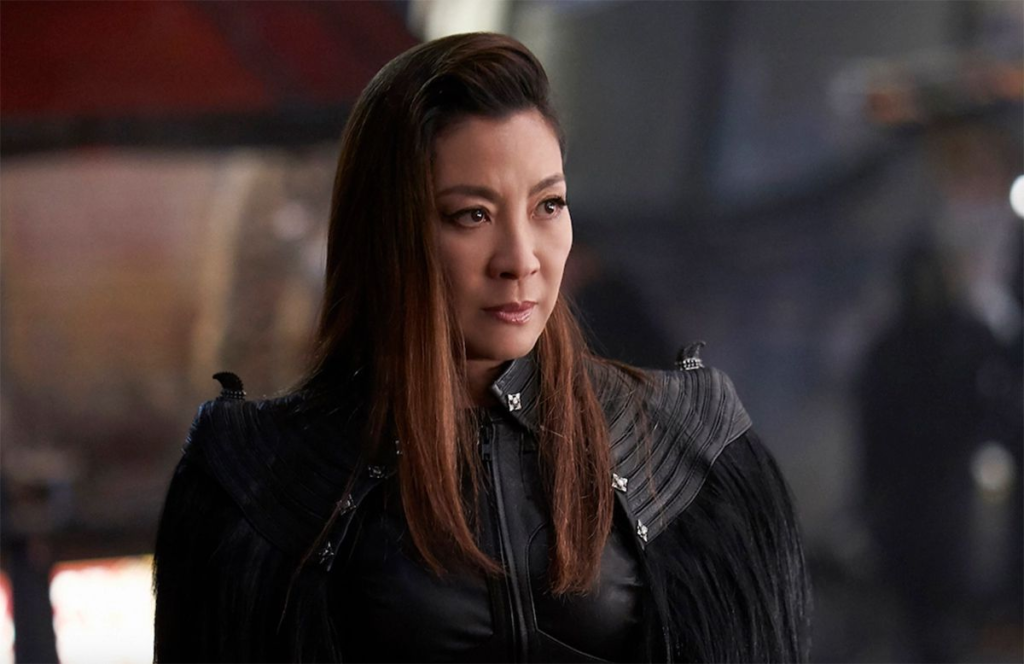
The mirror trope in Discovery (right; see top image) serves in its global application to reflect universes rather than personal images. The doubling effect of the mirror universes is a species of mise en abyme because the ‘mirror’ first reflects or doubles the overall systems (the universes) and within the mirror frame, provides the doubled characters, all possessing qualities native to the universe which they inhabit. Thus, the Michael of the Prime Universe, as a member of Starfleet, is principled, honest, and prone to self-doubt based on her powerful conscience, while the Michael of the Mirror Universe, a denizen of the Terran Empire, was apparently ruthless, cruel, and unquestioning of her own grasping motives. Much the same can be said of the two Georgiou versions.[10] As Shuli Barzilai states of the evil maternal figure in ‘Snow White,’ ‘The queen is characterized throughout in unremittingly negative terms: she is most often deemed “wicked,” but she is also proud, overbearing, and envious.’[11]Much the same can be said of the Emperor in her early scenes in the series.
Emperor Georgiou nearly has Michael Prime executed for treason.[12] In one of the series’ time travel episodes, the Emperor is revealed to have killed Mirror Michael, an action she decides to correct.[13] This plot element fits with the second phase in the Zipes schema, in which envy of the stepdaughter causes the stepmother to attempt to kill her.[14] The Emperor begins to display signs of a weakening or softening of her rigidity towards Michael, a trend that will accelerate when she accompanies Michael to the Prime universe. One way of understanding this process recalls the fairy-tale motif of the treacherous mirror, prominent in the differing Snow White versions:
. . . what remains dominant in almost all oral and written versions of the tale is the power of the mirror, and most important . . . is the relationship of the queen to the mirror that orchestrates her life . . . . Another way of describing her situation is that she becomes trapped in the spectacle of male illusions.”[15]
The need for ‘male approval’ is another of the elements noted by Zipes (‘Evil Stepmothers’ 551). Michael Prime often seeks such approval, particularly from Ash Tyler (Shazad Latif)—an unfortunate choice, as his bizarre character arc shows—[16] and the extremely dependable Kelpian Saru (Doug Jones), while Mirror Michael appears to have sought approval from no one except for Emperor Georgiou. Since Georgiou Prime died so early in the series, her perspective must remain unclear. Mirror Georgiou resists patriarchal approval, as her dismissively savage treatment of Lorca shows. As Emperor, she seeks to supplant traditional patriarchy while preserving in her rule qualities or ‘illusions’ often associated with ruthless patriarchs. Additionally, her resentment of Michael seems based more on an offended sense of the disloyalty shown her by the real Prime Michael, who had rebelled against her authority. Once the Lorca conflict is resolved with his death and the Emperor travels unwillingly to the Prime universe with Michael, the Emperor continues reluctantly to shed some of her inflexibly pitiless personality, becoming somewhat like the deceased Captain Georgiou. While in the Mirror universe, any display of maternal concern or guidance by the Emperor is suspect because tinged with manipulation and self-interest.[17]
One way of understanding the mixed messages sent by the Emperor is to refer to the archetype underlying the Evil Stepmother type, that is, according to Erich Neumann, the ‘Terrible Mother’ archetype, who equates, at least in one aspect or attribute, with ‘the hungry earth, which devours its own children and fattens on their corpses.’[18] Elsewhere in his[19] study, as Sarah Lynne Bowman observes, Neumann points out that ‘[b]oth the Good and Terrible aspects of the Archetypal Feminine are contained within what he calls the Great Round,’ and, ‘with Neumann’s theory as a model,’ Bowman ‘suggest[s] that this [good and evil] distinction between the Disney princess and her Terrible Mother[20] nemesis [and, presumably, their fairy tale originals] is . . . a false dichotomy.’[21]
In subsequent episodes, the erstwhile Emperor notably softens toward Michael and assists in overcoming threats to Discovery. In an important way, the absence of the firm but benevolent maternal Captain Georgiou, who was only present briefly in the first season, is filled here by the initially anti-maternal Mirror Emperor Georgiou, who then adopts at least partially the role of the late mother-figure. The changing attitude of Mirror Georgiou is also concurrent with her gradual weakening due to an ailment triggered by her new physical existence in a universe of which she is not a native.[22] In her last appearance in the series, when she returns from a wrenching time-travel experience, she displays strong maternal emotion towards Michael, having traversed the spectrum of affection to land in a position of accepting the emotions she had clearly tried to obscure.
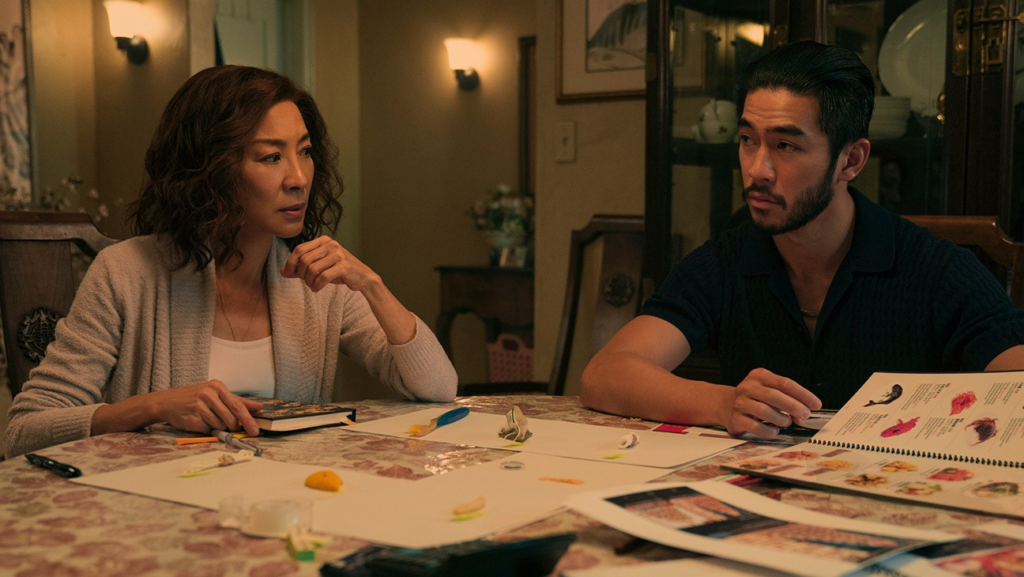
An imperious maternal character in a lighter vein was played by Michelle Yeoh in the recent but short-lived Netflix series The Brothers Sun.[23] The action-comedy series focused on the Sun family, a Taiwanese gangster organization. The family members and their associates are divided between Taiwan, where the paternal head of the family, Big Sun (Johnny Kuo), lies recovering after an assassination attempt, and Los Angeles, where his wife Eileen (Michelle Yeoh), lives with her feckless college student son Bruce (Sam Song Li) and, temporarily at least, with her other son Charles (Justin Chien), a trained assassin and bodyguard, who has travelled from Taiwan both to protect his mother and to search for clues to the provenance of the assassination attempt.
Within this tale of a gangster family, the dynamics of the relationship between the parents and the sons become paramount. Although clearly influenced by television series such as The Sopranos, The Brothers Sun should be understood in terms of the traditional relationships within the family which have been prescribed by the Confucian corpus and which have been subjected to changes with modernity.[24]
In traditional Confucian culture, as Hsu Jing and Tseng Wen-Shing observe,
. . . the father is the most important person in the paternal patriarchal Chinese family system, . . . However, in actual life, both traditionally and in modern times, usually it is the mother who is closer to the child and far more influential than the father[25] (my ellipsis).
In this series, the brothers are divided initially both by parent and by geographical distance. Charles lives in Taiwan assisting his father, while Bruce lives in Los Angeles with his mother. The assassination attempt on his father causes Charles to move, at least temporarily, to Los Angeles, so that both sons spend most of the series living with their mother. As the series begins, Charles appears not to question the authority of his father, while Bruce tries, though not openly, to escape or to bend the strictures imposed on him by his mother. She expects Bruce to complete his college education, while Bruce wants instead to learn improvisational comedy techniques. In any event, when Charles moves back to Los Angeles, both brothers attempt to rebel to some degree against their mother while still working to protect her.
Michelle Yeoh offers a complex and amusing portrait of a modern Chinese mother pulling away from patriarchal control. While seeming to be a traditional mother, maintaining the household and caring for her son Bruce, she soon reveals that she has another aspect to her character, an awareness of the need to maintain a network of ‘agents’ to protect herself and Bruce (as well as Charles) from attacks on the family both by other criminal families and by insurgents who want to destroy the Triad organizations.
The ‘agents’ or resources used by Eileen are a talkative and shrewd group of women who play mah-jongg and who work as a kind of Chinese grapevine with information helpful to Eileen. Despite her openly maternal posture, Eileen displays both ruthlessness and courage in her confrontations with enemies of her family. Given the absence of her husband from the California household, Eileen has functioned not only as mother to Bruce but, in a limited sense, as a surrogate father. According to accepted Chinese custom, the roles of the parents were divided:
. . . it was the father who was to play the role of disciplinarian in the home. Traditionally, the father has been characterized as being strict, and the mother as being kind . . .[26]
Eileen has taken on both roles with her son Bruce, with limited success given his persistent evasion of her rules and mandates. Her influence on Charles has been much more restricted, and she discovers that he tends to confront her much more openly than does Bruce. Eventually, however, both brothers discover that she has a hidden plan to take control of the family ‘business.’
Ying Nan, the aunt character played by Yeoh in Shang-chi and the Legend of the Ten Rings (Destin Daniel Cretton, 2021),[27] is, somewhat like Eileen, confronted by a heretofore absent relative, Xu Wenwu (Tony Leung), the husband of Nan’s deceased sister.[28] In this Marvel Comics adaptation, the deceptively manipulative father is misled by a demon masquerading as his deceased wife, causing him to return to his villainous past, while the aunt, a surrogate stepmother for Xu Shang-chi (Liu Simu) turns out to be benevolent though firm, fitting rather neatly into the Confucian model. The father had trained and disciplined Shang-chi and his sister as children, but his seemingly Confucian practice was not only excessively harsh but also concealed a sinister ambition.
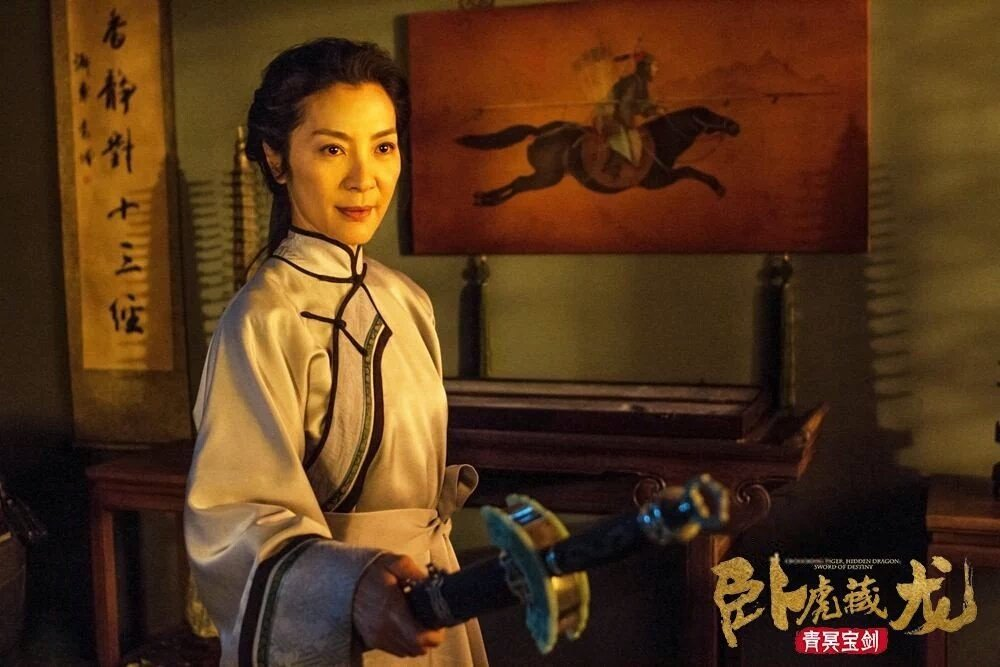
Michelle Yeoh played a more subtle role in the very successful wuxia film Crouching Tiger, Hidden Dragon (Ang Lee, 2000).[29] The film concentrates rather heavily on family challenges, particularly with respect to filial loyalty. Yu Shu-lien (Michelle Yeoh), an accomplished swordswoman who runs a security service, is tasked with guarding an ancient sword, the Green Destiny, for a family with political influence. Soon she meets a young woman, Yu Jen[30] (Zhang Yiyi), who is engaged to be married to a member of an important family. The sword is promptly stolen by a martial artist in disguise (Jen), who is assisted in escaping from the more skilled Shu-lien by a dangerous woman named Jade Fox (played by the late Cheng Pei-pei).
The film foregrounds the cultural and psychological importance of the warrior (wuxia) ethos for the major characters.[31] The two elders in the swordplay world (the jianghu),[32] Shu-lien and Mu-Bai, have observed the strictures of the ethos, paying a steep price in their interpersonal relations. When Jen idealizes the lifestyle of the wuxia, buying into the legendary, popular culture image of the jianghu world, ‘Shu Lien . . . narrates the story of her love for Mu Bai and the honor code that prevents them from consummating their love.’[33] This scene echoes, although in a more compassionate manner, the debunking of the gunfighter life in Unforgiven (Clint Eastwood, 1992), when the acerbic gunfighter English Bob (the late Richard Harris) shatters the pulp exaggerations of the dime novels devoured by journalist W. W. Beauchamp (Saul Rubinek).[34] Shu-lien decides to assist Li Mu-bai in his pursuit of the twisted Jade Fox not only from a sense of duty and honor[35] but because of her now internalized love for Li Mu-bai. As Mie Hiramoto observes,
. . . one of the noticeable tendencies of female wushu [martial arts] fighters in popular Chinese films is that a number of them . . . choose to battle for their love interests . . . . These films include Crouching Tiger, Hidden Dragon . . . .[36] (my ellipsis).
Although Crouching Tiger, Hidden Dragon stresses the conflict between an idealized warrior life and the grim reality of that life, the narrative also parallels fairy-tale structure. Shu-lien and her beloved Li Mu-Bai (Chow Yun-fat), a master swordsman, attempt to ‘parent’ the talented and rebellious Jen, serving as a ‘good stepmother’ and ‘good stepfather.’[37] Jen does not wish to follow the mandates of her own family, who have arranged her marriage.[38] The mysterious Jade Fox has ‘adopted’ Jen, acting as her governess but filling the fairy-tale role of an evil stepmother. Like the evil stepmother in ‘Snow White,’[39] who envies Snow White’s beauty and tries to kill her, Jade Fox resents her martial arts pupil Jen because as pupil, Jen did not fully share with her the secrets of the manual once owned by the master of Li Mu Bai, Jiang Nanhe, whom she resented and murdered because of her perception of his ‘lying to exchange advanced martial arts skills for their sexual relation.’[40] Thus Jen has surpassed her teacher, who only confesses her hatred on the verge of her own death, when she admits to Jen that the poisoned dart which hit Mu Bai was intended for Jen. Jade Fox resents Jen because Jen did not share the secrets of the Wudan training manual with her.[41]
The sequel to Crouching Tiger, Hidden Dragon, Crouching Tiger, Hidden Dragon: Sword of Destiny (Yuen Woo-ping, 2016),[42] reprises some of the plot elements—the attempted theft of the Green Destiny sword, the presence of a young swordswoman, for example—but adds some staples of martial arts films—rival clans of fighters, an evil clan leader, heroic independent martial arts fighters. A twist on the original film is the revelation that Shu-lien’s fiancé was not killed but survived a battle with the newly introduced swordsman (and evil clan leader) Hades Dai (Jason Scott Lee). Having adopted the name Silent Wolf, the erstwhile fiancé (Donnie Yen) meets Shu-lien and becomes her ally in guarding the Green Destiny. The narrative also adds a layer of complexity about the provenance of two of the younger characters, Snow Vase (Natasha Liu Bordizzo), who attempts to steal the sword but who becomes the disciple of Shu-lien, and Wei Fang (Harry Shum, Jr.), who belongs to the West Lotus clan, essentially a gangster mob, headed by Hades Dai.
The fairy tale parent motifs are displayed in a rather intricate manner in this film. Snow Vase and Wei Fang are both mistaken about one of their respective parents. Wei Fang had believed that he was the son of a concubine, while Snow Vase had assumed that she was the daughter of a famed swordswoman, Han Mei (Chang Shuya). Wei Fang and Snow Vase had been switched as babies in a variation on the changeling motif. Wei Fangwas adopted by Iron Crow (Roger Yuan), a famed swordsman, and was trained by him. Similarly, Snow Vase was adopted and trained by Han Mei. Now young adults, both Wei Fang and Snow Vase acquire another step-parent: Silent Wolf for Wei Fang, Shu-lien for Snow Vase.
Michelle Yeoh continued playing maternal characters in her Academy Award winning performance in Everything Everywhere All at Once (2022, dir. Daniel Kwan; Daniel Scheinert).[43] The comically absurdist film places Evelyn (Yeoh), a frustrated mother and wife trying to hold together her relationship with a challenging daughter and an apparently rather feckless husband while facing failure with the family laundromat business. Her performance is very complex, as her character navigates the multiverse with differing versions both of herself and of her family members and other contacts. Her apparent final resolution of the family difficulties provides a fitting but probably not a permanent coda for Yeoh’s maternal performances.
Works Cited
Anonymous. ‘Coatlicue Statue.’ Wikipedia, 2024. Retrieved from ‘https://en.wikipedia.org/w/index.php?title=Coatlicue_statue&oldid=1241639168.’ Accessed 20 November 2024.
Bartsch, Wilhelm. ‘Aschenputtel and Cinderella: The Brothers Grimm Versus Walt Disney: Or, a Moral and a Social Story.’ Print. Annual of Foreign Films and Literature 2 (1996): 31–42.
Barzilai, Shuli. ‘Reading “Snow White”: The Mother’s Story.’ Signs 15, no. 3 (Spring 1990): 515–34. Https://www.jstor.org/stable/3174426. Accessed 4 March 2024.
Birkhäuser-Oeri, Sibylle. The Mother: Archetypal Image in Fairy Tales. Originally published as Die Mutter im Märchen (Stuttgart: Verlag Adolf Bonz, 1977). Print. Edited by Marie-Louise Von Franz. Translated by Michael Mitchell. Toronto: Inner City Books, 1988.
Bowman, Sarah Lynne. ‘The Dichotomy of the Great Mother Archetype in Disney Heroines and Villainesses.’ In Vader, Voldemort, and Other Villains: Essays on Evil in Popular Media. Print, edited by Jamey Heit, 80–96. Jefferson, North Carolina: McFarland, 2011.
The Brothers Sun. Television series. With Michelle Yeoh, Justin Chien, Sam Song Li, Highdee Kuan, Joon Lee, Alice Hewkin, Jenny Yang, Madison Hu, and Johnny Kuo. Created by Brad Falchuk, Amy Wang, and Byron Wu. Brad Falchuk Teley-Vision/Netflix, 2024.
Brundage, Burr Cartwright. The Fifth Sun: Aztec Gods, Aztec World. 1988. Austin: The University of Texas Press, 1979.
Cai, Rong. ‘Gender Imaginations in Crouching Tiger, Hidden Dragon and the Wuxia World.’ Positions: East Asia Cultures Critique 13, no. 2 (Fall 2005): 441–71. Https://muse-jhu-edu.iris.etsu.edu/article/186805. Accessed 12 November 2024.
Carroll, Lewis. The Annotated Alice: Alice’s Adventures in Wonderland & Through the Looking Glass. Print. With an introduction by Martin Gardner. Cleveland: Forum Books, The World Publishing Company, 1965.
Chan, Kenneth. ‘The Global Return of the Wu Xia Pian (Chinese Sword-Fighting Movie): Ang Lee’s Crouching Tiger, Hidden Dragon.’ Cinema Journal 43, no. 4 (Summer 2004): 3–17. Gale Literature Resource Center (accessed November 11, 2024). https://link-gale-com.iris.etsu.edu/apps/doc/A160419016/LitRC?u=tel_a_etsul&sid=summon&xid=24f3bcd5.
Chappelle, Joe, director. ‘The Day We Died.’ With Anna Torv, Joshua Jackson, John Noble, Jasika Nicole, Michael Cerveris, Lance Reddick, and Brad Dourif. In Fringe, vol. 3.22, 6 May 2011, Television series, Digital Blu-ray Videodisc. Bad Robot-Warner Brothers-Fox Network, 2011.
Chen, Ya-chen. ‘The Fox, Dragon, and Lotus in Crouching Tiger Hidden Dragon.’ In Chen, Ya-chen, Women in Chinese Martial Arts Films of the New Millennium: Narrative Analyses and Gender Politics, 31–46. Blue Ridge Summit: Lexington Books/Fortress Academic, 2012. Https://ebookcentral.proquest.com/lib/etsu/detail.action?docID=948637. Accessed 30 November 2024.
– – – – – – . ‘Interview with Tsai Kuo-Jung, a Coplanner and Screenwriter of Ang Lee’s Crouching Tiger Hidden Dragon.’ With Chen Ya – chen. In Chen, Ya-chen, Women in Chinese Martial Arts Films of the New Millennium: Narrative Analyses and Gender Politics, 229–33. Blue Ridge Summit: Lexington Books/Fortress Academic, 2012. Https://ebookcentral.proquest.com/lib/etsu/detail.action?docID=948637. Accessed 30 November 2024.
Chomsky, Marvin J., director. ‘All Our Yesterdays.’ With William Shatner, Leonard Nimoy, DeForest Kelley, James Doohan, Ian Wolfe, Mariette Hartley, and Kermit Murdock. In Star Trek: The Original Series, vol. 3.23, 15 December 1969. Digital Blu-ray Videodisc. Paramount-CBS, 2009.
Chong, Woei-lien. ‘Ang Lee’s “Crouching Tiger, Hidden Dragon” and Fruit Chan’s “Little Cheung”: Two Chinese Highlights at the 2001 International Rotterdam Film Festival.’ Print. China Information 15, no. 1 (2001): 166–93.
Cretton, Destin Daniel, director. Shang- Chi and the Legend of the Ten Rings. Film. With Michelle Yeoh, Simu Liu, Tony Chiu-wai Leung, Awkwafina, Ben Kingsley, and Yuen Wah. Marvel Studios, 2021.
Eastwood, Clint, director. Unforgiven. Digital Blu-ray disc. With Clint Eastwood, Morgan Freeman, Gene Hackman, Richard Harris, and Saul Rubinek. 2006. Malpaso-Warner Bros., 1992.
Fairlamb, Horace L. ‘Romancing the Tao: How Ang Lee Globalized Ancient Chinese Wisdom.’ Symplokē 15, no. 1 –2 (Winter 2007): 190–205. Gale Literature Resource Center, link.gale.com/apps/doc/A181989865/LitRC?u=tel_a_etsul&sid=summon&xid=5c4e79f3. Accessed 6 Dec. 2024.
Frakes, Jonathan, director. ‘Despite Yourself.’ Season 1, Episode 10. With Sonequa Martin-Green, Jason Isaacs, Doug Jones, Shazad Latif, Anthony Rapp, and Mary Wiseman in Star Trek: Discovery. Digital Blu-ray Videodisc, 2017–18. Paramount, 2009.
Frankenheimer, John, director. The Manchurian Candidate. 1962. Digital Videodisc. With Laurence Harvey, Frank Sinatra, Janet Leigh, and Angela Lansbury. MGM-M. C., 2004.
Funnell, Lisa. Warrior Women: Gender, Race, and the Transnational Chinese Action Star. Albany: State University of New York Press, 2014. Https://doi-org.iris.etsu.edu/10.1515/9781438452500. Accessed 6 December 2024.
Gomes, Catherine. ‘Crouching Women, Hidden Genre: An Investigation into Western Film Criticism’s Reading of Feminism in Ang Lee’s Crouching Tiger, Hidden Dragon.’ Print. Limina 5 (2005): 47-56.
Grimm, Jacob, and Wilhelm Grimm. ‘Snow White.’ In The Annotated Brothers Grimm. Print, Bicentennial ed., with a preface by Maria Tatar, with an introduction by A. S. Byatt, 246-61. New York: W. W. Norton & Co., 2012.
Hiramoto, Mie. ‘Don’t Think, Feel: Mediatization of Chinese Masculinities Through Martial Arts Films.’ Language & Communication 32 (2012): 386-99. Http://dx.doi.org/10.1016/j.langcom.2012.08.005. Accessed 12 November 2024.
Hiramoto, Mie, and Cherise Shi Ling-teo. ‘I Am The Invincible Sword Goddess: Mediatization of Chinese Gender Ideology Through Female Kung–Fu Practitioners in Films.’ Societies, Basel 4, no. 3 (2014): 477–505. Https://www.proquest.com/scholarly-journals/i-am-invincible-sword-goddess-mediatization/docview/1615933889/se-2?accountid=10771. Accessed 22 November 2024.
Ho, David Y. F. ‘Fatherhood in Chinese Culture.’ In The Father’s Role: Cross-Cultural Perspectives. Print. Edited by Michael E. Lamb, 227–45. Hillsdale, New Jersey: Lawrence Erlbaum Associates, Publishers, 1987.
Ho, D.Y. F. ‘Traditional Patterns of Socialization in Chinese Society.’ Print. Acta Psychologica Taiwanica 23, no. 2 (1981): 81–95.
Jing Hsu and Tseng Wen-shing. ‘Family Relations in Classic Chinese Opera.’ Print. International Journal of Social Psychiatry 20, no. 3–4 (1974): 159–72.
Johnson, T. W. ‘Far Eastern Fox Lore.’ Asian Folklore Studies 33, no. 1 (1974): 35–68. Https://www.jstor.org/stable/1177503. Accessed 18 November 2024.
Keeler, Amanda. ‘Visible/Invisible: Female Astronauts and Technology in Star Trek: Discovery and National Geographic’s Mars.’ Science Fiction Film and Television 12, no. 1 (2019): 127–50. Http://dx.doi.org/10.3828/sfftv.2019.7. Accessed 5 December 2024.
Kwan, Daniel, and Daniel Scheinert, directors. Everything Everywhere All at Once. With Michelle Yeoh, James Hong, Jamie Lee Curtis, Stephanie Hsu, and Ke Hu-Quan. A24, 2022.
Lee, Ang, director. Crouching Tiger, Hidden Dragon. Digital Videodisc. With Michelle Yeoh, Chow Yun-fat, Zhang Ziyi, Cheng Pei-pei, and Chen Chang. Sony Pictures Classics-Columbia Pictures Film Production Asia, 2000.
——. ‘Interview.’ Print. China Times Weekly 65 (March-April 1993): 75.
Lee, Ang, and James Schamus, interview by Neil Norman. From the Guardian, November 7, 2000. Interview conducted at the British Film Institute. Copyright Guardian News and Media Ltd. 2000. In Ang Lee: Interviews. Edited by Karla Rae Fuller, 36–48. Jackson: University Press of Mississippi, 2016. ProQuest Ebook Central, https://ebookcentral.proquest.com/lib/etsu/detail.action?docID=44386. Accessed 5 December 2024.
Leung, William. Crouching Sensibility, Hidden Sense.” Film Criticism 26, no. 1 (Fall 2005): 42–55, 78. Https://www.proquest.com/scholarly-journals/crouching-sensibility-hidden-sense/docview/200838669/se-2?accountid=10771. Accessed 12 November 2024.
Liu, James J. Y. The Chinese Knight-Errant. Print. Chicago: University of Chicago Press, 1967.
Louie, Kam, and Louise Edwards. “Chinese Masculinity: Theorizing Wen and Wu.” Print. East Asian History, no. 8 (1994): 135–48.
Millsap-Spears, Carey. Star Trek Discovery and the Female Gothic: Tell Fear No. Print. Lanham: Lexington Books, 2024.
Neumann, Erich. The Great Mother: An Analysis of the Archetype. Print. Translated by Ralph Manheim. 1963. Bollingen Series, vol. 47. Princeton: Princeton University Press, 1970.
Nordin, Kenneth D. ‘Shadow Archetypes in Ang Lee’s Crouching Tiger, Hidden Dragon and The Hulk: A Jungian Perspective.’ Print. Asian Cinema 15, no. 2 (Fall/Winter 2004): 120–32.
Pevney, Joseph, director. ‘The City on the Edge of Forever.’ With William Shatner, Leonard Nimoy, DeForest Kelley, James Doohan, Joan Collins, Nichelle Nichols, George Takei, and Bartell La Rue, written by Harlan Ellison and Gene Roddenberry. In Star Trek: The Original Series, vol. 1.28. 6 April 1967. Digital Blu-ray Videodisc. Paramount-CBS, 2009.
Shih, Shu-mei. ‘Globalisation and Minoritisation: Ang Lee and the Politics of Flexibility.’ Print. New Formations 40 (March-April 1993): 86–101.
Teo, Stephen. Chinese Martial Arts Cinema: The Wuxia Tradition. Print. Edinburgh: Edinburgh University Press, 2009.
Uther, Hans-Jörg. ’ “The Fox in World Literature: Reflections on a “Fictional Animal”.’ Asian Folklore Studies 65 (2006): 133-60. Https://www.proquest.com/scholarly-journals/fox-world-literature-reflections-on-fictional/docview/224528576/se-2?accountid=10771. Accessed 21 November 2024.
Williams, Christy. ‘Who’s Wicked Now? The Stepmother as Fairy-Tale Heroine.’ Marvels & Tales 24, no. 2 (2010): 255–71. Https://www.jstor.org/stable/41388955. Accessed 23 September 2024.
Yuen, Corey Kwai, director. Yes, Madam! Digital Videodisc, original title Huang jia shi jie. With Michelle Yeoh, John Sham, Cynthia Rothrock, Tsui Hark, and Sammo Hung Kam-bo. D & B Films, Ltd./Media Asia, 1985.
Yuen, Woo-ping, director. Crouching Tiger, Hidden Dragon: Sword of Destiny. Film. With Donnie Yen, Michelle Yeoh, Harry Shum, Jr., Natasha Lui Bordizzo, Jason Scott Lee, Eugenia Yuan, Roger Yuan, JuJu Chan Szeto, and Gary Young. The Weinstein Company-Netflix, 2016.
Zipes, Jack. The Enchanted Screen: The Unknown History of Fairy-Tale Films. New York: Routledge, 2011. Http://ebookcentral.proquest.com/lib/etsu/detail.action?docID=667919. Accessed 8 October 2024.
——. ‘Evil Stepmothers and Magic Mirrors: Snow White.’ In The Golden Age of Folk and Fairy Tales: From the Brothers Grimm to Andrew Lang. Print, edited and translated by Jack Zipes, 551–89. Indianapolis: Hackett Publishing Company, Inc., 2013.
Notes
[1]. Corey Kwai Yuen, dir., Yes, Madam! Digital Videodisc, original title Huang jia shi jie, with Michelle Yeoh, et al. (D & B films, Ltd./Media Asia, 1985).
[2]. The Brothers Sun, television series, with Michelle Yeoh, et al., creators Brad Falchuk, Amy Wang, and Byron Wu (Brad Falchuk Teley-Vision/Netflix, 2024).
[3]. For commentary on Yeoh as a maternal figure in films not discussed here, see Lisa Funnell, Warrior Women: Gender, Race, and the Transnational Chinese Action Star (Albany: State University of New York Press, 2014), Https://doi-org.iris.etsu.edu/10.1515/9781438452500. Accessed 6 December 2024, esp. 49-53.
[4]. A striking reversal of ‘the wicked stepmother’ type is found in a recent fictional treatment:
Robert Coover’s 2004 novel, Stepmother, takes on the wicked stepmother figure of fairy-tale tradition . . . . Stepmother, the title character and the novel’s protagonist, is trying to save her daughter’s life. (Christy Williams, ‘Who’s Wicked Now? The Stepmother as Fairy-Tale Heroine,’ Marvels & Tales 24, no. 2 [2010]: 255, Https://www.jstor.org/stable/41388955. Accessed 23 September 2024.) (my ellipsis)
[5]. Lewis Carroll, The Annotated Alice: Alice’s Adventures in Wonderland & Through the Looking Glass, print, introd. by Martin Gardner (Cleveland: Forum Books-The World Publishing Company, 1965).
[6]. Wilhelm Bartsch summarizes ‘step’ relationships, including step-siblings, in fairy tales:
According to fairy tales, stepmothers are different from natural mothers. Natural mothers will not severely test their children, but stepmothers will. Stepmothers make the life of stepchildren miserable . . . . The word step in stepmother means a step away, inflexible, egotistical, not natural. Stepparents, as well as stepsisters and stepbrothers, provide hardships for their half-siblings. They test those who eventually will become the hero or heroine, before they take their proper place in society, namely to become king or queen, father or mother of the country and its people. (Wilhelm Bartsch, ‘Aschenputtel and Cinderella: The Brothers Grimm Versus Walt Disney: Or, a Moral and a Social Story,’ print, Annual of Foreign Films and Literature 2 (1996): 32.) (my ellipsis)
Flashback sequences show Michael being tested for entrance into the Vulcan Science Academy and arguing with her stepbrother Spock. In retrospect, all her travails with family, step and natural, prepare her not for a queenship but for the captaincy of Discovery. Later in the series, another example of sibling rivalry, frequent in fairy tales, will feature Cleveland Booker (“Book”) (David Ajala) and his estranged brother.
[7]. Frakes, Jonathan, dir., ‘Despite Yourself,’ Season 1, Episode 10, with Sonequa Martin-Green, et al. in Star Trek: Discovery, Digital Blu-ray Videodisc, 7 January 2018 (Paramount, 2018), Ch. 4.
[8]. Whether intentionally or not, the screenwriters gave Lorca, a father-figure for Michael Prime—at least until she discovers his real origin—the masculine form of her real mother’s first name, Gabrielle. Thus, the already complex status of Michael’s parentage is given another dimension.
[9]. [Jack Zipes], ‘Evil Stepmothers and Magic Mirrors: ATU 709–Snow White,’ in The Golden Age of Folk and Fairy Tales: From the Brothers Grimm to Andrew Lang, print, ed. and trans. Jack Zipes (Indianapolis: Hackett Publishing Company, Inc., 2013), 551.
[10]. Amanda Keeler compares Captain Georgiou with the Terran Emperor: ‘The wise and maternal Philippa Georgiou’s doppelgänger is ruthless and bloodthirsty, fittingly so as she turns out to be the mirror-universe Terran Emperor.’ Amanda Keeler, ‘Visible/Invisible: Female Astronauts and Technology in Star Trek: Discovery and National Geographic’s Mars,’ Science Fiction Film and Television 12, no. 1 (2019): 140, Http://dx.doi.org/10.3828/sfftv.2019.7. Accessed 5 December 2024.
[11]. Shuli Barzilai, ‘Reading “Snow White”: The Mother’s Story,’ Signs 15, no. 3 (Spring 1990): 523, Https://www.jstor.org/stable/3174426. Accessed 4 March 2024. Note also that the Mirror Michael character deviates from the innocent persona of Snow White, to whom ‘an angry or hostile response is never attributed’ (Barzilai 523).
[12]. At this stage of the narrative, the resentful Mirror Georgiou ‘perceives her [Michael] as the Mirror Universe’s version of Captain Burnham who once was her unruly daughter’ Carey Millsap-Spears, Star Trek Discovery and the Female Gothic: Tell Fear No, print (Lanham: Lexington Books, 2024), 157.
[13]. Besides the direct connection to the provocative episode from Star Trek: The Original Series, ‘The City on the Edge of Forever’, Joseph Pevney, dir., ‘The City on the Edge of Forever,’ with William Shatner, et al., in Star Trek: The Original Series, 1967, vol. 1.28, 6 April 1967, Digital Blu-ray Videodisc, (Paramount-CBS, 2009), the Emperor’s attempt to revise her choices in her time-line parallels one of the most intriguing episodes of the series Fringe (2008-13), ‘The Day We Died,’ which features an attempt by Peter Bishop (Joshua Jackson) to revise a dystopian present by following the urging of scientist Walter Bishop (John Noble) to ‘make a different choice within what happened’ (Joe Chappelle, dir., ‘The Day We Died,’ with Anna Torv, et al., in Fringe, vol. 3.22, 6 May 2011, television series, Digital Blu-ray Videodisc (Bad Robot-Warner Brothers-Fox Network, 2011).
[14]. [Zipes], ‘Evil Stepmothers.’
[15]. Jack Zipes, The Enchanted Screen: The Unknown History of Fairy-Tale Films (New York: Routledge, 2011), 116, Http://ebookcentral.proquest.com/lib/etsu/detail.action?docID=667919. Accessed 8 October 2024.
[16]. Starfleet officer Ash Tyler, kept prisoner by the Klingons, is subjected to a horrific procedure in which the consciousness of an important Klingon, already deceased, is physically implanted into his human body, causing him to become dangerously unstable on a psychic level.
[17]. In this respect the personality and affect of the Emperor show some kinship to the unforgettable portrayal by Angela Lansbury as the deceptive and ruthless mother of the tragic Raymond Shaw (Laurence Harvey) in The Manchurian Candidate (John Frankenheimer, 1962) (John Frankenheimer, dir., The Manchurian Candidate, Digital Videodisc, withs Laurence Harvey, Frank Sinatra, Janet Leigh, and Angela Lansbury, 1962 (MGM-M. C., 2004).
[18]. Erich Neumann, The Great Mother: An Analysis of the Archetype, print, trans. Ralph Manheim, reprint, 1963, Bollingen Series, vol. 47 (Princeton: Princeton University Press,1970), 149. For another Jungian study of the mother and stepmother archetypes, see Sibylle Birkhäuser-Oeri, The Mother: Archetypal Image in Fairy Tales, originally published as Die Mutter im Märchen (Stuttgart: Verlag Adolf Bonz, 1977), print, ed. Marie-Louise Von Franz, trans. Michael Mitchell (Toronto: Inner City Books, 1988), esp. ‘The Jealous Stepmother’ (pp. 29-40).
[19]. Sarah Lynne Bowman, ‘The Dichotomy of the Great Mother Archetype in Disney Heroines and Villainesses,’ in Vader, Voldemort, and Other Villains: Essays on Evil in Popular Media, print, ed. Jamey Heit (Jefferson, North Carolina: McFarland, 2011), 82.
[20]. One of the more fascinating (and unsettling) manifestations of the Terrible Mother archetype is the Mexica (Aztec) goddess Coatlicue (‘Serpent Skirt’). In her terrible aspect, she was the devouring mother. She was memorably represented in a fascinating (or horrifying, depending on the perspective of the viewer) statue, now in the Museo Nacional de Antropología in Mexico City. This magnificent work of Aztec art ‘was excavated in the main plaza of Mexico City . . . on 13 August 1790 during the excavation of a water canal’ and was reburied ‘on the orders of the clergy, because its presence resulted in worship’ and was not excavated again until 1823. (Anonymous, ‘Coatlicue Statue’ [Wikipedia, 2024], 2, Retrieved from https://en.wikipedia.org/w/index.php?title=Coatlicue_statue&oldid=1241639168. Accessed 20 November 2024 (my ellipsis). Brundage provides a concise but rather detailed description of the statue: Burr Cartwright Brundage, The Fifth Sun: Aztec Gods, Aztec World, reprint, 1988 (Austin: The University of Texas Press, 1979), 167–68.
[21]. Bowman, ‘The Dichotomy of the Great Mother Archetype in Disney Heroines and Villainesses,’ 82.
[22]. A similar motif, in the context of time travel, is crucial in ‘All Our Yesterdays,’ an episode from the third season of the original Star Trek series. In that episode, travel to the past gradually kills the traveler who has not been ‘prepared’ beforehand (Marvin J. Chomsky, dir., ‘All Our Yesterdays,’ with William Shatner, et al., in Star Trek: The Original Series, vol. 3.23, 15 December 1969, Digital Blu-ray Videodisc [Paramount-CBS, 2009].
[23]. The Brothers Sun.
[24]. Film director Ang Lee, a Taiwanese native, noted that modern Taiwanese display an ambivalent perspective on traditional ethics. In an interview he [Ang Lee] gave to China Times Weekly in 1993, ‘he said that Taiwanese today are Westernised just like Chinese immigrants in the United States, and both groups want to be Westernised yet maintain Chinese familialism and Confucian ethics’ (Shu-mei Shih, ‘Globalisation and Minoritisation: Ang Lee and the Politics of Flexibility,’ print, New Formations 40 (March-April 1993): 95; Ang Lee, ‘Interview,’ print, China Times Weekly 65 (March-April 1993): 75.
[25]. Jing Hsu and Wen-Shing Tseng, ‘Family Relations in Classic Chinese Opera,’ print, International Journal of Social Psychiatry 20, no. 3–4 (1974): 160. See also David Y. F. Ho, ‘Fatherhood in Chinese Culture,’ in The Father’s Role: Cross-Cultural Perspectives, print, ed. Michael E. Lamb (Hillsdale, New Jersey: Lawrence Erlbaum Associates, Publishers, 1987), 227–45.
[26]. D.Y. F. Ho, ‘Traditional Patterns of Socialization in Chinese Society,’ print, Acta Psychologica Taiwanica 23, no. 2 (1981): 87.
[27]. Destin Daniel Cretton, dir., Shang-Chi and the Legend of the Ten Rings, film, with Michelle Yeoh, et al. (Marvel Studios, 2021).
[28]. Cretton, Shang-Chi and the Legend of the Ten Rings.
[29]. Ang Lee, dir., Crouching Tiger, Hidden Dragon, Digital Videodisc, with Michelle Yeoh, et al. (Sony Pictures Classics-Columbia Pictures Film Production Asia, 2000).
[30]. Chong comments on Jen’s name (in pin-yin, Yu Jiaolong): ‘She is mistakenly called “Jen” in the English subtitles. This is an unfortunate mistake since the second character of the girl’s name, “Long,” means “Dragon,” referring to her spiritual destiny to become a dragon soaring toward heights unattainable by normal human beings.’ Woei Lien Chong, ‘Ang Lee’s “Crouching Tiger, Hidden Dragon” and Fruit Chan’s “Little Cheung”: Two Chinese Highlights at the 2001 International Rotterdam Film Festival,’ print, China Information 15, no. 1 (2001): 167.
[31]. William Leung comments:
The word wu refers to a kind of cultivated martial arts skill, while the word xia refers to a type of ancient mythical hero, and thus combined, the phrase wuxia stands for an instantly recognizable form of narrative where traditional ideas about good and evil are played out in the stylish adventures of skillful, spiritually attuned warriors. William Leung, ‘Crouching Sensibility, Hidden Sense,’ Film Criticism 26, no. 1 (Fall 2005): 43, Https://www.proquest.com/scholarly-journals/crouching-sensibility-hidden-sense/docview/200838669/se-2?accountid=10771. Accessed 12 November 2024.
[32]. Regarding the concept of jianghu in modern Chinese literature like the source material for Crouching Tiger, Hidden Dragon, Stephen Teo cites a Chinese-language source:
Chen Pingyuan states that the development of twentieth-century wuxia literature has relied on the dramatizing of, first, the jianghu (literally, ‘rivers and lakes’, an anarchic domain with its own codes and laws in which knights-errant [wuxia] roam and operate and commit acts of violence based on revenge), second, martial arts action, and third, Buddhist concepts. Stephen Teo, Chinese Martial Arts Cinema: The Wuxia Tradition, print (Edinburgh: Edinburgh University Press, 2009), 7.
For commentary on the jianghu as well as Confucianism in the wuxia genre, see Catherine Gomes, ‘Crouching Women, Hidden Genre: An Investigation into Western Film Criticism’s Reading of Feminism in Ang Lee’s Crouching Tiger, Hidden Dragon,’ print, Limina 5 (2005): 47–56.
[33]. Kenneth Chan, ‘The Global Return of the Wu Xia Pian (Chinese Sword-Fighting Movie): Ang Lee’s Crouching Tiger, Hidden Dragon,’ Cinema Journal 43, no. 4 (Summer 2004): 8, Gale Literature Resource Center (accessed November 11, 2024). https://link-gale-com.iris.etsu.edu/apps/doc/A160419016/LitRC?u=tel_a_etsul&sid=summon&xid=24f3bcd5 (my ellipsis).
[34]. Clint Eastwood, dir., Unforgiven, 1992. Digital Blu-ray Videodisc, with Clint Eastwood, et al. (Malpaso-Warner Bros., 2006).
[35]. James J. Y. Liu comments on an important distinction between the Chinese knight-errant and the Confucian tradition:
In many ways, the knight-errant forms a strong contrast to the Confucian scholar . . . . the Confucians believed in degrees of love and duty—one must first love one’s parents, and filial duty was more important than abstract justice. The knight-errant, on the other hand, considered the same principles of justice and moral duty applicable to relatives and strangers alike. (James J. Y. Liu, The Chinese Knight-Errant, print [Chicago: University of Chicago Press, 1967], 7) (my ellipsis).
Both Shu-lien and Li Mu-bai extend their sense of obligation and honor to a wider sphere. For the contrast (and complementary nature) of wen (the scholarly pursuit) and wu (the military discipline) in Chinese culture, see Kam Louie and Louise Edwards, ‘Chinese Masculinity: Theorizing Wen and Wu,’ print, East Asian History, no. 8 (1994): 135–48. Rong Cai cites the summary by Liu of knightly virtues in China: Rong Cai, ‘Gender Imaginations in Crouching Tiger, Hidden Dragon and the Wuxia World,’ Positions: East Asia Cultures Critique 13, no. 2 (Fall 2005): 467n12, https://muse-jhu-edu.iris.etsu.edu/article/186805. Accessed 12 November 2024.
[36]. Mie Hiramoto, ‘Don’t Think, Feel: Mediatization of Chinese Masculinities Through Martial Arts Films,’ Language & Communication 32 (2012): 390n4, http://dx.doi.org/10.1016/j.langcom.2012.08.005. Accessed 12 November 2024.
[37]. The translation of Shu-Lien’s name, ‘Yü Xiulian [Yu Shu-Lien] (“graceful lotus”), symbolizing dignity, spiritual purity and lack of pollution),’ is fitting for her mentoring role: Ya-Chen Chen, ‘The Fox, Dragon, and Lotus in Crouching Tiger Hidden Dragon,’ in Chen, Ya-Chen, Women in Chinese Martial Arts Films of the New Millennium : Narrative Analyses and Gender Politics (Blue Ridge Summit: Lexington Books/Fortress Academic, 2012), 31, https://ebookcentral.proquest.com/lib/etsu/detail.action?docID=948637. Accessed 30 November 2024.
Chen also characterizes the relationship between ‘Yü Jiaolong (“jade appearing dragon”) and Shu-Lien as ‘sisterly’ (31, 40-41). “Maternal” or “motherly” seems a better fit, for generational and relationship reasons (Shu-lien is chronologically paired with Li Mu-bai, Yü Jiaolong with Luo Xiaohu).
[38]. Kenneth D. Nordin emphasizes the maturation of Jen: ‘ . . . from a Jungian perspective, the film is really about the emotional and spiritual development of Yu Jen, who progresses from being an adolescent trickster into a woman who gains individuation or spiritual wholeness’ (Kenneth D. Nordin, ‘Shadow Archetypes in Ang Lee’s Crouching Tiger, Hidden Dragon and The Hulk: A Jungian Perspective,’ print, Asian Cinema 15, no. 2 [Fall/Winter 2004]: 124).
Unlike the more mature Shu Lien, who plies her trade unselfishly despite her conflicted spirit, young Jen, in her adolescent phase, ‘reveals an anti-Confucian attitude’ despite the fact that she was ‘brought up with Confucian teaching and is well aware of the behavior expected of women.’ (Mie Hiramoto and Cherise Shi Ling Teo, ‘I Am The Invincible Sword Goddess: Mediatization of Chinese Gender Ideology through Female Kung–Fu Practitioners in Films,’ Societies, Basel 4, no. 3 [2014]: 487, https://www.proquest.com/scholarly-journals/i-am-invincible-sword-goddess-mediatization/docview/1615933889/se-2?accountid=10771. Accessed 22 November 2024).
[39]. Jacob Grimm and Wilhelm Grimm, ‘Snow White,’ in The Annotated Brothers Grimm, print, Bicentennial ed., preface by Maria Tatar, introd. by A. S. Byatt (New York: W. W. Norton & Co., 2012), 246–61.
[40]. Ya-Chen Chen, ‘Interview with Tsai Kuo-Jung, a Coplanner and Screenwriter of Ang Lee’s Crouching Tiger Hidden Dragon,’ in Ya-Chen Chen, Women in Chinese Martial Arts Films of the New Millennium: Narrative Analyses and Gender Politics (Blue Ridge Summit: Lexington Books/Fortress Academic, 2012), 231, https://ebookcentral.proquest.com/lib/etsu/detail.action?docID=948637. Accessed 30 November 2024. Tsai also identifies Jade Fox as belonging to a familiar folklore category: ‘ . . . she represents fox spirits or female scapegoats of chauvinistic Chinese men’s immoral sexuality.’ (Chen, ‘Interview with Tsai Kuo-Jung, a Coplanner and Screenwriter of Ang Lee’s Crouching Tiger Hidden Dragon,’ 231). For information on ‘fox spirits’: T. W. Johnson, ‘Far Eastern Fox Lore,’ Asian Folklore Studies 33, no. 1 (1974): 35–68, https://www.jstor.org/stable/1177503. Accessed 18 November 2024; Hans-Jörg Uther, ‘The Fox in World Literature: Reflections on a “Fictional Animal”,’ Asian Folklore Studies 65 (2006): 133–60, https://www.proquest.com/scholarly-journals/fox-world-literature-reflections-on-fictional/docview/224528576/se-2?accountid=10771. Accessed 21 November 2024.
For comment by Ang Lee on Jade Fox, the Green Destiny, and Taoist symbolism, see Ang Lee and James Schamus, interview by Neil Norman. From the Guardian, November 7, 2000. Interview conducted at the British Film Institute. Copyright Guardian News and Media Ltd. 2000. In Ang Lee: Interviews, ed. Karla Rae Fuller (Jackson: University Press of Mississippi, 2016), 2, ProQuest Ebook Central, https://ebookcentral.proquest.com/lib/etsu/detail.action?docID=44386. Accessed 5 December 2024.
[41]. For the ‘pairs of characters’ in the film, and for commentary on Taoism and Confucianism relative to the film, see Horace L. Fairlamb, ‘Romancing the Tao: How Ang Lee Globalized Ancient Chinese Wisdom,’ Symplokē 15, no. 1–2 (Winter 2007): 190–205, Gale Literature Resource Center, link.gale.com/apps/doc/A181989865/LitRC?u=tel_a_etsul&sid=summon&xid=5c4e79f3. Accessed 6 Dec. 2024 (194-96 et passim.).
[42]. Woo-Ping Yuen, dir., Crouching Tiger, Hidden Dragon: Sword of Destiny, film, with Donnie Yen, et al. (The Weinstein Company-Netflix, 2016).
[43]. Daniel Kwan and Daniel Scheinert, dirs., Everything Everywhere All at Once, actors Michelle Yeoh, et al. (A24, 2022).
Ken Hall (Ph.D., University of Arizona, 1986; MA, University of NC-Chapel Hill, 1978) is professor emeritus of Spanish at ETSU, where he had taught since 1999. His publications include Professionals in Western Film and Fiction (McFarland, 2019), John Woo: The Films (McFarland, [1999] 2012), John Woo’s The Killer (Hong Kong University Press, 2009), Stonewall Jackson and Religious Faith in Military Command (McFarland, 2005) and Guillermo Cabrera Infante and the Cinema (Juan de la Cuesta Hispanic Monographs, 1989). His monograph on the series Line of Duty (BBC, 2012- ) is forthcoming with Channel Academic Publishing, a new imprint of BearManor Media.