

By Thomas M. Puhr.
As someone with no direct experience with such atrocities, I can only imagine how painful it would be for a survivor to walk into a screening and not know what they’re in for….”
I’d been teaching for five or six years when I experienced my first—and, so far, only—legitimate school lockdown. It was during the tail end of passing period, I think (some details are hazy). I know I was in the hallway outside my classroom, though, because I remember the look of confusion I shared with a colleague when we both heard the principal’s voice announce it over the PA. “Did we forget about a scheduled drill?” one of us asked the other. No, no—that definitely wasn’t it.
The alternative froze my blood. I got the last of the nearby students into my room, locked the door, and pulled down the little felt curtain meant to cover the glass window in the door. I turned the lights off and made everyone sit quietly along the wall adjacent to the door. I could see the barely suppressed panic on their faces. “Is this real?” one of them asked.
We sat in silence for a few nerve-shredding minutes. I don’t remember exactly what was going through my mind, but I know I thought about making the students jump from the windows if we heard any shots. After all, my room overlooked a field, and we were only on the second floor. Better to make a run for it than to hide behind that stupid felt curtain.
Teachers have long bemoaned teenagers’ phone addiction, but social media saturation actually came in handy that day: In fact, the students found out what was happening before I did. It turns out a mental patient from the hospital a few blocks down the road had escaped and been spotted on the school grounds. Videos quickly circulated of the man wandering around, futzing with nearby parked cars, etc. He clearly wasn’t much of a threat, but we had to stay in lockdown until given the all-clear.
And so we waited, reading and watching the updates as they circulated on social media and through texts with friends, family, and classmates. Some students were even able to snap a few photos of the guy running around the field while police officers halfheartedly chased him with tasers. The absurd misadventure reached its climax when the guy attempted to hop a fence and his robe snagged on the wire top. Now the cops were chasing a streaker. (Did I mention this occurred at an all-girls high school?)
In light of this last bit of news, something kind of incredible happened. Sitting in that darkened classroom, having all shared—just minutes earlier—the collective fear that we were about to be killed in a mass shooting, we broke into laughter. One student offered to show me a video of the guy running around naked. I politely declined.
***
There’s a moment deep into the runtime of Kristoffer Borgli’s occasionally hilarious, frequently uncomfortable—and, believe it or not, ultimately heartwarming—The Drama (2026) in which a teenager records a confessional manifesto in her darkened bedroom. Thick mascara encircles her eyes, and a rifle stands erect at her side. She wears a quasi-military uniform: a tween cosplaying as a right-wing survivalist. As she recites the kind of stock phrases that have become all-too-familiar to anyone who has seen such videos—By the time you see this, I’ll be dead … You’re probably wondering why I did it …—an update box pops up on her computer screen and ruins the recording. She sighs, immediately reverting from a coldblooded would-be killer to a pissy teenager annoyed at her dumb computer.
This visual gag brought the house down in the packed theater where I saw The Drama (2026). There’s something exhilarating about feeling an entire crowd (yourself included) shift from solemn silence to uproarious laughter within a fraction of a second. Not unlike my lockdown experience, it was a beautifully cathartic moment: a collective, joyful release. It’s also formally impressive: Borgli (who coedited the film) is adept at making a fairly mundane image hilarious by cutting to it (or away from it) at just the right time.

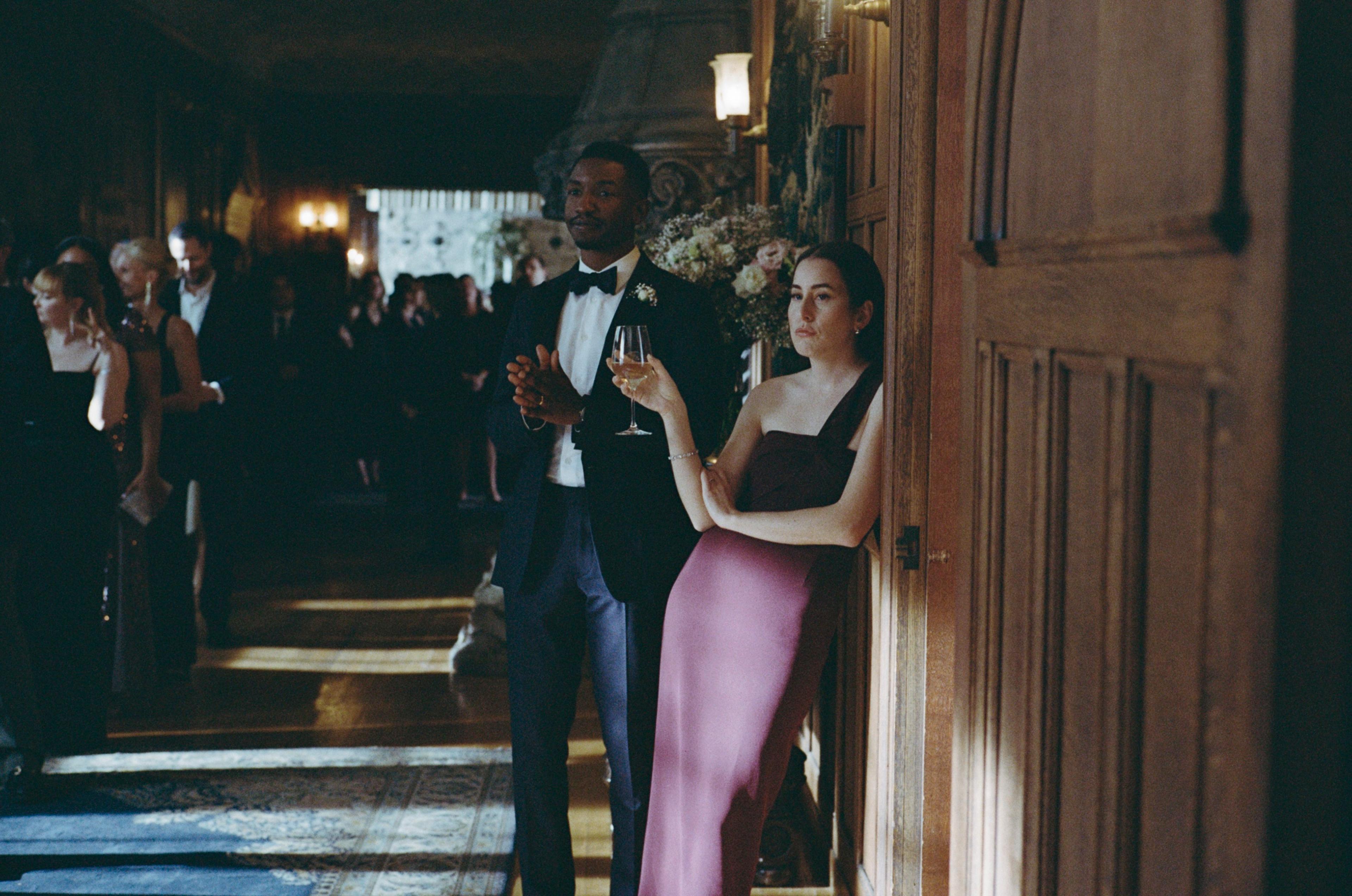
The deeply troubled girl in the bedroom (Jordyn Curet) is actually the teenaged version of Emma (Zendaya). At the beginning of The Drama, Emma is a week away from marrying the love of her life, Charlie (Robert Pattinson). Their picture-perfect engagement is put to the test when, during a drunk night of wine-testing with friends Rachel (Alana Haim) and Mike (Mamoudou Athie), Emma makes a shocking admission: When she was in high school, she meticulously planned and very-nearly executed a mass shooting.
The film’s trailer and official synopsis hinged on withholding this revelation. It was an enticing marketing ploy: What is Emma’s big, dark secret that’s making everyone freak out? (My guess, given Borgli’s button-pushing reputation, was cannibalism.) Some have (understandably) bristled at the notion that A24 would package The Drama as a wedding-themed romcom and turn something as fraught and tragic (and depressingly prescient) as a school shooting into a “plot twist”—or, worse, a punchline. (Although, to be fair, anyone even vaguely familiar with the writer-director’s work should know that he would have something else up his sleeve.) As someone with no direct experience with such atrocities, I can only imagine how painful it would be for a survivor to walk into a screening and not know what they’re in for.
The Drama isn’t perfect, to be clear. Some critics—Vulture’s Angelica Jade Bastién, for example—have called attention to its seeming refusal to engage with “the Black womanhood of this character [Emma], despite the fact that it is her identity that allows for this premise to come across as provocative in the first place.” This is a fair point—one that warrants further consideration and examination. For the purposes of this piece, however, I’ve chosen to focus on the backlash against the perceived glibness with which Borgli addresses school shootings.
But here’s the thing: The Drama is no more “about” school shootings than Bobcat Goldthwait’s Sleeping Dogs Lie (2006) is “about” bestiality, or Louis Malle’s Murmur of the Heart (1971) is “about” incest. (Borgli is clearly a Malle fan, as one of his characters makes a passing reference to 1974’s Lacombe, Lucien.) Such films challenge us to think about taboos writ large: not just to face them, but to consider the consequences of loving someone who has indulged in them (or, in this case, has thought about indulging). They also permit us to laugh at them (not, and this is so incredibly crucial, about them) in the same way we must laugh at all human folly lest we cry ourselves to sleep every night.
Because it elicits such questions, The Drama is a great ‘What would you do?’ movie. Would you practice radical acceptance and believe your partner when they say they’re now a different person? Would you rationalize or diminish the severity of what they’ve told you? Would you call the police?”
Borgli may lack the subtlety and earnest warmth of a Malle, but he does share the French master’s desire to not shock simply for shock’s sake. One of The Drama’s chief philosophical concerns is with the fine line separating thought from deed. Christian theology—by which I mean things my religion teachers told me when I was in elementary school—holds that thinking about committing a sin is just as bad as actually doing it. But anyone who has casually fantasized about killing someone who cut them off in traffic (which we’ve all done; unless you haven’t, in which case I haven’t) knows how facile this argument is.
Granted, Emma did a whole lot more than fantasize; via flashback, we see her target practicing with her father’s gun, recording the abovementioned manifesto video, and obsessively researching past massacres. We’re even provided the alarming revelation that the “only reason” she didn’t go through with it was because another shooting—at a local mall—beat her to it. Borgli complicates things further: The tragedy at the mall inspired her to not only drop her plan but also become an impassioned gun control activist (much to her military father’s chagrin). At the end of the day, she didn’t actually harm anyone, and the experience arguably made her a better person: the loving, empathetic woman Charlie hopes he’s marrying.
The same cannot be said for Charlie and company. The film’s extended centerpiece sequence, in which everyone drunkenly shares the “worst thing” they’ve done, offers some insight into each character’s cruelty: Mike used a date as a human shield against a feral dog; Charlie cyberbullied a classmate so harshly that the kid’s family moved away; and Rachel—the one, tellingly, most scandalized by Emma’s revelation—locked a mentally disabled child in an abandoned trailer (in a forest, no less). She would have fessed up eventually, Rachel insists, but a search party found him a few days later, before she had to come clean about the cruel prank. Sure, Rachel … Whatever helps you sleep at night.

So who’s worse here: the person who planned something unutterably depraved, or the people who actually did bad things, comparatively tame though they may be? (For what it’s worth, the woman next to me in the theater turned to her partner during this scene and whispered, “What Rachel did is worse.”) Could a thought be so evil that it’s worse than certain actions?
Because it elicits such questions, The Drama is a great “What would you do?” movie. Would you practice radical acceptance and believe your partner when they say they’re now a different person? Would you rationalize or diminish the severity of what they’ve told you? Would you call the police? It helps that Borgli placed this sensitive material in the hands of Zendaya and Pattinson, two of our great young actors. Thanks to them, we feel Emma’s embarrassment and shame, as we do Charlie’s paranoia and uncertainty.
Dubious marketing tactics notwithstanding, The Drama is also a fun movie. The wedding, when it comes, has the earmarks of a classic farce: awkward speeches are given, punches are thrown, things are overhead (and misunderstood) through closed doors. That Borgli is able to juggle these tonal shifts without seeming outrageously flip is a small miracle in and of itself. And the final scene—a perversely optimistic riff on many a romcom’s resolution—feels well-earned and genuine. I think Malle would be proud.
***
For years now, teachers and students have become desensitized to the lockdown drill. Like a tornado or fire drill, it has become another task to dutifully mark off the checklist—another catastrophe that we vaguely accept might happen to us but would rather not think about right now. I’m speaking from experience, having discussed with students the alarming numbness with which we hear about new mass shootings: It seems that every few months (if we’re lucky; they sometimes occur more frequently), another one filters through our hellish mediascape for a couple of hours before being quickly subsumed by the other daily horrors of life in America. When talking heads do discuss it at any length, it’s often to suggest asinine solutions (arming teachers) rather than real change (gun control legislation). It’s all so demoralizing.
I’m not endorsing apathy or political disengagement but acknowledging how difficult it has become to resist compassion fatigue. And yes, humor has undeniably become one of the tools that help us stick with it. It helped me in that classroom a few years ago. Don’t hate The Drama; hate the world it reflects all too well.
Thomas M. Puhr lives in Chicago, where he teaches English and language arts. A regular contributor to Bright Lights Film Journal, he has published Fate in Film: A Deterministic Approach to Cinema with Wallflower Press.
The way you captured those candid moments is really something.
Thank you for the kind words, Laura!