

By Jonathan Monovich.
When I think about movies that are in theaters, to a great extent…. They’re only aiming for the whole family’s satisfaction. They’re only aiming for spectacle from the beginning to the end. But, there’s something about Normal that makes you want to say, ‘Well, it’s a movie. It’s not a story that you want to turn into a streaming thing.’”
—Bob Odenkirk
In the John Wick documentary, Wick is Pain (2025), it’s said that “Pain’s not necessarily a bad thing. Pain is the end result, often, of brave choices.” This philosophy materializes throughout action screenwriter Derek Kolstad’s filmography. Dolph Lundgren in One in the Chamber (2012), Steve Austin in The Package (2012), Keanu Reeves in John Wick (2014) / John Wick: Chapter 2 (2017) / John Wick: Chapter 3 – Parabellum (2019), and Bob Odenkirk in Nobody (2021) / Nobody 2 (2025) all endure pain in the name of bravery. This pain, countered by comedy, has exponentially increased with Kolstad’s movies; the stakes have been made bigger and the stunt sequences continue to become more ambitious. Kolstad has become a highly proficient writer, finding a way to explore both the emotional weight and comic absurdity of action cinema. It’s fitting that Bob Odenkirk of Breaking Bad (2009-2013) / Better Call Saul (2015-2022) fame, who considered Monty Python his Bible and found profundity in Eric Idle’s tongue-in-cheek Life of Brian (1979) lyrics, has developed an ongoing creative partnership with Kolstad.1 With their collaborations, both Odenkirk and Kolstad have found a way to embrace the sentiment of “Always Look on the Bright Side of Life” by offering energetic stories of pain without being too serious and allowing themselves to laugh along the way.
Following in the footsteps of their Nobody series, Odenkirk and Kolstad’s latest feature, Normal (2025), is a lean, mean, ninety-minute action flick with some clever tricks up its sleeve. Directed by Ben Wheatley [Sightseers (2012), Free Fire (2016), Rebecca (2020)], Normal gets its namesake from the fictitious rural town of Normal, Minnesota. Like Free Fire, Wheatley builds tension before arriving at similarly confined chaos. With the recent death of Sheriff Gunderston, Ulysses (Odenkirk) strolls into town to become Normal’s “temp sheriff.” Upon arrival, Ulysses quickly becomes suspicious of the townspeople and doubts Normal lives up to its name. The local hardware store’s owner has an excessive amount of locks on a cabinet behind the checkout counter, an elderly woman listens to the police scanner in her knitting shop, the mayor (Henry Winkler) appears on edge, and the police station’s armory is equipped with C4. When Ulysses sees Normal’s 1,890 residents have raised an extravagant $16.8 million dollars, his suspicions grow. Trauma from Ulysses’ past keeps him up at up at night, and Normal’s mysteries keep him guessing during the day. When a bank robbery commences, Ulysses starts getting answers at the scene of the crime but simultaneously gets swept into an all-out war.
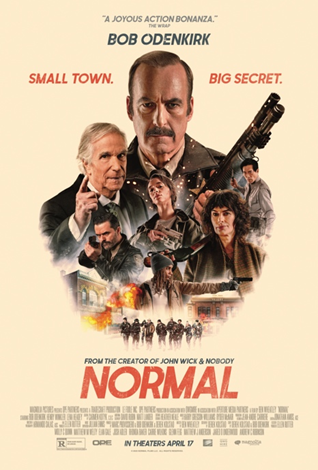
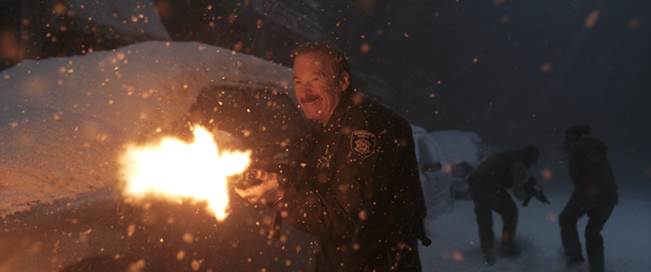
Emblematic of the genre hybridity of 1970s crime films like The Taking of Pelham One Two Three (1974) and Dog Day Afternoon (1975) that were strangely successful in also being comedic, Normal triumphs in upholding a similar sensibility. Furthering the look and feel of ’70s cinema, cinematographer Armando Salas seemingly relies on natural lighting. Normal, though humorous, is a dark film that borders on horror at times. Fittingly, sunlight is virtually absent; grey skies and black nights are lit by gunfire. The location of Normal resembles Fargo (1996) and the scenario is emblematic of Hot Fuzz (2007), but Kolstad and Odenkirk are very much fixated on the big problems currently facing America’s small towns. Aware of these towns’ desperation to stay afloat, Kolstad and Odenkirk cleverly make Normal a tale of the consequences of both mob ties and following a mob mentality. The film bops back and forth between Minnesota and Japan, and Normal’s yakuza connection makes for an entertaining conundrum. There is a clear reverence for Asian cinema in Normal, particularly the gun-fu of John Woo that also influenced the John Wick films. Pairing this intensity with the silliness of Odenkirk’s sketch comedy background in a smalltown snowstorm even evokes Gremlins (1984) at times. Simultaneously, Normal maintains Kolstad’s conscious realism that has sustained since his first film. Just as Dolph Lundgren could be seen strategically counting his ammo aloud in One in the Chamber, Odenkirk approaches Normal’s onscreen narrative beats with intention.
Odenkirk’s range in his career has been quite prolific, transforming from a comedy writer to a dramatic actor to an action star. Like Nebraska (2013) and The Post (2017), Normal offers one of Odenkirk’s best performances in recent years. Odenkirk channels Clint Eastwood, offering a stern/stoic grin paired with wit and wisecracks. Just as Odenkirk’s directorial work poked fun at the mumblecore generation in Melvin Goes to Dinner (2003), American juries in Let’s Go to Prison (2006), and male buddy comedies in The Brothers Solomon (2007), Normal satirizes America’s ongoing identity crisis and disregard for rural support. In Odenkirk’s memoir, Comedy Comedy Comedy Drama, he quotes John Cleese that “All comedy is critical.”2 Normal, too, is critical, but Odenkirk, whose Mr. Show (1995-1998) served as the American equivalent of Monty Python, also recognizes in his memoir that comedy is a great means of distraction that has been “keeping people sane for centuries.”3
Normal is a film best seen on the big screen and preferably on 35mm if possible. After Odenkirk and Kolstad screened the film in Normal, Illinois, the real town whose name inspired the feature, I had the pleasure of speaking with them about Normal in conjunction with Chicago’s inaugural Beyond Fest at the Music Box Theatre.
Normal opens with an amazing Japanese rendition of Black Sabbath’s “Paranoid.”
Bob Odenkirk (BO): That song is great!
Derek Kolstad (DK): I don’t know how we found that song, but it’s perfect [laughs].
That song immediately sets the tone, and you know exactly what you’re getting. Normal is a very tightly edited / no nonsense film. There’s a tendency for contemporary action films to be unnecessarily long, so Normal’ssuccinct runtime is refreshing. Did you always have this fat-free approach in mind for Normal?
DK: Our director, Ben Wheatley, was always aiming for ninety minutes.
BO: Ben Wheatley is a big reason for what you just said, but it was between the trio of myself, Derek, and Ben. It was a priority for Ben from the beginning. There’s a Hitchcock quote he would say all the time, “a movie should be as long as one can hold their bladder” [laughs]. There’s a mix of film styles in Normal. There’s comedy, suspense, action, horror-inspired kills, western tropes, and they’re all working together. It feels like a movie from the ’70s, and that’s part of the reason why we want to show it on 35mm.
I was thinking about that a lot as I was watching Normal. Bob, you’re going to introduce a 35mm screening of the original The Taking of Pelham One Two Three at the Music Box Theatre for Beyond Fest. The original Pelham, like Normal, has a lot of genre hybridity.
BO: Yes, absolutely! There’s an unsettling, cloying sweetness to the townspeople in Normal. You start questioning, “They can’t be this idyllic. Can they?” Something’s obviously wrong, like the old lady with a police scanner in her little knitting shop. There are things like this that throw you off, and you’re left thinking, “What is she listening to the police scanner for?” When Derek first told the story of Normal to me, my favorite part was the first chapter. Ulysses is this temporary sheriff, who is getting to know the town, and of course, so is the audience. He knows something isn’t right, but he doesn’t know what it is. Also, we learn that he has a part of himself that he doesn’t want to know.
This aspect of the town not being what it seems on the surface level reminded me of Blue Velvet (1986). Bob, you even worked with David Lynch on Girlfriend’s Day (2017). The close-up of the cop’s ear on the ground felt like an homage to Blue Velvet. Is that what you two were going for?
DK: Oh, yeah, for sure! In everything Bob and I do, we want an element of humor. It’s grounded in character, but it’s still one of those scenes where you find yourself chuckling.
BO: There’s a lot of homage in this movie. It’s one of the reasons people like you and film festival audiences have loved Normal through the roof. They’re seeing the David Lynch, Coen brothers, and Clint Eastwood references. They’re getting the ’70s movie vibe and the horror film-inspired kills. They’re seeing all of this mixed together, and they understand where it’s coming from.
I also enjoyed how there’s a conscious realism in Normal, and there’s clear intention in the script. Bob, you get pretty dinged up throughout Nobody, Nobody 2,and Normal.
BO: Suffering…that’s my contribution to the art of action filmmaking [laughs]. Ulysses is a character who suffers as he gets the shit kicked out of him.
DK: And you track the injuries, as the movie develops, which is fun. You see him whittled away, but his will is all the stronger still.
There’s a mix of film styles in Normal. There’s comedy, suspense, action, horror-inspired kills, western tropes, and they’re all working together. It feels like a movie from the ’70s, and that’s part of the reason why we want to show it on 35mm.”
—Bob Odenkirk
It’s like John McClane in Die Hard (1988), where you see his battle wounds as the film progresses.
DK: Yeah, exactly! And, at the end, right before the kitchen scene, Ulysses is kind of relaxed. Then, just as things go south, there’s this moment where you go, “Oh, no, we’re not done here!”
Bob, you mentioned in your memoir, Comedy Comedy Comedy Drama, that you wanted to shoot Let’s Go to Prison on 16mm film like a Corman production.4 You can tell there’s a respect for Grindhouse movies in Normal, which makes it a perfect fit for Beyond Fest. This is a film that is tailor made to be seen with an audience. It must be satisfying to be able to screen Normal on 35mm. How did the decision to strike a film print come about?
BO: I had wanted to make Let’s Go to Prison more like a blaxploitation movie. You don’t know what kind of movie you’ve made until you’re done making it. It’s a weird thing. You think you do, you try, you aim for something, and you talk about it constantly. Once Normal was done and we looked at it, there was this vibe that Derek and I sensed. You obviously sensed it, too. I said, “I want to see this movie on film.” There’s something about it that makes you understand Normal even better when your brain subtly knows that its looking at film. Magnolia was so great to say, “Sure, we’ll dub it onto film.” There’s five 35mm prints for Normal. We’re going around the country showing it on film as prep screenings for the April 17th opening. On April 17th, it will open in over two thousand theaters nationwide. It will mostly play digital, but I know the Vista in Los Angeles is going to show it on 35mm. It’s also going to be shown on 35mm in New York and anywhere else we can get the prints shown throughout the duration of the run. That is as long as they remember how their equipment works. In Austin, Texas…
DK: This is a good story [laughs].
BO: It was great, and everyone really liked it there, but they fucked up [laughs]. They didn’t put the reels out of order, but they just didn’t start one of the reels on time. One reel ended and went to black. Everyone knew it was on film, so they were just sitting there thinking, “Nothing’s wrong. They just forgot.” They didn’t load the next reel up or press go. Then, a few seconds later, you saw the countdown going “three, two, one,” and the movie started [laughs].
That’s one of the unique aspects of film. The success of the screening starts with the projectionist, but even a mistake like that makes for a more memorable experience.
DK: That’s true.
BO: There’s something about Normal that makes it feel like a movie I haven’t seen in a long time. I can pontificate, but I still don’t really know why. For me, I feel like there’s an ineffable quality to the movie Normal, and I don’t know what that is. When I think about movies that are in theaters, to a great extent, theaters have become the province of big, conceptualized stories that aim to please children and adults. They’re only aiming for the whole family’s satisfaction. They’re only aiming for spectacle from the beginning to the end. But, there’s something about Normal that makes you want to say, “Well, it’s a movie. It’s not a story that you want to turn into a streaming thing.” Normal is best seen and experienced in a theater with a bunch of people laughing at all these reactionary moments. There’s something about the tightness of the story that belongs in a feature film.
DK: When we watched it in Austin, there was a bunch of seventy-year-old women behind us. It was great because I kept hearing, “Ohhhh, no” [laughs]. It was just a blast, and they were always the first ones laughing.
I’d like to transition to the stunts in Normal. Bob, you’re put through the ringer for your collaborations with Derek, but you also have recognized how fun these films are to make. You worked closely with Daniel Bernhardt, from the Bloodsport sequels, for the Nobody films. Was he also involved with the making of Normal, and how did your experience with the stunts compare between Normal and the Nobody movies?
BO: Daniel Bernhardt was not officially involved in Normal, but I train with Daniel. He’s my trainer. I actually just trained with him last week. The truth is, in our independent training that he’s so kind to do with me, we did go over these stunt sequences. To a great extent, we have to give credit to Greg Rementer. Greg’s our second unit director on Normal. He also was our second unit director for Nobody and Nobody 2. The same guy choreographed the action sequences in all three films.
DK: My plan is never to hurt Bob [laughs]. Rather, it’s to challenge him. Bob does the training and does as much as he can on screen. As action fans know, when the camera is behind someone’s head, oftentimes it’s not actually them. You pick up on that. For Normal, the camera’s going after Bob as much as possible. You feel a sense of appeal that’s just awesome.
I agree. Bob, your comedy writing has provided many laughs over the years from SNL (1987-1995)to Mr. Show to Tenacious D (1997-2000)and beyond. It’s said that laughter is the best medicine, and in a way, Normal is a satire of contemporary America. You’re both from the Midwest. How did your Midwestern upbringings influence this film, and why now for Normal?
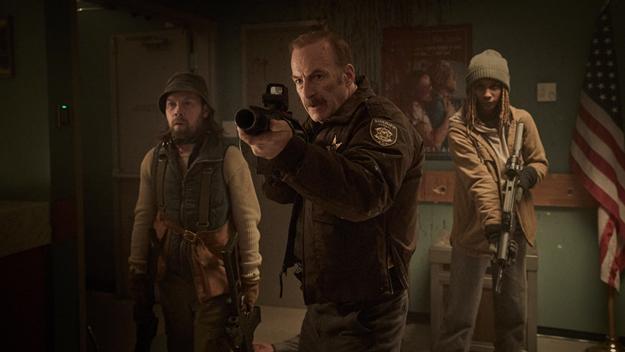
BO: I immediately understood the story that Derek had cooked up, and I know these kinds of towns well. Naperville, where I grew up, isn’t really one of them, but the towns nearby and the farming and factory towns in southern Illinois are like “Normal.” Financially, they’ve been struggling for thirty years. Henry Winkler’s character, the mayor, gives a speech in Normal and says, “Small towns like ours are littered across America, and they’re half boarded up. They’re lucky to keep a dialysis center open.” It’s a great speech, and it really rings true to me. I like representing that on screen. I like talking about it and sharing it. There’s also the thematic aspect of mob behavior and a reminder to always be careful of getting into any mob or any group that says, “We’re going over here!” In this case, the town switches their allegiance halfway through the movie. I sort of get them to switch their goals and their team. There’s a lot about smalltown America in Normal.
DK: Where I grew up, all my family were smalltown farmers and in construction. They’re survivors. Normal is about what people are willing to do to survive and then suddenly wake up and go, “Oh, am I the bad guy?” But, ultimately, the last thing we ever wanted to do was mock small towns because we’re from them. This is about embracing them and going, “Dude, I remember the day.”
With Ulysses, there’s humor to the role, but there’s also a serious side to the character like most of your recent roles. He has some baggage and endures emotional and physical pain throughout his hero’s journey.
BO: Yeah, he does. I’ve been wanting to play a character who’s my age my whole life. Saul Goodman was like twenty years younger than me at the closest. It’s been a goal of mine to play somebody who’s really my age. Hutch Mansell, my character in the Nobody movies, is also younger than me. Ulysses is my age. He’s seen a lot of life, and life has made him unsure of himself. This leads to the explosion that is Normal.
Normal marks the third time you two have worked together. To quote Casablanca (1942), “I think this is the beginning of a beautiful friendship.” Do you have plans to keep this collaborative partnership going?
BO: [laughs] Yes!
DK: We’d love to! If press lands on Bob for another project, I immediately text him and vice versa. He’s my friend, and I love working with him. He’s one of those few guys that when you see his name on your phone calling you go, “Oh, sweet. Hey, Bob!” [laughs]. I love this character, I love this world, and I love this team.I’d love to do more.
BO: Me too!
Notes
- Odenkirk, Bob. Comedy Comedy Comedy Drama: A Memoir. Random House, 2022, pp. 20.
- Ibid., 237.
- Ibid., 183.
- Ibid., 191.
Normal is exclusively in theaters, starting April 17th, via Magnolia Pictures.
Jonathan Monovich is a Chicago-based writer and a regular contributor for Film International. His writing has also been featured in Film Matters, Bright Lights Film Journal, and PopMatters.