

By Indya J. Jackson.
Ultimately [through the depiction of failed mothers] Singleton replicates the anti-Black, anti-poor, and misogynistic rhetoric of neoliberal reformists by embedding a definite preference for fathers and the heteropatriarchal family structure within his films.”
After Boyz N the Hood (1991) launched John Singleton into rarefied air, he told Peter Brunette that “a woman can’t teach a young boy how to be a man, only a man can teach a boy that.”1 Singleton’s apotheosis of fathers implicitly devalues the work of mothers, prompting consideration of the harmful rhetoric undergirding his narratives. This chapter examines how Singleton’s disparagement of maternal labor finds expression in Boyz and in Baby Boy (2001), the film for which he wished to be remembered.2 Along with 1993’s Poetic Justice, these films form Singleton’s “hood trilogy.”3 Sharing similar settings (South Central Los Angeles) and themes (coming-of-age), they are also united in their portrayal of households led by single Black mothers as sites of cultural pathology; this is an extension of the anti-Black rhetoric that casts issues of systemic racism as issues of Black culture. In Boyz and Baby, Singleton’s treatment of gender difference is filtered through a lens of misogynoir whereby single Black mothers are figured as emasculating figures who—in spite of their best attempts—fail to effectively parent their sons. Singleton’s mothers, in other words, lead the charge in the “collapse” of the heteropatriarchal Black family. Their sons are teenage parents, fiscally irresponsible, violent, prone to criminality, as well as too childlike to be fully realized adults. While these characteristics may merely suggest that both mothers and sons are subject to similar social forces, Singleton repeatedly frames single Black mothers as failed parents, a consistent narrative in his films that performs harmful cultural work and perpetuates anti-Black stereotypes. In contrast, both films identify Black men as uniquely capable of establishing order and salvaging the ruins of single mothers’ incompetence.
Boyz and Baby reinscribe the images of Black life popularized by policymakers in search of support for neoliberal reforms. In a discussion of Boyz, the link between Singleton’s films and neoliberal reformists is highlighted by Glen Masato Mimura, who interrogates the director’s anti-Black representational politics:
Women—whether ‘good’ mothers like Reva (good because she knows her limits) or ‘bad’ mothers like Mrs. Brenda Baker [—] are incapable of successfully raising boys, of properly directing their transition to manhood. Possibly the film’s greatest political failure, this representation of black womanhood reinscribes the myth of black matriarchy, internalizes this white supremacist ideology codified most powerfully by the infamous 1965 Moynihan Report.”4
Mimura acknowledges the lack of novelty in Singleton’s depictions of Black mothers. Named after its author, Daniel Patrick Moynihan, a former Senator who was an Assistant Labor Secretary at the time of the report’s publication, the Moynihan Report is notorious for suggesting that racial inequity among Black Americans and their white counterparts is largely a consequence of Black Americans’ failure to maintain traditional nuclear family structures.
While Moynihan locates American chattel slavery as a root cause of what the report describes as a “fatherless matrifocal (mother-centered) pattern,”5 Black feminist scholars have long since debunked the myth of the Black matriarchy. In Ain’t I a Woman: Black Women and Feminism, bell hooks takes issue with widespread uncritical use of the term “matriarchy” with regard to Black families. hooks contends: “The misuse of the term matriarch has led many people to identify any woman present in a household where no male resides a matriarch.”6 With this formation, hooks begins to undo the logic that suggests matriarchal households (and therefore patriarchal households) are merely the products of the prominent presence of a correlating sexed subject. In Ain’t I a Woman hooks continues to unpack the flawed logic of renderings of Black families as structurally matriarchal:
Although anthropologists disagree about whether or not matriarchal societies ever really existed, an examination of available information about the supposed social structure of matriarchies proves without any doubt that the social status of the matriarch was in no way similar to that of black women in the United States. Within the matriarchal society woman was almost always economically secure. The economic situation of black women in United States has never been secure.”7
Here, hooks casts popular invocations of Black “matriarchies,” such as that articulated by Moynihan, as ahistorical at best. Because Black women have never been regarded as an economically secure group, hooks argues, Black women have no claims to the kinds of power that would, for example, be true of their white, heterosexual male, property-owning counterparts. It is the element of power—economic power from which social power follows—that is the hallmark of any possible patriarchal or matriarchal configuration. That Black women, regardless of their living arrangements, remain subordinated along racial and gendered lines precludes the possibility of a widespread matriarchy within the Black community.
In the early 1980s, on his path to the White House, Ronald Reagan continued the report’s project of framing Black women–led families as sites of a pathology. Armed with an ever-transforming tale of a “welfare queen,” Reagan prominently capitalized on the anti-integration animosities of white Americans to advocate for neoliberal political reform. In Dog Whistle Politics: How Coded Racial Appeals Have Reinvented Racism U Wrecked the Middle Class, Ian Haney López explains how Reagan’s fable stoked white animosity toward Black women:
Reagan repeatedly invoked a story of a ‘Chicago welfare queen’ with ‘eighty names, thirty addresses, [and] twelve Social Security cards [who] is collecting veteran’s benefits on four non-existing deceased husbands. She’s got Medicaid, getting food stamps, and she is collecting welfare under each of her names. Her tax-free cash income is over $150,000.’ Often, Reagan placed his mythical welfare queen behind the wheel of a Cadillac, tooling around in flashy splendor. Beyond propagating the stereotypical image of a lazy, larcenous black woman ripping off society’s generosity without remorse, Reagan also implied another stereotype, this one about whites: they were the workers, the tax payers, the persons playing by the rules and struggling to make ends meet while brazen minorities partied with their hard-earned tax dollars.”8
As Haney López puts it, Reagan employed the “welfare queen”9 anecdote to frame white Americans’ economic woes as the consequence of undeserving nonwhite people—especially Black women—emptying government coffers to which they held no entitlement. Where Moynihan pointed toward Black “matriarchies” to recast racial inequality as a problem of Black culture, Reagan similarly used the welfare queen anecdote to cast Black households (as the result of the proclivities of Black women) as uniquely burdened by laziness and other forms of immorality.
Such images of Black women–led families exacerbated conservative anger stemming from the Civil Rights Movement, desegregation, and affirmative action. Such hostility culminated in political support for widespread neoliberal economic reforms including welfare retrenchment. Arguably, however, the project of welfare reform was not consecrated until President Bill Clinton “fulfilled his campaign promise to ‘end welfare as we know it’”10 by signing into law the Personal Responsibility and Work Opportunity Reconciliation Act of 1996 (PRWORA). Among its most notable provisions, the PRWORA repealed Aid to Families with Dependent Children (AFDC)—a then sixty-one-year-old piece of federal legislation that matched states’ allocation of cash assistance to children and their caregivers, who were most frequently single mothers.11 In place of the AFDC, Temporary Assistance for Needy Families (TANF) was enacted, which “strengthened work requirements, capped cash assistance at a five-year lifetime limit, and allowed states to impose stricter sanctions and time limits.”12 The rhetorical implications of the policy’s reduction of cash benefits, time limitations, and work requirements ring as putative condemnations of single mothers who primarily exist in the public consciousness as Black. As Parvin R. Huda suggests, “PRWORA’s ‘pro-family’ and ‘pro-work’ rhetoric and provisions privilege marital status and implicitly and explicitly condemn childrearing and childbearing outside of marriage. The moral tenor of PRWORA reflects an entrenched cultural perception of single motherhood as pathological.”13 In other words, the PRWORA is an expansion of both Moynihan’s framing of Black women–led households as failures and Reagan’s framing of welfare as primarily benefiting entitled, lazy, and criminal Black women. Instead of locating class, race, and gender inequality as consequences of classist, racist, and sexist public policy, the PRWORA rescripts failures in public policy as personal failures endemic to Black families led by Black women who are necessarily inept. This same framing appears as a primary ideological underpinning of Boyz N the Hood and Baby Boy.
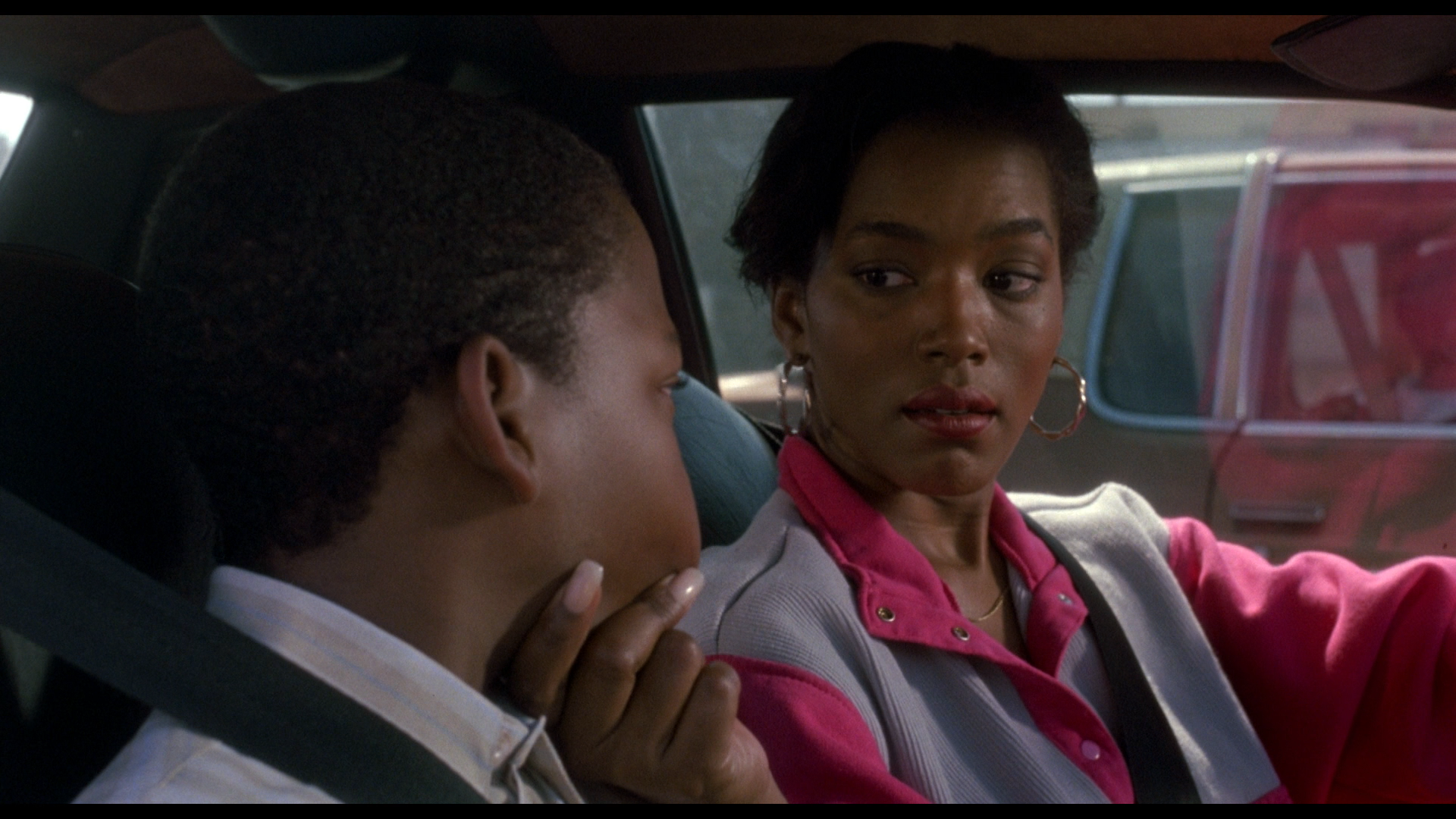
First, this chapter examines Singleton’s representation of Furious Styles (Laurence Fishburne) in Boyz. Singleton treats Furious as an exemplary parent. Next, the chapter examines Singleton’s depictions of single mothers Reva Deveraux (Angela Bassett), Shanice (Alysia Rogers), and Brenda Baker (Tyra Ferrell) in Boyz. In sharp contrast to Furious, Reva is cast as ineffective, Shanice as benign, and Brenda as abusive to her children. The chapter then turns its attention to Baby Boy and its protagonist, Jody (Tyrese Gibson). While Jody is presented as immature and irresponsible, this chapter contends that Jody is primarily used to highlight the purportedly dysfunctional nature of households led by single Black mothers. In turn, the chapter examines how Singleton depicts Jody’s primary partner, Yvette (Taraji P. Henson), as necessarily unable to provide stability for herself or her child without the help of a male partner. Similarly, Juanita’s (A.J. Johnson) failures in parenting her son, Jody, are treated as the definitive source of his unfulfilled manhood. Ultimately, Singleton replicates the anti-Black, anti-poor, and misogynistic rhetoric of neoliberal reformists by embedding a definite preference for fathers and the heteropatriarchal family structure within his films. This preference comes at the expense of single Black mothers, whose households are characterized as sites of dysfunction and sources of racial inequity.
Singleton’s One True Father
Early in the film, an elementary-school-aged Tre Styles (Cuba Gooding Jr.) is sent to live with his father, Furious. While Tre has been living with his mother, Reva, he breaks an oath to her by getting into another fight at school. As a consequence for this expression of violence, Reva takes Tre to his father’s house where he is to finish the school year. Furious seems pleased at the prospect of being responsible for his son. Ricky Baker (Morris Chestnut), a football-obsessed adolescent, and Darrin “Doughboy” Baker (O’Shea “Ice Cube” Jackson), Ricky’s generally disaffected, slightly older brother, are introduced as Tre’s neighborhood companions. In contrast to Tre’s household helmed by a responsible, wisdom-wielding Furious, the Baker household is helmed by Brenda Baker, who is presented as both ill-tempered and overbearing in her interactions with Doughboy and overly permissive and failing to implement structure in her relationship with Ricky. Singleton is resolute in his portrayal of Furious’s success in raising in his son. When Reva delivers Tre to his father, the film figures Furious’s fathering as an intervention in Tre’s propensity to engage in acts of “Black-on-Black” violence.14 Singleton’s romanticization of Black fathers is well documented. While Furious Styles is an approximation of his own father whom Singleton, in a 1991 profile, calls “awesome”15 and to whom, in another profile, he credits his love for film,16 he most ardently cites his father as giving him responsibility and ensuring his manhood. “I was going to be man,” Singleton explains, in a 2003 interview, expressing gratitude for his father’s guidance which he sets against his “little friends across the street who [didn’t] have a daddy to teach them[.]”17 For Singleton, manhood, responsibility, and success are all tied to the presence of a boy’s father. Where he sees households led by Black women as sites of dysfunction and Black women as, at times, fomenting that dysfunction,18 Singleton upholds households led by fathers—single or otherwise—as essential to boys’ ability to fulfill a “functional” manhood.
Singleton’s perspective on the importance of fathers animates a disparity central to Boyz N the Hood. “Doughboy didn’t have a father like Furious Styles,” Singleton explains, “who would make him think about his actions before he did them.”19 In contrast to Tre, who ultimately survives South Central to attend the esteemed historically Black, all-male Morehouse College,20 both Baker boys are murdered as a consequence of their single mother’s failures in parenting. Ricky is murdered by Doughboy’s rivals, who are young Black men seeking to retaliate against Doughboy for an earlier slight. Although Doughboy’s demise is merely confirmed by an epilogue that explains he was murdered two weeks after Ricky is murdered and after Doughboy brutally avenges his brother’s murder, it is all but certain that Doughboy also succumbs to violence wrought by young Black men. A native son of Los Angeles, Singleton is careful not to leave his viewers without guidance useful in overcoming the source of his ire. He offers present Black fathers as remedy. Implicitly, then, Singleton aligns with political reformists who portray households led by Black single mothers as centers of dysfunction and failed manhood.

Furious and Ricky are the film’s only fathers of whom to speak. Through Singleton’s direction, however, Furious is framed as the film’s only representation of a “real” father. The film is replete with scenes that emphasize this point. While viewers are introduced to Furious as a man excited to take responsibility for raising his son, he is very conspicuously never depicted outside of moments where his import as a model of paternal responsibility is reinforced. Just after Reva departs, Furious explains to his son that, during their time together, his aim is to teach Tre responsibility. Tre’s friends are not as fortunate, Furious notes, as they do not have anyone to do the same for them. Furious’s paternal utterance consecrates the film’s didactic message. Tre will succeed because his father is present to teach him responsibility. Ricky and Doughboy will fail because they do not have fathers to do the same. In this short exchange, the film’s plot is laid bare.
Shortly after Tre moves in, an intruder breaks into the home he shares with Furious. Furious shoots at but misses the home invader (a Black male). As father and son await the police, Furious comments, “Somebody must’ve been praying for that fool. Cause I swear I aimed right for his head.” When Tre laments, “[You] should’ve blew it off,” Furious uses the exchange as an opportunity to redirect his son’s acceptance of “Black-on-Black” violence. “Don’t say that,” says Furious, “it just would have been contributing to killing another brother.” Where Black-on-Black violence poses a threat, the Black father is granted the ability to protect his family while asserting an ethics of nonviolence. In another scene, Furious uses a father–son fishing outing to lecture and quiz his son on a range of subjects including leadership, integrity, and respect. At this juncture, Furious reveals that he became a father at the age of seventeen (not unlike Ricky Baker). In recounting this chapter in his life, Furious explains that he declined a friend’s request to participate in a robbery. Further in this exchange, Furious explains that he joined the military, eventually being deployed to Vietnam because he wanted to be somebody Tre could “look up to.” While Singleton frames Furious’s military service as an example of his willingness to risk his life to fulfill his paternal obligations, Furious’s warning— “Don’t ever go in the Army, Tre. Black man ain’t got no place in the army”— is used to signify the young father’s wisdom, divestment from violence, and commitment to ensuring his son’s well-being.
Other points at which Singleton reinforces Furious’s role as paternal savior of both son and community include a scene in which Furious condemns Tre for his failure to practice safe sex; a scene in which Furious lectures Tre, Ricky, and a crowd of community members about the threat of gentrification; and a scene in which Furious convinces Tre to relinquish a gun the teen has been contemplating using to retaliate against Ricky’s murderers. Collectively, these scenes align with Singleton’s prescription: Black fathers are key to “responsible” reproduction, Black fathers are key to unifying the Black community, and Black fathers are the salve for Black-on-Black violence. Whereas Furious’s status as a single parent and a teenage father is redeemed by his commitment to being a provider, single mothers and teenage mothers in Singleton’s films are noticeably excluded from any such redemption. Where the mothers of Singleton’s films do not possess the capacity for leadership, mothers’ status as providers is a target of Singleton’s critique—they provide to a fault and harm their sons through excessive coddling.
Failed Mothers in Boyz in the Hood
There are, notably, more mothers to account for in Boyz N the Hood than fathers: Reva (Tre’s mother), Brenda (Ricky and Doughboy’s mother), and Shanice (Ricky’s live-in girlfriend). The mothers range in degree from passive to outright harmful. Where the film paints Reva as ineffective, Shanice is painted as benign—too young to be a fully realized mother—and Brenda as abusive. Because Singleton tends to romanticize fathers for what he sees as their unique ability to guide boys into a successful, functional manhood, his interest in Black mothers is primarily to uphold the same messaging. Depictions of Black mothers in Boyz are generally used to prove women’s insufficiency in rearing sons. Overwhelmingly, Singleton’s approach replicates the rhetoric historically used to support neoliberal reforms and pathologize Black families.

Reva very overtly echoes Singleton’s sentiments. She perceives her womanhood as limiting her capacity to raise Tre and distinguishes her mothering from Furious’s proper mode of teaching Tre “to be a man.” Outside of her own admission of insufficiency, Reva’s ineffectiveness is depicted during a scene in when she makes a phone call to Tre. As he swaps back and forth between calls with his mother and Brandi (Nia Long), Tre mistakenly asks his mother about “skins.”21 Reva expresses her displeasure at his comment and Tre quickly apologizes. Reva does not linger on the awkward encounter and instead turns the conversation toward her desire to have more time with Tre. When Tre passes the phone to his father, Furious, echoing his son, says, “Who this?” Reva corrects Tre’s telephone greeting only to find that Furious uses the very same salutation. Reva may have more education, finer tastes, and more eloquent speech than Furious, but her influence on Tre rings as inconsequential. What is more, Reva’s conversation with Furious reveals that Tre would prefer to spend time with his father. In a scene that solely presents Furious’s side of the conversation, Tre’s father and mother argue about where he should live. Through the conversation, viewers learn that Furious is convinced of his success in instilling the virtues of manhood into his son; he perceives Tre as mature enough to make decisions about both safe sex and where he wants to live. Unsurprisingly, Tre wants to live with his father where he can gain valuable lessons in manhood, find guidance for his budding sexual interests, and exercise his autonomy. After all, unlike Reva, Furious would never make the mistake of treating Tre like “a baby.” Reva’s desire to coddle, to pursue feminine concerns with manners, makes her an ineffective mother. Casting mothers as coddling their sons is a trope that Singleton deploys time and again. To Singleton, a mother’s “coddling” is dangerous—a sign that a boy is being denied the “toughness” and “responsibility” pivotal to functional manhood. Singleton aligns with Moynihan and others in locating single Black mothers as the root of Black men’s purported crisis of responsibility and, consequently, the root of racial inequality. Singleton belabors this perspective throughout the film.
Later in the film, Tre’s parents meet at a restaurant in a scene which asserts that Reva’s refinement is no match for Furious’s masculine guidance. Over the course of the meeting, Reva tells Furious that she has purchased new shoes for Tre, but Furious insists that Tre should be expected to purchase things with money earned at his part-time job. Once more, Reva is coddling Tre—attempting to keep him a child—while Furious is doing the noble work of raising Tre into a man. As they talk, the conversation turns to Tre’s desire to move in with Brandi when he goes to college. To Reva’s disbelief, Furious asserts his conviction that “Tre is old enough to make his own decisions.” Incredulous, Reva questions his parenting, “You’re his father—that means you’re supposed to guide his decisions.” Now visibly frustrated, Furious answers in anger, “What the hell do you think I’ve been doing for the last seven years?” Through this conversation, Singleton presents Reva’s inability to see her son as a young man as an indication of the harm she would have surely caused had she no Furious to intervene in her ineffective parenting. That she cannot see how successful Furious has been in turning Tre into a man of good instinct and character is another nod to the chasm between mothers and fathers. Reva does mean well. However, by the film’s conclusion, Singleton guides viewers to the conclusion that making Furious Tre’s primary caretaker is the best parenting choice she could have ever made. Devoid of any other choices that seem to have consequence in her son’s life, Reva is cast as ineffective.
Other maternal figures in the film are either ineffective or harmful. In the Baker household, both types of mother coexist. Singleton presents Ricky’s partner, Shanice, as passive and ineffective. She first appears in an argument with Ricky over whether or not their son needs his diaper changed. Shanice is correct—the child does need to have his diaper changed. Nevertheless, she lets Ricky take the child. When she relents, Ricky rewards her with a sensual kiss and Shanice is satisfied to let him lead. Brenda, who is nearby, sees the kiss and encourages her son to ensure that his girlfriend is taking her birth control pills.22 Brenda then takes her grandson from his father and exits the scene.
Important here is the fact that Ricky inhabits his role as a father for mere seconds before Brenda usurps her son’s claim to patriarchal power. The scene’s critique of the fatherless Black family is multifold. Ricky is positioned as an immature father due to his own father’s absence (the source of which is never directly addressed in the film). Singleton contrasts Ricky’s immaturity to Tre’s maturity; as a consequence of his own father’s involvement, Tre does not father a child as an out-of-wedlock teenager. Mimura reads the scene as emblematic of Singleton’s argument against families led by single mothers: “As Furious’s son, Tre evidences the virtues of good fatherhood, as opposed to Ricky . . . we see Ricky unable to cope with his newborn baby’s needs: the baby is crying because its diaper is wet, and Ricky doesn’t know when or how to change it.”23 Although Ricky does not overtly oppose fatherhood, Singleton argues that he simply has not been taught how to be a responsible father as he has no Furious to guide him into manhood. In contrast to Tre whose mother has been removed as a barrier to his successful maturation, Ricky’s father is absent, and he is doomed by an unfit mother.
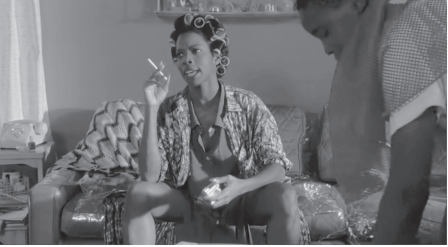
Brenda is portrayed as all at once domineering and infantilizing in her approach to mothering. The film’s earliest portrayal of Brenda occurs not long after Tre moves in with his father. On the very day of his arrival, Tre is instructed to do his chores. Tre’s friends—including a young Doughboy— witness Furious instructing Tre on the task and Doughboy comments, “Damn, your daddy mean. He’s worse than the boogeyman himself.” This perspective on Furious is meant to be especially ironic as Brenda, not Furious, is undeniably mean and angry. In contrast, Tre later waits outside the Baker household where Brenda is heard yelling at her sons well before she is seen. As Tre remains outside, the scene shifts to reveal Brenda sitting on the couch wearing hair rollers and a housecoat (Figure 1.1). She searches for her cigarettes and berates Doughboy. Perceiving Doughboy as “getting smart,” Brenda threatens to “knock [him] into the middle of next week” before addressing her son as a “little fat fuck.” Where Tre is the narrative foil for Ricky (and Doughboy as well), Furious is the foil for Brenda. Given these narrative logics, it is no surprise that Doughboy commits crime. His imprisonment is a testament to Brenda’s harmful mothering in the absence of a wise, even-tempered father figure like Furious. Put differently, Brenda is coded as the poor, underserving Black mother that figured prominently in the Reagan administration’s stereotyping rhetoric, just as she is exemplary of those targeted by Clinton’s PRWORA. She also embodies the dysfunctional “matriarch” of the Moynihan Report. Indeed, in speaking about the women in his films, Singleton has echoed the rhetoric of neoliberal reformers by locating women as the members of the Black community who “have the real power.”24 In contrast, Singleton perceives Black men as having “no economic power.”25 As a testament to the contradictory political messaging around single Black mothers, Brenda is powerful but impoverished. She is present in her sons’ lives but the source of their downfalls. Necessarily damned by their mother, Brenda’s sons meet untimely deaths regardless of her different approaches to their rearing.
Brenda’s treatment of Ricky is also a site of critique for Singleton. Her attitude toward her younger son is notably less domineering and more infantilizing. The film suggests that the Baker boys’ fathers may be the source of their mother’s uneven treatment. Were this the case—that Brenda’s uneven treatment of her sons is a reflection of her attitude toward their respective fathers—within the context of Singleton’s argument, this means that even absentee fathers predetermine the outcomes of their sons. As Michael Eric Dyson puts it,
[Doughboy’s] father is symbolically present in that peculiar way that damns the offspring for their resemblance in spirit or body to the despised, departed father. The child becomes the vicarious sacrifice for the absent father, though he can never atone for the father’s sins. Doughboy learns to see himself through his mother’s eyes, her words ironically re-creating Doughboy in the image of his invisible father.”26
In naming Brenda’s opinion of their different fathers as a potential source of the brothers’ incongruous treatment, Singleton argues for fathers as saviors. Singleton makes this pronouncement by casting Doughboy as incapable of transcending his “ain’t shit” father’s example. Likewise, the death of Ricky promotes the same logic by insinuating that, in spite of Brenda’s favorable attitude toward Ricky, his father’s absence still amounts to a failure to save the teen from his mother’s permissive parenting.
The source of Brenda’s treatment of Doughboy may, on the other hand, be a symptom of Doughboy’s lack of direction. While Ricky has football, Doughboy seems to have—if anything—a knack for getting into trouble. The film questions, however, whether Doughboy’s lack of direction is the result—not the cause—of his mother’s harshness. After his release from jail, Doughboy’s welcome-home party and the violent altercations leading to and following Ricky’s murder are used to narrate a trend in the elder brother’s waywardness. And while Doughboy’s welcome-home party serves as the lone indicator that Brenda must, to some extent, care for him, evidence of her concern for Ricky is much more plentiful. Throughout his childhood, Brenda bestows Ricky with verbal affirmation with regard to his athleticism. As he ages, Brenda’s support for Ricky appears in other ways. For example, she allows Ricky’s girlfriend to move into her home. As Doughboy says, “the motherfucker’s got babies, in-house pussy. Let me do shit like that, Ma would be like, ‘I ain’t having it.’” That is, Brenda’s permissive treatment of her son’s relationship with Shanice is another form of her preferential attitude toward Ricky. The contrast between Brenda’s treatment of Ricky and Doughboy suggests that households led by single mothers are inevitably dysfunctional. Echoing those who claim that racial inequity is the product of dysfunctional homes, Singleton suggests a son who is a teenage father and a son who is a teenage felon are equally tied to the pathological nature of the single-mother-led household.
To emphasize this point, after Ricky is killed, Tre avoids a similar fate when he asks to be let out of Doughboy’s car before the latter commits revenge murders. In this instance, Tre’s upbringing, his father’s ethos of morality, and stance against Black-on-Black violence prevail in Tre’s ability to act with integrity. On the other hand, Doughboy, degraded by his mother’s parenting and damned by his absent father’s sins, has no resistance against the cruel logic of “the streets.” His murder two weeks later tacitly supports Singleton’s argument against households led by single mothers. Without a guide like Furious, Doughboy is guided by his anger just as Ricky is guided by his childlike logic. Brenda, by virtue of being a single Black mother, ruins both of them. Singleton’s masculinist themes are laid bare in this sequence of tragedies befalling the Baker family: without present, responsible fathers, Black families, Black sons, and the Black community are doomed.
Failed Mothers in Baby Boy
If Ricky and Doughboy are presented as the rule—the inevitable outcomes of failures in parenting—then Jody Summers is the exception. Baby Boy is another coming-of-age film that takes a dramatic look at life in South Central. Jody is a twenty-year-old who has failed to live up to the expectations of adulthood. Unwed, Jody has two children by two different women (Peanut [Tamara Bass] and his primary partner, Yvette) between whom he traipses at his will. Jody lives with his mother, Juanita, in his childhood bedroom where he constructs model cars in his ample free time. He has a nondescript criminal record, uses Yvette’s car as his primary mode of transportation (a flashy low-rider bicycle is his secondary mode), constantly cheats on her, sells illegally procured women’s clothing in the underground economy for a living, and is deathly afraid that his own young mother will one day forsake him for a new significant other. Jody is not thriving as a parent, a partner, or a young adult. Though Singleton does impress upon the audience that Jody can do better, the film takes a unique interest in examining Jody’s status as a symptom of failure in his mother’s parenting.
Baby opens with imagery of a fully grown Jody in utero (Figure 1.2). He has an umbilical cord, he is floating in amniotic fluid, and he is clearly an adult male. In a voice-over, Jody paraphrases the words of controversial psychiatrist Frances Cress Welsing:
There’s this psychologist, a lady named Dr. Frances Cress Welsing, she has a theory about the Black man in America. She says essentially the Black man in this country is a ‘baby’, a not yet fully formed being who has not realized his full potential. To support her claims she offers the following: First off all, what does a Black man call his woman? Mama. Secondly, what does a Black man call his closest acquaintances? His boys. And finally, what does a Black man call his place of residence? His crib.”
As the voice-over ends, viewers are immediately confronted with a scene in which Jody eats candy while waiting for Yvette outside an abortion clinic. After twice failing to appropriately comfort Yvette, Jody asks if he can use her car. Yvette agrees and Jody very excitedly leaves her sulking in bed. In a gross display of insensitivity and infidelity, Jody uses her car to visit the mother of his youngest child, with whom he has sex.
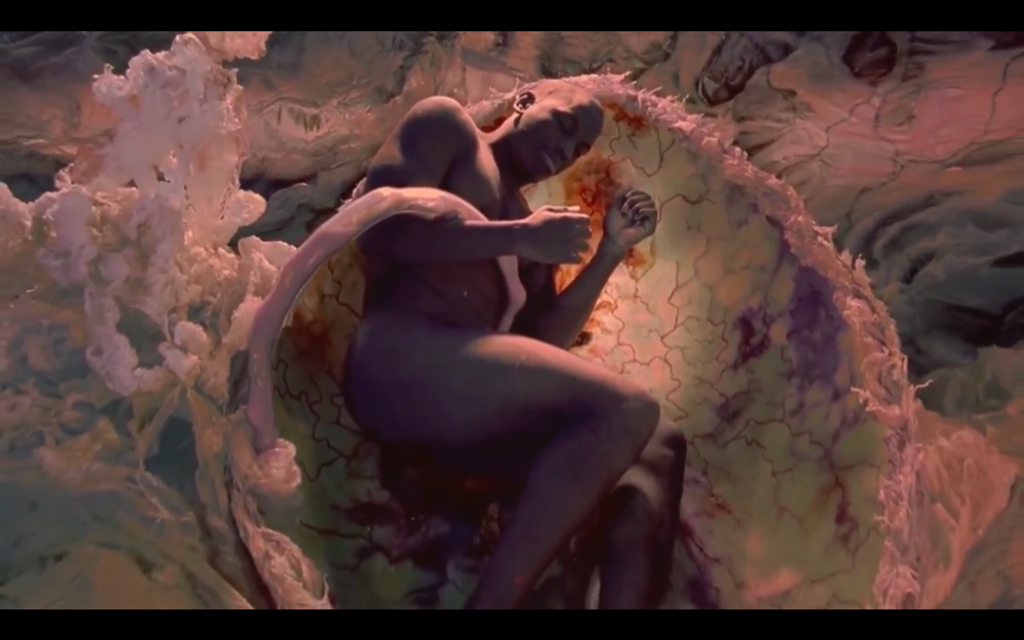
Together, these early scenes are structured to depict a culture devoid of personal responsibility or parents equipped to course correct. The in-utero scene emphasizes the character’s failure to properly mature. Singleton’s “baby boy” is not a child who has, through circumstance, prematurely adopted the habits and concerns of adults. Instead, Singleton’s “baby boy” is a man—neither an infant nor a child—who has resisted the call to manhood. Welsing’s words offer evidence that Jody is meant to be a stand-in for what she and Singleton identify as “the Black man in America.” The veracity of Welsing’s assertion is dubious at best. Nevertheless, the inclusion of her theory in the film’s opening suggests that she and Singleton are united in their view that Black men’s purported failure to meet the demands of adulthood is a pathological issue. Historically, “Jody” is a moniker given to a figure from African American folklore who is known to be a “backdoor man” or one who sleeps with men’s wives while they are away at work, in the military, or in prison.27 However, while the Jody of folklore is memorialized in a lighthearted fashion through work songs, blues songs, and rhythm & blues songs as a kind of trickster figure,28 Singleton’s Jody is meant to embody a serious message.
When asked about the film at the time of its release, Singleton discussed his decision to include Welsing’s theory:
The great thing that I was about to do was to find inspiration in Isis Papers for actually the whole script in terms of the social dysfunction of black America. [Any man who] was a black in this country has been thought of, and thinks of himself, as a baby. This kind of infantilism is perpetuated by being raised within a racial, institutionalized society that basically has created these dysfunctional rite of passages for black men. They believe—it’s perpetuated in music and culture—to be a man you have to be a killer. What are they talking about? Killing each other. Or, they set the notion that you will do prison time. And that’s a mark of honor. Everything else is perpetuated toward that end. That path is just there in front of a lot of people.”29
Singleton uses Welsing’s theory to frame the film as a narrative about social ills that pervade the experiences of Black men. The social ills—familial dysfunction, failure to become proper adults, and the looming specters of “Black-on-Black” crime and mass incarceration—are outlined by Singleton as symptoms of the “the social dysfunction of black America.” Even more, Singleton’s words reveal that he sees “the social dysfunction of black America” as the culprit in Black men’s “infantilism” and violent tendencies. It is certain that Singleton has some knowledge of the ways in which systemic racism impact the outcomes of marginalized groups. Nevertheless, Singleton frames Jody—the titular “baby boy” in the likeness of Black men untold—not with nuance or delicacy, but as a victim of the Black community’s various pathologies. As Henry Giroux argues, “Social problems in [Baby Boy] become personal problems, and systemic issues are reduced to private considerations.”30 In other words, rather than presenting Yvette’s abortion as an issue of reproductive justice or Jody’s immaturity as merely a symptom of his age, Singleton chooses to paint these concerns as personal failings and as failings rooted in Black culture. As such, Jody appears in his mother’s womb because he has failed to mature and she has failed to evict him. In the same vein, Jody must accompany Yvette to the abortion clinic because they are not in the position to support another child’s maturation within or without the womb. Jody fails to leave his mother’s womb; therefore, he fails to support the child growing in Yvette’s womb. This is the film’s cautionary messaging.
Throughout the film, Jody’s relationship with Yvette evokes the dysfunction that Singleton imputes to Black women. Examples are plentiful. While Yvette’s abortion stands as one indication of the young parents’ dysfunction, Jody’s refusal to commit to Yvette is another. That Jody borrows Yvette’s car to cheat on her with Peanut is plain awful. That Jody does so just after Yvette has had an abortion is egregious. Shortly after his dalliance with Peanut, Jody returns to the home he shares with his mother, Juanita. He finds her working in her new garden where she remarks, “I can’t be giving you money every time you get one of these girls pregnant, Jody.” Juanita’s words suggest that she has likely given Jody money for previous abortions with the myriad of women with whom he has sex and that Jody cannot manage his own reproduction. Jody’s inability to manage his sex life has required his mother to become involved with his affairs. He cannot meet the demands of adulthood; therefore, his mother must function as a provider in his stead. Unlike Furious, who prevents his son from prematurely becoming a father through meaningful conversations about responsible reproduction, Juanita’s conversation with Jody rings much like Brenda’s warning to Ricky. Where Brenda tells her son to ensure Shanice is on birth control after the couple has already become teenage parents, Juanita’s warning to Jody similarly comes after Jody has fathered two children and assisted at least one abortion. To Singleton, the mothers have already failed. While Juanita is a primary subject through which Baby Boy implicates single Black mothers for the supposed collapse of the heteropatriarchal Black family, Yvette is located within the same continuum of failed Black mothers.

Later, Yvette learns that Jody has used her car to cheat on her with one of her coworkers. As the couple argues, Jody admits that he has continued to have an affair with Peanut and that he has had sex with other women as well. Yvette explains that she had already accepted that Jody was having an affair with Peanut: “I know you fucking Peanut. I figured that much. I ain’t mad at you cause I knew already.” In spite of her permissive attitude toward Jody’s affair with the mother of his other child, Yvette cannot accept his other betrayals. Soon, the couple becomes embroiled in a physical altercation, and while Yvette vows to leave Jody, he is soon supplanted in her household by an even worse character—Yvette’s ex-con boyfriend, Rodney (Calvin “Snoop Dogg” Broadus Jr.). Rodney is horrible to Yvette and the son she shares with Jody, Joe Joe. In a chilling moment, Yvette narrowly escapes being raped in front of her child by Rodney. In response to this violation, both Yvette and Joe Joe openly express their desire for Jody’s return to the home. Though a teenage mother, Yvette possesses a job, an apartment, and a vehicle. As a single Black mother, however, she is purposefully characterized as unable to provide her son with a functional home life. Yvette must abort a pregnancy out of financial necessity rather than desire. Yvette accepts her boyfriend’s mistress. Yvette and her boyfriend exchange physical blows. Yvette cannot prevent an ex-con from forcing his way into her home. Nor can she prevent him from harassing her son and forcing himself on her. Singleton unquestionably renders Yvette’s household, a household led by a single Black mother, a site of dysfunction. Accordingly, Singleton echoes neoliberal renderings of single Black mothers and their homes as pathological. The film suggests that, in Yvette’s household, Joe Joe is at risk of becoming a “baby boy” just like his father.
In an interview conducted around the film’s debut, Singleton identifies the influence of Jody’s mother as a source of the character’s dysfunction:
Basically, Juanita [A.J. Johnson] [sic] was a teenage mother, who’s grown now, and her son, Jody, is a grown man. It’s been said in the Black community that mothers raise their daughters and spoil their sons, they baby them to the point that they don’t ever want to leave, give them so much love. And I believe that there’s a lot of baby boys like Jody. My definition of a baby boy is that he’s the most dangerous cat around, because he’s hypersensitive. Raised in a single-parent family, he’s always trying to define and defend his manhood at the same time.”31
Here, as in Boyz N the Hood, the director is overt in outlining Black mothers as ill equipped to raise successful sons. To Singleton, Jody’s behavior is directly linked to his mother’s age, her marital status, her tendency to “spoil” him with love, and her inability to help him define his manhood. It is notable that, despite being a single parent, Furious Styles of Boyz was a teenage father, offered his son clear guidance (however dubious) about defining his manhood, and frequently charged his son’s mother with “spoiling” their son. Thus, while Singleton does use “mother” and “parent” interchangeably in this interview, it appears all but certain that his emphasis is on single mothers—not single parents. In the interview, Singleton expands on his understanding of dysfunction within the Black community:
[Jody’s] dealing with rites of passage and in urban America, that rite of passage is dysfunctional, because it says that you’re not a man unless you’re a killer. But who are they talking about killing? Each other. There’s an accepted notion that you go to jail at a certain time in your life, as a rite of passage, but it’s a dysfunctional rite of passage. My thing is that a baby boy will get your daughter pregnant and kill your son. I saw how dysfunctional these experiences are, including some of my own, and I thought, ‘This seems like the norm and not the exception: I have to explore this.’”32
While characterizing the entirety of “urban America”33 as subject to the dysfunction of intracommunal (“Black-on-Black”) violence, Singleton explains that he sees young men like Jody as participants in violence and irresponsible fertility practices because these activities constitute rites of passage. Singleton is resolute in his view of Black single mothers as ill equipped to guide their male offspring toward outcomes removed from the purported realm of dysfunction. What is more, in Singleton’s understanding, baby boys’ likelihood of being imprisoned, murdered, or merely irresponsible implies a cycle of single mothers failing to guide their sons away from dysfunctional rites of passage.
Juanita is exemplary of the rhetoric that undergirds Singleton’s perspectives on the incompetence of single mothers. In the film, Juanita is characterized as a teenage mother who Jody blames for the death of his older brother. In Jody’s perspective, she chooses the affections of violent men over her children. Perhaps, most importantly, she and her boyfriend and the logic of the film suggest that Jody’s immaturity and irresponsibility are rooted in Juanita’s history of coddling her son. Throughout the film, Juanita implores her son to become more independent and responsible. The introduction of Juanita’s boyfriend, Melvin (Ving Rhames), is portrayed as a boon for the mother but a threat to the son. Melvin is a felon who has, in the wake of incarceration, found success as the owner of a small gardening business. While Melvin has no difficulty being a provider, the older couple’s relationship is also presented as strong as they go on dates, regularly engage in public displays of affection, resolve their conflicts maturely, and have a noteworthy amount of passionate sex. In fact, Melvin’s captivation of Juanita’s attention rings as a primary source of Jody’s animus toward the gardener. One morning, Jody encounters a stark-naked Melvin cooking breakfast in the family kitchen. Subsequently, a conversation unfolds revealing Jody’s insecurities and Juanita’s growing dissatisfaction with her “baby boy.” To Jody’s protests against Melvin spending the night, Juanita responds: “Them days of not having a life is all over. I ain’t like Big Mama. I got to have me some fun. You have fun. Why can’t I enjoy my life?” “He a killer just like Henry was,” Jody responds, “and you got him up in the kitchen, scrambling eggs and drinking up all the Kool-Aid?”
While Juanita contends that she will not adopt the selfless, matronly demeanor associated with so-called Black “matriarchs” of previous generations, Jody insists Melvin is a part of her history of making poor choices with regard to romantic partners. Just as Henry (implied to be one of Juanita’s former partners) was a violent man, Jody expects Melvin is the same. To Jody, however, the threat is not simply that he believes Melvin has the capacity for violence, but that Melvin has become a household fixture. If the opening scene of the film exposes Jody’s failure to leave his mother’s womb, then Melvin represents a threat to Jody’s ability to remain in utero. Adding further clarity to Singleton’s womb metaphor, the mother–son exchange continues with Juanita suggesting that Jody should consider moving out and Jody complaining that his mother wants to kick him out. Jody’s fear of leaving his mother’s home/nest/womb is front-and-center alongside Juanita’s longing for her son to acquire more markers of responsibility and maturity. Importantly, Juanita never does indicate that she is forcing Jody to leave the home. Though she wants him to be proactive in embracing responsibility and maturity, Juanita does not go as far as to confirm her son’s fear that he is being forced out of the home. Hoping to help her struggling son, Juanita also asserts that he should form a traditional nuclear family structure with Yvette and that he may find Melvin to be a fitting mentor. In this, it is probable that Juanita perceives the similarity in Jody and Melvin as two of Singleton’s baby boys.34
Juanita’s hope that Jody forms a traditional family unit with Yvette echoes the belief that traditional family structures are the key to combating racial inequity. She, alone, has not been able to provide either of her sons with the tools supposedly conducive to successful manhood. Where one son has been murdered and the other is clinging to her metaphorical womb, to Juanita, her living son’s ability to fully realize adulthood rests on his embrace of a household structure prescribed by Moynihan, Reagan, Clinton, and others. Singleton’s preference for the heteropatriachal family is repeated in one of the film’s most pivotal moments. Melvin and Jody become embroiled in an altercation and Melvin confronts Jody, saying, “You need to check yourself. You know what your problem is, baby boy? You got shit all twisted. You got a Oedipus complex. You want your mama to be your woman, but this is my woman. My woman.” Capitalizing on his own personal history as a baby boy, Melvin can excite Jody’s sensitivities like no other. By suggesting that Jody has an Oedipal complex, Melvin becomes the film’s only character to plainly charge Jody with being unnaturally attached to his mother. Where Tre’s desire to live with his father is a sign of the structure and responsibility Furious provides, Jody’s attachments to his mother and childhood home are solidified as grotesque and threaten his mother’s dreams of achieving stability. So hurtful are Melvin’s words that Jody responds by throwing a punch. The baby boys—one young, one old—fight until Juanita intervenes. Realizing that his rehabilitation has been imperiled, Melvin threatens to end his relationship with Juanita and to leave the house. Juanita pleads with him not to leave, and Jody, without prompting, packs a bag and starts out of the house. On the way out he tells his mother, “If I get killed, it’s on you mama.” Juanita cries as he exits, but in spite of her tears, Juanita is happy that Melvin stays. Melvin, however flawed, is a force of stability in the single mother’s otherwise dysfunctional life. In Singleton’s estimation, Yvette can only fulfill the needs of her son by forming a traditional family unit with Jody. Juanita’s equilibrium is similarly attached to the maintenance of her relationship with Melvin. While Jody and Melvin are both in possession of criminal records, histories of domestic violence, and children born outside of committed relationships, by virtue of being men, their markers of “social dysfunction” (in the language of Singleton and neoliberal reformists) do not preclude them from becoming stabilizing forces in the lives of their partners or children. This point should be emphasized: in a context that alleges single mothers’ original sin is being without a husband, mothers in Singleton’s films appear to need the masculine presence of a male partner, no matter how financially secure and independent they are. Even with Jody’s flaws, the film seems to suggest, Yvette and Joe Joe would be better off with his presence than without it.
Jody’s Redemption in the Failed Heteropatriarchal Family
In the final act of Baby Boy, Jody makes strides in embracing an ethics of personal responsibility and is duly rewarded. Naturally, Jody’s decision to change is not spurred by simple introspection. Instead, a near-death encounter spurs his change in attitude. Jody is nearly murdered by Yvette’s ex-boyfriend, Rodney. In retaliation, Jody and Sweetpea conspire and succeed in murdering Rodney. In the aftermath of the murder, Jody returns to his childhood bedroom where Melvin finds him crying, distraught, afraid, and still in possession of the murder weapon. Without uttering a word, Melvin knowingly coaxes Jody to relinquish the gun. The same night, Jody returns to Yvette. She is comforted by his presence and holds him tightly. Although they do not speak, through his demeanor she understands—to use Singleton’s words—“a dysfunctional rite of passage” has been fulfilled and Jody has chosen a permanent position with her and Joe Joe over one with his mother.

As the film concludes, Jody visits his mother in her garden. He is in a brighter mood and, viewers learn, at peace about moving out of his mother’s home. He offers his mother money (as opposed to his usual requests for financial support), and he expresses approval for her new relationship. It has taken a near-death experience, and indeed Jody has just committed a violent crime, but even dysfunctional rites of passage are preludes to adulthood and Jody has become a man. Though undoubtedly still a baby boy, in the logic of the film, Jody’s decision to evacuate his mother’s home places him much closer to proper adult functionality. He has left his mother’s womb—a site of failed parenting—to move in with Yvette and Joe Joe. In other words, by finally leaving his mother’s home and in spite of the odds, Jody has accepted his status of father and spouse and, in doing so, provides his son and Yvette with a stabilizing presence unavailable during his upbringing in his mother’s household. Jody is no Furious Styles, but he is no longer running from manhood and therefore possesses the potential to save his son and spouse from certain dysfunction. In the film’s closing montage, a pregnant Yvette flashes an engagement ring while she and Jody enjoy a game of cards in the park. Joe Joe plays nearby. These final images are a telling final nod to Singleton’s overall message. Because Jody did not have a traditional nuclear family, his mother failed to guide him into manhood. Unlike Tre, who was guided into manhood by his father, in order to reach maturation, Jody had to survive a “dysfunctional rite of passage.” Where Doughboy and Ricky did not survive their rites of passage, Jody was simply luckier.
By way of conclusion, it bears repeating that Baby Boy and Boyz N the Hood participate in the pathologization of households led by single Black mothers that fueled economic reform. These films are culturally significant for Singleton’s auteurship and for their depictions of Black life in South Central Los Angeles during the early 1990s and the early aughts. Yet close examination of these films reveals how each fails in its representation of Black women who are maligned and stereotyped within the neoliberal project of recasting racial inequity as rooted in the cultures and behaviors of the racially marginalized.
Notes
- Peter Brunette, “Singleton’s Street Noises,” in John Singleton: Interviews, ed. Craigh Barboza (Jackson: University Press of Mississippi, 2009), 23–4.
- Travis Bean, “The Movie John Singleton Wanted You to Watch: ‘Baby Boy,’” Forbes, May 4, 2019, www.forbes.com/sites/travisbean/2019/05/04/the-movie-john-singleton-wanted-you-to-watch-baby-boy/?sh=a698016492bf
- Wilson Morales, “An Interview with John Singleton,” BlackFilm 7 (2001), http://blackfilm.com/0707/features/i-JSingleton.shtml
- Glen Masato Mimura, “On Fathers and Sons, Sex and Death: John Singleton’s Boyz N The Hood,” Velvet Light Trap 38 (Fall 1996): 14, https://link.gale.com/apps/doc/ A90190311/LitRC?u=anon~ee0231f4&sid=googleScholar&xid=8d1950d4
- Daniel Geary, “The Moynihan Report: An Annotated Edition,” The Atlantic, September 15, 2015, www.theatlantic.com/politics/archive/2015/09/the-moynihan-report-an-annotated-edition/404632/
- bell hooks, Ain’t I a Woman: Black Women and Feminism, 1st ed. (New York: Routledge, 2015), 104.
- hooks, Ain’t I Woman, 104.
- Ian Haney López, Dog Whistle Politics: How Coded Racial Appeals Have Reinvented Racism and Wrecked the Middle Class (Oxford: Oxford University Press, 2015), 58.
- In a 2013 investigative report, Linda Taylor (born Martha Louise White) is identified as the woman at the center of the “welfare queen” myth. Despite a history of Taylor representing herself as a woman of multiple different and racial backgrounds, on her birth certificate, Taylor is, ironically, identified as a white woman. See Josh Levin, “The Welfare Queen,” Slate, December 19, 2013.
- Amy Zanoni, “Remembering Welfare as We Knew It: Understanding Neoliberalism through Histories of Welfare,” Journal of Policy History 35.1 (2023): 118–58, https://doi.org/10.1017/ S0898030622000318
- In a 1995 brief, Bureau of the Census reported that the majority of women receiving AFDC payments were white women. Policymakers’ emphasis on Black mothers reveals the racist underpinnings fueling the ascension of Reaganomics. See Bureau of the Census, Mothers Who Receive AFDC Payments—Fertility and Socioeconomic Characteristics (Washington: Government Printing Office, 1995).
- Zanoni, “Remembering Welfare,” 119.
- Parvin R. Huda, “Singled Out: A Critique of the Representation of Single Motherhood in Welfare Discourse,” William U Mary Journal of Race, Gender, U Social Justice 7.2 (February 2001): 341–81.
- “Black-on-Black” violence is racist logic often employed for political purposes. The phrase employs anti-Black rhetorics to cast intracommunal violence as unique to Black communities and, therefore, suggests that crime in the Black community exists apart from and should be treated differently than crime affecting non-Black communities.
- Brunette, “Singleton’s Street Noises,” 23.
- Patrick Goldstein, “His New Hood Is Hollywood,” in John Singleton: Interviews, ed. Craigh Barboza (Jackson: University Press of Mississippi, 2009), 10.
- George Alexander, “Why We Make Movies: Black Filmmakers Talk about the Magic of Cinema,” in John Singleton: Interviews, ed. Craigh Barboza (Jackson: University Press of Mississippi, 2009), 158.
- Kristal Brent Zook, “Rocking the Cradle,” in John Singleton: Interviews, ed. Craigh Barboza (Jackson: University Press of Mississippi, 2009), 133.
- Goldstein, “His New Hood,” 6.
- Pupils and graduates of Morehouse College are commonly referred to as “Morehouse Men.” In her 2022 book, Respectable: Politics and Paradox in Making the Morehouse Man, Saida Gundy explains that, based on her interviews with “Morehouse Men,” many identify the moniker as respecting ideals of leadership, success, and racial fidelity. See Sara Weissman, “Author Discusses Recent Book on the ‘Morehouse Man,’” Inside Higher Ed, October 16, 2022.
- Here, “skins” is used to connote sex.
- While Brenda advocates for responsible sex, at this point in the film, Ricky already has one child. Singleton frames the mother–son conversation as an indication that Brenda is already less effective at parenting her sons than Furious.
- Mimura, “Fathers And Sons,” 21.
- Patrick Goldstein, “A Difficult Coming of Age,” in John Singleton: Interviews, ed. Craigh Barboza (Jackson: University Press of Mississippi, 2009), 123.
- Dan Heaton, “Singled Out: A Chat with Director John Singleton,” in John Singleton: Interviews, ed. Craigh Barboza (Jackson: University Press of Mississippi, 2009), 138.
- Michael Eric Dyson, “Between Apocalypse and Redemption: John Singleton’s ‘Boyz N the Hood,’” Cultural Critique 21 (1992): 130.
- Tyina Steptoe, “‘Jody’s Got Your Girl and Gone’: Gender, Folklore, and the Black Working Class,” The Journal Of African American History 99.3 (2014): 251, https://doi. org/10.5323/jafriamerhist.99.3.0251
- Steptoe, “Jody’s Got Your Girl,” 253; 265.
- Morales, “An Interview with John Singleton.”
- Henry A. Giroux, “From ‘Manchild’ to ‘Baby Boy’: Race and the Politics of Self-Help,” Jac 22.3 (2002): 528, www.jstor.org/stable/20866509
- Cynthia Fuchs, “Baby Boy: I Took the Training Wheels Off—Interview with John Singleton,” Nitrate Online, July 13, 2001, https://nitrateonline.com/2001/fbabyboy.html
- Fuchs, “Training Wheels.”
- Here, “urban” is a euphemism for “Black.”
- Singleton explains that “They’re all baby boys: Melvin (Rhames) is a baby boy, Sweet Pea (Omar Gooding) is a baby boy, and so is Rodney.” See Fuchs, “Training Wheels.”
The chapter was excerpted from ReFocus: The Films of John Singleton (edited by Daniel Dufournaud, Edinburgh University Press, 2025). All rights reserved.
Indya J. Jackson is Assistant Professor of African American Literature at Ramapo College of New Jersey.