

By Jonathan Monovich.
I chose to focus more on the screenplay that I inherited from (Bertolucci), Ludovica, and Ilaria because it is somewhat of an autobiographical work of Bertolucci. I chose not to invest myself in Bertolucci as a filmmaker but Bertolucci as a man.”
Over the span of fifty years, Bernardo Bertolucci created some of the most complicated films, spanning historical epics [1900 (1976), The Last Emperor (1987)],adaptations of novels [The Sheltering Sky (1990), The Dreamers (2003)], controversial dramas [Before the Revolution (1964), Last Tango in Paris (1972), Luna (1979)], explorations of youth [Stealing Beauty (1996), Me and You (2012)], spiritual journeys [Little Buddha (1993)], and even comedies [Tragedy of a Ridiculous Man (1981). To capture such diversity with routine precision deserves recognition, and that’s without even mentioning The Conformist (1970)—a film that remains as poignant as ever. While Me and You, an underrated film about youthful alienation, was Bertolucci’s cinematic swan sang to his eclectic body of work, Italian filmmaker Andrea Pallaoro has brought Bertolucci’s final screenplay to life. Written prior to Bertolucci’s passing in 2018, The Echo Chamber (2026), co-written by Ilaria Bernardini and Ludovica Rampoldi, is the real deal. Don’t mistake The Echo Chamber as a gimmick, rather Pallaoro successfully captures the unflinching spirit of Bertolucci and presents the dense themes of the source material with authenticity.
Whereas Pallaoro’s prior films, Medeas (2013), Hannah (2017), and Monica (2022) were women driven character studies, The Echo Chamber plays like a two hander. Having strong actors, Luca Marinelli and Alicia Vikander, take on this challenge makes for a gripping experience. By now, Pallaoro’s style has become recognizable. His films possess a rawness. Minimalist in nature, Pallaoro restrains from showing too much. Pallaoro lets the actors take control, and their commanding performances speak louder than words. By just looking at Catalina Sandino Moreno in Medeas, Charlotte Rampling in Hannah, or Trace Lysette in Monica, their characters’ pain can be felt. This showcases Pallaoro’s eye for casting, but more importantly, it also demonstrates Pallaoro’s understanding of the basics of cinema. Concerned with the psychology of his characters, emotions are often internalized in Pallaoro’s films. Viewers may walk away with more questions than answers as a result, but that’s the point—generating connection through thought. Pallaoro’s work is about being. He focuses on the experience, the journey, the struggle, and the pain. Pair that with deliberate framing/thoughtful color and you have a form of poetry unfolding on screen. It’s fitting that Pallaoro has risen to the occasion to direct Bertolucci’s final screenplay as his filmmaking philosophy aligns with a spiritual ideology from Little Buddha—“To learn is to change. The path of the enlightenment is in the middle way.”
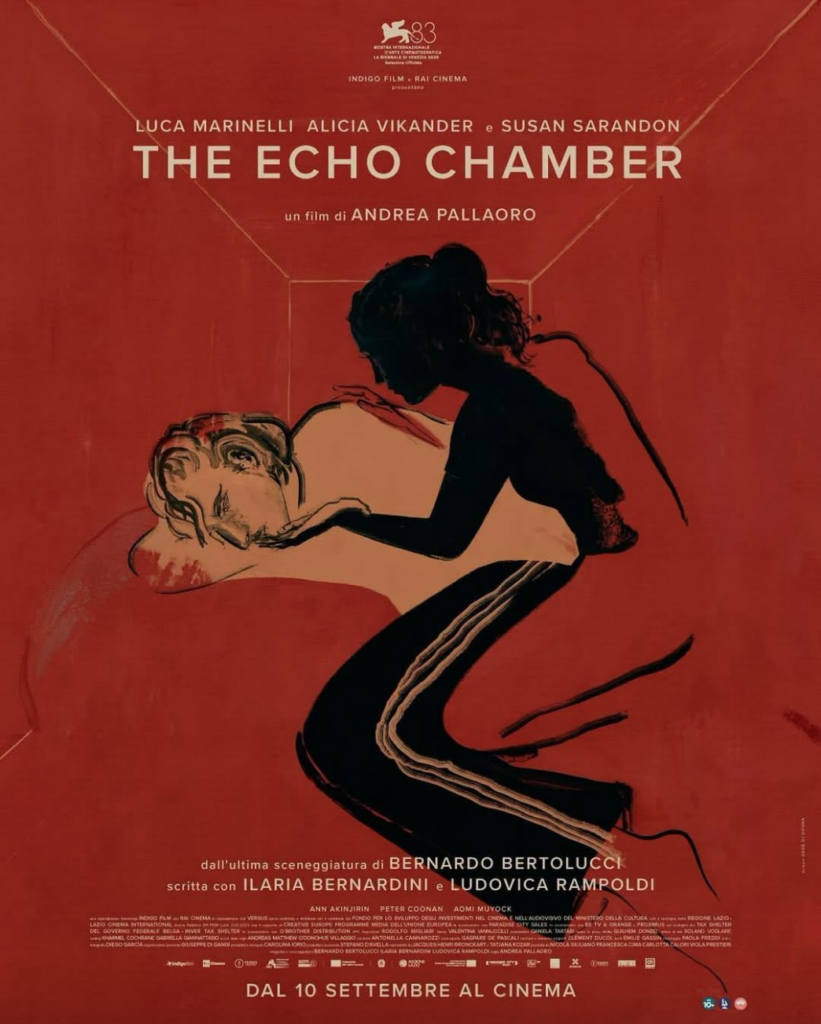
The Echo Chamber follows Leo (Luca Marinelli), a music producer, with a chronic back injury. Like Luna and Me and You, The Echo Chamber continues Bertolucci’s study of addiction. When the pain becomes unbearable, Leo seeks the help of Anne (Alicia Vikander), a physical therapist, who visits his apartment. The two develop a mutual attraction for one another, which disrupts the moral boundaries of their relationship. The film’s subject matter, a woman caring for a sick partner, also feels reminiscent of The Sheltering Sky at times, but The Echo Chamber morphs into something much more tangled. Between Leo and Anne is Ava (Susan Sarandon), a singer collaborating with Leo. Together, Leo and Ava record a beautiful, yet haunting, composition. More than an artistic partner, Ava serves as a voice of reason, a source of wisdom, and a guiding force for Leo. Though Ava shares her experience with Leo, only he can confront his inner demons. Even through the discomfort, like other Bertolucci films, The Echo Chamber possesses a hypnotic feeling. Throughout The Echo Chamber, shots tend to linger after characters have left the frame. Watching the material presented in The Echo Chamber will make viewers do something similar, taking a moment to pause and reflect on what was just seen.
Following its Venice Premiere, The Echo Chamber saw its North American Premiere in the International Competition section of the 62nd Chicago International Film Festival (CIFF). At the CIFF, Pallaoro graciously took the time to speak with me about The Echo Chamber.
The Echo Chamber’s screenplay was written by Bertolucci, so naturally there are thematic similarities to his other films, but The Echo Chamber very much has your signature style. Compared to Bertolucci, your films are slower in terms of pacing, the cuts are more brutal, and the camera is more static. Why did you feel it was important to make the film feel like your own?
That’s a good question. I feel like the only way to honor the screenplay that Bernardo wrote with Ilaria Bernardini and Ludovica Rampoldi was to be as honest and sincere as possible. That required me to filter the material through my own vision, my own sensibility, and my own cinematic language. Trying to recreate something that wasn’t generally filtering through my own vision would have backfired. It would have created a relationship with spectators that was insincere. I’m interested in cinema that’s sincere. That’s what I want to watch and am eager to see as a spectator. It’s also the type of cinema I want to make as a filmmaker.
The Echo Chamber opens with a dance scene. Despite how dark Bertolucci’s films can be, dancing at pivotal moments is a recurring theme in his work. As I was watching this scene, I was thinking of Matthew Barry dancing to the Bee Gees in Luna, Eva Green dancing to “La Mer” in The Dreamers, Liv Tyler dancing to Nina Simone in Stealing Beauty, and of course Marlon and Brando and Maria Schneider dancing at the end of the infamous Last Tango in Paris. As the film is about musicians and music production, were you thinking about the role of music in Bertolucci’s films in general?
Yes, of course! Music was a very important element from the beginning. The main character, Leo, is a music producer, and the central creative relationship in the film between Leo and Ava is explored through their creation of music. For me, the music that Clément Ducol composed, with the collaboration of Susan Sarandon and Luca Marinelli, really elevated the film and gave us a way to penetrate the emotional and psychological world of these characters. I felt like it was a lens. The music became a lens to understand the world of the film, the characters, and their dynamics.
There’s a great scene where Anne’s asked if it must be scary working in a hospital because of the sounds, and it’s said that the silence is actually worse. For a film that’s about musicians, the film has a lot of silence. And it’s true that silence can be scary, especially when you’re alone. What kinds of conversations did you have about sound and the lack thereof with your crew?
There’s another moment when Anne asks Leo, “What is the opposite of music? Noise or silence?” That was also very much in line with what you’re describing. This is a film that allows the spectator to project themselves onto these characters in a very individual and independent way. The music is exclusively diegetic in that we only hear the music of the characters themselves. It’s not a commentary. In that way, it was very important that it reflected those priorities and that we understand how these characters are motivated by music and the meaning of it. Music is central to Leo and Ava, and we understand these characters through their questioning of music, sound, silence, and noise. I saw it as an opportunity to understand the poetry of these characters. I wanted to understand the characters poetically and not just intellectually.
There definitely is a poetic element to the film. The film also takes place primarily in Leo’s apartment…
Exclusively in Leo’s apartment!
Yes, exactly, which makes for an interesting dynamic to allow for the ghost/memory analogy to play out effectively. It also allows for the dynamic of Alicia Vikander and Luca Miranelli’s performances to really thrive. It feels claustrophobic watching this relationship unfold in close quarters. What did you discuss with your production designer and the actors to achieve the reality of this relationship?
The apartment was a character in itself. It was the fourth character. It’s something that also had to translate the bipolarity and the dichotomy that we were exploring. This is really a film about the relationship between codependence and intimacy. The film really explores the boundaries between what it means to take care of another person and what it means to control another person. It’s also about how the same action or behavior can really be seen through two different lenses and be understood both ways at the same time. What Alicia Vikander’s character, Anne, does, there’s really an ambivalence. The same can be said for Leo. We needed an apartment that could reflect that ambivalence. It was both a psychological/emotional prison and a refuge. It was a place containing memories and a symbol of surveillance. We wanted to find an architecture and visual language that could suggest these relationships, and it’s through this apartment that we see the dialogue and relationship between these two characters manifest itself. These are characters that chase one another and communicate through the apartment and the objects of the apartment like the pillow, the coffee cup, and the scarf. We needed the apartment to become an architecture of desire and control. For example, it was an apartment that allowed us to have a very specific depth of field visually; this suggested the idea of the echo. How we can see the different rooms from one perspective creates a sense of movement both in space and time. It’s implied.
When you look back at your other films like Medeas, Hannah, and Monica, your protagonists have typically been isolated and lonely characters with some sort of void in their lives. The Echo Chamber continues this exploration of isolation, yet in a different way. What attracts you to keep returning to this thematic preoccupation?
I’m very drawn to characters who are undergoing something that is transformative or cathartic. I feel like that happens in moments where someone is particularly vulnerable, and that vulnerability comes from feeling disconnected, not understood, not appreciated, or not seen. That is an emotional and psychological space that I am particularly interested in.
Bertolucci also examined solitude and characters searching for connection throughout his films. Were you consciously thinking about some of his other work as you made The Echo Chamber?
I chose to focus more on the screenplay that I inherited from him, Ludovica, and Ilaria because it is somewhat of an autobiographical work of Bertolucci. I chose not to invest myself in Bertolucci as a filmmaker but Bertolucci as a man. To tell you the truth, I was much more interested in understanding him as a human being rather than thinking about his cinema.
It’s a bit of a full circle moment to see Susan Sarandon sing on screen as she also did that for one of her earliest roles as Janet in The Rocky Horror Picture Show (1975). The life that film has had is amazing. Were you thinking about this when you cast her, or were there any particular roles that made you think Sarandon had to be the one?
I am a huge fan of Susan. I’ve loved her for a very long time and her performances have been very meaningful and powerful to me over the years. Just think about Thelma and Louise (1991)and Dead Man Walking (1995). There are so many more. The Rocky Horror Picture Show is so iconic. She’s a legend, and she’s one of the most extraordinary actors that the world has ever seen. To be able to bring this character to life with her has been the honor and the pleasure of a lifetime.
Troubled relationships are go-to material for Bertolucci. The blurred lines, elements of control, and power dynamics in The Echo Chamber also reminded me of Phantom Thread (2017). Given that Bertolucci passed away not long after Phantom Thread came out, do you know if he saw the film and it helped spark the idea?
I have thought about that, and I questioned it myself. My guess is that he did see the film, but of course, I can’t be sure. It’s true. It certainly does have elements of the exploration of the relationship from Phantom Thread.
When The Echo Chamber premiered at Venice, Luca Guadagnino’s new seven-hour documentary about Bertolucci, Joie de vivre/Joy of Living (2026), also played at the festival. Even though Bertolucci’s films possessed a darkness or a weight to them with the complexity of the controversial topics they investigated, I think he really was getting at the joy of life’s messiness as the title suggests. That’s why his characters endure through their struggles. It’s sort of like what Susan Sarandon says to Luca Marinelli about using his pain in his art and not running away from it. Would you agree?
I haven’t seen Joie de vivre yet. I’m really looking forward to it.
Me too!
I do agree with the fact that suffering and pain are so important and crucial to our sense of identity, who we are, and our evolution as human beings. They provide something that is quite magnificent because they promote a way for us to understand one another more. It’s through that pain and suffering that we can connect to another human being. I do believe that there is a lot of value in what Susan’s character, Ava, says in that moment about using the pain and the suffering; it provides an incredible opportunity to evolve, transform, and understand more.
I’ll wrap it up here, but what do you hope The Echo Chamber adds to the ongoing discussion of Bertolucci, or would you be merely happy that it creates discussion in general? Meaningful discourse about film happens to be much rarer these days.
Thank you for watching the film so closely. I really enjoy your questions. That’s so true. For me, the type of cinema that I’m interested in watching… that I’m starving for… is cinema that allows the spectator to have a very individual and independent relationship with the characters. Cinema that doesn’t tell you what to think or what to feel but gives you the opportunity to have your own experience, that is where the real catharsis is. That is the real role of art—to allow you to ask the questions yourself without giving you the answers. Just the simple act of asking that question is the opportunity for that catharsis, and the moment that you give the answer, I think you take something away from the spectator. That’s my wish.
Jonathan Monovich is a Chicago-based writer and regular contributor for Film International. His writing has also been featured in Film Matters, Bright Lights Film Journal, and PopMatters.