

By Thomas M. Puhr.
Corbijn and company have crafted an engaging, surprisingly funny examination of how fiction allows you to experience the life or death (or sex, for that matter) you think you deserve.”
Tom Ripley has become so ingrained in the cultural consciousness that even someone who has never read Patricia Highsmith’s 1955 novel The Talented Mr. Ripley or seen any of its (many) filmic adaptations—from René Clément’s Purple Noon (1960) to Steven Zaillian’s Netflix miniseries Ripley (2024)—can probably still give you a decent description of the character: a conman and murderer with a chameleonic ability to assume any number of identities. I doubt the guy would continue to pop up in a new movie every few decades, however, if he were nothing more than a ruthless killer. Like Hannibal Lecter or Dexter Morgan, he oozes an undeniable charm: a cool cunning most of us could only dream of exhibiting.
A Talent for Murder (2026), the latest thriller from director Anton Corbijn, understands this enduring appeal. Written by Joanna Murray-Smith and based on her play Switzerland, the film focuses on two of the iconic antihero’s biggest fans: the author herself (played with an acerbic iciness by Helen Mirren) and one Edward Ridgeway (Alden Ehrenreich), an ambitious editor sent to convince Highsmith to write one last Ripley novel. This character, the publishing world reasons, is far too popular (and profitable) to gather dust in his creator’s alcohol-soaked mind. And so, Ridgeway (whose name, of course, bears a striking phonetic resemblance to his favorite character’s) finds himself on a Swiss train to the reclusive author’s countryside home. The stakes are high: He may be out of a job if he returns to New York without a signed contract.
Although Ridgeway is a self-proclaimed superfan, Highsmith has no intention of making his visit easy. She insults his artistic taste as an American (“The French may be repulsive,” she explains, “but they do know their stuff”), questions his masculinity (my favorite barb, delivered when she observes the way he holds a knife: “What a fey little choir boy!”), and grudgingly allows him to spend the night only after she learns that he was orphaned as a child (this background—one he shares, tellingly, with Ripley—suggests he wasn’t born with a silver spoon up his ass and may actually have something interesting to say). Complicating matters further is the fact that Ridgeway’s predecessor to Switzerland, an editor by the name of Bradley Appleby, has vanished under mysterious circumstances. Is it possible that Highsmith—inspired, perhaps, by one of her crime novels—is behind the man’s disappearance? (Now would be a good time to mention that A Talent for Murder is entirely fictional.)
Being unfamiliar with Murray-Smith’s play, I thought I was in store for an elegant two-hander in which Highsmith and Ridgeway battle wits. (Their first conversation, which is mostly set in her writing room and lasts more than twenty minutes, bears this theory out.) But A Talent for Murder has something else up its sleeve: Once Highsmith’s creative spark is rekindled, Corbijn cuts to a brand new Ripley adventure as the author and her young protégé map it out together. This subplot not only comprises a fun Ripley story in and of itself (complete with seduction, murder, and exotic locales) but also cleverly probes the inevitable intertwining of fact and fiction during the creative process: In addition to playing Ripley during these scenes, Ridgeway also casts a beautiful woman he met on the train (Olivia Cooke) as the killer’s latest target. The name he suggests to Highsmith is the same one he spotted on the woman’s luggage tag: Clementine Harriet Balfour.
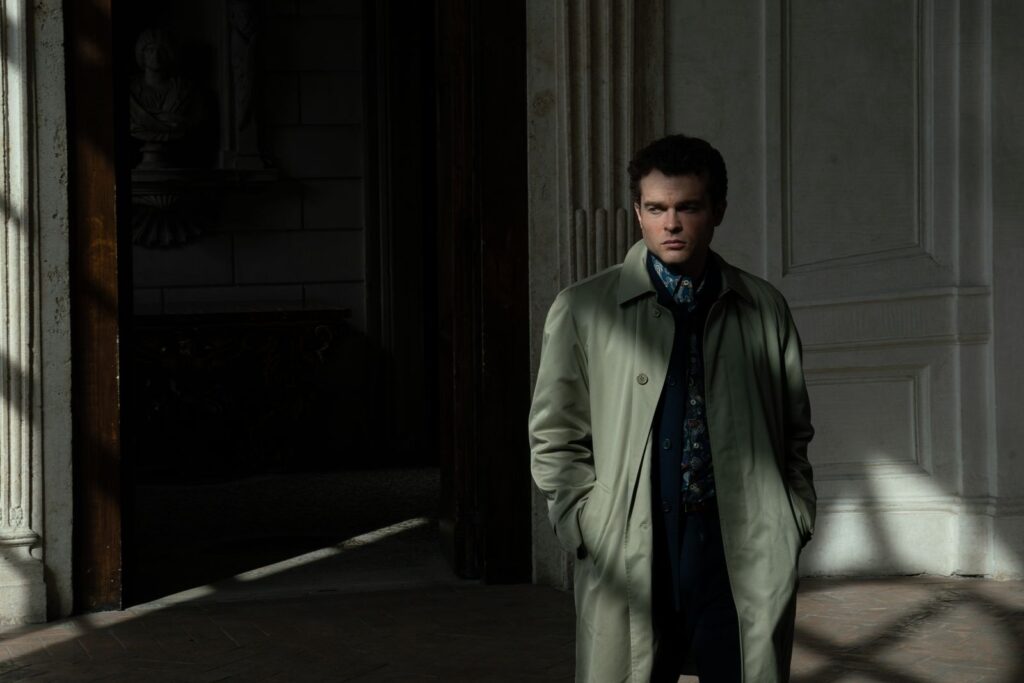
Ehrenreich in particular has a lot of fun playing both a nebbish editor and ultra-smooth killer. Homicidal impulses notwithstanding, Ripley clearly represents Ridgeway’s (and Highsmith’s, come to think of it) idealized self: the antithesis of all his insecurities. Contrast, for example, the awkwardness with which Ridgeway attempts to pass as a rich sophisticate during a family party at Clementine’s place (an elderly attendee sees right through this act and kindly advises him to undo the bottom button of his blazer) with the ease with which Ripley insinuates himself into his lover’s old-money milieu. For her part, Cooke is given less to do in the multiple-character department, but this limitation is by design: Ridgeway, after all, doesn’t really know this woman, so his fictional version of her has little to stand out against. The book he’s outlining, then, grants him the power to both embody the man he wants to be and determine the woman he wishes Clementine could be for him.
In its closing minutes, A Talent for Murder gets a bit lost in its own house of mirrors (the thing self-reflexively folds in on itself one too many times), but Corbijn and company have crafted an engaging, surprisingly funny examination of how fiction allows you to experience the life or death (or sex, for that matter) you think you deserve. In real life, the end credits tell us, Highsmith died from a prolonged illness. Perhaps she would have preferred the irresistible drama of being offed by someone like Tom Ripley. It certainly would have made for a flashier ending.
Thomas M. Puhr lives in Chicago, where he teaches English and language arts. A regular contributor to Bright Lights Film Journal, he has published Fate in Film: A Deterministic Approach to Cinema with Wallflower Press. His study of Robert Siodmak’s The Killers is forthcoming from Channel Academic Publishing.