

By Thomas Gladysz.
For decades, it’s been said G. W. Pabst cast Louise Brooks in Pandora’s Box after having seen her in A Girl in Every Port. It’s an assertion repeated so often it has become fact, part of the legend which surrounds not only the acclaimed German film, but also Brooks herself….”
On first glance, the assertion makes sense; the two films were released barely a year apart and Brooks’ character in each – as Mam’selle Godiva (a gold-digging high-diver in A Girl in Every Port, 1928) and Lulu (a femme fatale show girl in Pandora’s Box, 1929) – are not so dissimilar.
But, how do we know this assertion is true? Did Pabst ever say as much? If not, who first made the claim?
I’ve been looking into the life and films of Louise Brooks for more than 30 years, and as far as I know, Pabst never claimed to have seen A Girl in Every Port prior to selecting Brooks to play Lulu. It’s been nearly 100 years since Pandora’s Box was released, and in that time, no studio records, personal letters, notebooks, articles, or memoirs have come to light in which the director himself makes such a claim. If there is or had been any sort of a paper trail, it has either been lost or remains hidden away.
Let’s unwind the legend.
Seemingly, the first time anyone said Pabst chose Brooks after having seen the Howard Hawks film was decades after the fact. This first claim is found in James Card’s article, “Out of Pandora’s Box: New Light on G. W. Pabst from his Lost Star, Louise Brooks,” which appeared in the September 1956 issue of Image, a publication of the George Eastman House. At the time, Card was the museum’s curator of film, and Brooks – then living in obscurity after having relocated to Rochester, New York the year before, was Card’s “discovery.”
After recounting the intersecting trajectories of both Pabst’s and Brooks’ careers, Card writes, “Throughout Germany and France Pabst searched in vain for his heroine. The requirements were rather drastic. Lulu was a forthright and earthy vampire who had to have the innocence of a child in her face, the instincts of a black widow spider and the beauty of Semiramis. His talent scouts must have enjoyed a fascinating season hunting for Lulu, but Pabst rejected their every discovery.”
Card continues, “Then he saw Louise Brooks. He saw her first in an American movie. It was probably A Girl in Every Port with Victor McLaglen, released early in 1928. He sent for Louise Brooks with an offer to play Lulu…. When Louise Brooks arrived in Berlin, G. W. Pabst looked into the face of his twenty-one year-old star from North America for the first time. He knew then that he had really found his Lulu for The Box of Pandora.”
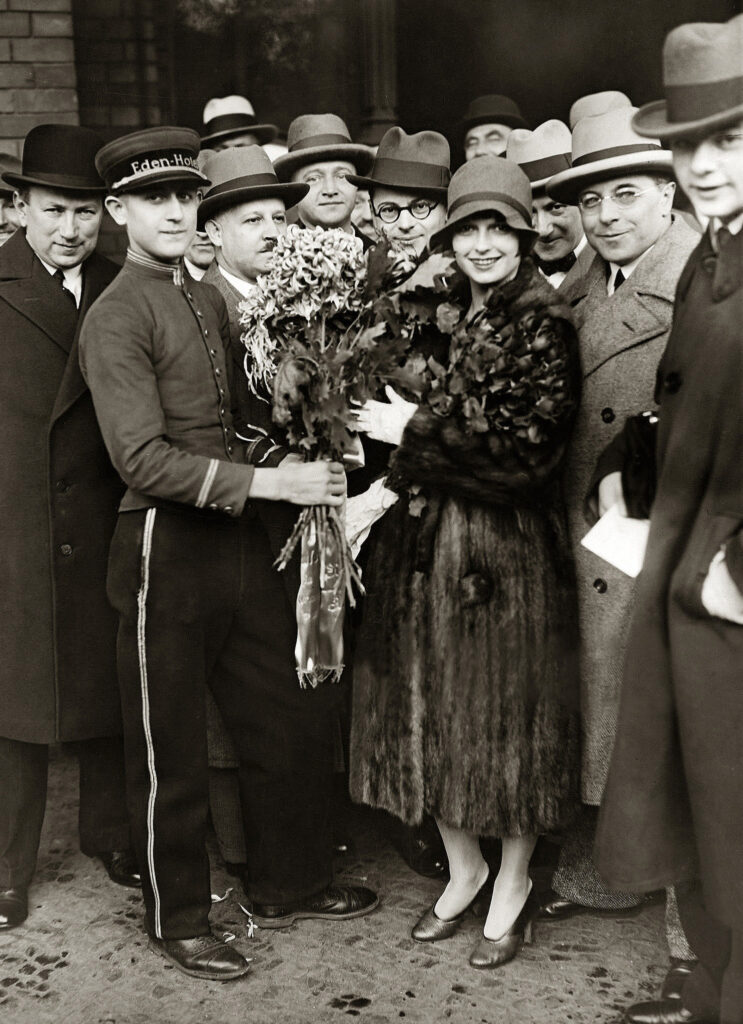
Card is likely speculating. And his assertion, is, notably, tentative. He uses the word “probably” to suggest – 27 years after the fact, that the Hawks’ film provided inspiration, writing “It was probably A Girl in Every Port…”.
In the same 1956 issue of Image, Brooks penned a companion piece titled “Mr. Pabst”. It immediately followed Card’s article. In her piece, the American actress recounts various anecdotes from her time working with the director while making both Pandora’s Box and Diary of a Lost Girl. Among her anecdotes is one concerning the circumstances around her going to Germany. “I was under contract to Paramount at the time Mr. Pabst wanted me for Lulu. It happened to be the time when they were converting to talkies and studio executives had to come in out of the sun and think, and frightened actors were whispering to one another that even John Barrymore had to have his lines written on a blackboard back of the camera. It also happened to be the time when my option came up, and B. P. Schulberg was running the studio. And he, like all the other studio heads now forced into unprecedented decisions, decided to begin with the actors, the least palatable, the most vulnerable part of movie production. It was such a splendid opportunity, anyhow, for breaking contracts, cutting salaries, and taming the stars.”
Brooks continues, “Me, they gave the salary treatment. I could stay on without the raise my contract called for, or quit, Schulberg said, using the questionable dodge of whether I’d be good in talkies…. And then, as a sort of postscript he told me about Pabst wanting to borrow me from the studio for Box of Pandora, a job I was now free to take or not as I pleased.” Brooks concludes her anecdote, “And it pleased me on the day I finished the silent version of The Canary Murder Case to leave Hollywood for Berlin to work for Mr. Pabst.”
Notably, Brooks does not mention either Hawks or A Girl in Every Port, nor do other articles from the time. Among them, most significantly, is “Pandora i København: Interview med Louise Brooks,” which appeared in the December 1957 issue of Kosmorama, a Danish film journal. At the time, Brooks was on the cusp of rediscovery, with small retrospectives of her then available films taking place around post-war Europe. Accompanied by Card, Brooks travelled to the continent for a few of these screenings, including one in Copenhagen at the Danish Film Museum. Brooks was interviewed at the time of her visit; in the resulting three-page piece, the actress talks about her various roles, especially Pandora’s Box. And again, the Hawks’ film isn’t mentioned.
In the summer of 1958, a new article by Card, “The ‘intense isolation’ of Louise Brooks,” was published in Sight and Sound. It is a dramatic account of Brooks’ rise and fall – one which contains passages in Brooks’ voice. Seemingly, Card recorded conversations with the actress about her life and films. In her telling of how she got the role of Lulu, Brooks again recounts the already mentioned anecdote around failed contract negotiations, and again, she does not mention the Hawks film. In regard to getting the role in Pandora’s Box, Brooks simply notes, “And G. W. Pabst wanted me for Lulu. And my option came up…. So I went to Germany.”
Notably, the sole mention of A Girl in Every Port in this 1958 article is by Card himself, who does not associate it with Brooks being cast as Lulu. Instead, he merely recalls having seen the Hawks film as a teen in Ohio in 1928, and having been haunted by the image of the actress ever since.
Only in 1962 would Card declare with certainty that Pabst chose Brooks to play Lulu after seeing her in the Hawks’ film. He did so in the program notes for Pandora’s Box, which was shown as part of a film series at U.C.L.A titled “Psychological Masterpieces”. Card, who curated the series along with Pauline Kael, wrote, “Pabst started a world-wide hunt for Lulu that was only eclipsed in scope by the search for Scarlett O’Hara. Naturally every German actress was outraged that Pabst didn’t give her the loveliest plum to be had in all German dramatic literature. And most outraged of all, by the way, was Marlene Dietrich. The hunt was ended when Pabst chanced to see an American movie starring Victor McLaglen. It was A Girl in Every Port (see top image), and at the port of Marseilles, the girl was Louise Brooks.” Card makes this claim without attribution and without saying how he knows it to be true.
As the years passed, a kind-of cult around Brooks began to coalesce as films in her otherwise little remembered career began to emerge – films such as Pandora’s Box (1929), Diary of a Lost Girl (1929), and Prix de beauté (1930). To film archivists and historians such as Card, what better way to solidify the actress’ standing than to associate her with a prominent American director, namely Hawks, whose reputation may well have been at its zenith in the 1950s and 1960s.
Back in the 1920s, Hawks was just another American director – he had yet to make the landmark films of the 1930s, 1940s and 1950s which not only defined his career, but helped shape more than one film genre.
Writing in Cahiers du Cinéma in January 1963, the French film archivist Henri Langlois stated “It seems that A Girl in Every Port was the revelation of the Hawks season at the Museum of Modern Art in New York. For New York audiences of 1962, Louise Brooks suddenly acquired that ‘Face of the century’ aura she had had, many years ago, for spectators at the Cinema des Ursulines…. That is why Blaise Cendrars confided a few years ago that he thought A Girl in Every Port definitely marked the first appearance of contemporary cinema. To the Paris of 1928, which was rejecting expressionism, A Girl in Every Port was a film conceived in the present, achieving an identity of its own by repudiating the past.”
A Girl in Every Port is considered by many to be the most important of Hawks’ early works because it was the first to introduce the themes and character types he would continue to explore throughout his long and distinguished career. And notably, Brooks is the first to portray what would become known as the “Hawksian woman.” Certainly, Brooks appearance in what is now regarded as the director’s earliest “buddy film” and best silent could only add luster to the career of an actress on which there was then little to pin stardom.
Brooks spent much of the late 1950s and early 1960s researching her past. It may seem odd to research one’s own life, but Brooks was striving to understand why things went wrong, why her career seemed to fail, and why she ended up alone in a small apartment in upstate New York. With Card as her sometimes mentor, Brooks read whatever film journals she could get her hands on; she also borrowed books from the Rochester Public Library, watched movies on TV and in person at the George Eastman House, and, perhaps most importantly, carried on a voluminous correspondence with film historians, archivists and critics from all around the world. There are hundreds of letters to dozens of correspondents – everyone from Kevin Brownlow, Herman Weinberg and Lottie Eisner to Michel Ciment, Penelope Houston, Peter Cowie and Pauline Kael.
In 1965, Brooks authored one of her best-known articles, “Pabst and Lulu.” The piece, which appeared in the summer issue of Sight and Sound (and was later included in her 1982 book Lulu in Hollywood), is an anecdotal account of her relationship with director G. W. Pabst. And here, at last, Brooks references the Hawks’ film in relation to her role in Pandora’s Box. “How Pabst determined that I was his unaffected Lulu with the childish simpleness of vice was part of the mysterious alliance that seemed to exist between us even before we met. He knew nothing more of me than an unimportant part he saw me play in the Howard Hawks film A Girl in Every Port. I had never heard of him, and knew nothing of his unsuccessful negotiations to borrow me from Paramount until I was called to the front office on the option day of my contract.”
Brooks’ reference to A Girl in Every Port seems almost an after-thought, something now added-on to the familiar story about her failed contract negotiations. This later reference also begs the question; how did Brooks know Pabst had seen her in the Hawks film? Did Pabst – with whom she had still been in sporadic contact – tell her as much? (We don’t know, nor is there reference to as much in the surviving correspondence.) Or did her mentor, James Card, tell her as much? (Brooks’ language in describing the Lulu character as childlike echoes Card’s.) If Card and Brooks are correct in their belief that Pabst saw Brooks in A Girl in Every Port prior to casting the actress as Lulu, then another question should be asked, what opportunity would the German director have had to do so?
Let’s rewind the narrative….
A Girl in Every Port premiered at the Roxy Theater in New York City in February, 1928. It proved popular, with Film Daily reporting the Hawks film broke the then world’s record for a single day’s box office receipts when it grossed $29,463.00 on February 22, 1928.
In the coming weeks and months, the film went on to open in cities and towns across the United States. Among them was Cleveland, Ohio, where the film opened in June at the local Palace theatre accompanied by a stage show which included a presentation by Prof. Leon Theremin, who performed on the Theremin-Vox. A teenage James Card, who grew up in nearby Shaker Heights, a suburb of Cleveland, attended a screening of A Girl in Every Port sometime during the film’s ethereal week-long run. It was then that Card, the future film archivist, first saw the Hawks film – and was first haunted by the image of the actress.
Why did A Girl in Every Port premiere in New York in February and open in Cleveland in June? Unlike today, films did not open everywhere on the same day. In fact, at the time, film openings were staggered in the United States, with a delay between a film’s national premiere and a local opening being days, weeks, or even months. In the case of New York City and Cleveland, it was nearly four months.
Coincidentally, Pabst’s production of Die Büchse der Pandora was publicly announced around the same time as the film opened in Cleveland – in June, 1928. And it was then that the director’s highly publicized search for Lulu commenced. During that time – the summer and early Fall, a handful of articles appeared in various European newspapers and magazines focusing on the production and its search for the right actress to play Lulu.
By the beginning of October, the search had ended. An anonymous piece in Close-Up (an English / Swiss film journal) reported “The long search at last is ended. Lulu has been found. By the time this is in print it will be news no longer. Having literally searched the whole of Europe for a suitable type for Lulu in The Box of Pandora (adapted from the book by Wedekind), having interviewed hundreds and tested scores, in Germany, France, Sweden, Austria, Hungary, G. W. Pabst has at last found, in America, the type for which he had been seeking in vain. Lulu will be no other than Louise Brooks, the well-known junior Paramount star. The search for Lulu has been almost the principal topic of interest in Germany for a couple of months. Everywhere one went one heard ‘What about Lulu?’, ‘Is Lulu found yet’… Lulu is found. And now, after long delay, Pandora will be filmed by Nero Film.”
Another October article which sheds light on the search for Lulu ran in both Der Hamburgischer Correspondent (a German newspaper) and Die Bühne (an Austrian magazine). It notes, “Today, when America is taking our best talent, do we have to bring over a Lulu from Hollywood? Do we perhaps want to repay the favor for the kidnapping of our stars? Or don’t we have enough foreign films in our country that we have to over-foreignize our own? . . .. Then the name of Louise Brooks appeared on the horizon of the film firmament, and when Pabst showed the gentlemen from Nero some films in which Louise Brooks had played, there was only one voice: this one or none at all! Cables and radio dispatches then went to Hollywood and New York. The anxious question arose as to whether Paramount would loan its star to Europe…. Louise Brooks was given her autumn leave, and in mid-October she arrived in Berlin. For the first time in film history, a major star from America was coming to Germany to bring a German stage character to the screen. Louise Brooks, the German Lulu, stands at the beginning of a new era in world film.”
The article in Der Hamburgischer Correspondent mentions Pabst showing executives from Nero films (the production company which released Pandora’s Box) “some films in which Louise Brooks had played.” One wonders, which films could those have been? The answer was either a Paramount film (the studio to which Brooks was under contract) or another non-Paramount film one would assume was already in circulation in Germany. A Girl in Every Port was neither.
As noted, films did not open everywhere at the same time in the 1920s. Release dates were staggered not only in the United States, but also overseas. In fact, an American film might open in Europe months or even a year or more later following its American debut. In the case of Blaue jungens, blonde Mädchen – the title under which A Girl in Every Port was shown in German speaking markets, it first played in Berlin at the beginning of December, 1928 – some nine months after it premiered in the United States, and more significantly, a few weeks after work on Die Büchse der Pandora had finished. In other words, it was not playing in Germany during the months Pabst was searching for an actress to play Lulu. One wonders, how could Pabst have seen the Hawks’ film if prints had not yet made their way to Germany?
[Could a physical copy of the film have made its way overseas? Possibly… the film’s earliest documented European screening was an advance, exhibitor’s showing in London in March 1928 ahead of the film’s official, U.K. release on August 13. After that, it was next shown in Paris in late September at the Cinema des Ursulines at a screening likely attended by the young Henri Langlois.]
Assuming that the incident described in the Der Hamburgischer Correspondent article is true (or somewhat true) – that Pabst screened “some films” for Nero executives, one wonders which films they might have been. The answer, most likely, were those few films featuring Brooks then in circulation in Germany during the first seven or eight months of 1928. According to exhibition records compiled from magazines and newspaper listings from the time, those films were Just Another Blonde, which was shown under the title Die Braut am Scheidewege, and Evening Clothes, which was exhibited under the title Ein Frack, ein Claque, ein Mädel.
Just Another Blonde, a late 1926 release, can be discounted if not eliminated as it was not a Paramount production, but rather a First National release for which Brooks was loaned out. Set in part at Coney Island, it is a romantic drama and very much a frivolous Jazz Age film in terms of theme, character, etc…. As such, it is an unlikely source of inspiration for Pabst. That leaves Evening Clothes, a Paramount release from early 1927.
Following the February, 1929 premiere of Die Büchse der Pandora in Berlin, critics returned to the question of how Pabst found Brooks, and asked how it was that an American actress could play Lulu, a character seen as essentially German. Reviews were all over the place, with some praising Brooks and some criticizing her. One article, which appeared in the Berliner Volks-Zeitung on February 13, 1929, offered a singular assessment. “Louise Brooks is Lulu. This young American conquered over 800 women of all nations. Pabst discovered her in an older Menjou film in a small role and waited for her for months until she was finally released from the country for his film. And it was worth the wait. Childlike in appearance, she often smiles like a playful little stubborn child. But behind this childish laughter lurks the grin of a demon. She plays the ending excellently.”
The “older Menjou film” referred to by the Berliner Volks-Zeitung article is likely Evening Clothes, one of two Paramount films Brooks appeared in alongside leading man Adolphe Menjou. (The other was A Social Celebrity, which was released in early 1926 and was shown in German speaking countries as Der Bubikopfkünstler – which translates into English as something like Bob-cut Artist.) Evening Clothes is based on an early 20th century French play, L’homme en habit, by Andre Picard and Yves Mirande. Though tame by today’s standards, this Paramount adaption raised eyebrows at the time. It, like Pandora’s Box, would be censored in some markets. The film was banned in Quebec because of “concubinage” – the suggestion of interpersonal or sexual relationship between a man and a woman in which the couple are not or cannot be married. Elsewhere, in The Netherlands for example, cuts were made and screenings were restricted to those 18 and over.
In Evening Clothes, Brooks plays a supporting role, a character named Fox Trot, who was described variously by American critics as either a “lady of the evening” or “a chic little gold-digger.” As she would in latter films, Brooks played a bad-girl akin to Mam’selle Godiva and Lulu.
Today, Evening Clothes is a considered a lost film, so we can’t see for ourselves what Pabst might have seen in Brooks had Pabst in fact seen the film back in 1928. What stood out and still stands out about Evening Clothes – both at the time of its release in 1927 and today among its surviving film stills and magazine clippings, is the fact that it was the first time in a film Brooks did not wear her signature, center-parted, sharp cut, bobbed hair. Instead, she wore her hair “curled over her head.”
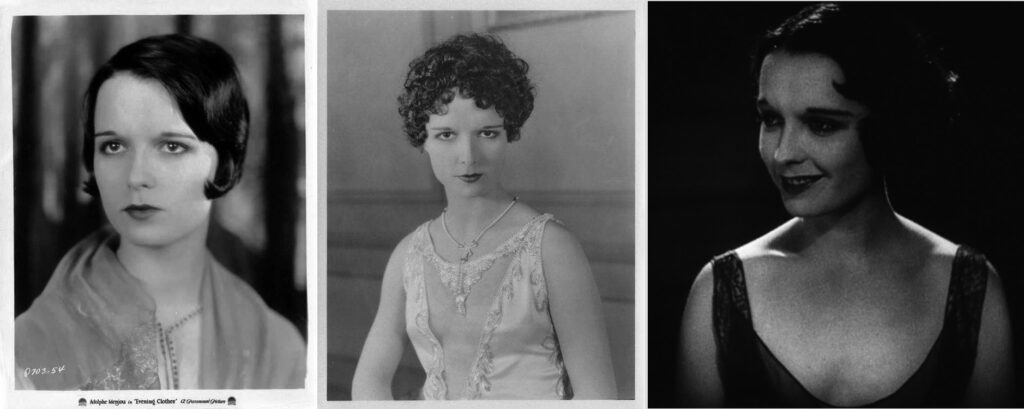
The next and only time Brooks would wear her hair so differently would be in Pandora’s Box, in the scenes near the end of the film which take place on the gambling boat. Lulu is on the run having escaped custody during her trial for murder, and to disguise herself, the character parts her hair slightly off-center, brushes away her bangs, and gives herself some soft curls. Is this change in hairstyle a visual bread crumb, a clue as to what might have once caught Pabst’s eye?
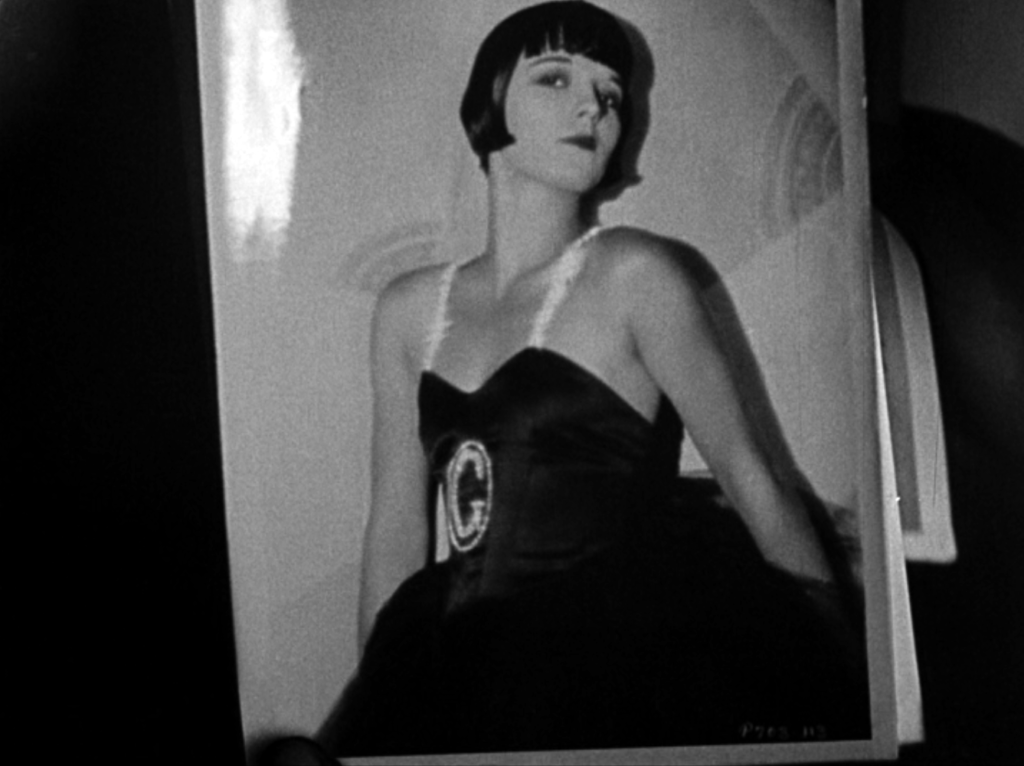
The one other Brooks’ film besides Evening Clothes Pabst may have been aware of was a late 1927 Paramount release, Now We’re in the Air. (The film is known in German speaking countries as Riff und Raff als Luftschiffer, though there is no record yet found of it having been shown in Germany or Austria in 1928.) Some twenty-three minutes of this long thought lost WWI comedy was found by film preservationist Robert Byrne in 2016 in the Národní filmový archive (National Film Archive) in Prague. In it, Brooks plays twins named Grisette and Griselle, one raised French and one raised German. The French Grisette plays a carnival worker who, memorably, dashes about in a dark tutu emblazoned with the letter “G”.
Interestingly, intriguingly, and significantly, a promotional image for Now We’re in the Air depicting Brooks wearing this same tutu is flashed across the screen in a later scene in Pandora’s Box. How could it have got there? Is it another a visual bread crumb, like the actress’ hairstyle change?
One of Brooks’ long-term friends was Lothar Wolff (1909-1988), a German-born fan who would go on to work as a film editor, assistant director, and producer. The two first met in Berlin in 1928, when “Woofie” (as Brooks called him) was 19 and the actress was 21.
Wolff started out as a fan, and as a teen in 1926, he landed a position as an apprentice at Parufamet – the European distributor for Paramount, UFA, and Metro-Goldwyn-Mayer. Wolff handled publicity materials for the three studios, and eventually, he moved up the ladder and attained a position as a junior employee. However, as he once admitted, his job amounted to little more than stamping the backs of images with “Please credit Parufamet…”.
Wolff had a fan’s crush on the actress, an actress who he once described as “extremely beautiful.” According to “Reminiscences of an Itinerant Filmmaker,” a 1972 article by Wolff published in the Journal of the University Film Association, Pabst visited Parufamet in 1928 while searching for an actress to play Lulu. When he met the famed director, Wolff put forward images of Brooks. Wolff writes, “My boss asked me – since I handled hundreds of stills of American actresses – for suggestions when Pabst came to see him one day. I presented him with stills of my favorite actress. She was an ex-Ziegfeld girl, a Paramount star: Louise Brooks.” Apparently, Wolff’s enthusiasm did the trick. “The search was over. She got the part and I got the job, moonlighting, doing the production publicity.”
The images Wolff may well have handed Pabst, and those the director likely took with him, could be the same cheesecake images flashed across the screen in Pandora’s Box. Were these images (including the publicity image for Now We’re in the Air) a bread crumb, a clue to Pabst’s motivation in choosing Brooks?
In pitching Brooks to Nero executives, Pabst could not have shown the actress in a role as dramatic or demanding as the role of Lulu in Pandora’s Box. Except for Beggars of Life (1928) – which wouldn’t be shown in Germany until later, Brooks had yet to play a character as vulnerable or wounded and dangerous as Lulu. All Pabst could do was to pitch Brooks on her looks, her sex appeal. Many films have been built around less.
One other motive Pabst might have had in picking Brooks is one few historians have previously mentioned, cross border marketing. In 1955, Paul Falkenberg was interviewed by Cinemages, an early film journal issued by the Group for Film Study in New York City. Falkenberg was an assistant director on Pandora’s Box, and he spoke about the process of selecting an actress to play Lulu. He noted that Brooks was considered a popular American actress, and was “very much liked, and quite successful in Europe”. He also stated it was common practice to cast actors from across the continent – especially actors with some sort of following in their home country – in order to sell the film beyond Germany’s borders. Since German silents like Faust and Metropolis had already proven successful in the United States, might Pabst have thought an American star might help sell Pandora’s Box across the Atlantic?
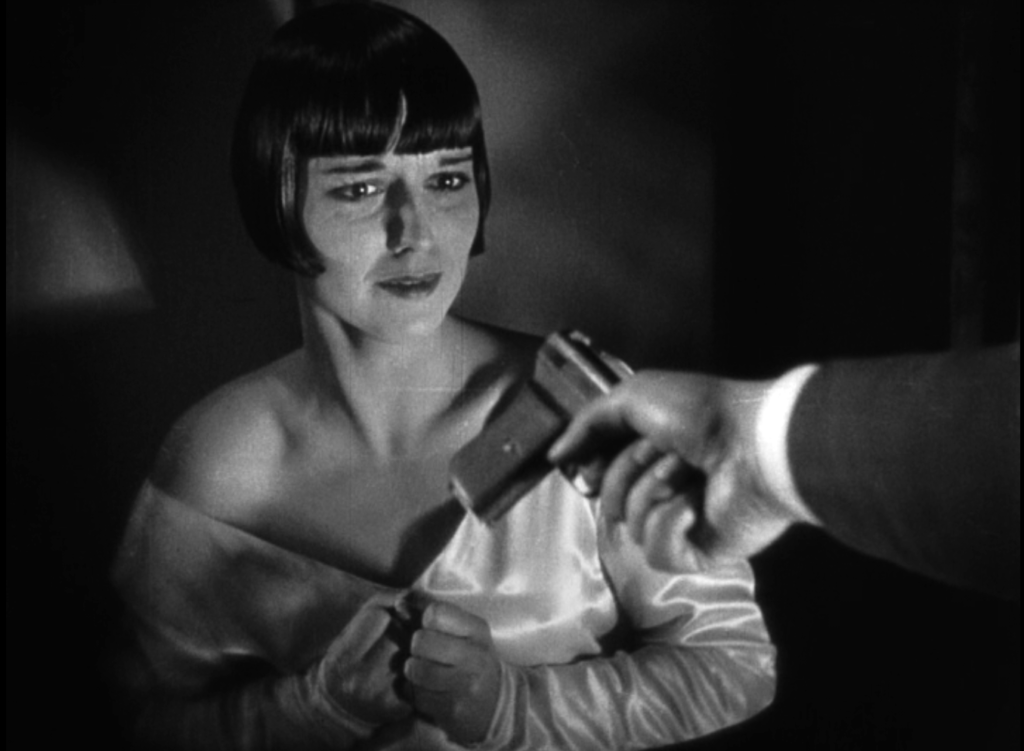
Today, we still don’t really know why or how Pabst came to cast Brooks to play Lulu. We may never know for sure, as there seems to be no smoking gun. Perhaps the answer to this question lies somewhere in Pabst’s personal papers, which are housed in the Archiv Film- und Medienkunst at the Akademie der Künste (AdK) in Berlin. Or perhaps some light on this question will be shed by a Pabst biography, which is reportedly in the works.
Wolff’s reminiscence – the closest we may come to any kind of eyewitness account – runs counter to the long-held notion that prior to selecting Brooks to play Lulu, Pabst spotted the actress in A Girl in Every Port, and that is what got her the role. Reportage from the time likewise fails to support the claim. Instead of A Girl in Every Port, Pabst choice of Brooks to play Lulu may have been inspired by another film, or it may have been inspired by a chance meeting with a young publicist. Or both…. Later in life, Pabst’s son wrote to Brooks and told her that his father thought her the most beautiful actress he ever worked with – more beautiful than Garbo. In 1928, when he was preparing his production of Pandora’s Box, Pabst may have seen some publicity photos of the actress which – as they would others, haunted him.
Thomas Gladysz launched the Louise Brooks Society website in 1995. He has authored numerous articles on the actress, as well as five books. The most recent is The Street of Forgotten Men: From Story to Screen and Beyond, with forwards by Kevin Brownlow and Robert Byrne. Gladysz also contributed an essay and audio commentaries to the recently released Blu-ray Focus on Louise Brooks (Flicker Alley). In 2026, the Louise Brooks Society website was chosen for inclusion in the Library of Congress Motion Picture Web Archive.
Thank you, Thomas for your thorough research. I’m 89 now and I started seriously reading about films about 64 years ago, and it did not take long to learn to approach many colorful Hollywood “stories” with some skepticism.
A brilliant essay. It is refreshing to read an article filled with facts sweeping away the cobwebs of false film history.
Excellent article, thx. Need to have a Brooks festival. I haven’t played PANDORA or DIARY in a long time