

By Jonathan Monovich.
Some people only want to see what they expect to see, but I’m not that kind of person. Josef Von Sternberg was once told his movie didn’t seem very realistic, and he responded, ‘Of course not, it’s much better than reality.’”
–Julian Schnabel
In the truest sense of the word, Julian Schnabel is an artist. And, like his late friend, Lou Reed, he shares a rock and roll heart. When Schnabel emerged on the scene as a young painter, he was a disruptor. Today, Schnabel’s lively spirit, described as “larger than life” in Julian Schnabel: A Private Portrait (2017), continues to drive his creation. Guided by the evolution of the image, Schnabel has succeeded in painting, photography, and film, and even made an album, Every Single Lining Has a Cloud, in between. Being a renaissance man, it’s fitting that Schnabel’s latest cinematic triumph, In the Hand of Dante (2025), harkens back to the Italian Renaissance. Inspired by Nick Tosches’ novel of the same name, Schnabel’s take on In the Hand of Dante navigates between black and white and color, traverses paradise, purgatory, and hell, and spans centuries, offering an eternal mosaic that forms the present. When these elements combine, using the “ancient art of weaving” like Keith Richards and Ronnie Wood on a Rolling Stones record, they come together like Schnabel’s plate paintings.
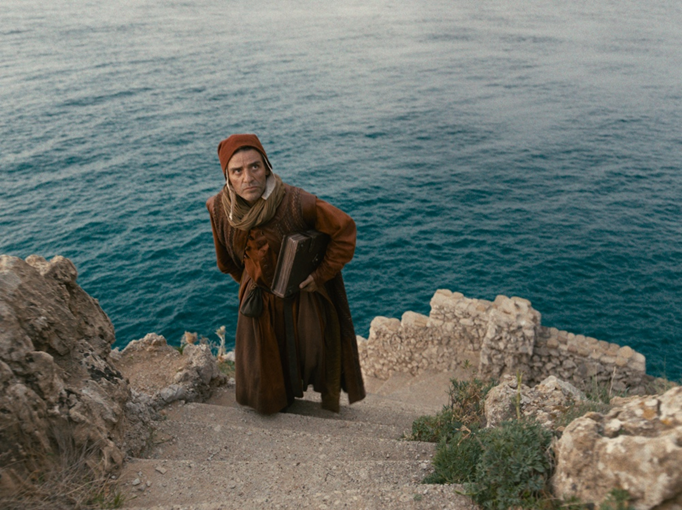
Unsurprisingly, the seeming unfeasibility of adapting In the Hand of Dante for the screen attracted Schnabel. A true auteur, this has been a recurrence in Schnabel’s oeuvre, pursuing what others see as unadaptable material and proving these skeptics wrong. Afterall, this is the same director of Before Night Falls (2000), The Diving Bell and the Butterfly (2007), Lou Reed: Berlin (2007), and Miral (2010). Basquiat (1996), inspired by Schnabel’s own relationship with Jean-Michel Basquiat, with freely used excerpts from Rene Ricard’s essay, “The Radiant Child,” was even unfairly met with cynicism (purely because it was a painter’s first film). Now, it’s considered a classic. Excited by the challenge of In the Hand of Dante, Schnabel put faith in Oscar Isaac, who previously portrayed Paul Gauguin in his film At Eternity’s Gate (2018), to lead this gargantuan effort. Depicting a fictitious version of Tosches, Isaac is tasked with finding and authenticating the original manuscript of Dante Alighieri’s The Divine Comedy for a slippery mobster, Joe Black, played by John Malkovich. Whereas the manuscript’s artistry intrigues Nick, Black solely finds interest in its profitability.
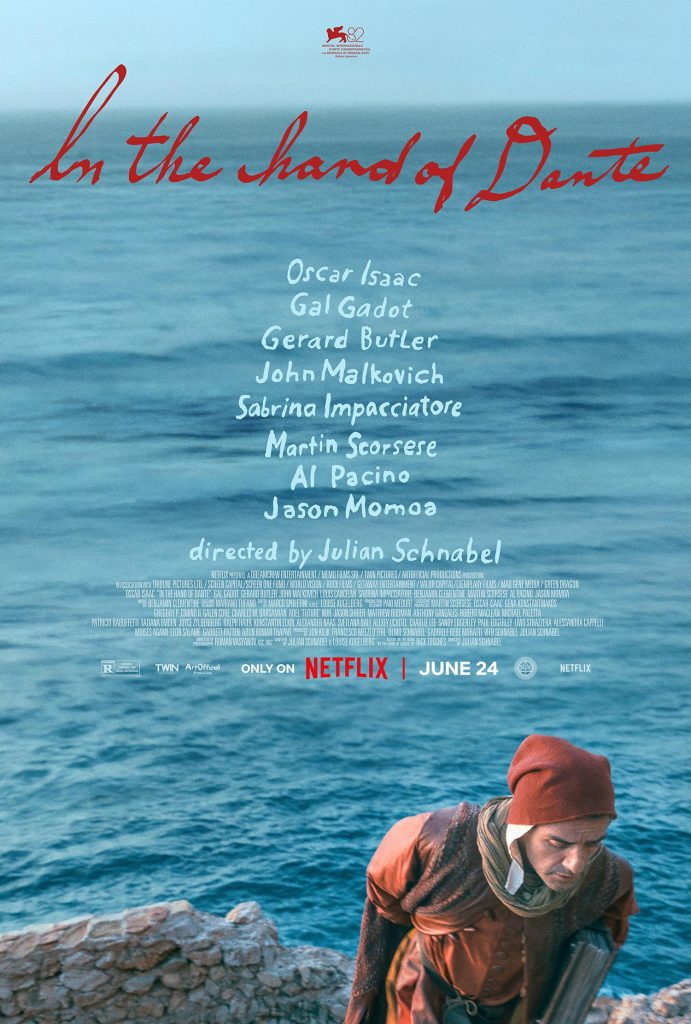
Simultaneously, Isaac plays Dante on a path for boundless artistry, doing everything in his will to become the poem, The Divine Comedy, he sets out to write. Both men’s journeys are plagued by naysayers, obstacles, and neuroses. However, it is Martin Scorsese’s presence as Isaiah, Dante’s mentor, who intelligently helps these men to understand that God is found within and wisdom is womanly. The women in their lives, Gemma and Giulietta, both played by Gal Gadot, join them on their pursuit of paradise. Also accompanying Nick is the ill-mannered/wisecracking assassin, Louie, one of Black’s goons, with a startling performance from a bleach blonde Gerard Butler who finds holding the hand of a “dog shit broad” (a woman who has had a plastic bag in her hand to clean up after her dog) to be more sick than having sex with a corpse. Amusingly, Butler also plays Pope Boniface VIII who exiles Dante. Nick recognizes artists are often paid posthumously, and Schnabel’s stylistic choice to make the present black and white in In the Hand of Dante signals we are living in dark times. This follows the recent black and white restoration of Basquiat for the Criterion Collection. Schnabel meditatively chose to void the artist’s world of color, making for a much bleaker viewing experience that mirrors our current nightmarish reality. Yet, seeing Basquiat painting in color after the credits suggests there is always room for hope.
In the Hand of Dante’s thematic exploration brings back memory of Martin Scorsese’s collaboration with Fran Lebowitz, Public Speaking (2010), which opens with the tale of a Picasso painting whose description was repeatedly limited to its price tag. The man who owned the painting, eventually revealed to be blind, reportedly hit the painting with his elbow, tearing the canvas. Lebowitz proceeds to unabashedly say, “There is no more suitable and potent image/symbol for our time than the image of the blind art collector… If you were going to write just a history of the era, you should call it ‘the blind art collector and other stories.’” The populace’s seeming failure to fully grasp Schnabel’s similar cinematic statement with In the Hand of Dante extends the sentiment, suggesting we also live in an adjacent era to be titled “the blind art critic and other stories.” However, In the Hand of Dante extends past art, and Schnabel’s magnum opus is an empathetic statement of the universal struggles of humanity and the beauty of life’s complexity. By the time Nick Cave’s “Into Your Arms” plays, rivaling the poignant musical moments of Schnabel’s earlier films, the viewing experience will have felt transcendental for those fortunate enough to escape.
Schnabel graciously spoke with me across the globe from a field in Sweden. Surrounded by deer and trees, he shared artistic philosophies and anecdotes about his latest cinematic milestone.
Following the film’s theatrical release, In the Hand of Dante is now streaming on Netflix with future theatrical screenings planned.
I’ve now seen In the Hand of Dante twice. It was great to finally be able to see it theatrically and on Netflix.
It’s great to see it in a movie theater with other people and see them laugh when something sardonic happens; it’s a tragicomedy. I’m super happy that they took the film to Netflix. I guess twenty-three million people will see it.
It seems some have been surprised by the tone of In the Hand of Dante. This reaction suggests that they did not read the book or understand the film is a tragicomedy. One of the most important realizations from The Diving Bell and the Butterfly is that it’s important to have a sense of humor, especially in your darkest moments. Why do you think it’s important for people to laugh amidst the chaos of In the Hand of Dante?
Well, it is important to laugh for your mental health, even if you’re not in movies. When I read Nick’s book, I thought it was an impossible book. I changed the story quite a bit. In the book, Gemma and Giulietta are not the same person. I thought there was an opportunity to talk about love and how it might take you seven hundred years to figure out that you’re with the right woman. She knew who Nick was, but I like to make movies where the audience knows something the people in the film don’t know. Why do they fall in love so immediately? Well, they knew each other. That’s not something that was in Nick’s book. I guess he didn’t feel like he needed to describe that, but I think the idea of transgressing time was something that was implicit in his book. The first line of his book is “Louie pulled off his bra and threw it down upon the casket.” I love that line, but the idea that this writer’s going to kill a bunch of mafia guys made me think I needed to show that he’d done it before. I moved the scene with Nick as a child earlier. I think Al Pacino is so extraordinary in that scene, and it sets a tone. I’m a big fan of the film, so you’re talking to the choir. I liked the idea that we’re really living in purgatory right now, and it is black and white. When Giotto lived and painted the Cappella degli Scrovegni in Padova, the world was in living color. I liked the idea of flipping that. I don’t think there are any flashbacks or flash forwards in the film. I think it’s all happening simultaneously. I even made a sweatshirt that said, “There’s only the eternal present.”
You also changed the ending, implying that Nick is the reincarnation of Dante. It’s a very unconventional book. You’re no stranger to adaptations, but I’m curious how you and your wife, Louise, approached writing this film. Also, what was Tosches’ involvement with the screenplay before he passed away?
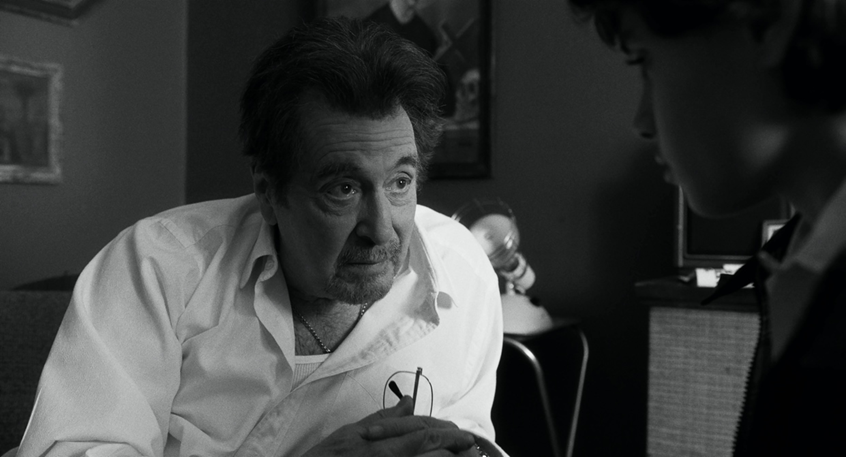
He didn’t have any involvement, but he read it and loved it. I was amazed that he could write in this very vulgar/brutal voice as Louie, this delicate/affectionate way when Nick talks about his daughter, and in a radically contrasting lyrical way as if he was in the 14th century. I liked going from black and white to color and pulling the rug out from beneath the viewer. It’s not just in terms of the narrative, but there’s also a psychological veiling of the viewer. It’s really an experience that I’m offering. It’s a kind of movie where I think you can take the trip. It’s like traveling and saying, “I’ve been there before, but I want to go back because I liked it. I think I’ll get another ticket.” In Nick’s book, he wrote, “Find my grave, baby.” Well, my ending is very different. Giulietta is really Gemma. When she says, “My sweet Dante,” Nick says, “Yes, but this time, I will be of joy immeasurable.” She repeats something that she would only know if she was Gemma, which is something Isaiah had said to Dante. So, it connects the dots. It’s beautiful. It was Louise’s idea to say, “A God that is hidden from man, I have found her,” which I think is powerful and not to be missed. Nick never would have said he was Dante, but I felt like he knew more about Dante than almost anybody. And, it’s not like Dante’s going to come back and criticize his work. There are a lot of non sequiturs and formal juxtaposition in the novel, and Nick didn’t try to over illustrate. The characters are beefy and well developed. It’s amazing to have them all in the same film.
One of your artistic philosophies is to not copy yourself. You put yourself into your art and have become your art like Dante, while finding a way to keep making something that feels new. What drives you to continue to experiment?
Well, it’d be very boring to just illustrate what you know. It’s compelling to experiment and exciting to collaborate with people who you believe can accomplish something. It’s so extraordinary to see Oscar spread his wings like that with his performance. I can’t imagine anything better. He never missed a beat… and Gerry Butler, Sabrina Impacciatore, and everyone who’s in the movie. We don’t mention Lorenzo Zurzolo enough. He’s the young guy who plays Don Lecco as a kid. To come in for a few days and do that, it’s pretty seamless. I felt like I was making a Sam Peckinpah movie for a moment. We worked in Italy and went to places like Caccamo, which has the kind of buildings and landscapes that are witnesses to time amassed. This informs the authenticity of the film. I spent a lot of time in Italy over the years, so I wanted to share that with people. Tom Waits and his wife, Kathleen, sat next to me at a screening. They loved the film, and it meant the world to me. I have this great friendship with Marty Scorsese who had some incredible things to say about the film. I’m honored that he thinks I’ve created my own cinematic language. Well, I didn’t know how to do it any other way. You can’t please everybody, but there are some people you really want to please, especially those who know and care about cinema.
You’ve mentioned a few cast members in passing, but there’s so many great actors in this film. Scorsese does a great job. There’s also Franco Nero, Paolo Bonacelli, Jason Mamoa… the list goes on.
One of my favorite directors is Pasolini. I love Accattone (1961). Paolo Bonacelli worked with Pasolini for Salò, or the 120 Days of Sodom (1975), so I wanted him to be in the movie. It’s funny, when they were talking to the younger actors for a press kit, they said, “Talk to that guy [Bonacelli].” Bonacelli said, “I like Julian because he’s like Pasolini. He does all kinds of things; he’s not just a director. We’re going to make a lot more movies.” He ended up dying that year at eighty-eight.
When I asked Jason to do this, I’m sure he thought, “What does he want me to do?” He was like some sort of archangel. He could have approached it like anybody in the mafia from this age, but it was his idea to torture Oscar with that little manicuring kit. It was interesting that he broke the cliches of what’s expected from his action movies. When he finally shows up, Jason’s presence feels supernatural. He throws Oscar over his shoulder like a sack of a potatoes. When he comes up to Sabrina and puts his arm around her at the library, you’re thinking, “What the hell is going to happen to her?” Then, it’s odd to find out she’s his love interest. What happens on that terrace is so insane. It can make people think, “What kind of movie am I watching?” But, it’s hilarious. It’s amazing that Oscar could speak this old Italian to Sabrina. She thinks she’s Beatrice, and then, he throws her off the terrace. You just don’t expect that. Some people only want to see what they expect to see, but I’m not that kind of person. Josef Von Sternberg was once told his movie didn’t seem very realistic, and he responded, “Of course not, it’s much better than reality.”
The aerial shot, looking down at their bodies on the terrace, was framed like a painting.
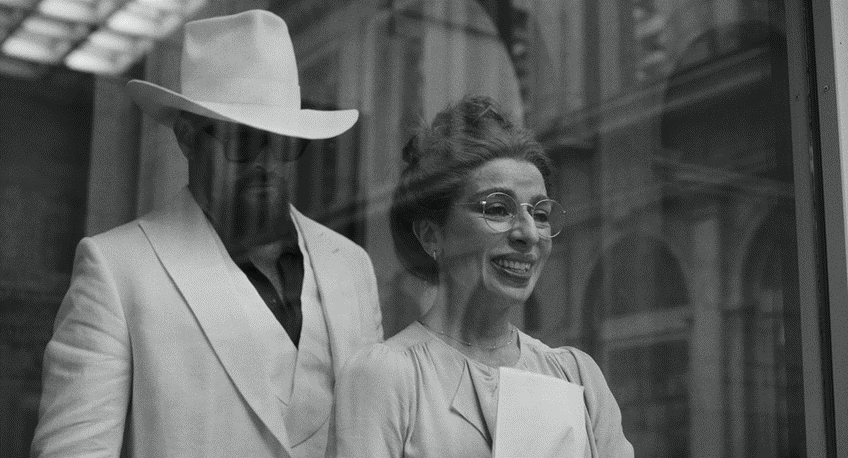
I was worried that people would think it was the end and start clapping. I’m glad they didn’t because Benjamin [Clementine]’s music is so good. It segues with them walking into his place, and he’s playing the piano as Mephistopheles. He sorts them out and sends them on their way, where they can be together.
I enjoyed the way Clementine combined piano, strings, and the accordion.
He’s brilliant. It’s the first score he’s done for a film.
Your films’ soundtracks include songs by some of my favorite musicians like the Rolling Stones, Tom Waits, Lou Reed, Iggy Pop, John Cale, the Pogues, and so forth. You’ve also incorporated musical themes from other films like The 400 Blows (1959), Lolita (1962), and Pixote (1980). The “Jumpin’ Jack Flash” scene is lifted from Tosches’ novel, but the songs you’ve added like “Wooly Bully,” “Poor Moon,” and “Into Your Arms” worked very well. How do you go about curating your musical selections?
I’m glad that you picked up on all of that. It’s intuitive. It’s just the stuff I like to listen to. I could be listening to Ryûichi Sakamoto’s score for The Revenant (2015), Martha Reeves & the Vandellas’ “Dancing in the Street,” Ennio Morricone, or Jimmy Cliff’s “Many Rivers to Cross.” A DJ named Arman asks different people about the music they’re listening to in their lives. I named fifty-one songs, and you can listen to them on Spotify. As we’re talking, I’m asking myself, “Why didn’t I include ‘Dream Baby Dream’ by Suicide?”
“No great art comes out of being polite. I didn’t think I needed to make the film for the lowest common denominator in order to sell more tickets. I’d rather give people the gift of what I was seeing, and if they appreciated it, great. If they didn’t, they didn’t.”
I was fortunate to interview Martin Rev from Suicide a few years ago. Going back to the cast, it’s quite an eclectic group. It seems like you create an environment that allows your actors to thrive by giving them trust. Can you talk about your relationship with the actors and why it was particularly important for you to cast Scorsese? Over the years, there were moments where he was ousted like Dante.
You’re absolutely right. When he made The Last Temptation of Christ (1988), they said he was the antichrist. There used to be a line in In the Hand of Dante where he said, “It’s easy. Lie and go to hell. Tell the truth and get crucified.” It was in the book, but it was more important for him to say, “He’s allowed you this gentle lifting of the veil of the inexpressible. You have entered the sigh. You have become the poem.” I think all artists want to transgress death by becoming the poem. That was the best review that Nick or Dante could ever get. I thought Marty lived through all of this, so he’d be perfect. I’m not really interested in people acting. I’m more interested in their capacity for being, digging into who they are, and being free enough to do that in front of the camera. It’s amazing what Oscar and everyone did. It’s a great pleasure to talk about it, and I appreciate your questions. It’s funny you mentioned “Wooly Bully.” The weekend before Hal Willner died, he sent me a video of Harvey Weinstein with his walker going to a courtroom set to “Wooly Bully.” I hadn’t heard that song in a while and thought, “Wow, I’m going to put that on for Hal.” It’s timeless. Because the film is in black and white, you don’t really know what time it is. It feels like an old gangster movie like Mafioso (1962). Sometimes it feels like The Killers (1946), Paths of Glory (1957), or an Antonioni movie.
There’s a great scene where Gerard Butler and John Malkovich have an exchange about the Rembrandt self-portrait. Between this scene and Isaac’s line about Christie’s finding a way to put a price on the priceless manuscript, there’s some satire of the art world at play. Your love of art is also on display with your recreation of Botticelli’s The Birth of Venus with Gal Gadot. Why did you think it was important to show this dichotomy of art?
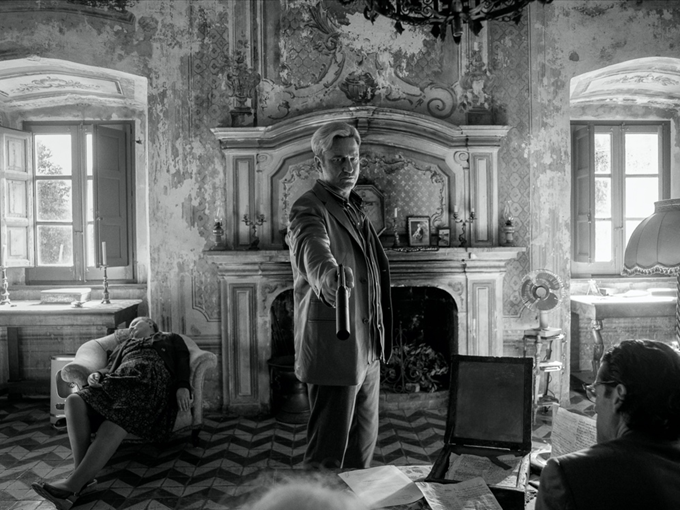
When Dante was writing, his goal was to make a work of art, not money. When I’m making a work of art, I do it to make the art. It’s been reduced to this quantity, so these people are just going around purgatory trying to get this manuscript because it’s worth money. They want to sell it, but that’s not what it’s about. I think the contrast between that and the idea of actually wanting to create something is palpable. I think John Malkovich and Gerry Butler were amazing. Louis Cancelmi, who plays Lefty, is also such a great actor. He’s nothing like that in real life, but he can do anything. Gal Gadot was so welcoming to Oscar. She was like Ingrid Bergman in this movie. You could believe that she knew him before. When Oscar walks into the courtyard, he says, “There’s something familiar about this place… Kind of a wisp of a memory that can’t be caught before it fades away.” That line was inspired by Perfume: The Story of a Murderer.
It’s my understanding that you approach filmmaking like painting and treat the camera like a paintbrush. You’ve also referred to your films as portraits. Did the process of creating In the Hand of Dante spark any ideas for new paintings or vice versa?
I actually did make velvet paintings of the mountain fortress a few years ago. I also made umbrella pine paintings, while I was in Ansedonia, waiting to see if we were going to be in the Venice Film Festival. I paint my way through the anxiety. The show, “Italy Through Its Trees,” is currently at the Pace Gallery in New York.
I read there were battles over the film before it premiered in Venice. This is ironic as In the Hand of Dante is about a writer trying to maintain his artistic integrity. For the Before Night Falls commentary, you mentioned truth is an artist’s responsibility. How were you able to remain true to your vision?
I think what you’re saying is art imitates life and vice versa. People probably take it literally when Nick says, “I don’t get edited.” Nick actually wrote those lines. It would seem like I’m writing that and saying it about what I was doing, but I do get edited. The best editors are the ones who conspire with the artists to bring freedom and gain. Louise and Marco Spoletini were great editors, but we made the movie we wanted to make. No great art comes out of being polite. I didn’t think I needed to make the film for the lowest common denominator in order to sell more tickets. I’d rather give people the gift of what I was seeing, and if they appreciated it, great. If they didn’t, they didn’t. We recently did a Q&A with Paul Dano at the Tribeca Film Festival. He said, “How do you make a decision with the camera?” Oscar said, “When the cameraman would place the camera on the floor, Julian would say, ‘Look what’s happening. Now it looks better. Shoot it without looking in the eyepiece. That looks better, movement that is not preconceived, like life.” I’m looking at what’s in front of me. I’m looking for the surprise. There are no accidents, but I’m looking for that accident that’s supposed to be there. It was complicated to get it done the way I wanted to do it. For it not to be compromised, I can only really thank Ted Sarandos. He knew it was unlike a lot of films on their platform, but it’s such a blessing it was something they needed. Jeff Berg, who used to run ICM, was also extremely helpful to me. He was a great person to talk to who loved the film and encouraged a lot of things to happen. John Kilik worked out all the details with Netflix. Lisa Taback also had an important role in this.
Going back to The Birth of Venus scene, you add the wave in the sky like Basquiat. It seems the natural world is important to you just as Willem Dafoe says, “I feel God is nature, and nature is beauty” in At Eternity’s Gate. You also do a lot of your paintings outside and incorporate elements of the Earth in them. How important was the influence of nature in creating In the Hand of Dante?
I’ve been surfing since I was fifteen, and I still do it. When Nick’s having his dream, I had this idea that the energy crushing down from the water was a parallel force with the buildings coming down on 9/11. The impact of the wave’s energy exploding like that could be synonymous with the buildings coming down. I don’t think people understand what actors are really doing. They’re not acting. They’re being there, and it’s hard to stand still without any kind of communication. I kept swimming back and forth to Gal, because Oscar was on the land. I guess I’m very physically involved in whatever I’m doing. When Mathieu Amalric had to be still for such a long time in The Diving Bell and the Butterfly, people walked by like he was a piece of furniture. Actors put themselves in these physical situations that I couldn’t do. I’m always astounded by that. When I talked with the actors, they felt like I left it to them to figure out what rang true to them. They have that inside of them, and they can bring that to the work. I think that makes the movie.
In the Hand of Dante’s mixed reception reminds me of when Miral was released. I think both films have admirable messages as they’re both about human struggles. Miral suggests peace is possible, and In the Hand of Dante suggests paradise is attainable if one suppresses fear and holds fast to where their spirit guides them. Yet, it’s a strange reality that films with a sense of hope sometimes aren’t treated as seriously. Why do you think this happens?
Some people are curious and others are not. I remember Clement Greenberg walking around one of my shows at Leo Castelli’s in 1982. He said, “If you take eighteen inches off the top of this painting, it’d be really great. Or, if you take the brown out of this painting, The Raft, it’d be much better.” If people only come to see their expectations fulfilled, they’re never going to see anything. People go to museums to see Van Gogh’s self-portrait just to check if it looks like the magazine where they originally saw it. People also take photographs all over the world, but they don’t stop to look at a tree. It’s about perception and the transcendental power of making art, whether it’s a painting or a film, and that’s not necessarily the goal of the movie business. I remember someone asking me if I could change some of At Eternity’s Gate to sell more tickets, and I said I wouldn’t change a frame.
I think it’s particularly important that In the Hand of Dante is coming out now. Art has been having its challenges in recent years, and this is a film that is very human. Your films are often about artists, but they’re also about being. There are certainly benefits to advancements in technology, but why do you think it will be crucial for humanity to be at the front of art?
We don’t know each other, but I’m really enjoying listening to what you have to say because it’s absolutely true. The problem is the lack of humanity. Human contact is what makes it work. You have all these people in the middle who don’t want to lose their jobs, and the only reason this film got made is because I got to talk to Ted. If you think of Steve Jobs, he said something like, “The production side of things has been diminished, and the public relations side has become the protagonist.” It’s like Ezra Pound’s poem, “Canto XLV,” saying usura is just a fee put on a product. Pier della Francesca didn’t come from usura. The freedom of not being bound to that is a great thing. Unfortunately, a lot of people can’t be that free and are struggling to just get by. The marketplace has been designed for guilty pleasures, not art. I actually like watching those kinds of movies, but they’re not something I ever felt like making. Nobody wanted to make a movie about a homosexual anticastrista poet from Cuba with an unknown actor named Javiar Bardem, but I did. I figured out a way to get it made, and Javiar got nominated for the Academy Award. I wouldn’t trade that performance for anything. It’s one of the great performances that anyone has ever given. You just have to follow your intuition. I’ve been really blessed to be free enough to do what I want. There’s a funny line in In the Hand of Dante; Oscar says, “Who do you work for,” and Benjamin says, “Only the very foolish and the very arrogant say that they work for themselves” [laughs]. He says, “I work for the lord of the world… Maybe, I simply work for you.”
They say art allows you to connect with people you don’t know. I’ve felt that way talking with you. A lot of your art resonates with me.
It’s all part of the all. I think that’s what the movie was about, ultimately. What we all face. Not necessarily as artists but as humans, like you said.
Jonathan Monovich is a Chicago-based writer and a regular contributor for Film International. His writing has also been featured in Film Matters, Bright Lights Film Journal, and PopMatters.