

By Ali Moosavi.
From erotic poetry to deadpan animation….
Several movies screened at this year’s Cannes Film Festival have not been well covered, with more attention on the main competition. Here are ten shown in some of the other sections of the festival.
Special Screenings
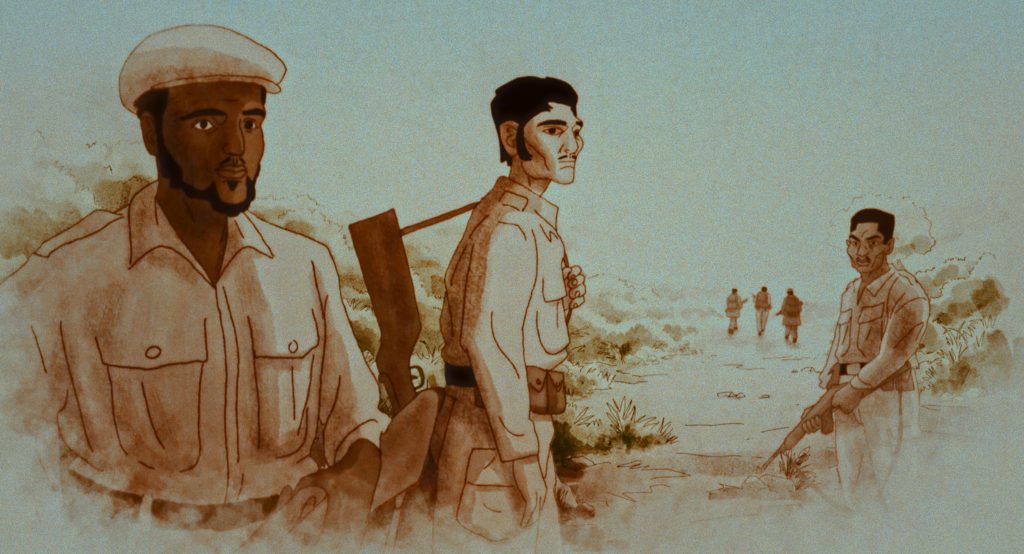
There have been many movies, both fiction and documentary, made about the Bolivian revolutionary, Che Guevara; a man whose image drawn on a poster adorned many student dorms in the sixties and seventies. 2027 marks the 60th anniversary of Che Guevara’s death. Christophe Dimitri Réveille’s film, Che Guevara – The Last Companions, though not specifically about Che, is an absolutely fascinating documentary about events immediately following Che’s death. The film, narrated by Vincent Lindon, opens with footage of Che’s dead body laid on a table for viewing by reporters and other interested bodies. Che was captured by the Bolivian army and at the request of US was executed in a way to appear as though he was shot during skirmishes with the army. The film follows Che’s remaining 17 companions, composed of Cubans and Bolivians as they try to make the 2400 KM trek to the Chilean border, pursued by a 4,000 strong Bolivian army. Dimitri Réveille has three masterstrokes in his fascinating film. The first is rare archival footage relating to the events portrayed in the film, the second is the very effective and imaginative use of animation to depict the absolutely riveting deadly hunt by the army for the six guerillas. His final, and most amazing masterstroke, achieved after 20 years of research and hard work, is not only to track down the three remaining Cuban companions, one of the Bolivian companions, the Bolivian army captain leading the hunt, a Cuban CIA agent joining the hunt and a French journalist at the centre of these events, but also persuade all of them to appear before the cameras and recount their role in the events depicted in the film. The hunt for the guerillas, which took a few months, is more exciting than any Hollywood action movie that I can remember. The men are pursued in the forests, in the desert, along a river, in the caves and over the mountains. The guerillas had made a pact before embarking on their escape that if any of them was injured in a way to be unable to walk, another companion will shoot him dead rather than leave him to be captured and tortured by the army. Two statesmen of the time, who play major roles in the events as they unfold, were General De Gaulle, The French President and Salvador Allende, the President of Chile. Without the direct intervention and help of these two, neither the guerillas nor the French journalist, who was sentenced to be executed by the Bolivian army, would have survived to recount their memories of these amazing events.
Cannes Premiere
Christophe Honoré, who I interviewed for his 2022 film Winter Boy is one of French cinema’s leading writer-directors. His particular ability is to create the perfect atmosphere for the film’s events and draw very natural performances from his actors. His new film, Orange Flavoured Wedding is, as the title suggests, is set in a wedding. Honoré uses the eventful day to examine the psyche of the various characters attending the wedding and a very wide range of human emotions which transpire during the course of the day and the night of the wedding. These emotions include happiness, sadness, love, jealousy, depression, disillusionment, anger, desperation.
Jacques (Paul Kircher) and Martine (Malou Khebizi) are getting married. It is the late seventies. To be precise it is March 11, 1978, the day the popular French singer Claude François died at the age of 39. The news of his death, from electrocution while changing a light bulb, casts a shadow over the already doomed wedding ceremonies. The guests in the wedding include Dominique (Vincent Lacoste), a young man out of work and on the edge; Roger (Alban Lenoir), who suffers from PTSD as a result of his time with the French Army in the conflict in Algeria. At the centre of the film though is Claudie (Adèle Exarchopoulos), a young woman on the edge of a nervous breakdown. Her condition has worsened since noticing his Ex turning up at the wedding with his new partner.
Rather than using flashbacks to provide us with more background for the characters, Honoré uses flash forwards to show how a few of the key characters end up. This approach works well in the context of this movie. For Honoré the storyline and the narrative is of secondary importance. He focuses on the characters and their actions within an environment carefully designed by him. As usual, Honoré has elicited superb performances from his cast, most notably from Adèle Exarchopoulos. He has also made excellent use of some of the memorable songs of that era by artists such as Rare Earth, Rod Stewart and, naturally, Claude Francoise.
Marie Madeleine is set in Haiti, where its writer-director Gessica Généus was born. Généus presents two widely contrasting worlds, a church and a brothel, situated exactly opposite each other in a coastal town in Haiti. The church is run by Jacques, a hardline, noncompromising pastor full of rage. His anger and hatred are fuelled daily by the sight of the brother in front of his church and the loud sound of music being pumped out of the speakers at the brothel. He has lodged a complain at the court to no avail. Mary Madeleine is a free-spirited sex worker working at the brothel. Jacques’s son, Joseph is a kind, mild mannered pastor; a total contrast to his father. A romance between Mary and Joseph, during which Mary takes him on an acid trip, does not bode well for either, specially for Joseph. We are not in a normal, civilised territory. A man accused of being a werewolf is tried and then the angry crowd put a tire around his neck and set fire to it, burning him alive. Gessica Généus has said that as a little girl in Haiti she witnessed the lynching of a man accused of stealing a banana, an image that has stayed with her and no doubt has influenced this film. Joseph’s friendship with Mary is considered a cardinal sin by Jacques, who gathers his congregation and carries out a religious trial of his son, proclaiming that it’s better to cut off one hand than to burn in hell. This contrast of religious fever of Jacques and his followers set against that free love and live-for-today attitude of the ladies of the brothel runs throughout the film. Joseph is also a keen photographer and in a way, Généus has shot every scene as though composing a photograph (kudos to cinematographer Nicolas Canniccioni). Mary Madeleine is a very topical and needed cry for religious tolerance and understanding.
Un Certain Regard

There are apparently boarding schools in Asia, and in particular in Japan, where girls enrol to become professional mermaids! The first question that pops into mind is what doers a professional mermaid do? From what we can tell in Greek filmmaker Konstantina Kotzaman’s movie is that they perform in fish tanks among the fishes, take part in an annual Best Mermaid competition, achieve many followers on the social media. But from what we can see in the film, there must be significant financial rewards too to make it worthwhile for the girls to endure an extremely tough program at these schools. They must learn to expand their lungs to be able to perform underwater for long periods, learn underwater dance and movement routines and sing. Once they enrol at the school, they choose a mermaid name: Eternal Sunset, Yokohama Blue, Deep Sea, etc. There are also programs for meditation and mind control. Not all the girls can endure the program and some drop out. When the school headmistress tells the mother of a girl who is quitting the school that girls must follow their dream, the mother retorts that dreams are for weak girls, strong girls make money, to which the headmistress replies strong girls make waves. Kotzaman’s film is a feast of light and colour, driven by electronic music and pop songs. The main drama in the movie is a psychic connection between one of the girls and the male coach. Titanic Ocean highlights the emotions and traumas experienced by young girls, which is compounded by the social media and pressures to stand out in a crowd.
Forever Your Maternal Animal (see top image) is a film about family relationships; between two sisters, the sisters and their mother, the sisters and their father. The Franco-Costa Rican writer-director Valentina Maurel has set her film in Costa Rica. Elsa (Daniela Marin Navarro) has returned to Costa Rica after years of studying in Europe. When she goes to visit her younger sister Amalia (Mariangel Villegas) in their family home, she finds the graffiti “whore” written on its wall and the locks changed. What she finds is that her sister is psychologically disturbed. Amalia tells Elsa of spirits coming to rape her and spoil the virginity that she is keeping for her wedding day. At the same time Elsa is worried about the crowd that Amalia hangs out with. Their estranged mother Isabel (Marina de Tavira) is a published writer who writes erotic poetry. We see that Elsa, though sexually promiscuous, is embarrassed both by her mum’s poems and her facelift surgery. Their father Nahuel (Reinaldo Amien) is going through a series of relationships with women. There is clearly a physical and emotional separation between the parents and their children. Isabel has been focused on her writing and career and Nahuel on finding a partner. Elsa has also lost touch with both her parents, and more crucially with her younger sister, while living in Europe. Maurel has elicited fine performances from her cast and has managed to clearly show the differences between the family members. The film’s curious title comes from a poem by Valentina Maurel’s mother, who is a well-known poet in Costa Rica.
ACID
This delightful animation from France centres on a dysfunctional family. Carol has just been promoted to a managerial position and is doing her best, most unsuccessfully but hilariously, to win over her subordinates. She has been her family’s money earner and her husband Jacques has always stated at home. Their teenage son Blaise is very introverted and says very little. When the parents have been called in by Blaise’s school to talk to the school psychiatrist, Jacques talks nonstop about his own worries and issues! At a friend’s party Blaise meets Josephine, who with her own peculiarities seems to be a perfect match for him. Josephine who has a very rich dad, does her best to hide this fact and, to gain Blaise’s respect and friendship, takes him to anti-government demonstrations. Among other characters there is also someone who claims to be a TV star though no one recognises him!

The humour in Blaise is of the deadpan variety, perhaps not to dissimilar to that seen in Roy Andersson’s movies. Blaise started out as a comic book. In the movie, the animation uses paper cutout characters. In fact, the voices were recorded first and then the filmmakers Dimitri Planchon and Jean-Paul Guigue dressed up a number of people in customs designed for the film, took numerous photos from them in various positions and did the drawings. The style perfectly suits the film’s characters and situations. The film’s music is also an important element, humanising the characters and their actions. Blaise is both a very funny and at the same time quite touching film. Blaise promises to be one of the breakout movies from this year’s festival.
Critics’ Week Competition
Though there have been many films about the lives of women in patriarchal societies, such as Afghanistan, the Yemeni-Scottish filmmaker Sara Ishaq’s debut fiction film The Station is the first film that I have seen which deals with the plight of women in Yemen, a country engulfed in civil war. Layal (Manal Al-Mulaiki) runs a women-only petrol station in Yemen. In a war-torn country petrol is as valuable as gold. Layal’s petrol station also serves as a social gathering place for ladies. They come there to have coffee, purchase goods, exchange gossip and of course buy petrol. The warring factions are recruiting, by force, any boy aged sixteen and over to the army. One such young boy is Layal’s young brother Laith (Rashad Khaled), whom she has kept hidden in the petrol station. The school curriculum has been replaced with a military one and Layal will do everything in her power to keep Laith from being sent to the front. When a woman official finds out about Laith, she wants either a large quantity of petrol or sizeable cash to keep the secret. These circumstances force Layal to ask help from her sister Shams (Abeer Mohammed), with whom she’s not been in speaking terms for some time. There is a civil war and the two sisters live on areas belonging to the opposite sides of the warring factions.
The Station is a great achievement by Sara Ashaq. She has drawn completely naturalistic and believable performances from her non-professional cast, the events in the film are very powerfully depicted, are extremely touching and, at times, heart breaking. Ishaq maintains a high level of tension throughout the film. The cinematography and the music have both enhanced the film. The Station has opened our eyes to a country and its people, especially its women, who hitherto have been largely absent from cinema screens.
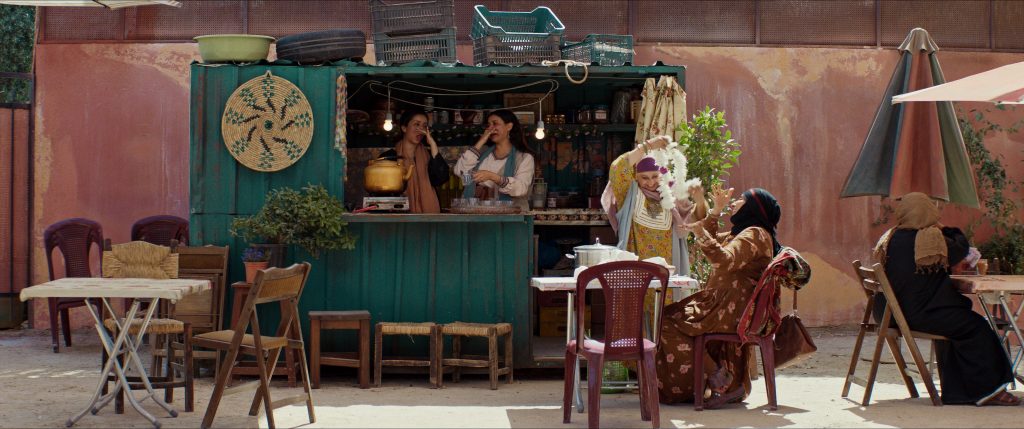
Ishaq and her crew also deserve plaudits for filming in the most extraordinary and difficult conditions. When filming began, Israel was actively bombing Yemen, including its main airport. Somehow, they manged to relocate to Jordan and just as the film wrapped, Israel and Iran began exchanging missiles over Jordan, which led to the closing of the country’s airspace and the main roads to their filming location.
In Brokeback Mountain Ang Lee depicted a gay love story in the traditionally macho world of the American cowboys. In Flesh and Fuel, filmmaker Pierre le Gall brings us a gay love story set in the equally macho world of truck drivers. Étienne (Alexis Manenti) is a truck driver who mostly keeps to himself. In his truck he has pinned pictures of a woman and a child. Other truck drivers assume they are his wife and child. In fact they are his sister and his niece. One night walking among a nearby woods he witnesses gay sex and he takes an immediate sexual attraction to one of the men engaging in the sex, Bartosz (Julian Swiezewski), a Polish truck driver.
Étienne’s world is turned upside down and he cannot just stay inside his truck. A flame has started burning in his heart and would not let go. However, having a gay relationship in the macho world of truck drivers is no easy task. Pierre le Gall with notable contribution from his cinematographer Antoine Cormier and the electronic music of Paul Sabin have successfully created the male dominated environment in which the truck drivers go about their work and life. Alexis Manenti, who had impressed previously in The Mohican (2024) handles the role of Étienne with admirable sensitivity. Flesh and Fuel is a praiseworthy addition to the LQBQT themed movies.
Directors’ Fortnight

The title character in Shana (Eva Huault) is a young French girl of Moroccan origins who is Jewish in name only. She is a real outlier in the family, she has an Arab boyfriend, much to the consternation of her grandmother, though she herself has Arab origins. However, we can sympathize with the grandmother since Shana’s boyfriend is currently in jail for drug pushing and other crimes. He sends messages from jail asking Shana to do the drug pushing in his absence. Shana is basically a few days in the life of the eponymous character as she tries to handle pressure from many fronts: her family, her criminal boyfriend and her desperate need for money to escape from her existing situation. There’s also a ring which her grandmother has given her which is supposed to bring her good luck, but Shana may be forced to sell it. Shana is well acted and directed and is a noteworthy addition to films about the young French Arabs in today’s France.
Midnight Screening
All the usual ingredients for a midnight movie are present in abundance in Marion le Corroller’s Species: blood and gore, sex and a pulsating electronic soundtrack. After Titane (Julia Ducournau, 2021), The Substance (Coralie Fargeat, 2024), Species is another Cronenberg-esque movie dealing with body changes and mutations. Interestingly all three films were made by women filmmakers and they all debuted at Cannes. Though Species makes some topical social comments regarding the influence of social media and the incredible pressure exerted on young doctors, it does not have the depth and punch of the socio-political and feminist context of the aforementioned films. It kicks off with a great opening segment in the aptly named Bloody Burger. A customer, who claims to be a social media influencer, wants the Royal King burger and nothing else. When being informed, repeatedly by the BB guy behind the cashier, who wears a frozen smile, that Royal Burger is not available, the influencer threatens to use his “influence” to get the poor cashier sacked. A “bloody” stupid thing to do!
Margot (Mara Taquin) is a young doctor, the first in her family, her father proudly says. She is starting work in the ER, run by the ruthless Professor Virgile (Karin Viard) who has a chart posted in her office with the names and photos of all the young doctors in her department, which is regularly updated. First prize for the person at top of the chart is becoming Chief Resident at ER. Margot’s bitter rival is Pauline (Kim Higelin), who unlike her comes from a distinguish medical family. There’s also Louis (Sami Outalbali) another young doctor in ER who becomes Margot’s confidant and lover. When Margot notices mutations in her body with blood pouring out, she starts investigating whether this is an epidemic.
To emphasize the bloody nature of the film, Corroller has the hospital shrouded in red colour. The effects are impressively stomach churning and Karin Viard makes a great villain though I cannot see Species becoming a horror franchise.
Ali Moosavi has worked in documentary television and has written for Film Magazine (Iran), Cine-Eye (London), and Film International.