

By David Greven.
Moving beyond caricature and never trying to goose the audience, Looking consistently offered quiet, introspective scenes like these that took character development and interaction further while maintaining a consistent style. For these reasons, the series remains a resonant touchstone that entices repeat viewings.”
The English director Andrew Haigh is one of the most prominent gay filmmakers working today. Most of his output has focused on gay themes. His first feature-length work, Greek Pete (2009), filmed in a cinema verité style, centers on London rentboys and debuted at the London Lesbian and Gay Film Festival. Weekend (2011) is a kind of Before Sunrise for gay men, a film that has developed a cult following. All of Us Strangers (2023) is also a gay male love story, one told through Lynchian manipulations of temporality and situation and also involving key autobiographical elements. Haigh has also applied his distinctive style to narratives with manifest heterosexual content: the acclaimed 45 Years (2015) and a film that should be much better known, Lean on Pete (2017).
Like other gay auteurs such as Todd Haynes (Mildred Pierce, HBO 2011), Luca Guadagnino (We Are Who We Are, HBO and Sky Atlantic 2020), and Gregg Araki (Now Apocalypse, Starz 2019), Haigh has done some of his most striking work on television. This essay focuses on Looking, an American television series that ran on HBO from 2014 to 2016, and Haigh’s efforts to depict gay male life in sensitively realist terms.
At the same time, this essay makes a case for the achievement of a series that was greeted with criticism, condescension, and even hostility at the time. Ironically, much of this was from members of its target audience of gay men. Created by Michael Lannan and produced by David Marshall Grant, Sarah Condon, and Andrew Haigh, Looking was based on Lannan’s short film Lorimer (2011). The series focuses on a group of friends, mainly gay men, in contemporary San Francisco. The series was headlined by Jonathan Groff in the leading role of Patrick Murray. HBO, hoping for the kind of ratings that Lena Dunham’s controversial Girls (2012–2017)achieved, canceled Looking after only two seasons, citing increasingly low viewership. Haigh directed many episodes in the two-series run and the wrap-up movie that followed the show’s cancellation.
Haigh TV: HBO, Quality Television, Auteur Style
Looking was met with hostility in the American press on several fronts. The criticisms ranged from complaints that the series was racist, presenting an all-white world, to accusations of being out of touch with gay lives. In particular, the series was criticized for ignoring the queer Asian American population of San Francisco. Just as damagingly, the series was often described as “really boring.” Focusing on the Haigh-directed episodes, this essay explores his development of a personal aesthetic within the format of a cable television series aimed at buzzworthy commercial success and produced in a climate of heightened cultural sensitivity and Instagram memes.
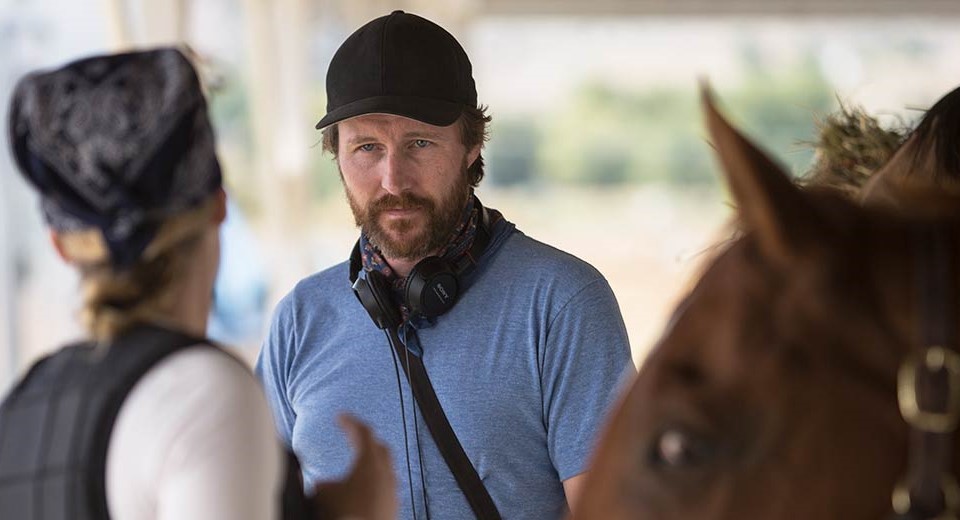
While HBO series such as Girls and Sex and the City (1998-2004) emphasized sexual shock and took a parodic look at its striving characters, Looking took its time, wearing its romantic heart on its sleeve and slowly building towards character and thematic development. In this regard, Haigh’s style was both an apt fit for the series’ sensibility and a predictably disastrous one for the needs of the cable industry and its increasing need for high ratings in the post-Sopranos era.
An American crime drama created by David Chase, The Sopranos ran on HBO from 1999 to 2007, a critical success and a rating juggernaut that led to the legendary ad campaign, “It’s not TV. It’s HBO.” The series “marked a turning point in the production of quality TV and, in particular, in HBO’s programming, which had begun in 1980” (Villanueva-Jordán 2021: 34).
The “telecinematic aesthetics in Looking are “framed by the general model of HBO’s quality TV,” and yet they are ultimately authored by Haigh” (Villanueva-Jordán 2021: 36). Haigh’s at times oblique, indirect approach to narrative here dovetails with his cinematic output, most notably his breakout film Weekend (2011) and critical success All of Us Strangers (2023). Andrew Moor has called this style the “New Gay Sincerity” (Moor 2018: 4). Haigh’s sensibility challenges not only conventional images of gay men but also understandings of, to wax Freudian, “what gay men want.”
His distinctive style is achieved through idiosyncratic aesthetic choices: a penchant for the long take, a willingness to let scenes play out without conventional fast-paced cutting or resolution, a languid yet curious, attentive focus on emotions and bodies. Haigh’s style challenges mainstream television production practice and enlarges the meanings within his steadily maintained tableaux. His aesthetic allows the viewer to orient themselves within the narrative and develop their own relationship with characters, spaces, feelings, and themes shaped by Haigh’s sensibility.
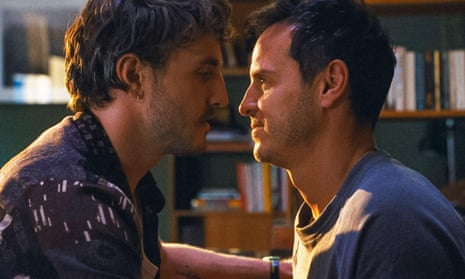
Haigh’s style evokes the categories arthouse and indie even within the television medium. Which is to say, when making television, Haigh still seems like he is making films, and films that seem closer to the slow cinema movement than the adrenalized cutting and activity of most mainstream television programming, where the characters speak rapidly to match the frenetic pacing.
Haigh makes a place for the lyrical and for the dislocation of the viewer in narrative spaces presumably designed for that viewer’s pleasure. Refusing conventional representation and predictable outcomes, his work offers both aesthetic innovation and political commentary in ways both hampered and enabled by the television format. Haigh’s style was consistently at odds with the expectations of viewers and executives, given the series’ initial reception.
By exploring Haigh’s use of a lyrical mode to tell the stories of gay male friendship, romance, sexual experience, and hopes, this essay considers Haigh’s work in television as consistent with his cinematic aesthetic and the approach he takes to depicting subjectivity, social relations, and sexuality with an emphasis on authenticity and emotional realism.
Looking for Realness
In an episode of Amy Poehler’s podcast A Good Hang (10 February 2026), Jonathan Groff discusses his personal situation when he received the script for Looking. He was a newly out gay man yet scared to play a gay character. “But I’d seen Andrew Haigh’s film Weekend at the IFC” in New York City, Groff recounts, “and I was…like…a wreck, crying in that movie theater, ‘cause I’d never seen anything that felt so real. And so, when he became attached as the director, then, I was like, yes, ‘No Brainer,’ I wanna do this.”
Anecdotally, I can report that many gay men have shared such reactions to the film along with Groff. The verisimilitude of this film about a brief love affair between gay men recalls Nouvelle Vague filmmaking, yet one can only say this in recognition of how resolutely heterosexual in orientation even the loosest of those bracing, innovative French arthouse hits of the 1960s were. Haigh’s Weekend (even its title evokes Godard) was plangent and ordinary, aching and offhand, qualities contributing to its general air of authenticity. Haigh brings that achieved affect to the episodes he directed of Looking. (It should be noted that several episodes were directed by others).
Emma Kirwin expands on the overlaps between Weekend’s naturalism and Looking.
It’s this naturalism that’s also picked up in the show’s visual style… Haigh’s hand-held camera work and poor Instagram filter-vision rejects the mythic gay postcard paradise of San Francisco. The seemingly improvised and often overlapping banter between characters also feeds into this sense of realism. (Kirwin 2020)
She expands on these points in relation to the series’ approach to representing gay male sex.
Looking doesn’t seem to be too terribly concerned with sex either. Rather, sex is simply something that the characters partake in, along with eating in restaurants, riding the subway and asking ex-boyfriends for money. There’s no “coming out” stories or moments of grappling with their sexuality; Looking simply deals with the everyday nature of being gay. It’s the same verism of Christopher Isherwood’s A Single Man (1964), reborn in the 21st century, where contemplating your own morality while reading Aldous Huxley on the toilet is replaced with texts about Zumba and frozen yogurt. (Kirwin 2020)
As I will have occasion to discuss, while I agree with Kirwin in many ways, I disagree with her assessment that the series “doesn’t seem to be too terribly concerned with sex.” In contrast, I would say that the series is very concerned with depicting sex in accordance with its aesthetic of naturalism.

Nevertheless, depictions of sex mired the series in controversy. Again anecdotally, I can report that some gay men chafed against the perceived inadequacies and frustrations of the series when it came to this matter. One man I spoke to when its first season was still airing, an academic specializing in queer media representation, took issue with the series from its first scene onward.
The first episode, “Looking for Now” (airdate 19 January 19, 2014), opens with leading character Patrick Murray (Groff) in a wooded cruising area of a public park in San Francisco, near Golden Gate Park. As Patrick allows a bearded middle-aged gentleman to fondle him (“Cold hands!” the adventurer cries out), Patrick’s cell phone begins throbbing, and he fumbles to answer it. He also fumbles this assignation, which quickly ends. Patrick’s friends Agustín Lanuez (Frankie J. Alvarez) and Dom Basaluzzo (Murray Bartlett) have dared him to do something transgressive, having cruisy sex in the park, and are now calling to check up on him.
The queer media professor’s take was that this scene was entirely fraudulent. No one Patrick’s age and living in San Francisco would be so naively inept at coordinating such a cruising episode. While the scene raised no red flags for me, I acknowledge that it established Patrick’s character early on: someone with a sweet disposition, naturally quite a nervous, unsure person, very eager for new experiences and titillated by the desire to transgress, and also primarily concerned with what his friends think of him and with comparing notes about his experiences with them. In the language of Sex and the City archetypes (which is not to suggest that Looking is a retread of that series), he’s a Charlotte.
San Francisco, where the principal characters live, provides a distinctive backdrop for the series. As a place historically associated with gay liberation and arguably the most well-known of all “gay cities,” it both supports the characters’ goals and aspirations and challenges them. As a city that was one of the key epicentres of the AIDS crisis, associated with the early days of the crisis, the first AIDS decade, and social activism, San Francisco’s crucial historical relevance to the lives of LGBTQ+ communities haunts the series. This history is explored in the deeply affecting documentary We Were Here (David Weissman, 2012). Looking’s second season makes AIDS history a much more palpable presence than it was in the first.
The twenty-nine-year-old Patrick is a level designer for video games. Agustín, with whom he went to college, is an artist, currently working for Stina, an older, established artist whose show, involving chairs nailed together and suspended in the air, is about to open. (Stina is played briefly but memorably by the downtown NYC icon Ann Magnuson.)
Agustín has been agonizing over whether to move in with his gentle, supportive, sassy boyfriend Frank (O-T Fagbenle) and has finally decided to do it. Dom (Murray Bartlett) is sexy, hirsute, mustachioed, and middle-aged, working in the famous real-life restaurant Zuni, where he is a fixture but feels stuck. He is brooding over whether to call and reconnect to an ex named Ethan (Derek Ray) who has become a highly successful realtor in LA. A character who becomes a series regular in the second series, Doris (Lauren Weedman), is Dom’s roommate, and she hates the idea that Dom might reconnect with the violent, “meth-head” Ethan. Both “a couple of Modesto rednecks,” as Doris puts it, who made good, she and Dom were high school sweethearts until Dom came out as gay.
Doris is a nurse in a ward for children. She mentions a five-year-old girl with a heart defect, but, as is typical for her, makes a joke out of how “needy” the patient is. As wisecracking and wise as her job is grim, she recalls the classical Hollywood era’s supporting character actresses like Eve Arden and Joan Blondell. In the second season, Doris’s role is expanded when she becomes a series regular. After complaining that her gay friends “are not good for her vagina,” she gets a boyfriend, a winning and droll Black man named Malik (Bashir Salahuddin).

In “Looking for Now,” Patrick goes on a tense OkCupid date with a young oncologist, who cuts the date short. Patrick then heads to the joint bachelor party of his ex, Jason (Jason Ralph). On a Muni, Patrick meets Richie, who becomes another important character. We learn that Richie Donado Ventura (Raúl Castillo), a Latino man from a working-class background, has decided to become a barber after years of cutting his friends’ hair.
Stung by his failed date and on his way to his very happily engaged ex’s joint bachelor party (the object of much sarcastic humor from Patrick and his friends, including the fact that Jason’s fiancé is, according to Patrick, “a little portly”), Patrick does, indeed, seem to merit Richie’s conversation-starting question, “Are you lost?” Richie asks this in reference to Patrick’s intent scrutiny of the transportation map. “Staring at the map makes you look lost.”
Richie, casually attired and wearing a baseball cap, moves seats so that he can sit in front of Patrick and look directly at him as they speak. Richie flirtatiously banters with an initially withdrawn, guarded Patrick. Patrick’s closed-off demeanor gradually warms up to the point where he can ask Richie a question about himself. Richie, as Castillo so wonderfully plays him, conveys depths of feeling as well as inquisitive desire through his eyes. His efforts culminate in an invitation to Patrick to join him at an event night at the real-life Esta Noche, a gay Latino bar and nightclub in the Mission District (16th Street), which, sadly, closed the very year that this episode aired. “Pretty blue eyes drink two for one,” Richie mischievously adds. Patrick responds with one of his characteristic embarrassed but tickled smiles.
Patrick still has the rejecting doctor’s business card in his lapel, and Richie boldly reaches in and clasps it. “So you’re a doctor?” Richie asks, to which Patrick sheepishly (or mischievously) assents. “That’s good,” Richie responds, “since I need taking care of.”
The show’s creator Michael Lannan, who wrote “Looking for Now,” has spoken about his fondness for this scene, and one can understand why. It’s beautifully performed and executed, capturing that evanescent urgency of a chance encounter in the instantaneous and undeniable chemistry the men convey. But will they ever see one another again? It seems doubtful. And yet, after attending his ex’s party, along with Dom, disgruntled because a fellow waiter at Zuni, a young blond newbie ephebe, rejected his advances, Patrick surprises us by going to Esta Noche. The episode ends as Patrick, all sheepish smiles, and Richie, working the door, begin happily speaking.
In the talkback that follows the episode on HBO Max (“Looking: Inside S1 E1″), Haigh and Lannan discuss their goals in making it. “Overall, the look and aesthetic of the show was incredibly important to both of us,” Haigh declares. “It was going for a real sense of naturalism and authenticity but still letting it be beautiful and letting it feel tender and real.” In reference to the scene where Agustín and Frank have sex with Stina’s newly hired assistant Scotty (played by the dark- and doe-eyed Tanner Cohen) in Stina’s studio after she leaves for the day, Haigh notes, “For me, what’s important is showing gay intimacy rather than gay sex as such. It’s more about the intimacy rather than just the sex.”
The way Haigh films the scene lends support to his credo. Agustín is waxing enthusiastic about a work of art, holding the younger Scotty in thrall. Frank, who seems to know his boyfriend intricately, jokingly tells Scotty, “He’s trying to impress you.” Not missing the opportunity for a segue, Scotty, saying “Speaking of a work of art,” lifts his T-shirt and shows a tattoo on his belly, identifying it as Dolly Parton’s signature. Agustín rubs the tattoo and looks at Frank inquiringly; with his eyes, Frank encourages him to proceed with the inspection.
As O-T Fagbenle plays Frank, his ambivalence over Agustín’s desire to add a third to their relationship, even as he sanctions it, is palpable. The quiet lyricism that informs the show can be felt in moments like this one, where sexual arousal and transgression are conveyed as gentle surprise. (Agustín’s affect recalls a child opening up a Christmas present as he begins to unbuckle Scotty’s pants) This chance encounter has the complexity of a one-act play shot through with eros and humour.
As we move into the end credits, which contain the title of the series in a distinctive neon font, “A Little Respect” by Erasure plays over the titles. The choice of music for these credit sequences at the end of each episode lend the series a distinctive quality as well. All of the songs reflect the themes of the series. These opening lines of “A Little Respect” are a good example: “I try to discover / A little something to make me sweeter / Oh, baby, refrain / From breaking my heart / I’m so in love with you / I’ll be forever blue / That you give me no reason / Why you make a me work so hard….” These lines prognosticate the bumpy romantic journey on which Patrick and Richie embark.
Looking for Character
Groff, who would go on to achieve much greater fame on Broadway in the musicals Hamilton and Just in Time and his Tony-winning role in the revival of Stephen Sondheim’s Merrily We Roll Along, is very much the star driving the series. There are comparatively few scenes involving the other principal characters that do not include his Patrick, “Patty” as his friends call him.
I am aware of two scenes over the course of the series involving only Agustín and Dom. There are several between Dom and Doris, establishing their relationship as discretely important. They are first established as a comedy team, given Doris’s winning caustic commentary. (In the first episode, after Dom has sex with a twink to restore his self-confidence, Doris comes home and hears the twink singing in the shower. “Did you fuck the pain away with the cast of Wicked?” she caustically asks.) In the second season, the relationship between the friends becomes more fraught, leading to a falling out over Doris’s offer to fund Dom’s business ventures with Doris’s inheritance money.
Similarly, there are several scenes between Agustín and Frank in the first season, with especially pointed ones when they break up. In the second season, there are many scenes between Agustín and Eddie (Daniel Franzese), who becomes Agustín’s boyfriend after Frank dumps him. The series follows Sex and the City in having Patrick be the central figure not only in his own life but in that of his friends, very much like Carrie Bradshaw on SATC, where very few scenes occurred within the friendship group that did not include Carrie.
If it is a limitation of the series that the relationships between Agustín and Dom, Richie and the other characters, Doris and the characters other than Dom, and especially between Kevin Matheson (Russell Tovey), Patrick’s British new boss at the video game company and eventually Patrick’s lover, and others besides Patrick were never fully developed, the series nevertheless explores the lives of its three central characters amply. Dom’s determination to open up his own restaurant occupies much of season one, and in season two we learn that his ardent goal of popularizing “peri peri chicken,” the spicy Portuguese chicken dish, stems from his lingering sadness about his relationship with his father, who started a similar business eventually taken over by a donut company. Compounding Dom’s oedipal attachment to his father’s restaurant failures is the fact that, as we learn in season two, Dom never came out to his father.
Agustín arguably goes through the most striking character development of all. In season one, he maintains a cooler-than-thou, elitist artist air that affects all of his relationships, especially with the gentle but increasingly suspicious Frank. Their scenes as a couple are palpably tense and prickly, with Agustín resolutely rebuffing all of Frank’s efforts to motivate Agustín’s art-making.
When Agustín, who has been Patrick’s roommate for some time, moves in with Frank, the latter discovers a piece of art juvenilia, a collage of naked male images in the shape of a unicorn, which Frank wants prominently to display, an idea that Agustín adamantly rejects. One can feel the electric buzz of prickliness when Agustín rebuffs Frank’s whimsical wishes. Similarly, Agustín’s attitudes towards the established artist Stina—highly critical ones—become manifest when he openly tells her, shortly before her show opens, that this isn’t her best work. After she quite understandably fires him while also pointing out his noticeable lack of creative productivity, he acidly retorts about her upcoming show, “I’m sure they’ll love your fucking chairs.”
Agustín’s most irksome attitudes emerge in the first season when Patrick tells him about and introduces him to Richie, who becomes, with some uncertainty, Patrick’s boyfriend. Immediately, Agustín digs, “Patrick’s got himself a cholo boyfriend,” referencing Richie’s Mexican background derisively.
As Frank, when breaking up with Agustín, points out, Agustín is a privileged Cuban-American. The series does not extensively delve into this issue, but it does suggest an internecine, class-based Latino rivalry as the basis of Agustín’s and, for that matter, Richie’s immediately enflamed tensions. The charges of racism against the series, while not negligible, seem more arguable given its prominent Hispanic characterizations.
In the scene where Patrick introduces Richie as his boyfriend to his friend group, in the park where all gather one day to celebrate Dom’s moodily acknowledged fortieth birthday, Agustín’s behavior becomes truly egregious. Talking to Patrick privately, or so he thinks, given that Richie overhears the conversation, Agustín chides Patrick for going out with “this poor guy, just to prove something to us. You’re slumming, and it ain’t cute.” Understandably, Richie becomes incensed; less justifiably, he wants to beat Agustín up, which Patrick circumvents.
What is political is the effort to depict gay men and gay male sex with realism and feeling, without capitulation to prevailing tastes and without caricature.”
In season one’s second episode “Looking for Uncut” (airdate 26 January 2014), directed by Haigh, Patrick tells his friends about Richie, and Agustín immediately lays into him, as mentioned. Agustín’s mockery includes the titular state of Richie’s “cholo” penis. “If he’s Mexican, he’s probably uncut. Are you ready for that?” So Agustín challenges Patrick.
Patrick, despite his protestations, is clearly not ready for that. When he and Richie end up in bed together after an initially cuddly but increasingly awkward first date spent bar-hopping, Patrick discovers that Richie is, indeed, cut, despite Agustín’s negative prognostications. Patrick giggles in a tell-tale fashion while trying to assure Richie that the whole issue is just a silly point made by his friends. Richie, however, carries around deep-seated pain about class and ethnicity, and takes irresolvable offense at the whole question of his circumcision status. “I’m tripping…I think I’m going to go,” he tells Patrick, ending their sexual encounter and date.

Patrick and Richie reconnect in a later episode not directed by Haigh, “Looking for $220/Hour,” where the gang entice Patrick to dress up in leather and join them at the Folsom Street Fair, the famous leather/kink/BDSM event. This is the episode where Agustín meets the blond, bearded sex worker CJ (T.J. Linnard), whom he eventually hires to perform sexual acts with Frank that Agustín “artistically” documents without Frank’s knowledge. At the episode’s close, Patrick, encouraged by Frank (“Go fetch!”), solemnly walks up to Richie at a club and apologizes for his behavior. “I’m still cut,” still wounded Richie retorts. Nevertheless, the two begin slow-dancing and erotically pressing their bodies together.
Looking for the Future
“Looking for the Future” (airdate 16 February 2014) is the Haigh-directed episode that follows “Looking for $220/Hour.” He also wrote it, and it is the closest to the Weekend aesthetic of Haigh’s Looking episodes. Here, we focus entirely on two characters, Patrick and Richie. The men wake up in bed together, cuddle, part, reconnect, have sex again, have breakfast, walk in the park, venture to the Planetarium, walk hand in hand on the beach, visit Richie’s personal priestess, return home, prepare to have sex again, this time penetrative intercourse. It’s a one-day evolution of a relationship. Perhaps the men also fall in love. The bold decision to focus on this pair, their rapport, and their possibilities establishes them as the heart of the series, certainly its romantic heart.
Raúl Castillo gets ample opportunities to shine as Richie. For one thing, he’s most clearly represented as the object of desire in this episode. Early on, when Patrick sneaks off to the bathroom in the morning, trying to leave for work before Richie wakes up, he returns to the bedroom with a naked Richie sitting on the bed, singing a love song while playing the guitar that is strategically placed over his genitals. Richie seems like someone who taught himself these musical skills, but what the performance lacks in sophistication it more than makes up for in swooning romantic feeling. And yet the atmosphere is playful rather than ponderous.
We cut to Patrick and Richie supine on the bed, making out while Patrick keeps insisting he needs to go to work. With his eyes, Richie gestures downwards, which leads Patrick to trace a hand across Richie’s beautiful hairy olive skin treasure trail and, unseen, touch his erect penis, to which Patrick says, “Oh, hello.” Nevertheless, Patrick leaves for work.
On the street and no doubt heading to a Muni, Patrick suddenly has a change of heart and returns to Richie. In the next scene, we see them having sex, Richie performing oral sex on Patrick specifically. Analingus also occurs, implicitly, since Richie says “Relax, it’s okay, you just had a shower.” Patrick announces that Richie should stop giving him oral sex due to Patrick’s imminent orgasm, but Richie only intensifies his action and brings Patrick to orgasm. Haigh focuses on Patrick’s face, the emphasis being the shift from caution to clenched submission to sustained release.
I focus on these details to expand on the earlier point about Haigh being interested in showing sex as well as intimacy despite readings such as Kirwin’s. Sex does not seem to be a subject that Haigh is invested in representing, according to this critic. She adds, “Haigh and Lannan also seem not to be too particularly preoccupied with issues of gay representation,” and for Kirwin this is a positive thing. “Looking plays with cliché and stereotypes instead of rejecting them; indeed, it is this disinterest in issues of authentic representation or progress that feel like progress in itself” (Kirwin 2020).
While I take her point and appreciate that she has positive remarks to make about the series, I am not in agreement with her assessment. In my view, what Haigh seeks in his episodes and what is also true of the goals of the series is authenticity of feeling and situation. Showtime’s Queer as Folk (2000-2005), an American remake of the British series, was groundbreaking and meant a great deal to many of us at the time. But it seems hopelessly shallow in comparison to Looking: sped-up, prone to sitcom situations and caricatures, and willing to jettison its characters’ personalities for the sake of a plot.
Kirwin argues, to reflect on her points, that Looking takes the post-identity route of eschewing representation, of just showing the characters as they are. It is true that this is not an overtly political show, focusing as it does on characters who seem privileged on racial and class terms (although Dom and Richie and Doris are certainly not wellborn and struggle with their finances and future prospects).

But what is political is the effort to depict gay men and gay male sex with realism and feeling, without capitulation to prevailing tastes and without caricature. When Patrick and Richie enjoy a postcoital breakfast, sitting at the counter of a cheerful neo-retro diner, they have an unhurried discussion about the sex they have just had and their HIV status. “You probably think I’m a puto,” Richie says, in reference to the fact that he swallowed. But Richie insists, “I don’t do that very often.” He explains to Patrick that he made this gesture because of the connection he feels to him. It’s a rare moment in a television series when any character or set of characters can discuss their sexual experiences and attitudes toward sex in a realist mode. Haigh keeps the camera focused on the two men, alternating medium close-ups of them in conversation.
Simply showing two men enjoying a range of emotions as well as sexual experiences with one another is, of course, a political act given the pervasive homophobia of American culture despite the equally prominent example of LGBTQ+ progress. Haigh’s radicalism here—and the staunch custodians of queer theory will likely chafe at this—is to emphasize tenderness and connection. I will return to these points.
Another dimension of Haigh’s approach here is a meta-cinematic sensibility. Establishing a running joke between them, Patrick reveals that he loved the Spielberg-produced teen movie The Goonies (Richard Donner, 1985), which Richie has never seen. Patrick imitates the Sloth character, a gentle giant, helping “Captain Chunk,” a heroized heavy-set teen member of the Goonies, rescue the other members from an evil character. Specifically, he imitates Sloth, eyes on opposite side of his disordered face, hollering “Hey, you guys!” Richie humorously retorts to Patrick, “That’s the face you made this morning.” (This joke comes up again when Patrick and Richie reconnect in the Looking movie. This time, Richie does the Sloth imitation and claims that he has finally seen the film.)
Rising to Patrick’s challenge to Richie that he must devise a very special plan for their day together given that Patrick is playing hooky from work, Richie takes Patrick to the Planetarium. The only people in the space, Patrick and Richie sit close to another beneath the vast darkened dome of the venue, staring up at the celestial patterns glowing in the dark. This scene pays homage to the scene in Rebel Without a Cause (1955), the famous teen-angst American melodrama directed by Nicholas Ray. Starring James Dean, Natalie Wood, Sal Mineo, the movie is notable for its palpable depiction of homoerotic longing on the part of Mineo’s troubled Plato for Dean’s sensitive rebel Jim Stark. An important sequence of the film is set at a Planetarium, filmed at the real-life Griffith Observatory in Los Angeles.
The chief distinction between Ray’s film and Haigh’s episode is that the Planetarium scene in the latter is in service to the burgeoning love between Patrick and Richie. In Ray’s film, the scene establishes Plato’s interest in Jim, but its larger context is the increasing male homosocial violence directed at the newcomer Jim. Despite his charm and obvious good looks, Jim fails to make a connection with the other males around him, led by the charismatic, black leather jacket-wearing tough Buzz Gunderson (Corey Allen). Indeed, they proceed to terrorize him, egged on by female characters such as Natalie Wood’s Judy.
In contrast to the large crowds in Ray’s film and the gang of boys who terrorize Jim, Patrick and Richie look up at the skies as if they are the only two people in the world. Indeed, the world seems to begin anew with this unusual, affectionate, turned-on pair.
What are we to make of the singularity of the male couple sitting together and alone in the Planetarium in Looking? The suggestion is that the world has been cleared away to make room for them. Implicitly, this means that the usual impediments and threats to romance generally and to queer couples specifically have been held at bay. The celestial context of the Planetarium’s show also suggests a need to be elsewhere, a different planet or galaxy, in order for queer lives to flourish. This tableau anticipates the ending of Haigh’s finest work to date, All of Us Strangers, which follows a devastating reveal about a character’s fate with a dazzling, as well as somewhat perplexing, image of the male lovers in a celestial dreamscape.
Looking for Excitement
Another crucial character in Patrick’s life is his new boss from England Kevin Matheson, introduced in the Haigh-directed first season episode “Looking at Your Browser History.” Haigh co wrote the episode with Lannan and J. C. Lee. The opening sequence of the episode makes clearer than any other such moment in the series that Haigh’s style defied conventional television drama practice.

We open in a long shot that is also a tracking shot. A group of people seen at a distance walk towards something in a shipyard. That something turns out to be a naval carrier, the setting for a corporate party hosted by Patrick’s video game company. Eventually, we see Patrick along with his colleague Owen (Andrew Law) walking towards the ship.
Haigh’s technique here resembles that in his films such as 45 Years. The use of long shots and long takes, the unhurried way that scenes unfold, the image of the central character Kate, played by Charlotte Rampling, walking across the screen from a distance, placing her unobtrusively in the natural setting, all complement this film about a wife’s discovery of a love affair that occurred between her husband Geoff (Tom Courtenay) and a woman he was in love with before he met Kate. The same restraint and detachment are curiously in evidence in this scene from Looking, suggesting ironic distance from the event portrayed—which is quite understandable, given the over-the-top quality of renting a naval carrier for such an event—and also from our giddy protagonist, who seems inebriated at the very prospect of this occasion.
Jack Cortvriend, in an ambitious essay on overlaps between Haigh’s cinema aesthetics and his work on Looking, does not discuss the opening of this episode, but offers commentary that illuminates it. Focusing on the first episode, he discusses the shot of Patrick, Agustín, and Dom walking on a San Francisco street following the failed cruising-in-the park scene. I quote his reading at length because it dovetails so acutely with my understanding of Haigh’s aesthetic and its emphases and effects:
The camera is positioned at a distance from the trio as they walk towards the camera which is mostly still other than the slight pan or tilt to follow the characters. It is an on-location shot as evidenced by the other action occurring: cars drive around, people zigzag through the streets and walk in front of the camera (again creating the occasional blocked foreground). This on-location long shot marked by duration is a familiar trope of Haigh’s feature filmmaking. For example, in Weekend, there are multiple shots when Russell and Glenn wander the streets of Nottingham in which the camera has a fixed position and the characters move towards or away from the camera. In 45 Years, this is further exhibited, particularly the repeated shots of Kate ambling around Norwich’s high street. These shots figure the characters’ in their different everyday worlds, yet they carry various meanings. The shots of Kate wandering alone, for example, draw attention to her growing isolation; the shots of Glenn and Russell foreground their romance; and the shot here of Patrick, Dom and Agustín demonstrates the group’s solidarity and close friendship. All of which position the characters, and their behaviour, within their real-world milieu. (Cortvriend 2018: 101)
Patrick sustains this giddy mood as he marvels at the setting. Inside the ship, while mingling, Patrick notices the handsome Kevin, albeit speaking to an attractive woman, which makes us think he is one of those get-any-woman-he-wants straight corporate honchos.

Patrick starts explaining to a small, gathered crowd why gay men identify with female characters. “So, why do you play as the woman?” Kevin, suddenly present, asks. “Gay men get it,” Patrick answers, referring to cross-identification with another oppressed group. After Kevin walks away, Patrick/Groff does a spot-on cutting imitation of an English accent (prefiguring Groff’s role as King George in Hamilton). Owen commiserates: “British people are the worst!” Shortly thereafter, Patrick spies Kevin across the room, once again speaking with a woman. This time, Patrick remarks to Owen, “that is the gayest laugh. He is one hundred percent gay. He is gay, gay, gay, gay.”
In a subsequent scene, Patrick sits astride a torpedo, beside which another torpedo is mounted, playing a video game. Kevin comes in and sits on the other torpedo. As Patrick—not yet aware that Kevin is his new boss—flirts with the Englishman, the two men astride torpedoes strike an arresting pose. This image sends up masculinity and gay male desire at once, especially since Kevin reveals, with a bit awkwardness, “Yes, I am…gay.”
Kevin has a boyfriend, Jon (Joseph G. Williamson), a strapping fellow who works in sports medicine. Patrick meets Jon when Kevin introduces them in the park, where Patrick is attending Dom’s fortieth birthday party. Right before this meeting, Patrick had been prancing about to entertain his friends, performing “gay voice.” So when Kevin sees Patrick and says, in regards to the prancing, “I thought that was you,” the joke stings a bit.
Patrick and Kevin have a palpable sexual chemistry to match that between Patrick and Richie. When they have a fight before Patrick’s sister’s lavish wedding, Richie, feeling insulted by Patrick’s bad mood, storms out, leaving Patrick to attend the wedding solo. And yet, as it turns out, Jon and Patrick’s sister’s new husband are friends, so Patrick encounters Kevin along with Jon at the wedding.
As the evening wears on, Kevin gets more inebriated. He bumps into Patrick in the men’s room. Unexpectedly, he makes a pass at him, kissing him on the mouth, greatly to Patrick’s surprise. By the next episode, Patrick and Kevin have had sex and are, as the season two opener confirms, having an affair. At the end of the first season finale “Looking Glass,” directed by Haigh and co-written by Lannan and Tanya Saracho, Richie surprises Patrick on his doorstep when Patrick returns home after his first tryst with Kevin. “Pato,” as Richie calls him, “I am this close to falling in love with you. But,” Richie continues, “I’m not going to do that to myself. Because you aren’t ready.” Patrick immediately sheds a tear. But he doesn’t disagree.
Looking for Connection
The second season features, as did the first, five episodes directed by Haigh. The second season opener, “Looking for the Promised Land” (airdate 11 January 2015) is one of the finest episodes. Haigh both wrote and directed it. Dom has become involved, uncharacteristically for this youth-chaser, with an older man who co-owns a well-known Castro-area flower shop. This man, Lynn, played by Scott Bakula, has made it very clear to Dom that he can only commit so far emotionally given that Lynn’s lover Brian died of AIDS and Lynn was his caregiver. Complicating their relationship, Lynn has become Dom’s chicken-window restaurant backer, leading to frequent friction.
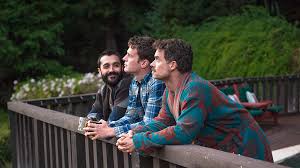
In this episode, the friends travel to Lynn’s cabin in the gorgeous Russian River area, in Northern California. “A shrine to Brian,” as Lynn describes it. An surreal painting of the young Lynn in a natural setting hangs prominently on the wall. Patrick and Dom have an agenda: staging an intervention for Agustín, who has taken heavily to substance abuse after Frank broke up with him at the end of the first season. The reason for the breakup was summarized by Frank, regarding CJ and Agustín’s documentary art project involving the filming of CJ and clients, including Frank, but not with his knowledge or consent: “You paid some whore to fuck me? You cant even pay rent.”
The episode comes to raucous life when Doris joins the group. Undermining Patrick’s intervention, Doris wants to party and mockingly rejects his suggestions of board games. There is a very humorous moment when Patrick chides Agustín for wanting to join in substance-fueled revels, and Doris repeats Patrick but with a satiric edge: “Agustín.” The group venture into the woods at night for rave, and are told by a guide they encounter, “Fairies will guide your way.” Once at the rave, the friends ingest “molly” (ecstasy), which gradually transforms their moods into appropriately ecstatic ones.
To convey this transport, Haigh switches to a series of slow-motion pans of the revelers, each on their own individual adventures, as Sister Sledge’s iconic song “Lost in Music” fills the soundtrack. Agustín is shown flirting with a man he has met named Eddie, also known as “Eddie Bear,” an apt description given the bearded and bearish Eddie’s physical presence. Patrick also summons Kevin for a clandestine tryst, an act clearly fueled by ecstatic drugs. In one of the most intensely sexy scenes of these series, Kevin arrives and tells Patrick, “This had better be worth it.” Patrick responds, “Oh…it’s worth it,” while giggling, and Kevin proceeds to have penetrative intercourse with a bottoming Patrick against a tree.
The setting nicely ironizes Patrick’s fervently earnest efforts to get his friends to embrace nature, literally, as when Patrick models his dictates by hugging a tree in an earlier scene. Doris is shown, during that slow-motion sequence, dancing while riding the shoulders of a tall, athletic-looking woman. The next day, Dom remarks, “I think we lost Doris to the lesbians.”
The episode contains a highly poignant and quiet moment when Dom and Patrick leaf through one of Lynn and Brian’s photo albums of when they were together and young. “They look so young and handsome,” Patrick remarks. In a series that has heretofore barely mentioned AIDS, this reminder of inconceivable losses and halcyon days is quite moving. It also seems like an implicit announcement of the second season’s efforts to bring AIDS consciousness to the fore. The episode ends with a now iconic shot of the three friends standing above the river, post-revels, sharing their adventures. (They could be the Bennet sisters.) Agustín tells them about Eddie and mentions, “Oh, and he has a House in Virginia.” Patrick, very Patrick-like, responds that he’s always wanted to go there. Agustín explains the meaning of the acronym: Eddie is HIV+. Agustín and Eddie’s relationship demands more space than I can give it here, but one aspect of it that resonates is that it humanizes the acrid Agustín considerably. He and Eddie eventually get married in the Looking movie.
Looking for Ice Cream
There is a great deal more to be said about the series as well as the wrap-up film. In conclusion, I want to focus on one more episode that Haigh directed, written by Tanya Saracho, “Looking for Truth” (airdate 15 February 2015). It is both representative of Haigh’s work and enriches our understanding of Richie.
Richie and Patrick embark on a journey taking place on multiple levels. Patrick, having decided to break things off with Kevin, who seems to be remaining in his relationship with Jon, volunteers to help Richie pick up and move an ice cream truck in Richie’s old neighborhood (San Leandro/East Bay). Before heading to Richie’s old neighborhood, he and Patrick—“You’re always hungry,” Richie affectionately notes—stop to get Mexican food. Their banter recalls their previous tenderness when they were a couple, Richie calling Patrick “Pato” as he wipes some food off his face. Patrick also gently prods Richie to open up about his horrible relationship with his homophobic father, still very much unresolved.

When Richie and Patrick pick up the truck at a garage, they encounter Richie’s cousin Ceci, played by the episode’s writer Tanya Saracho. Ceci is, as they say, a pistol, lively, vivid, and tough. She gives Patrick a hard time about having ended things with Richie. The conversation turns unexpectedly poignant when she and Patrick are alone together. She reveals:
I know I’ve been giving you a hard time, but I was just really rooting for you. I’ve never seen him be so into anyone. Well, not in a long time, and then when he came to borrow 200 bucks for some suit for some wedding you were taking him to, that’s when I knew. Too bad.
Ceci references the suit that Richie bought in order to accompany Patrick to his sister’s wedding.
The heart-to-heart that Patrick and Richie have in the ice-cream truck is a typical Haigh set piece, done as a long take and in a naturalistic setting, the street where the truck is parked. The two men do not come together in a romantic-sparks-flying manner, but they do speak with a newfound honesty. Patrick tells Richie that he had sex with Kevin on the night that he found Richie waiting for him on his doorstep. He also explains that it wasn’t because he didn’t like Richie enough that their relationship failed to move forward. Richie maintains an alternately defensive and taciturn attitude, but in the end he tells Patrick that he is very glad to have him in life and that their relationship has deep value.
Moving beyond caricature and never trying to goose the audience, Looking consistently offered quiet, introspective scenes like these that took character development and interaction further while maintaining a consistent style. For these reasons, the series remains a resonant touchstone that entices repeat viewings.
References
Aaron, Michele. 2008. “Towards Queer Television Theory: Bigger Pictures sans the Sweet Hereafter.” In Queer TV, edited by Glyn Davis and Gary Needham, 93–106. London: Routledge.
Cortvriend, J. (2018). “Stylistic convergences between British film and American television: Andrew Haigh’s Looking.” Critical Studies in Television: The International Journal of Television Studies, 13 (1), 96-112.
Davis, Glyn, and Needham, Gary, eds. 2008. Queer TV: Theories, Histories, Politics. Oxford: Taylor & Francis Group. Accessed March 28, 2026. ProQuest Ebook Central.
Fallon, Kevin. 2014. “HBO’s Looking, gays, and sex: Are we all expecting too much?: The makers of Looking and TV critics sound off on the expectation that HBO’s new ‘gay show’ represents the expectations of every gay man.” The Daily Beast (Jan 17), https://www.proquest.com/blogs-podcasts-websites/hbos-looking-gays-sex-are-we-all-expecting-too/docview/1648934116/se-2 (accessed March 28, 2026).
Kirwin, Emma. 2020. Television review: Looking. University Wire, Jul 15, 2020. https://www.proquest.com/wire-feeds/television-review-looking-xa0/docview/2424052680/se-2 (accessed March 28, 2026).
Moor, Andrew. “‘New Gay Sincerity’ and Andrew Haigh’s Weekend (UK, 2011)”, Film Studies 19, 1 (2018): 4-19, accessed Mar 28, 2026, https://doi.org/10.7227/FS.19.0002
Villanueva-Jordán, Iván. (2021). “Translation and telefiction: Multimodal analysis of paratextual pieces for HBO’s Looking.” Language Value, 14(1), 33-59. Universitat Jaume I ePress: Castelló, Spain. http://www.languagevalue.uji.es.
David Greven is Professor of English at the University of South Carolina. Greven specializes in both nineteenth-century American literature and Hollywood film. His books include Men Beyond Desire: Male Sexuality in Nineteenth-Century America (Second Edition, Palgrave, 2025), All the Devils Are Here: American Romanticism and Literary Influence (University of Virginia Press, 2024), Maurice: A Queer Film Classic (McGill-Queen’s University Press, 2023), The Bionic Woman and Feminist Ethics (McFarland, 2020), Intimate Violence: Hitchcock, Sex, and Queer Theory (Oxford University Press, 2017), Psycho-Sexual: Male Desire in Hitchcock, De Palma, Scorsese, and Friedkin (University of Texas Press, 2012), and Representations of Femininity in American Genre Cinema (Palgrave, 2011). He is currently writing a book under contract with Oxford University Press called Gothic Hitchcock.
Even though I didn’t see every episode, I found this series very engaging. (Love the soundtrack!) Thanks for illuminating aspects of the show l hadn’t considered. (By the way, do you think it is a convention of the gay TV series to feature an inexperienced protagonist like Patrick? I’m thinking Justin in Queer as Folk or Noah in Noah’s Arc.)