

By Jonathan Monovich.
Now that we spend so much time not speaking to each other in person and relationships have become something filtered through technology, we actually are fascinated by people interacting. I think audiences get a thrill from films about people having to struggle through the complexity of relationships.”
—Olivia Wilde
Though primarily known as an actress, Olivia Wilde has now directed three feature films. All three fixate on characters navigating the displeasures of their lives. Booksmart (2019) followed the regret of two high school students, recognizing academic success overshadowed their recreation. Don’t Worry Darling (2022) centered on the illusion of a housewife’s idyllic suburban life, attempting to break free. Wilde’s latest, The Invite (2026), is by far her best yet, exploring midlife crisis and marital tension. Adapted from Cesc Gay’s Spanish play turned film, Sentimental (2020), The Invite shares Gay’s basic premise and lifts some of his dialogue, but Will McCormack and Rashida Jones’ screenplay improves the source material. Moving from Spain to a San Franciscan setting, The Invite sees two couples, Angela (Wilde) / Joe (Seth Rogen) and Pina (Penélope Cruz) / Hawk (Edward Norton), flirting with the idea of adultery in the confines of an apartment over the course of a single night. The film’s quartet of actors in a restricted setting makes the theatrical origins obvious, but The Invite remains very cinematic due to Wilde’s precision as a director, the warmth of Adam Newport-Berra’s [The Last Black Man in San Francisco (2019)] cinematography and Jade Healy’s [Marriage Story (2019)] production design, the intensity of Devonté Hynes’ [Master Gardener (2022)]cello score, and the acting prowess of the film’s four leads.

The combination of The Invite’s themes and setting are equally indebted to Paul Mazursky’s Bob & Carol & Ted & Alice (1969). Before a 35mm screening of The Invite at the Chicago Critics Film Festival, I had the opportunity to do a brief interview with Wilde. She reaffirmed that Bob & Carol & Ted & Alice was an influence, saying, “Yeah, big time! I had the entire cast and crew watch that movie the night before we started shooting.” Wilde also described The Invite as a “love letter to Who’s Afraid of Virginia Woolf? (1966).” Like Woolf, The Invite begins with an argument before the hosts’ guests arrive; whereas most films would use an argument as a setup, the couples quarrels sustain throughout Mike Nichols and Wilde’s films, serving as the lifeline of Woolf and The Invite. The display of distressed couples yelling at one another paired with occasional monologues and mentions of a child that is never shown makes The Invite’s love for Woolf easily noticeable. Unsurprisingly, Wilde also professed that Ingmar Bergman’s Scenes from a Marriage (1974) was an influence. Though The Invite has plenty of similarities to these groundbreaking films, its comedic prominence differs. As expected, Seth Rogen buffoonery generates the most laughs, bickering with his onscreen spouse—Wilde.
As The Invite is dedicated to the late Diane Keaton, I inquired how Keaton influenced Wilde’s performance. She replied, “She [Diane Keaton] definitely influenced my performance! There’s no Angela, my character in The Invite, without Diane. So much of my performance is me tipping my hat to Diane and several roles that she played. She was the master of complex women who were struggling with insecurity, anxiety, and passion, and joyful characters who were also really heartbroken. In one minute, she could play the entire range of emotions… despair, elation, curiosity. She was just so funny and so completely singular. She was a great influence on me, personally. I got to work with her, and she played my mom in a film [Love the Coopers (2015)]. She was so loving and so full of life. She told me to direct, so this movie’s for her.” Wilde accomplishes channeling Keaton’s signature emotional range, while also recalling Dyan Cannon, Elizabeth Taylor, and Liv Ullmann at times from their performances in the forementioned films. Though, Wilde’s performance is ultimately outshined by Rogen and their onscreen neighbors, Cruz and Norton, whose poised yet simultaneously awkward sensuality spices up the night in The Invite. Wilde’s ability to bring out the best from her actors, while encouraging improvisation, in The Invite is a testament to her directing ability.
So much of my performance is me tipping my hat to Diane [Keaton] and several roles that she played. She was the master of complex women who were struggling with insecurity, anxiety, and passion, and joyful characters who were also really heartbroken.”
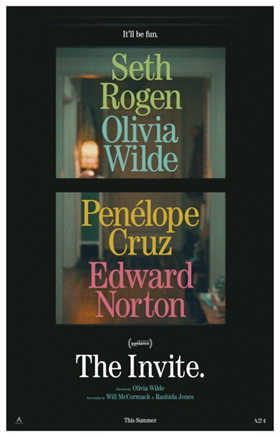
Apart from The Invite’s primary focus of confronting relationship drama and marriage taboos with humor, the film, like the Edward Norton-starring Fight Club (1999), also satirizes how we buy things we don’t need with money we don’t have to impress people we don’t like. Wilde’s character, Angela, puts on a show for her neighbors, buying home goods and food with the hopes of impressing them. The lavish last minute planning upsets Rogen’s Joe who disapproves of the spontaneous arrangement. With time, Angela’s motives become apparent, and the night transforms into a spectacle of blame, shame, couples therapy. Though unmentioned by Wilde, The Invite is also at times reminiscent of Carnal Knowledge (1971), another Mike Nichols film, and its similar unflinching honesty. Rather than flashy art, The Invite’s poster makes its actors names and the film’s title the focal point in the vein of Carnal Knowledge’s minimalist black variant of the one-sheet. The choice is appropriate, conveying the toned-down nature of the film. Like Carnal Knowledge, The Invite shows a disastrous attempt at a partner swap like the cringeworthy exchange between Jack Nicholson, Cynthia O’Neal, Art Garfunkel, and Ann-Margret’s characters. Both films are also oftentimes uncomfortable as there is little distance between the viewer and the humiliation of the film’s subjects. However, Wilde’s direction makes the second-hand embarrassment tolerable by allowing viewers to laugh at the characters’ frustrations, diagnosing a perfect marriage is a fallacy.
The Invite continues a recent promising trend in cinema, veering towards thematic preoccupations and stylistic tendencies that were common in the films of the New Hollywood era. Whereas dialogue driven films with people talking about adult subject matter were anathema to Hollywood for years, The Invite proves a long-form conversation between talented actors can be captivating when done competently. When I pointed this out to Wilde, she said, “I agree. Now that we spend so much time not speaking to each other in person and relationships have become something filtered through technology, we actually are fascinated by people interacting. I think audiences get a thrill from films about people having to struggle through the complexity of relationships. They want to see that on screen, and they feel excited by it. The cool thing about this movie is that the audiences who have loved it the most are under thirty. There’s all these young film-loving people who are excited about the movie. When they see it, they love it. This makes me so happy, because I think it proves young people are much more intelligent and patient than studios often give them credit. They’re really open to different kinds of stories that aren’t spoon-fed to them. That’s been the most exciting part of this.” Wilde’s remark helps provide further reassurance that there is hope for future generations of filmgoers. Furthermore, The Invite, suggests what the world needs now is love like Bob & Carol & Ted & Alice’s signature song. Yet, The Invite also wittily leads with the words of Oscar Wilde [the inspiration for Olivia Wilde’s stage name], quoting, “One should always be in love. That is the reason one should never marry.” The Invite is a bit overlong and becomes somewhat repetitive by the end, but overall the film succeeds. More than anything else, The Invite will be sure to spark discussion amongst its viewers… just as the film’s cinematic influences did in their heyday and continue to do.
The Invite is exclusively in theaters, starting June 26th, via A24.
Jonathan Monovich is a Chicago-based writer and a regular contributor for Film International. His writing has also been featured in Film Matters, Bright Lights Film Journal, and PopMatters.