

By Anees Aref.
In a time where the U.S. President declares the media as the ‘enemy of the people,’ openly profits from his office, kidnaps foreign heads of state, and wages an unprovoked (and many would say illegal) war against Iran, we need people like Amy Goodman.”
At the beginning of the documentary Steal This Story, Please!, we find the film’s subject, longtime journalist/broadcaster Amy Goodman, at a climate conference, approaching a representative of U.S. President Donald Trump’s administration standing idly in the middle of the convention floor. Seeing her approach with her microphone and camera crew behind her, the representative quickly starts walking in the opposite direction, while Goodman tails him asking for a comment on President Trump’s now repeated claims that climate change is a “Chinese Hoax.” Several stairways and floor levels later, Goodman gets the bewildered Trump lackey to offer her a business card for a later interview, only to have a hallway door shut on her before receiving it. Huffing and puffing but undeterred, Goodman says to her cameraman “let me catch my breath.”
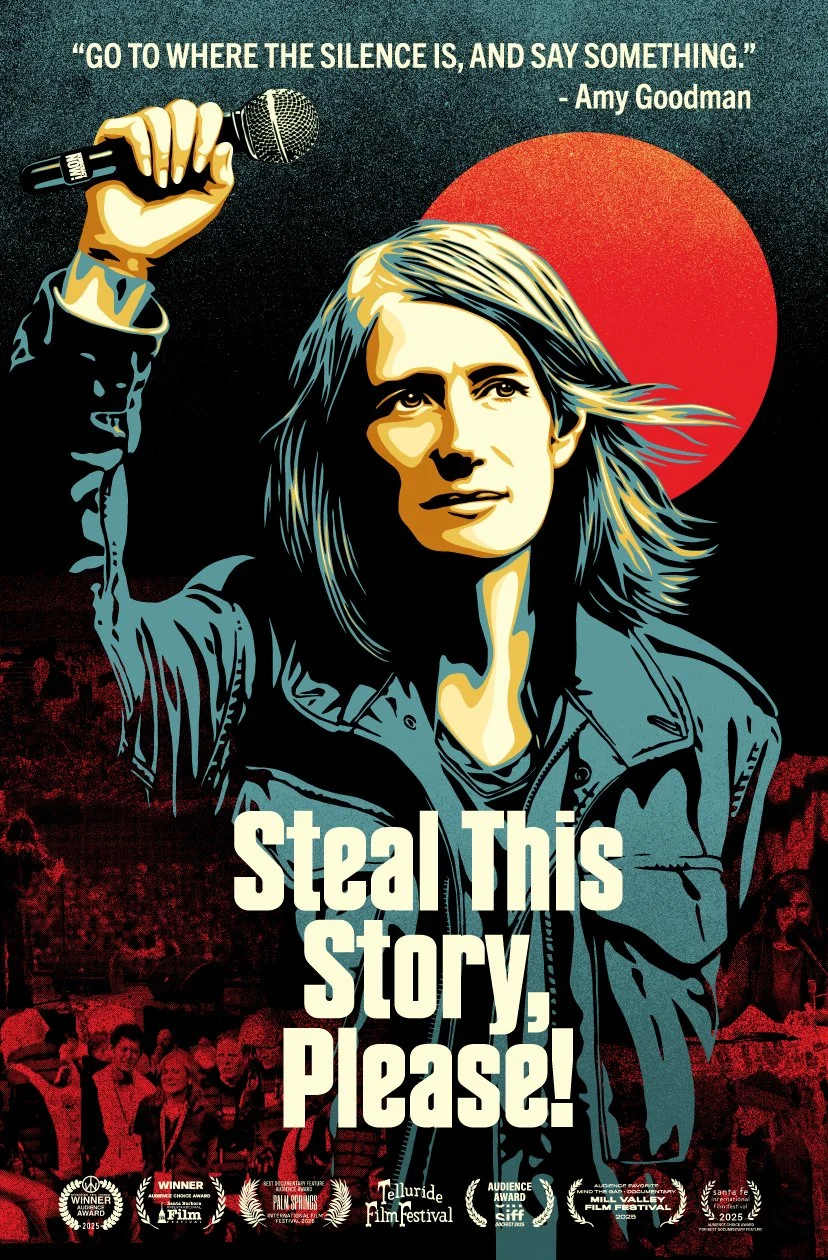
It’s a comical opening, but illustrative of the kind of dogged journalistic inquiry that has characterized Goodman’s unique career. From the director-producer team of Carl Deal and Tia Lessin, whose previous credits include the documentaries Trouble the Water (2008) and Citizen Koch (2013) as well as multiple collaborations with acclaimed filmmaker Michael Moore, Steal This Story, Please! is a straightforward but engrossing profile of Ms. Goodman, including her start with Pacifica Radio in New York city, to her founding of the daily news program Democracy Now!, which this year marks thirty years and counting since its premier in 1996.
Featuring interviews with Goodman, her friends, relatives, colleagues, and archival footage, the film also traces Goodman’s personal roots, the daughter of a Jewish family from Bay Shore, New Jersey. Goodman credits her “Jewish education” with instilling in her a desire to “ask questions”. In entertaining accounts, Goodman reveals the family newspaper started by herself and her younger brother Steven as her first foray into journalism. Goodman’s father was a doctor, her mother a teacher. The family was secular-minded, but religion still played a part in their cultural life.
Goodman’s grandfather was a rabbi, and her maternal grandmother was a Ukrainian Jew who fled the pogroms of early 20th-century Russia as well as the terrors of the Nazi German invasions during the Second World War. During a visit by Goodman to a present-day graveyard in Ukraine, we learn that though her grandmother escaped, several of their other family members did not and perished at the hands of Nazis and their Ukrainian collaborators, possibly during a mass execution of several thousand Jewish captives during the war.
Moreover, Goodman discusses her evolving view of Israel, from early enchantment after a childhood visit, to later disillusionment as an adult as she learned about and reported on Israeli treatment of the Palestinians.
When she entered journalism in the late 1970s, Goodman notes that the only television program that seemed to question mainstream political attitudes was The Phil Donahue Show, a daytime talk series which aired for 29 seasons from 1967 to 1996.
Highlights from Goodman’s early reportage include a harrowing account of Indonesia’s occupation of East Timor (the government of Indonesia’s longtime former President Suharto first invaded the ex-Portuguese colony in 1975). On November 12, 1991, Goodman and fellow journalist Allan Nairn reported on the Indonesian military’s massacre of thousands of East Timorian demonstrators. While witnessing the events, Goodman and Nairn were bloodily beaten by members of the Indonesian army. Other episodes include Goodman and colleague/protégé Jeremy Scahill’s coverage of the Chevron oil corporation’s collaboration with the Nigerian government in violent crackdowns on civilians in 1998, and a heated telephone exchange with then-president Bill Clinton in 2000.
These scenes from Goodman’s career are presented against the growing corporate consolidation of news media in the United States by the time Democracy Now! was established in 1996, based out of a studio in Lower Manhattan. The show set out to be an alternative to “legacy media” outlets like the New York Times, Washington Post and the various cable television news giants like Fox, CBS, NBC, etc. This came into sharp view in the post 9/11 War on Terror Era of President George W. Bush, where mainstream journalists “embedded” themselves with the U.S. military during its invasions and occupations of Afghanistan and Iraq. This led to often one-sided coverage of those conflicts, framed from the perspective of U.S. authorities, without capturing the views and effects of these wars on the other side. Whether its people on the ground in Iraq, Afghanistan, Syria, Ukraine, or Gaza, this has been Goodman and her team’s approach: giving voice to the voiceless.
Having said that, Steal This Story Please! does at times verge on being overly reverential towards its subject, as some reviewers have suggested. But the overriding theme is the importance of independent media, one that isn’t bound to commercial interests or solely reliant on government issued propaganda. This isn’t exactly new (after all, didn’t Network (1976) already tell us that the chase for “ratings” and corporate sponsors had already corrupted America’s major newsrooms?), but the film presents the message with powerful urgency and timeliness. As Goodman’s colleague Nermeen Shaikh puts it, the media chooses how it “frames” the news. Democracy Now! tries to “widen that frame.”Steal This Story, Please! concludes on an ominous note with the rise of the Donald Trump presidency. In a time where the U.S. President declares the media as the “enemy of the people, openly profits from his office, kidnaps foreign heads of state, and wages an unprovoked (and many would say illegal) war against Iran, we need people like Amy Goodman.
Anees Aref is a writer on film, history, and politics based in the Los Angeles area who has published abroad as well as in the United States. His work has appeared in Retreats from Oblivion: and Noir City Magazine.