

By Jeremy Carr.
Robert Z. Leonard knows what he has to work with and makes the most of Davies’s giddy promise.”
William Randolph Hearst was famously perturbed by what he saw as the obvious and unflattering resemblance between himself and the captivating, though oftentimes repellant, character of Charles Foster Kane. But to whatever extent that similarity is indeed manifest in Orson Welles’ 1941 film Citizen Kane, one has a hard time working up too much sympathy for the legendary newspaper publisher. When all was said and done, thanks to his wealth and power, the millionaire media baron was going to be just fine.
Far more significant was what Citizen Kane did to skew the assessment of Hearst’s romantic partner, actress Marion Davies. Her superficial Kane counterpart, Susan Alexander, is a laughable, no-talent amateur singer, molded and scolded by the demanding Charles and generally mocked by everyone else. This was decidedly not the case with Davies, whose reputation, all the same, sadly took a hit by association. Welles coyly downplayed the Hearst correlation and expressed regret about the Davies aftermath, ultimately writing in the foreword to her memoir, “Marion Davies was one of the most delightfully accomplished comediennes in the whole history of the screen.” Davies never saw Citizen Kane and harbored no ill feelings toward Welles, but for those who didn’t know any better and took the parallel at face value, the damage was done.
All of this is to say that anytime there’s a chance to revisit and appreciate the real Marion Davies — popular, hysterical, tremendously talented — one should not only take the opening, but bask in it. Such is the case with the recent 2K restoration and Blu-ray release of her 1928 comedy, The Cardboard Lover, from Ben Model and his Undercrank Productions.
Here Davies plays Sally Baxter, one of a horde of young tourists crammed on a bus and discarded at a Monte Carlo hotel. She makes a smashing entrance and is swiftly on her way to mischief and magnetic mayhem. An overzealous autograph hound, Sally picks up the scent of a troubled romance between tennis champion Andre Briault (Nils Asther) and his aloof vamp of a girlfriend, Simone (Jetta Goudal). Perhaps, Sally immediately reckons, she can snag Andre’s signature and, in the process, the man himself. After all, Andre soon confesses he is miserable with Simone (and miserable without her). Andre enlists Sally to help him steer clear of Simone by having the young American act like his new flame. Alas, he resists Sally’s supplemental advances (she plays the part exceedingly well) and occasionally relapses from his break with Simone. One would think a move from Goudal to Davies wouldn’t take much convincing, but without the fight The Cardboard Lover wouldn’t be much of a film. Instead, a series of anarchic incidents and amorous pushing and pulling sweep up all involved in one of the fading silent era’s most pleasant romantic comedies.
An exceptional screen comedienne, not just with her capacity for pratfalls and physical stunts, but for her endlessly expressive arsenal of mimicry and mugging. Her face is an elastic front for a stunning range of emotions and meanings, from curiosity, scheming, and excitement, to shyness, frustration, and huffy indignation.”
To this one can largely credit Davies. It’s quickly apparent she is an exceptional screen comedienne, not just with her capacity for pratfalls and physical stunts, but for her endlessly expressive arsenal of mimicry and mugging. Her face is an elastic front for a stunning range of emotions and meanings, from curiosity, scheming, and excitement, to shyness, frustration, and huffy indignation. That Asther, Goudal, and Andrés de Segurola (playing Simone’s other suitor) initially fail to keep up during their comparatively staid early scenes together isn’t necessarily a bad thing, and their setup is essential to the further plot, but we do wonder how Asther in particular will come around to Davies’s way of thinking — and behaving. But by the time the film reaches a scene where Andre pretends to be sick and Sally pretends to help him, Asther demonstrates in the sequence’s hilarious climax that his own facial contortions can similarly spark a succession of laughs. To note that Sally and Andre finally end up together isn’t really a spoiler, as it certainly shouldn’t be a surprise. Besides, how The Cardboard Lover ends (and it has a wonderful ending) isn’t nearly as important as how it gets to that point.
Based on the 1926 play “Dans sa candeur naïve,” by Jacques Deval, as well as the play’s 1927 Broadway adaptation, The Cardboard Lover was part of a crucial career change for Davies. As noted by biographer Lara Gabrielle in a brief but informed and passionate documentary included on the Undercrank disc, Davies managed to break free from the costume dramas Hearst preferred and was eventually able to realize her comedic potential. Gabrielle also explores Davies’s background, her contemporary esteem, the unjust perception she endured post-Kane, and how the star’s preservation efforts — keeping copies of her own films and those featuring others — helped yield this new restoration.
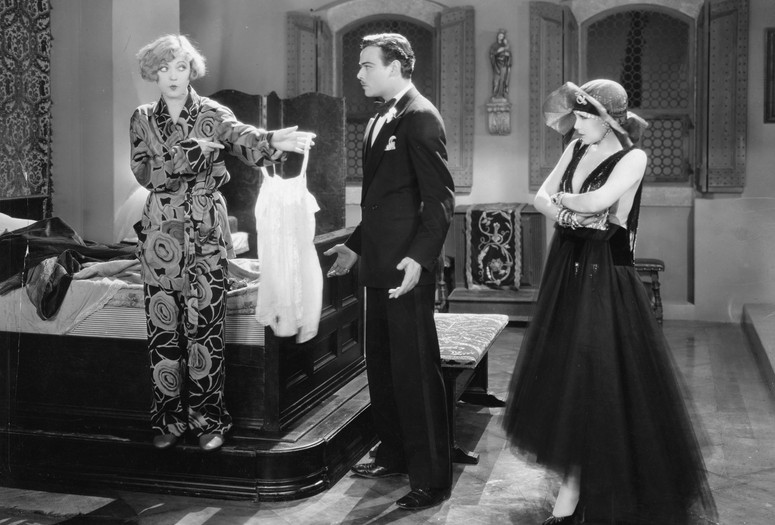
Produced by Hearst’s Cosmopolitan Productions and distributed by Metro-Goldwyn-Mayer, The Cardboard Lover is more than just a Marion Davies Production in opening credit only. The picture is undeniably a showcase for this beautiful bundle of energy. Her Sally lives life full speed ahead and is frequently at her best when she’s up to no good; even when she gleefully steals a tiny car (small enough to be parked in a phone booth, Sally quips), she’s easy to root for and even easier to fall for, despite what Andre’s initial reticence seems to suggest.
Just years away from his first of two Oscar nominations, for directing 1930’s The Divorcee, starring Norma Shearer (who would appear in a 1942 remake of The Cardboard Lover), Robert Z. Leonard knows what he has to work with and makes the most of Davies’s giddy promise. He’s also rather creative in his own right, as in the scenes when Sally tactfully exchanges clothes with a bell hop, or when she and Andre engage in one of their many fast-paced pursuits, shown only in close-ups of their scampering feet. Just as Leonard essentially functions in the service of his star, as he should, Model’s musical accompaniment, which is always stellar, often plays like a light, springy hymn to Davies’s dynamism, bolstering her visual vitality with his aural accents.
Alongside Show People and The Patsy, both also hitting theaters in 1928, this is Davies at her buoyant, amiable, attractive best. In The Cardboard Lover, as in so many other movies (Raoul Walsh’s 1933 Going Hollywood, with Bing Crosby, is another favorite), she is simply delightful.
Jeremy Carr is a Contributing Editor at Film International and teaches film studies at Arizona State University. He is the author of Kubrick and Control from Liverpool University Press and Repulsion (1965) from Auteur Publishing and a contributor to the collections ReFocus: The Films of Elaine May, from Edinburgh University Press, David Fincher’s Zodiac: Cinema of Investigation and (Mis)Interpretation, from Fairleigh Dickinson University Press, and Something Wicked: Witchcraft in Movies, Television, and Popular Culture, from Bloomsbury Academic. He writes for the publications Cineaste, Senses of Cinema, MUBI/Notebook, Cinema Retro, Vague Visages, The Retro Set, The Moving Image, Diabolique Magazine and Fandor. His monograph on Scarface (1932) is forthcoming from Channel Academic Publishing.