

By George Toles.
“What time is this? What time is this?”…The way “this” made the moment a real thing the woman had not been allowed to know or enter.”
—Harriet Clark, The Hill
“and thus the whirligig of time brings in his revenges.”
—Feste in Shakespeare’s Twelfth Night, or What You Will, Act 5, Scene 1
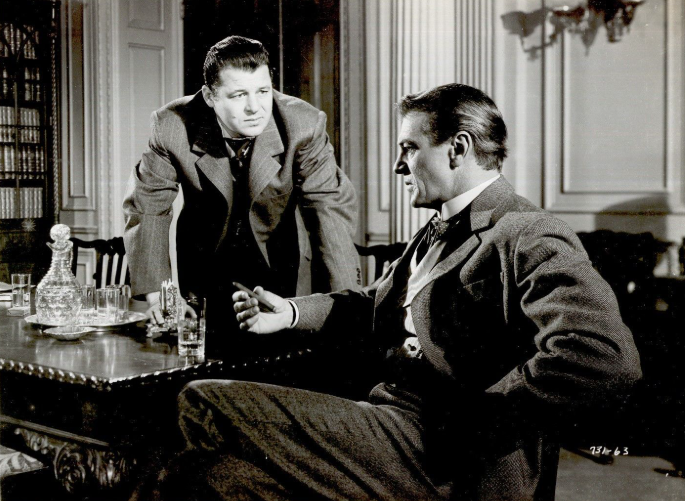
In the final scene of Michael Curtiz’s 1950 film, Bright Leaf, the ruthless, defeated protagonist, Brant Royle (Gary Cooper) leaves his home town on horseback, and while doing so, pauses briefly to consult his pocket watch. The date is a propitious one for time consciousness. It is New Year’s Day, 1900, a fact that the film only lightly stresses. We are not permitted to see what time the watch face reveals. The action Brant takes is not accentuated by close ups of either the watch or the face of the man examining it for a moment or two, as the narrative draws to a close. The pocket watch, which we know once belonged to Brant’s father, has a special feature. It produces a tinkling, cheery tune when the front lid is sprung open. Brant attends more to the music than to the time he has checked on, holding the watch up to his ear. Once this action with the watch is completed, Brant rides off on the road he is traveling, and we lose touch with him in the distance. It is here that Bright Leaf ends, in a somewhat inconclusive manner. n order to gain access to Brant’s state of mind and feeling about his departure from the town where he has dwelt for almost the entire length of the narrative, we are obliged to think about the watch, and by extension time, as it has received emphasis at various stages in the plot.
The concluding scene of leaving mirrors the film’s opening scene of arrival, when Brant pauses before a sign providing a name for the setting, Kingsmont, North Carolina. The opening supplies a crossing of paths for us to consider. A young Black boy on horseback is pulling along by chains a sizable crate of unprocessed tobacco leaves as Brant arrives at the town boundary, riding into Kingsmont from the opposite direction. The encounter between the two is given only slight visual and dramatic weight. The boy, viewed from behind, lifts his hat in deference to the white stranger. The reason for the boy’s inclusion at the story’s outset is twofold. He introduces the important theme of tobacco as a rapidly developing industry, but more subtly he shows us a person who combines the image of youth with a visible burden attached behind him. The burden is a habitual part of his labor, and it is unlikely the boy presently gives much thought to it. Brant Royle is revealed to us, when we first encounter his face in medium shot, surveying the town spread out below him, as someone carrying a substantial inner burden, which the film will go on to demonstrate he only partially understands, a burden exerting ever more binding control over him the longer he remains there. Brant’s face shows a mixture of trepidation, melancholy, and anger. The sign proclaiming Kingsmont’s existence also includes the information that it is the home of Singleton Tobacco Co. It is, of course, not yet clear that this company figures prominently in Brant’s past. It is fixed in his mind obsessively as a negative force, an antagonist of long standing with which he feels driven to contend. This entity and its tangled associations is the reason for his belated homecoming in 1894. Let us return to the issue of time, which, in its relation to helplessness, is the subject of this paper. I will have more to say later about Brant and his father’s pocket watch.
I have chosen Brant Royle as my starting point in this discussion of cinema time, because he strikes me as analogous in a manner I hope will prove surprising, to a film viewer, in his remarkable obliviousness to the time flow which in so many respects shapes and dictates his actions. He returns to the lost home from which his father was forced into exile, after the family’s once thriving tobacco company was destroyed by the Singleton Company. He is bent on revenge, but also by a peculiar compulsion to receive acknowledgment and affirmation by the man, Major Singleton (Donald Crisp), responsible for his father’s ruin. He feels an overwhelming need to win the love of Singleton’s daughter, Margaret (Patricia Neal), and to take over the plantation where she has been raised , whose gate has (since his demeaning association with paternal failure) been closed to him. One could argue that all of Brant’s actions in the film are an unconscious re-enactment of his early humiliations and family fall, an attempt to undo the never integrated or understood experience of being shamed with his father, broken, and cast out. Time stands still for Brant; it is like a graveyard in which he thrashes about, unseeing, in the company of ghosts. For a number of years, he is enormously successful, but in no respect does he move internally forward. His success, ironically, is dependent on a machine capable of creating cigarettes in almost no time at all. Time corrosively encloses him , but it does not outwardly impede him, or even register on his consciousness. He manages his business affairs with striking adroitness, and for a lengthy period overcomes all of his adversaries, including Singleton. What is noteworthy, for my purposes in this essay, is that until very close to the film’s last scenes, he manifests no awareness of time’s connection to his struggle at all. Ultimately he welcomes the burning of Singleton’s former mansion, which he has joylessly lived in, and begins to grasp both the useless wreckage of all his relationships, and the fact that the time devoted to his haunted, obsessive endeavours has been wasted time, empty. Though held in the grip of time past from the outset of his journey, time has been hidden from him, ongoing, of course, but not impinging on his awareness so that he must confront it directly. He does not dwell on it.
I would suggest that this is precisely the viewer’s experience of time in most of our engagements with movie narrative. Time intermittently is brought powerfully into focus, and we connect with it in an alert, tumultuous, if more often than not helpless way, but on most occasions, as in our waking lives, we are likely to lose track of it. And filmmakers realize this. It is inevitably the case that movie directors and editors are hyperfixated on how time unfolds, compresses or elongates at every point in a film’s structure. But that massive labor can co-exist with a recognition that a viewer’s sense of time’s presence and passing can be as light and muffled as it is on a lazy summer afternoon. The fact that time is constantly at work and making a difference does not require a viewer to think about it, any more than our participation in a movie scene solicits involvement with every (or any) specific cut.
In her memorable essay celebration of Christian Marclay’s The Clock (2010), “Killing Orson Welles at Midnight,” Zadie Smith aptly describes the 24 hour video supercut as a “movie that tells the time,” and does so relentlessly, through a miraculous compilation of clips. Images of clocks marking the time or figures onscreen declaring the time singled out every minute of a dreamlike day and night. Snippets of the accompanying atmospheres and movie actions in which the clock references are embedded accompany each of the successive revelations. The film is a monumental montage of stray pieces, some of them utterly obscure, others well-known, assembled from a multitude of disparate narratives, in which all genres and sub-genres are brought together and made to coalesce. The splinters of dramatic situations interact coherently, side by side, because of the inexorable “while the clock ticks” forward motion. If there is a story that unifies the fragments, which incorporate a huge, often comically discordant range of moods, it is the fact of time asserting its presence decisively as a small climax for each otherwise random event, stripping away the camouflage that makes time subordinate to other concerns, as though it were leaping out at us from a myriad of possible hiding places. The revelation of the present time is never passive, in its effect; whatever is happening, the announcement of the minute is the crown for whatever other sort of meaning emerges. Smith in her essay points out the two types of time forced together throughout The Clock: real and staged, which is to say “accidental clocks versus deliberate clocks.” (153) She goes on to distinguish between “time that has been caught on film” versus “time that has been manipulated for film.” In Smith’s view, “accidental clocks are more poignant than deliberate clocks. The actors in the street valiantly approximate reality, but the clock tower behind them has captured reality, a genuine moment in time, now passed forever, unrecoverable, yet reanimated by film.” (153). Smith feels that because the accidental appearance of the real moment is attached to authentic time flow it feels “unvarnished, unmanipulated.” (153) I would argue that the chosen moments commemorated in film stories acquire every bit as much poignancy in their own relation to evanescence and an almost mystical recoverability. They are part of the permanent séance that is movies, in which time and faces lost reemerge from death to present themselves afresh.
Smith characterizes the viewing experience of The Clock as “trancelike,” whether one watches only a small section of it or makes a full commitment to the exhausting/exhilarating 24 hour banquet. Toward the end of her commentary she raises the following question. “What else is The Clock if not thousands of fictional interpretations of time repurposed to express time precisely. That’s why you don’t feel you are watching a film, you feel you are existing alongside a film…The Clock is a joyful art experience but a harsh life experience because it doesn’t disguise what life is doing to you.” (159) I assume she is referring to the fact that we don’t have all the time in the world, that every minute is not merely in motion but leaking away. It is a continual scramble to have any sense of alignment, much less control over it. Marclay’s film also reminds us that although clock time is ubiquitous, and in the framework of The Clock truly inescapable as the subject for viewer enmeshment, that the clock is a mechanical and artificial way of measuring time in very small units. Our distant ancestors would not have been able to tell time in this way. The clock was profoundly useful for the industrial age, and its ever more tyrannical regimes for regulating behavior and making men and women workers hurry. As Aldous Huxley wrote in “Time and Machines,” we have gradually lost “the old awareness of time in its larger divisions. [What we know to the marrow] is “machine-made time. Of natural, cosmic time as it is measured out by sun and moon, we are for the most part wholly unconscious. Pre-industrial people know time in its daily, monthly and seasonal rhythms.” (124) I am astonished by Marclay’s achievement, but perhaps its most significant illumination for me was how differently our time-sense operates in The Clock—vigilant and ever mindful of time’s presence and effects—and in movie narratives generally, where it is allowed to remain dormant for long stretches, and detached from our conscious participation in screened experience.
Nietzche has a passage in Twilight of the Idols on “learning to see” that I think has some bearing on our customary separation from time sensitivity in film viewing. He speaks of “accustom[ing] the eye to composure, to patience, to letting things come to it, to put off judgment,” an overall encouragement or permission to relax in the presence of duration, “not to react to a stimulus [say, a time stimulus] right away.”(quoted in Posnock, Renunciation, 304). In so many cases, we are invited to occupy the eternal present tense of film with a sense of calm, natural, unself-conscious affiliation, as though we own, as visitors to film’s waking dream, the right to free passage through time, without undue laceration caused by time distress. We can easily imagine we control time as we exercise our ability to anticipate, predict, even roughly know what is to come in a story. Additionally, we often imagine a desirable form of movie escape as an escape from the fraughtness of time pressure in our daily lives. A movie like Bright Leaf can, on the one hand, foreground time as a central theme — Brant’s “unseeing” relation to deadening, self-devouring repetition of early, lost battles with time–but, on the other, not require us to feel the clawing process ourselves, to partake of Brant’s icy desolation as he is sealed in by time.
Let us return to the final view of him glancing at the time on New Year’s Day, 1900 on his father’s pocket watch, and listening to the watch’s tinkling melody, which could either be a taunt or a cleansing solicitation to begin again, on different terms, with the time remaining to him. With respect to the momentous fact of the dawn of a new century, I am reminded of a Robert Creeley poem, “New Year’s,” which summons an appropriately large disquiet: “we turn away into reassuring daylight but backwards. [stanza break] If it were the forward motion one wanted – /What tempers would not be resolved, can one keep the night out/ of it as or when it was there?” (For Love, 88) But director Curtiz handles the convergence of the “turn of a century” watch check, Brant’s acknowledgment of failure, and his transition to an as yet unchosen destination, casually, from an emotional distance. We are contemplating a puzzle – Brant’s present state of mind and his level of responsiveness.
The time quandary is an idea; it has, I think deliberately, no immediate sting. We recognize the watch as a significant recurring motif in the film. When it is first introduced to us, Brant does not have possession of it. He has given it as a gift some years ago to a young woman who worked in his father’s cigarette factory, Sonia Kovacs (Lauren Bacall). He has more or less forgotten or left behind his former romantic attachment to her. She has continued to love him, and has waited patiently for his return to Kingsmont, though no declaration of his intention to come back has been given. In the intervening years, she has grown wealthy, and is presently the madam of a thriving, elegant brothel. Sonia wears the watch around her neck at all times on a rather thick chain, both as a sign of her devotion (one can call it, within this narrative’s lexicon, as an enslavement to her memory of their time together) and a testimony to her unshakable faith in waiting. Keep the watch close to her heart, and he will eventually recall his heart’s desire and return. When Brant recognizes the watch and holds it briefly, he has no interest in retrieving it. He merely jokes that his father’s watch always ran a little slow. When Brant later marries Margaret Singleton, the daughter of his hated rival, the Major, who is an immense, dominating presence in Brant’s psyche, a humiliated Sonia returns the pocket watch to Brant as a wedding gift, and at this point it vanishes from the narrative as an entity for contemplation. Near the end of the film, when Sonia tells Brant that everything she once loved about him – the promise of his strange wildness – has burned out of her, and Brant, in reply, expresses regret that he failed to see who she was and what she could have meant to him “in time,” there is an opening for the watch’s reappearance in the final scene of departure.
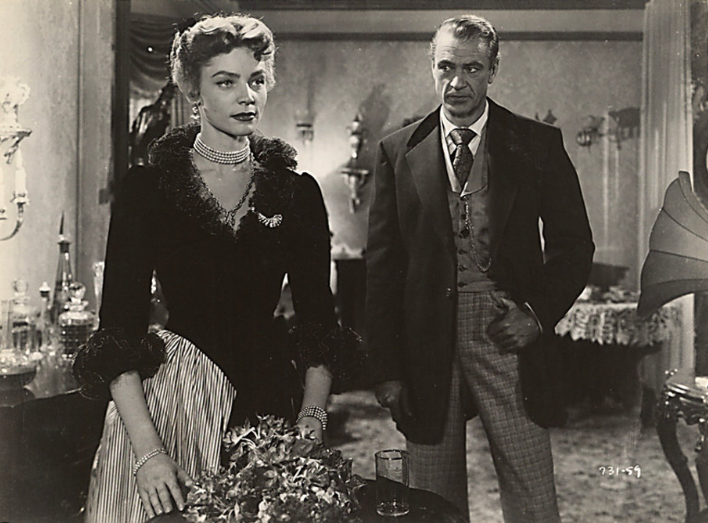
I think Curtiz means for us to be unsure what the possibilities for Brant’s regeneration “in time” are as he makes his final ride away from us, growing small, and perhaps insignificant, in the distance. We are disengaged from what I would term vulnerable time awareness in his brief reckoning with his father’s time piece at the town and new century boundary line. The disorientation and disengagement from active, feeling attention to time which is Brant’s curse throughout the film is for the most part the viewer’s predicament as well. Time’s destructive effects, due to an insensibility which afflicts most of the film’s characters, to some degree, are everywhere in Bright Leaf, but time as a pressure, a wound, a force painfully coming upon the viewer, in his or her experience of events, is almost nowhere. This withholding decision is a powerful strategic gamble.
There is one extraordinarily powerful short scene, however, marking the time of Major Singleton’s death, when time recovers its power to make itself felt, and renders the viewer, tied to a character’s perspective, feel visually disoriented , helpless, and stricken. The scene occurs after Major Singleton, who has lost his home and business to Brant, and suffered the additional indignity of Brant’s proposal to his daughter, unsuccessfully challenges him to a duel with a box of old pistols he carries to town at night for a public confrontation in a bar. Brant refuses to accept the challenge, And the Major, confused and broken, takes a shot at Brant and wounds him as his self-possessed foe stands before him unarmed. As he slowly retreats from the bar in disgrace, having been viewed by a large number of witnesses, his gentleman’s code and principles completely crumble. He climbs into his horse drawn hooded carriage. A pause ensues, as we view the stationary carriage from outside, apprehensive. We are deprived of any sight of Singleton as he decides to shoot himself. We are only permitted to hear the shot, as we observe the black border of the carriage hood as an obstructing screen. We do not know whether Singleton is already dead or severely wounded as his horse, frightened by the gunshot, rears and takes off. For the next jolting splatter of seconds we follow the driverless carriage as it races through the streets of Kingsmont. The horse’s destination is the Singleton home, which for the entire film Brant has longed to enter and be recognized as a worthy being, a victor who cannot be turned away. The horse crashes against the mansion gate, knocking it over, and Singleton’s body finally tumbles helpless and lifeless into view on the night-blackened ground. All of this action is experienced as intense, jarring time action , heightened by the agitating uncertainty of the old man’s condition and the mystery of the horse’s reckless course. The final point of arrival, the smashing of the symbolic barrier (the ever-closed Singleton gate), the viewer’s visual impairment in relation to the Major’s blockade of awareness leading up to this extended passage into death, make time – that has been operating from a chilled distance for equally lost combatants until now – palpable. We are at last precipitated inside it, and it seems that the meaning of the whole story, ungrasped by the characters, is laid bare in this single episode.
One of the implications of my claims about viewer-time sense in film is that our many inducements in film stories to sort out the time frame (what is happening when, and how events must be re-ordered to gain more clarity) do not put us inside the action of time emotionally. We are thinking about time questions from a distance, with a measure of safety. Similarly, our awareness of pace (quick or slow) and our experience of alignment or dissatisfaction with the imposed pace is by no means the same as an immersion in temporal pressure, with moments notching inside us as we slide forward, in the lurch. Helplessness is my key word for the way in which the time sense periodically, often without warning, invades us and sweeps us along. Accompanying realizations frequently have to do with the realization that time is running out, that it is too late for a desired or necessary action to be achieved, that the time immediately required for further knowledge is filled with zigzag apprehension. What hangs in the balance to be made known will either relieve our worries or make things far worse, perhaps irremediable. So much action proceeds with a jagged undercurrent of “too lateness.” There are numerous familiar gambits in genre films where a similar sort of temporal pressure is activated, and we move inside the experience in a vulnerable fashion, but oftentimes the time flow has guardrails that provide a measure of safety from visceral time penetration, because of our established comfort with the conventions of certain scenarios: heists, shoot outs, rounds in a boxing ring, bombs equipped with timers, races, tours of Gothic dwellings The typicality of such events supplies a buffer of “knownness.” Extended action sequences may have fresh, highly effective variations, but we have access to a survival handbook, due to our past encounters in a genre arena, that allows for a mingling of anxious time-keeping and detachment.

I think, by contrast, of a celebrated scene from Willliam Wyler’s The Heiress (1949) where the piercing and helplessness seem all-enveloping even though we know what time has in store for a character. Catherine Sloper (Olivia de Havilland) awaits the arrival of her suitor, Morris Townsend (Montgomery Clift), who has promised to elope with her. She is desperate to escape her father’s house because she has just received overwhelming proof of her only parent’s long-term incapacity to love her. Either Morris keeps his pledge and comes to rescue her, or (as she sees it) there is no love to be sought or counted on in the world. The viewer has only the faintest hope but no real expectation that Morris will appear. He has been gradually revealed to us, but not to Catherine, as a fortune-hunter, who, earlier in the evening, has learned from Catherine that she has severed all contact with her father and will receive no inheritance from him if she chooses to marry Morris. Catherine regards this decisive break as a crucial emancipation. As she stands, heavy bags packed, in her oppressive, glacial home and passionately awaits the sound of Morris’s promised carriage, she is observed by her Aunt Lavinia (Miriam Hopkins) who shares the viewer’s knowledge that Catherine yearns in vain for deliverance. Morris will not arrive. As the empty moments accumulate, we feel the time of abandonment on our pulse, encircling and crushing her. At one point a large pocket door slides shut, enclosing her in what seems like a domestic tomb, unable to block out the sound of her helpless wailing, which the viewer is helpless to ameliorate. We are still further inside the sheer weight of time and its eviscerating isolation of Catherine as dawn arrives and she carries her heavy suitcase, step by hopeless step, up an endless staircase to her room without a view.
The Heiress scene is a recognition scene, following close upon an equivalently tormenting previous recognition scene with Catherine’s father. Both of these scenes plunge us into time consciousness (the second more than the first), and time builds, with our painful participation, a dreadful enclosure around doubly betrayed Catherine Sloper. As I have argued, Bright Leaf closes with a muted recognition scene of an ambiguous sort that willfully suppresses the viewer’s emotional participation. Almost in the form of a guessing game suited to Brant’s impenetrable armature, it calls upon us to think about whether Brant still has viable temporal options as he moves, after momentarily casting a backward glance at his father’s musical watch, into a future that in its vast, century-starting openness may signal beneficial change. Has he already reaped his destiny, and become “played out,” or are their whisperings of release in the morning air? He appears to carry out of the film’s world exactly what we saw him bring into it. He is divested of visible burdens as well as attachments. Aloneness in his case, however, has not proven stabilizing or efficacious. What has he made of his father’s legacy, and what does it mean that he is now re-enacting his father’s exile from Kingsmont, the setting of hollow triumphs, this time voluntarily? Does the music in the watch he briefly hears convey a different meaning to him, perhaps a message he has never heard? Here our helplessness in time-sense has to do with placing Brant. In effect, our exclusion creates an emotional pressure, an unrewarded desire to enter in, and know how to make sense of the time arrows laid out for us, seemingly clear, but in fact coiled and mysterious.
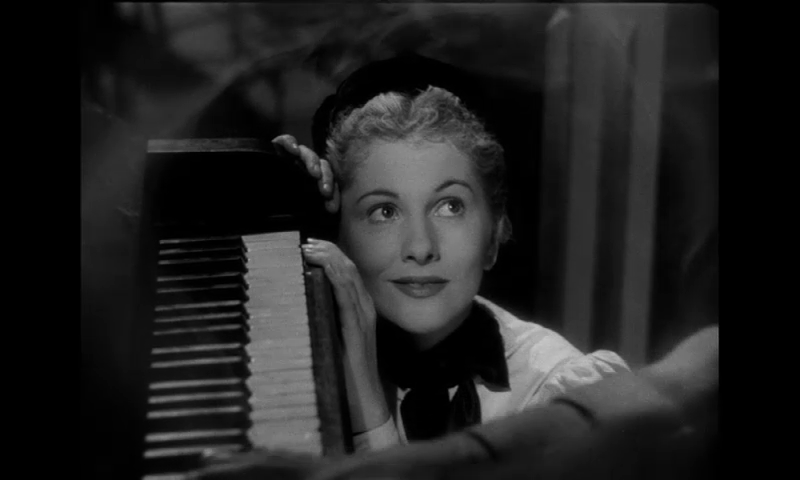
A far more disruptive, explosive time recognition scene is found at the end of Max Ophuls’s Letter From an Unknown Woman, but in its closing actions that film acquires a ghostly lightness, poised between tenderness and irony, that to a certain degree matches that of Bright Leaf. In order to evaluate with any precision the elaborate time-pressure at work in this ending, it is necessary to review the basic set up of the film’s plot and its hyperbolic time ramifications. The year in which the action takes place is, coincidentally, yet again 1900. A once famous, gifted Viennese musician, Stefan Brand (Louis Jourdan), who has gradually lost his calling and musical ambition and surrendered to a dissolute, aimless life, has been challenged to a duel because of his involvement with a married woman. He is informed by companions who drop him off by carriage at his apartment that they will pick him up in three hours for the scheduled 5am duel. The action commences in darkness with what feels like fatalistic rainfall. Stefan intimates that he will go through with the duel, but it is soon made clear that he has no intention of doing so. His aggrieved husband adversary is an excellent shot and is determined to kill him. We are shown that Stefan’s friends, after he leaves them, doubt his will to confront a demanding situation. Once Stefan is in his lavish upstairs apartment, reached by a winding stairway, he informs his elderly manservant, John (Art Smith), who is mute, that “Honor is a luxury only gentlemen can afford.” Almost by way of reply John gives him a letter tray containing a sealed envelope, and his manner of delivering it to him suggests that he is determined that Stefan read it. Unperturbed by the envelope, and visibly exhausted, Stefan begins to undress in his bedroom, casually tosses the letter on his bed, and waits for John to bring him coffee and cognac. He retrieves the letter as he enters his bathroom, and the opening of it follows directly on his action of splashing water on his face and washing his hands.(The hand action making contact with Stefan’s face will be mirrored and emotionally amplified by a similar gesture, near the film’s conclusion, when he has finished reading it.)
The letterhead informs Stefan and us that the communication has been sent from St. Catherine’s Hospital. Stefan is immediately struck by the letter’s disturbing and enigmatic opening sentences. “By the time you read this letter, I may be dead. I have so much to tell you and very little time. Will I ever send it? I don’t know.” We assume that the writer has managed to send the letter which its intended recipient now holds, but this assumption proves to be an error. We are not sure whether the writer is presently alive or dead, or why she has so much important information to convey. I should underscore the fact that significant, overlapping time issues are brought, at the film’s opening, dynamically into play. The letter seems to rest, unsettled, on the border between life and death. The time Stefan devotes to reading it, as well as what the contents may reveal, oppose his plan to leave his apartment with packed bags in an hour to escape the duel appointment. The fact that the letter promises to reveal so much indicates that it will require more than a little time to absorb. As it turns out, Stefan will become so caught up in the letter’s stunning revelations that when he arrives at its broken off endpoint, he has used up the entire three hours separating him from the duel. He has unwittingly lost his chance to escape. As a reader he has been immersed in an alternative time frame linked to his own past, devised for him by the “unknown” correspondent, Lisa Berndle (Joan Fontaine). Stefan appears oblivious of his current, dangerous predicament, temporally pressing in on him. The letter encloses him by gaining something that is rare for him to bestow: his full attention. And his involvement in the story it tells—a woman’s whole life compressed in epistolary time—renders him speechless and helpless.

What Lisa principally conveys to Stefan is that she has been singlemindedly in love with him since her first sighting of him in childhood , when he took an apartment in the same building her family occupied. “If this reaches you, you will know how I became yours when you didn’t know who I was or even that I existed.” She claims that the beginning of her conscious life coincided with their first meeting. Life at that moment and in all subsequent times touching upon him was for her at the acme of attention and elucidating power. Though she does not say it, the returned glance or gaze from Stefan never took hold; her image, behavior, gestures, speech on those rare, sometimes intimate occasions when they were together made no lasting impression. She has dwelt in the shadows of his own public, celebrated existence, preparing always inwardly for an acknowledgment of her presence and possibly the fulfillment of an answering love that never materializes. Their small handful of shared experiences, which included a night of lovemaking and a son who has died of illness whom his father has neither known about nor seen, have been the defining events of her existence, forming an emotional continuity that has shaped her vision of earthly possibility, its exaltations and sorrows. Whether she could provide the remedy for Stefan or not, she was intensely conscious of his own abiding sense of lack. It was also, as she eventually discovered, part of his seducer’s repeated performance, but it was also genuine, to a degree he only dimly fathomed. Their last meeting had led her to surrender all her achieved security (her home, her husband, her son, her status, and the people who cared for her), only to discover that Stefan could not summon the faintest specific recollection of her. And now she has perished of typhus, following her son, her letter concluding with the words “If only –” which signal both an incomplete sentence and a completed lament. The phrase links up, as a registration of time and knowledge’s permanently missing element, with a phrase cherished by William James: “ever not quite.” The postscript on the letter, written by a nun at the hospital, confirms the fact of Lisa’s death, adding with an intention to console that she spoke Stefan’s name as she died.
In spite of her misreadings of Stefan and the cumulative disappointment of her hopes, Lisa attests in her concluding sentences that “my life can be measured by the moments I’ve had with you and our child. If only you could have shared those moments, if only you could have recognized what was always yours, could have found what was never lost.” Strangely, but credibly, this litany of lost chances coexists with Lisa’s earlier expression of certainty in the letter that all her moves toward and away from Stefan in her tightly bound life were pre-destined, mystically ordained: “The course of our lives can be changed by such little things. I know now that nothing happens by chance. Every moment is measured; every step is counted,” perhaps with a symmetry as painfully exquisite as she finds in the music of a Mozart opera.
We are now in a position to consider our spectator affinity – intense enclosure, if you will – with Stefan’s recognition of something large, time reverberant, as he finishes reading the letter. In his lengthy chapter on Ophuls’ film in Contesting Tears, “Psychoanalysis and Cinema: Moments of Letter From an Unknown Woman,” Stanley Cavell makes two interpretive lunges at Stefan’s response to Lisa’s written confession. The first of them provides the opening of his essay; the second, which approaches Stefan’s recognition from a different angle, comes close to the essay’s end, as though it were the mystery the whole discussion, as well as the film’s own narrative, was required to solve. I will quote both of them at some length. They each probe the question of how we see and partake of Stefan’s wordless anguish with commendable intensity, but I am intrigued by the fact that what I see as overwhelmingly central does not enter directly into Cavell’s described experience at all. “When the man in Max Ophuls’ film Letter From an Unknown Woman reaches the final words of the letter addressed to him by the, or some, unknown woman, he is shown – according to well-established routines of montage – to be assaulted by a sequence of images from earlier moments in the film. This assault of images proves to be death-dealing. His response to finishing the reading of the letter is to stare out past it, as if calling up the film’s images; and his response to the assault of the ensuing repeated images is to cover his eyes with the outspread fingers of both hands, in a mixture of horror and exhaustion. Yet he sees nothing we have not seen and the images themselves (as it were) are quite banal – his pulling the veil of the woman’s hat up over her face, the two of them at the Prater amusement park in winter, her taking a candied apple, their dancing, his playing a waltz for her in an empty ballroom…It seems a particular mode of horror that these hands would ward off, since we may equally think of the images looming at this man not as what he has seen but what he has not seen, has refused to see. Then are we sure we have seen what it is up to us to see? What motivates these images? Why does their knowledge constitute an assault?” (81-82) In the second passage, Cavell is intent on further exploring not the remorse of time misspent and unrecoverable but the nature of Stefan’s horror: “And I think we can say that when the man covers his eyes – an ambiguous gesture between avoiding the horror of knowing the existence of others and avoiding the horror of not knowing it… – he is in that gesture both warding off his seeing something and warding off at the same time his being seen, which is to say, his own existence being known, being seen by the woman of the letter, by the mute [a reference to the more knowing and observant manservant John as a surrogate for Ophuls] and his (her?) camera – say, seen by the power of art – and seen by us, which accordingly identifies us, the audience of film, of assigning ourselves the position, in its activeness and passiveness, of the source of the letter and of the film; which is to say, the position of the feminine.” (111) He concludes by suggesting that the audience is potentially the implied activator of Stefan’s horror, and that we are enmeshed in his horror. We prefer to avoid being trapped in the feminine state of life-annulling victimization. Lisa, with whom we have been led to identify strongly, in her attempt to understand the tale she is telling, has no more than her death, ultimately, to show for herself.
It seems to me that Cavell, in his attempt to build up Lisa’s positive case – her letter not a direct accusation of Stefan for taking away her life but conveying a strong underlying awareness that she has been, without justification, the unknown, unfound, victimized woman – is reluctant to allow Stefan, in his own right, to absorb anything by way of final recognition beyond various reflex impulses of avoidance. Stefan is imbued by Cavell with a surfeit of horror, which he meets by blindly resisting a transformed understanding of himself. The cumulative horror of seeing himself differently in relation to what he has read leads him to push away everything that might grant him some saving access to Lisa’s love. Lisa knows herself in her telling of what she has faithfully pursued, and what it has meant to her. Stefan, in guilty response, fearfully seizes upon unknownness as a defensive position, taking on its negative connotations: an unwillingness to be known by others or know himself, which we might argue has been his predicament from the outset. Cavell draws interesting parallels between Stefan and John Marcher, the deluded central character of Henry James’s story, “The Beast in the Jungle.” Marcher is the man whose curse was to have nothing of consequence happen to him, to not allow anything close enough to touch him or leave emotional traces. Cavell quotes one of the story’s moving last paragraphs to conclude his discussion. The most telling sentence, for his overall argument, is this one: “Everything fell together…; leaving him most of all stupefied at the blindness he had cherished.” (113)

I have indicated that Cavell’s experience of Stefan’s recognition (or in his view, panicked non-recognition) is at variance with my own. What I think is omitted is the devastating awakening to time, which Stefan and the viewer may achieve simultaneously. To be overcome and rendered helpless by time (both its multitudinous offerings and losses) piercing you in a manner that is unprecedented is a recognition that can make a decisive difference. Cavell places great emphasis on the use of Stefan’s hands to block or refuse vision. But surely there are many instances when hands are raised to one’s eyes to register the enormous force of what a person has seen. It comes in the aftermath of the lightning stroke of realization. How long does a certain form of hovering, but ungrasped truth require to pass through one’s self-protective barricades. But the phenomenon of feeling a passage in film deeply but in a different register from another careful viewer who has given it a great deal of attention raises the important question of how do we gain access to the minds of film characters, which (like the minds of others in life) can so easily elude us? In this instance, I think there is clearly a different investment in the significance of Stefan’s power to grasp something large that he has not previously allowed himself to see, and make something of value out of it, even if it counts strongly against him. I would supplement this claim with a reminder of Anais Nin’s always pertinent declaration, “We don’t see things as they are. We see them as we are.” Likely one reason for my being so shaken by what I would call not so much an assault as Stephan’s avalanche of last images of himself in Lisa’s presence is that I feel, beholding them, a wind upon me out of my own past.
Cavell thinks of Stefan’s experience in active terms as a denial, a thrusting away of a series of images that could easily be described as banal in terms of what they disclose to him. I regard Stefan as helplessly opening himself to whatever images of felt life arose for him while reading Lisa’s confession that her letter has left for him, now that she and her son have both been pared away by death, but that the images he seeks fail to coalesce for him with sufficient clarity. He longs to see her as well as himself in the moments that she has enshrined as central to her love-centered existence, but he cannot form memory pictures that tell. The slow motion avalanche of images that the viewer receives effortlessly as memories from the film are closely linked to the traces Stefan is searching for, in an agonized trance, but Stefan in my view is not granted access to the sought-for moments. The viewer from the introduction of the reading action hears Lisa’s voice delivering the words she has transcribed. Stefan does not. The images that comprise the letter’s story, and therefore most of the film, are all from Lisa’s implied point-of-view, as though somehow preserved for a time from effacement, but this point of view can hardly be transferred intact to the man who has not held on to more than a ghostly scrap of their interactions. What the viewer sees and hears is a substantially different version of the letter than Stefan is processing. Yet it must be said that the letter holds sufficient power over him that he reads it, with wholehearted concentration, astonishment and pathos, straight through. It is strong enough in its communicative takeover of Stefan’s mind that he loses all sense of time. He is not reminded of his own self-protective need to escape the premises before the 5am duel. Lisa’s story takes precedence over his customary primary concern for his own well-being. But he reads the pages through a glass darkly, while the viewer’s dispensation is to read the letter face to face. What the viewer receives so freely, without obstruction, as sense memory, Stefan must labor over to revive or catch hold of Nevertheless, our comprehension of what the letter ultimately means is withheld from us and Stefan alike, at least until his concluding disruptive, helpless bid to see “in time” and make fleeting contact with Lisa before she is forever excised.
The images that Stefan reaches for but that mostly elude his ability to envision, corresponding to those the viewer witnesses and vividly recalls, are all versions, arguably, of the veil lifting from Lisa’s face. I would suggest that Stefan’s own tearful demeanour and the subsequent covering of his eyes are due to the fact that he begs for much-ness in the way of rescued time, but receives so little. How slight and barely legible are the fugitive instants that he took to heart when it might have made a difference, and that he failed to preserve. He poignantly uses a magnifying glass to enlarge the details of the photographs of his son that Lisa has enclosed in her letter, a son born and dead past saving in a few reading minutes, but the child cannot be endowed with motion for this belated reader or the ability to return his father’s futile, searching gaze. The force of too little, in its relation to “too late,” has the power to fell, in its own kind of avalanche. I think of it as an avalanche of grief and unappeasable longing met with a trickle of unfocused, borrowed memories. It is also likely that Stefan recognizes that each of the images from the past that he hopes to bring to mind were in no sense small for Lisa. They attested to monumental, ordained steps and transcendent intimations of possibility, while for him, they were interchangeable trinkets, heaped together with other performed seductions, diverting but swiftly eroded adventures, time-killing inertia. For all of Stefan’s restlessness and fretful pursuit of conquest, he seems the static figure, by contrast with Lisa’s numberless feelings in relation to her singular, abiding love and faith. How vast in its implied power, as William James argued, is the “feeling of if.” Is language, he asks, capable of “doing justice to all the shades” conjured by feeling relations? (234)
What might cause the receptive viewer to be severely shaken along with Stefan as he tries to call forth images from the grave of Lisa’s testimony? I think the power of the montage has a lot to do with a collision of time frames. Lisa’s visual narration, as she offers it to us in a securely maintained present tense, which her accompanying spoken interjections further re-animate and inhabit, is a reality sphere we have learned to count on. Its abrupt cessation, mid-sentence, replaced without transition by a typed, official notice of Lisa’s death at the hospital (voiceless) is akin to the stop-time effect of a sudden rupture in the act of film projection, the film trapped in the gate, with a frame or two held in place, then incinerated before our eyes. We look at our fellow reader, Stefan, desolate and silently protesting this cold termination of Lisa in mid-plea, recoiling as we are from the void of absence, the swift and absolute annihilation of Lisa’s voice and imagined presence. Whatever else he is going through, Stefan is no doubt confronted, in one of several wounding ways, by the thought “There has to be more of her than this.” The broken confession allows no space or time for amelioration or mending response. Stefan naturally joins us in the blind realm of nullity, silently attempting to call her back into presence, by whatever tenuous means are available to him. The images that surface in this collision of death with the flickering memory embers of story are almost entirely drawn from the one expansive night that they spent together, in a state that might be deemed happy mutual awareness. Only the first image in the series belongs to their dire near-in-time last encounter, when Stefan lifted Lisa’s veil, and beheld nothing he recognized. His distracted, mechanical unseeing was his reply to her surrender of every form of protection in life available to her, except for him. And, in effect, his unmindful blindness on this tawdry occasion was an obliteration that caused her death. All of the memory images presented are, like the first one, encircled with what appears to be a smoky haze, emphasizing ephemerality and visual impairment.
When we observed Lisa and Stefan’s solitary long, unsullied night together the first time, it seemed temporally spacious, devoid of hurry, with the seeming ability to make room for everything wished for. It seemed like endless, unawkward togetherness, without fatigue, strain or worry. Time opens out like a beautifully decorated fan, laden with delectable pictures. The evening’s most unusual event,perhaps, was a trip on a motionless train with a moving scenic backdrop, which allows the couple to travel through all the countries and famous cities of Europe while remaining stationary, and then to repeat the journey when there were no more countries left. As Stefan jokes “We’ll revisit the scenes of our youth.” The closing montage replays this one night, heavily compressed, pared down to a handful of resonant glimpses of Lisa, transported by romantic acknowledgment, which, as I’ve argued, Stefan strains without success to bring into focus in his grief. But it is not only Lisa he fails to recover in his scanning of the story’s most powerful illuminations, but himself. He was there at the time, possibly even fully open to the evening’s beauty and enchantment, but he cannot find himself, not even a shadow. And, for the viewer, what Lisa smilingly gazes at, and makes connection with, in this second, accelerated journey through the night of wonders, is the heart of absence. There is only emptiness in the places reserved for him. Stefan’s upraised hands covering his face are, for us as well as for him, perhaps, an instance of Emmanuel Levinas’s much-discussed form of helpless disruption, the “breach of being.” Stefan’s egoistic life is interrupted, painfully penetrated at last, by the undeniable call of the “Other,” though too late for responsible, reciprocal action. An unusual “other” to be sure, given Lisa’s lifelong willingness to mirror the one finally “breached,” to converge with an Ideal that she regards as all-in-all, the sole source of meaningful substance. What does one do with Levinas’s demand for infinite, inescapable responsibility when the “Other” that calls is dead? In Stefan’s case, he can die himself, almost certain to be slain in a duel he has forgotten to evade, by Lisa’s abandoned, unappeasable husband, a death, one might say, that is due to him, in the aftermath of a life Stefan fears that he is departing unlived. But it is not the prospect of Stefan’s death that is likely to induce helpless time tears, so much as the viewer’s chance to revisit, without Stefan’s equal partaking, the brief time of expansive, promising togetherness (alive) at the Prater, the night Stefan comes close to seeing, finding, knowing Lisa in felt relation to himself, and in a deeper than casual sense, choosing her. But even on that occasion, when he was as present as he knows how to be, his presence was not present enough.
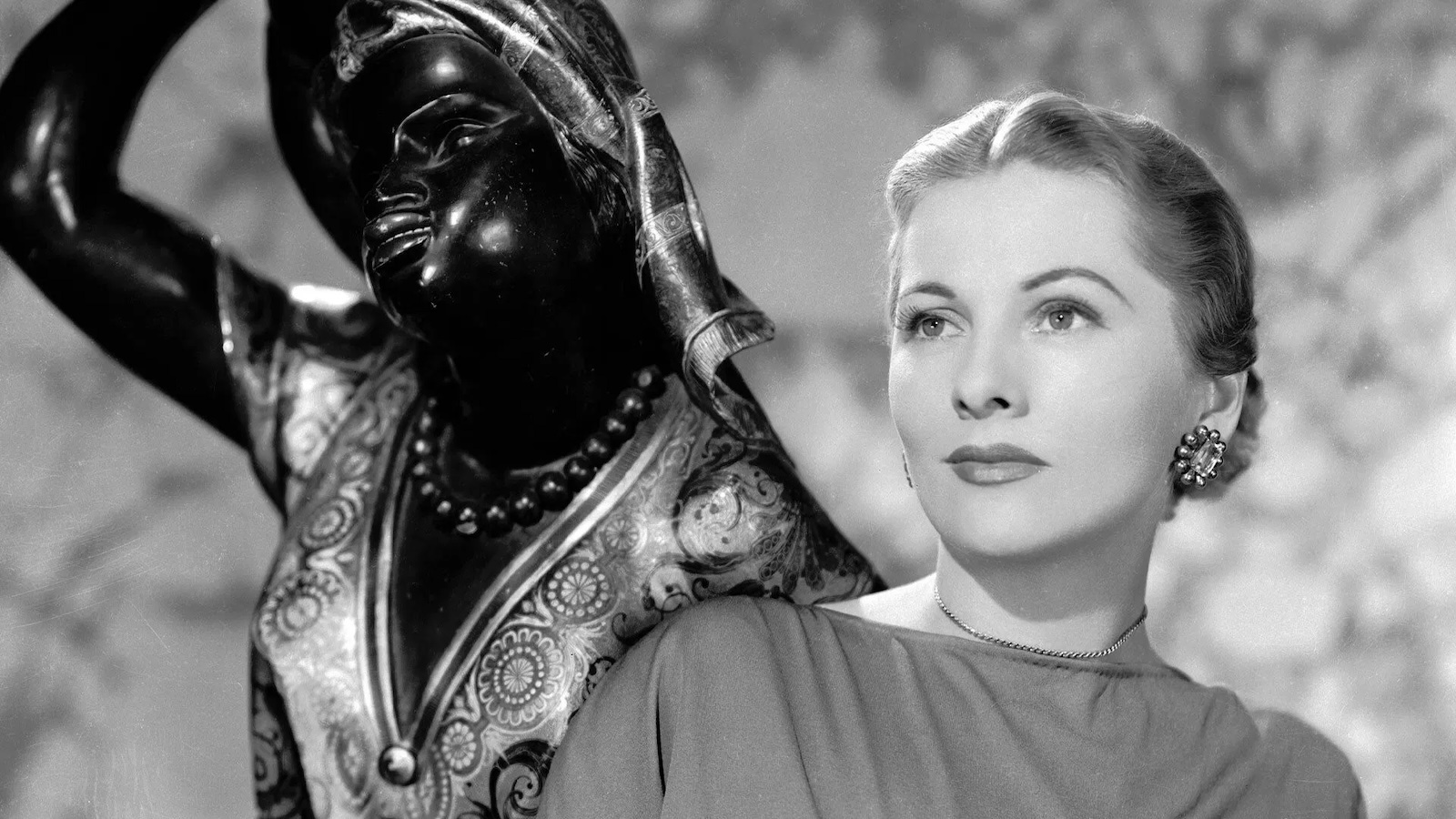
Writing about recognition scenes in tragedy in Aesthetics, Hegel provides a description of recognition’s moment that pertains to Stefan’s time of “breached” awakening in Letter From an Unknown Woman. “The totality of the circumstances of life, deeds, fates, is of course what shapes the individual, but his proper nature, the true kernel of his disposition and capacity, is revealed without all these, in one great situation and action, in the course of which he is unveiled as he is, whereas previously he was known maybe only by his name and external appearance.” (Quoted in Cave, 156). Hegel is less concerned than I am with the extent of the viewer’s vulnerable time consciousness, but one form of ‘modern’ (as opposed to ancient) recognition denouements that he singles out for attention is the recognition by the character that his fate is appropriate to his own action. As Terence Cave has noted with respect to Hegel’s response to King Lear, “the movement of a tragedy towards knowledge is wholly contained within the protagonist’s own moral or metaphysical self-recognition.” (160) The space for living in his absent way that Stefan has steadily cultivated, to his cost, seems to contract with every pulse of recognition that he experiences in being deprived at a stroke of the “time no more” that is now Lisa, who has “always been his,” but whom he has never known how to claim, see, or even name. Stefan has been, for Lisa, a steady compass, an inexhaustible subject for inner contemplation and wonder, which, despite his massive dereliction, are not an illusion. Her love, faith, and commitment have been real, and have operated at a depth within her that has made waiting not a stasis but a solemn, ongoing dance of the spirit, like the soul waiting for God to enter in. Her belief in Stefan, even in the aftermath of repeated disappointment, is what gives her power, centeredness, and for much of her existence serene purpose.
Lisa tells him, at the commencement of their carriage ride on their sole night of exchanges, that when she listens to him play the piano, that it sounds to her that “you hadn’t quite found – I don’t know – what you’re looking for.” Stefan agrees with her assessment of him. He is convinced that he is engaged in an authentic search, both in his music and in his transitory affairs for fulfillment, a luminous clarity that will answer to unresolved needs. This search makes him, in his unsteady mind, an adventurer on spiritual terrain. He is undeniably restless, but he consistently evades the task of going deeply inward and taking stock, or of feeling anything through in a manner that is grounded or deep. His spirit, one might say, is an available but unused well. He cannot bring his vitality or life close to him, certainly not close enough to give him definition. A game is what he made of his search, a game that he could not continue to take seriously. His search, like his interludes of seduction, became both a rote performance and excuse for lack of development. Play is, as Friedrich Schiller movingly argued, crucial to artistic and personal expression, but Stefan, in his steadily increasing disorientation and idleness, lost the capacity to take play seriously. Some large portion of this spectacle of waste comes upon Stefan, and possibly his viewer beholders, as he lifts his hands to his eyes.
In contrast to Stefan’s acceptance of what is ordained, we are rendered helpless. I find myself becoming the clock of death, taking on the fear that Stefan is spared: of death that is closing in on all sides.”
We hear a cathedral bell slowly tolling in the distance as attention shifts from the distraught, spent figure of Stefan to his manservant John. Without any show of hesitation John approaches Stefan’s desk, touches his shoulder, and shows him the time on an open watch. It is nearly 5, which means there is no avenue available to Stefan for another escape. The cathedral bell continues to sound the hour, confirming the watch’s silent declaration. Still dwelling exclusively on the unknown woman, Stefan asks John whether he remembered her. John nods affirmatively, picks up a pad and pencil from Stefan’s desk and begins to write. Ophuls cuts to an extreme close up of the pad as the name “Lisa Berndle” emerges pointedly, and with remarkable weight, from silent observer John’s memory. He is, in my view, not so much a stand in for the director as a perfected version of the feeling spectator, and what he or she has carried away from the letter’s ultimate power to communicate (as well as mystify). Gazing down at his desk, Stefan repeats the name Lisa twice, recalling perhaps the double train journey of the couple at the Prater amusement park.
At this instant, we are further entrapped by the approaching sound of horses’ hooves on the cobblestones outside, and the ominous reckoning they bring with them. (Their sound means the reverse of the similar approaching hooves in The Heiress scene, where it is quickly revealed that the conveyance passing Catherine Sloper’s house does not contain Morris, and is not for her.) We are briefly separated from Stefan as we are granted a view of two arriving carriages, one bearing Stefan’s challenger, and the forbidding, sealed off nature of the carriages’ paused solidity. As Stefan gazes out the window at the assembling forces of the ritual and its almost inevitable fatal outcome, he leans forward with his arm extended to the window, suggesting momentarily troubled realization. We too have almost forgotten the existence of a world outside and separate from that of the letter’s contents. Yet he quickly appears to shake off both despondency and fear—what I would term weight of feeling – in exchange for a resigned lightness of attitude that seems more genuine than feigned. He instructs John to “Bring my things,” as he unbuttons his vest. As his seconds climb the stairs to his door and ring the bell, their backs are to the camera, in a fashion that renders them more figures of fate than intimates. Before John admits them, he finds a moment to affectionately press Stefan’s arm and exchange a warm gaze of farewell. He seems to know the likely outcome as clearly as he knows Lisa’s name, but displays neither anxiety nor regret. Stefan (in our brief time away from him ) has donned a funereal black overcoat and an attitude of impressive composure. Before Stefan leaves he notices and remembers the white roses that Lisa brought on her final, otherwise traceless, unavailing visit to him. As he takes one of the roses, we hear Lisa’s voice, possibly audible to Stefan for the first time after his completed reading of the letter. “Oh, if only you could have recognized what was always yours, and never lost.” Stefan places the rose in his lapel button hole. I think it is important to stress that in our final views of him Stefan does not adopt anything resembling a sacrificial hero’s attitude. He does not aspire to the role of tragic hero or unjust victim or figure elevated by the weight of coming into fuller consciousness. A martyr’s elevation would be a return to subterfuge.
Stefan instead occupies the role he knows he is entitled to – that of detached, ironic lightness. In the minute or so that has elapsed since his speaking of Lisa’s name, he has completed a self-reckoning. His display of aghastness at his own distance from a life truly lived is not followed by denial, the habitual clouding over of his gaze. He has issued a verdict on himself in what he deems his last hour, a verdict of lightness. He has been the custodian of lightness for most of his adult years, a trifler, a play actor who has reaped his pleasures and rewards with a minimum of self-awareness and vulnerability. He will maintain his lightness in the time that remains, with his eyes open. There is nothing grandiose in his manner of squaring accounts. One major moment of seeing is still reserved for him. As he passes through the ground level glass doorway of his apartment into the courtyard, he takes a number of steps toward the waiting carriage and then a second memory of the letter’s text tugs at him and causes him to look back at the doorway threshold. It was there that Lisa caught her first sight of him while he walked through, oblivious of her presence. She appears as a ghostly translucency of the young girl beholding him, one of her hands clasping the door. This amorphous image, it seems to me, is the likely equivalent of his way of half-seeing her during his reading of the letter, an apparition throughout, striving for definition. The door that stands open here has more thereness than the gazing figure behind it, contemplating with wonder the compass and majestic affinity of Stefan’s powers. In Stefan’s end we are permitted a fleeting return to the one-sided beginning of Lisa’s attachment. But it is not too late for Stefan to find Lisa’s look at last, her clandestine hope for a confirmation of presence. Stefan goes forth, ironically composed, to meet her on a field of death more clearly lit for him than the field of life has been. And the time of the carriages solemnly departing with Stefan a willing passenger creates a shattering temporal harmony out of so much accumulated insensibility, disorder, and loss. We may well admire Stefan’s operative lightness as he contemplates the possibility of an alternative path through the life he realizes is drawing to a close – a new beginning – but, in contrast to Stefan’s acceptance of what is ordained, we are rendered helpless. I find myself becoming the clock of death, taking on the fear that Stefan is spared: of death that is closing in on all sides.

In Alain Resnais’s time-obsessed Hiroshima Mon Amour (1959; see top image) we meet another harried, disoriented female lover, this one nameless, striving to complete the seemingly straightforward task of entering a hotel where she has reserved a room and making her way back to it. Resnais confronts the viewer with the convention-breaking decision not to tightly compress, through editing, the woman’s walk toward the hotel, her passage up the hotel staircase and down the lengthy corridor leading to her room. Ordinarily, when a looming threat is not established, there is comparatively little drama to be found in the unobstructed movement through anonymous hotel space to a destination that is already well-known to the viewer from previous scenes played out within the assigned room. But there are, of course, ways and ways for things to loom and obstruct as time becomes manifest, an anxious, abrading factor marking the demands of progression. The walk through the hotel is a wordless scene that follows upon a lengthy confession scene that takes place in a Hiroshima cafe late at night, fourteen years after the Second World War ended. The woman “Elle” (Emmanuelle Riva) tells her recently chosen Japanese lover, also nameless, “Lui” (Eiji Okada) about her prolonged period of suffering, disgrace, and madness in her home town of Nevers, France during the war. The early portion of her telling is accompanied by a nostalgic instrumental piece playing on a cafe jukebox. Later the background sound is supplanted by cicadas and, at a crucial transition, by a wrenching scream from her flashback, indicating the onset of her madness. At age eighteen she fell in love with a young Nazi soldier during the German Occupation. The soldier, with whom she had an extended “first love” affair was killed by French gun fire on Liberation day, and she rested on his body for a prolonged time after he died, barely able to distinguish his state from hers. Elle was soon after punished as a collaborator; her head was publicly shaved and she was marched through the streets and subsequently treated as a pariah. The military and political Occupation of France by Germany was at an end, but the war continued. Elle’s parents advised her to live “out of sight” in the cellar of her home, a kind of jail in which her lacerating grief, isolation and ostracism led to a prolonged descent into madness. Eventually, after eight months of privation, she feels recovered sufficiently to abandon Nevers and travel to Paris by bicycle. Two days after arriving there she read in the newspaper that Hiroshima had been bombed. Life, as it were, resumed for her on different terms.
What makes it possible for Elle to reveal all of this previously “unshared with anyone” story to her empathetic lover is that she has managed to fuse him with the lost German lover of her youth. She speaks to Lui throughout her narrative as though he were both a present tense listener and the resurrected German youth who has, of course, had no chance of hearing, after dying, what had become of her. Lui’s connection with the dead German youth is starkly prefigured near the beginning of the film when Elle observes Lui’s hand twitching as he lies face down in her hotel room bed asleep. The twitch is instantly linked, as Elle watches him, with a match cut to her first lover’s twitching hand as he lies dying on the Nevers quay. We as yet have no context for reading this connection with any accuracy. Elle’s disburdening to Lui at the café offers a significant emotional release, but there are many more knots inside of her, that we do not necessarily recognize or comprehend, which have yet to be untied.
I think it is necessary to describe the atmosphere and partially resolving mood achieved at the end of the café scene before considering the forces at work in Elle’s walk through the hotel. We no doubt recall Lui’s intransigent insistence at the beginning of the film that Elle knows nothing at all about Hiroshima in reply to Elle’s many declarations, overlapping with a love scene, that she has “tried with all her might” not to forget Hiroshima, and to understand all she could about it during her time there. (She has been hired to act the role of a Red Cross nurse in a film where Hiroshima supplies setting and subject matter, and has met Lui near the end of her stay.) Elle knows—but in what form of knowing?– that “two hundred thousand died, and eighty thousand were wounded, in nine seconds,” and that the catastrophe that took place “will begin all over again,” but she has discovered in her lengthy visit, and especially in her brief time with Lui, that the city was also made “to the size of love,” that “love fits it like a glove.” As for Lui’s own way of knowing Hiroshima: he was not present in the city when the atom bomb fell. He was a soldier stationed elsewhere, but his family were there, and destroyed. In the screenplay, Marguerite Duras characterizes the montage views of current Hiroshima street life, in what looks like normative, picturesque calm, as “Universal banality.” (24)
Lui, an architect who is currently married, like Elle, and has two children, believes that he has understood much of what Elle has undergone in Nevers. He takes pride in the fact that he is the only one she has told of the Nevers experience. She claims not to have revealed the Nevers history to her present, living husband. He requests that she tell him even more, but she can think of nothing further to say. The darkness and near emptiness of the café begin to seem disquieting. Part of what entranced Lui about Elle is her symbolic nurse’s role, in her clean white costume bearing a Red Cross. In Duras’s words, “The eternal nurse in an eternal war.” (10) The clothes she wears in the café seem almost incandescently white, immaculate, resistant to stain, in strong contrast to the tale she has told. Elle wonders aloud if activity ever stops at night in Hiroshima. Lui says things never stop, and Elle takes comfort in the fact that there are cities where people are always awake, day or night. But the darkness of the café deepens as they speak and when they return to the street outside it appears empty of anyone but them. They have both resolved not to see each other further in the hours before Elle’s flight back home. Sixteen hours to fill somehow. Lui tries to imagine how his brief interlude with Elle will appear to him in the future. He suggests that he will remember her as the “symbol of love’s forgetfulness,” and will regard the adventure as “the horror of oblivion.” Standing with Lui behind her in the desolate street, Elle bids him to leave. As he hesitates, continuing the film’s established pattern of separations and re-joinings, Elle calmly concludes that “Probably we’ll die without seeing each other again.” “Unless a war..” Lui ironically adds.
The walking scene commences with Elle, apparently composed if tired, gradually approaching the hotel, carrying her white jacket. Resnais noticeably prolongs her movement in long shot as she makes her way with an unhurried pace to the entrance. We have time to consider as she walks the extent of what she has so far resolved. We might well pose the question that is central to Imago therapy: “Is there more?” It is unusual to have a central character’s trauma story told at such length in a film, with apparent catharsis, when the narrative still has a substantial amount of temporal ground to cover. Although nothing is directly signaled in Elle’s outside walking as a source of augmenting stress, we may notice the emptiness and silence of the street surrounding her. There are no suggestions of the ongoing night life Lui alluded to. This reinforced emptiness subtly introduces Elle’s new, gradually overwhelming awareness of Hiroshima as a pulverizing, blinding personal experience, which will be transmitted to her not through a predictable channel: further documentary or dramatized images of atom bomb horror. Instead her experience of separation from herself and crushing panic will come through sensations of conspiratorial covering over and hiddenness as she thinks she returns to safe, neutral hotel ground. In the previous café scene there has been an enormous quantity of verbal revelation granting us what feels like full access to Elle’s anguished and then increasingly collected, focused mental state. All of that sonic supplementation for gaining access to her psyche is suddenly stripped away as we witness her arrival at the hotel. The nearly bare soundtrack now places all its emphasis on the sound of her heels as she makes her way to her room. As I noted earlier, the lengthy coverage of Elle’s ascent of the hotel stairway without a cut and the subsequent prolonged scrutiny of her movement down the lengthy hotel corridor separating her from her room makes us time conscious in a manner that sharply accentuates duration. I would characterize the overall impact of time inching forward in this scene as a concentration on durational flux to the point of inner collapse. What we are tightly bound to is Elle’s progressively more agitated, stymied walking which stretches out, then reverses direction and reverses it once more, while adding numerous mysterious obstructions to Elle’s willed, intentional movement.
We have no clear indicators of what is preoccupying Elle as she returns to the hotel. Does she regret her decision to leave Lui, and bring their liaison to a close? Is she troubled retrospectively by her decision to share the Nevers episode with him? To what extent did he comprehend her story? Does she herself have the ability to grasp its meaning? Has she betrayed her dead lover by divulging the story in the manner that she did? Has the story she has held for years, unspoken, provided the secret center of her being, which has now been reduced drastically by escaping through talk? Is she slipping backwards to her deranged mindset while in her cellar prison entombment? Perhaps the initial sense of deep release was no release but a hurtling back to captivity. Has she perilously lost her footing in the present moment? Arguably more powerful an influence than any of these possible concerns is a closing in of the recognition that she is standing in Hiroshima, directly in the shadow of its 1945 obliteration, the asphyxiating emptiness and silence of annihilation without limit, conceivability, or salvageable meaning. Nine seconds, a known world wiped away, in the time that it would take to clear the crumbs from your lips with a napkin. The hotel she enters, matching her white apparel in its foyer décor, is a luxury hotel. It was designed and constructed to license forgetting and ease of occupancy. Beneath the foundation of the hotel is infinitely harrowed ground, layered with voiceless, fiery massacre. All the pictorial evidence that the film provided at the outset of what Elle feels she has learned and absorbed about Hiroshima – the careful arrangement of images of devastation, disfigurement, piled corpses, ravaged landscape, hospitals, museums, monuments – convey shock, revulsion, a desire to intervene somehow, like Elle’s fictive Red Cross nurse. It is unquestionably a kind of assault on the mind and senses, but possibly the sort one is accustomed to with unfathomable historic atrocities. Shock can function as an affirmation of the witness’s humanness, but it is delusory as evidence of fully exposed seeing-in, knowing without any available way of orienting, no internal support . Resnais brilliantly recuperates the experience of Hiroshima by presenting it in a setting where there is not the slightest sign of visible terror. It erupts in a hotel where everything is dedicated to comfort, reliability, quiet, and knownness.
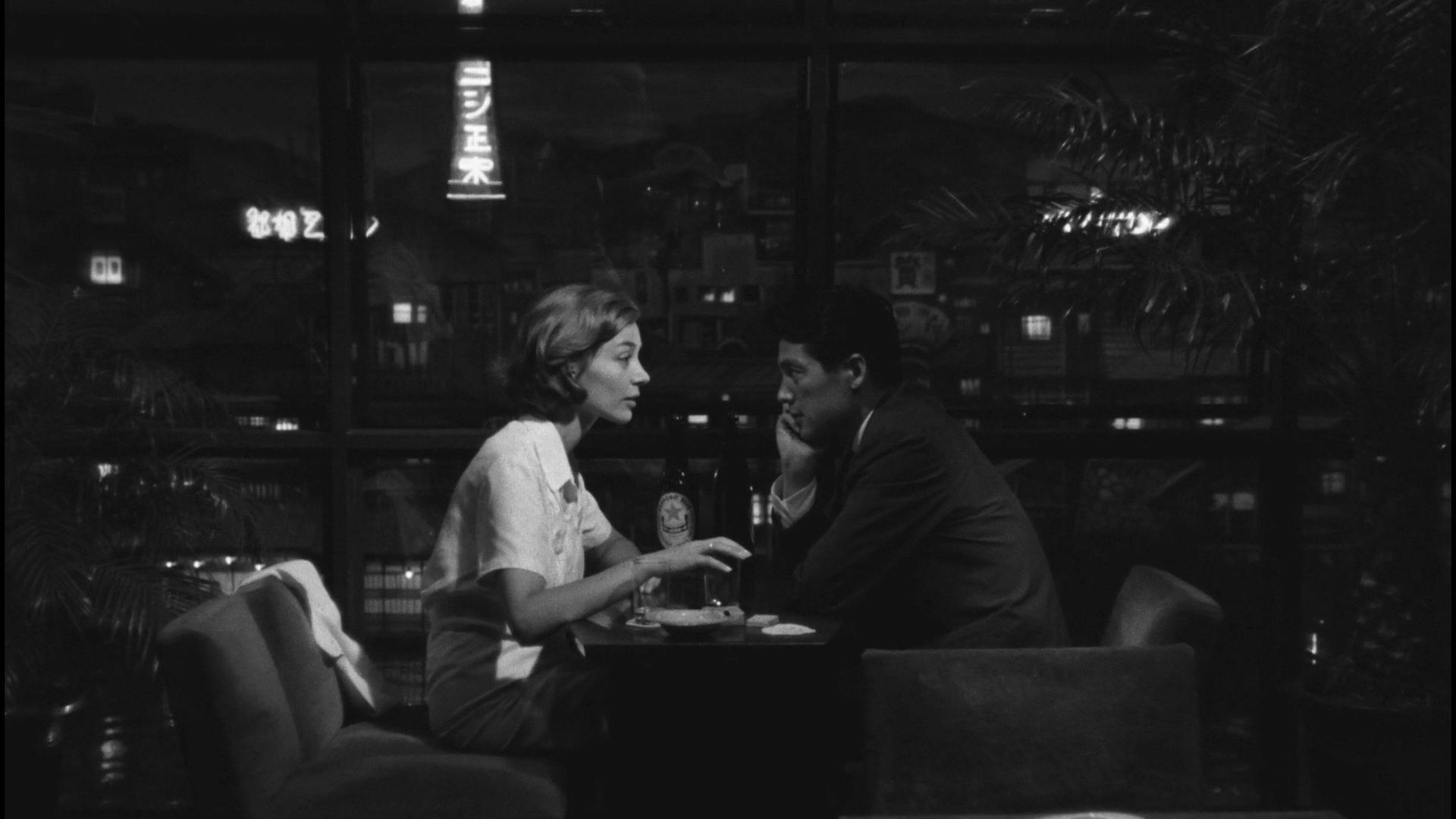
In an essay on the fiction of Laszlo Krasznahorkai, “Reality Examined to the Point of Madness,” James Wood discusses the Hungarian novelist’s sentences – “very long, breathing, unstopped… at once literary and vocal” – as akin to those in the work of many contemporary experimental fiction writers: among them Thomas Bernhard, Jose Sarramago, W.G. Sebald, Roberto Bolano, David Foster Wallace, and Claude Simon. He briefly draws attention to the way that Bela Tarr’s film adaptations of Krasnahorkai’s fiction create long, winding tracking shots that are in effect carrying out some of the serpentine, exhausted, repetitive looping achieved in these sentences. The extended, wordless shots of Elle moving through the hotel space in Hiroshima, Mon Amour seem to create a temporal pressure field where “relentless mental distortions”, with no clarification or verbal articulation, are taking place.(242) I shall borrow a portion of one of the Krasznahorkai sentences Wood quotes from his novel, War on War ,to indicate what kind of confounding, internal noise may be afflicting her in the hotel corridor. She is being broken open by something that can’t lead to clarification or cessation. It is like being carried around and around in the thinking equivalent of a bomb blast: “the fact that he now realized that he had not understood it did not mean that he did understand it now, because being aware of his lack of knowledge was not in itself some new form of knowledge for which an older one can be traded in, but one that presented itself as a terrifying puzzle the moment he thought about the world, as he most furiously did that evening, all but torturing himself in the effort to understand and failing, because the puzzle seemed ever more complex and he had begun to feel this world-puzzle that he was so desperate to understand was really the puzzle of himself and the world at once, that they were in effect one and the same thing…”(242-243) The progression of Elle’s back and forth movements in this poisonous atmosphere where everything exudes false stability and a crazed need to cover over and hide what won’t stay hidden is a notching out of palpable moments, where everything reached for is falling through. As Louise Gluck words it in her poem “Telescope,” “a place where human life has no meaning…You see again how far away each thing is from every other thing.”(550)
The apparent logic of the lengthy confession scene and its calm acceptance and acknowledgment in the cafe by Lui is that these lovers in their past respective spheres of war can join their memories to make war devastation of different sorts a common, decipherable possession. I admit that my early viewings of the film led me to an admiration that didn’t quite arrive at love because the retelling of the Nevers trauma and other blocks of poetic utterance seemed a little too comfortably ensconced in language virtuosity, making verbal sense of the incommunicable, artfully fencing with questions and abstractions where more gaps, impasses and failures in verbal expression might be warranted. But an unexpectedly fierce encounter with the hotel scene and its prolonged exposure of Elle (and the viewer) to wordless, unhinged lostness led me to reconsider everything that was going on. This episode, not too often discussed in commentary on Hiroshima, Mon Amour, struck me as the film’s center of gravity, its point of maximum, unresolved tension. Its primary purpose, I think, is to undo all the assurance achieved by Elle and the viewer in her version of the “talking cure.” Resnais and Duras suggest in this segment that as one understands more about what has happened to oneself in war, through confrontation with trauma, one is still tragically at a loss about what happened beyond the circumference of one’s own suffering experience. The bridges that retrieved speech provides to war survivors from elsewhere are fragile and dubious, and prone to collapse. The idea of a collective conscience and mutual recognition in relation to war’s innumerable dehumanizing brutalities is likely a consoling fiction.
Elle’s encounter with a different mode of revelation in the Hiroshima hotel, whatever it consists of beyond massive, unreasoning vulnerability and a need to escape, does not give one a perspective that lasts. I shall cite cite another poet, Rebecca Elson, who takes me close to the substance of “revelation” in this dark breakthrough scene, which leads to a death-laden suspension in time, then regression: “They are terrifying these mushrooms, the way they push up/overnight,/And spread, and you know they are feeding off decay,/That death is just below the surface, just, and they grow so fast/Like a cancer, I would go out into the night, as in a nightmare,/And rip them up, and scatter them, with my bare hands,/ But the death would still be there.” (68)
Let us wind back to the commencement of Elle’s walk through the hotel, considering with more precision what the images present to us and what we might infer from them as Elle succumbs to dart after dart of frightening displacement. We watch her climbing a flight of stairs in the hotel from bottom to top. Above her as she walks is a white accordion-like underside of another flight of stairs. She picks up speed as she ascends. I think that our likely emotional response to this upward movement, viewed from overhead, is positive. One might recall that it reverses the movement of her Nevers confinement as a madwoman in the cellar. But we may also register that this is a Hiroshima hotel, in which the design encourages visitors to lose contact with the foundation, the unspeakable past eruption and evaporation at ground level. A contrast seems to be enforced throughout this interior journey between Elle’s layered, storied trauma, which we have observed at length and at close range (both as past and present image representations) and the truth of nuclear evaporation. The camera glides to the right rather than cuts as we observe, now from behind, Elle walking beside a railing into a large, open space containing sizable chairs suitable for relaxed discussion among travelling strangers.

Before she arrives at this background area, the camera cuts to an extremely long hotel corridor. The viewer/camera placement is near the end of the corridor, very distant from Elle’s initial position . The corridor is illuminated by a series of overhead fluorescents but there is a quality of darkness in this space that the illumination is insufficient to disperse. Elle heads toward us at the beginning of the shot with its emphasized separation from us at the other end of the corridor. It is at this point that one becomes attentive, perhaps enfolded in the stretched time aspect of our involvement with Elle’s advance to her hotel room. We are made to witness every step she takes, ratified by the heel sound, and she appears purposeful, sure of what she’s doing. Her hands wave a little to steady her as she moves along. As she makes progress, she further accelerates, moving closer to the lefthand corridor wall and (no doubt unthinkingly) clutching her jacket which is bunched up in her left hand. There is something vaguely disquieting, even hostile about the indented series of doors in the corridor, separated from one another on the left by a large blank space of whiteness. Although not highlighted, the effect of the row of doors may lead us to recall the anonymous sterility of these interchangeable thresholds to “oblivion” bed chambers, with their invitation to secrecy and repose. The camera imperceptibly retreats a little to reveal the doorway of Elle’s room on the leftside of the corridor. We can make out the number 118 and see that she has been holding the key in her hand throughout her approach.
As she flicks on a light switch and opens the door we cut inside, with the camera planted just behind her bed. The room, with its two large, turned away chairs and its neatly stacked pair of suitcases by the door has been tidied up in her absence. The bed especially indicates the careful removal of any trace of prior activity or disorder. How smooth it looks. The room announces its emptiness and impersonal cleanliness with equal force. Elle, surprisingly, is brought to an abrupt halt at the edge of the doorway. Her speed and purpose break off, as the door slowly swings in and the sound of cicadas makes the space audible; it begins to hum. She takes an irresolute step forward, then, without seeming to know why, turns around and returns to the dark hallway. The lower portion of the door creates a lighted venetian blind pattern on her legs as the door closes. We are momentarily left alone in the room with the expanse of the well-made bed stretching away from us. Elle fails to shut the door more than half-way. We hear her heels retreating at what seems a steady pace but we briefly lose visual contact with her. The next cut places us at base of the now somewhat darker stairway that we previously watched her climb from above. We spot the lower portion of her body descending the stairs. She is now situated closer to the left side railing, as if to insure stability. Her way of descending the stairs is halting, and we can see her uncertainty about what she is presently doing.
It is at this juncture that I found myself recalling that Elle is occupying a grand, well-appointed hotel establishment in Hiroshima, and that she is unnervingly alone there. She comes to a stop several times before reaching the bottom of the staircase, and in fact pauses as the camera cuts to a medium shot inspecting her face as she contends with some form of confusion and indecision. Suddenly she elects to go back the way she came and impetuously runs up the stairs as if to prove she has a clear goal now, and has made up her mind where she needs to be. We view her again in stationary long shot as she races up the stairs and disappears. The impassivity and formal silence of the stairway and the windowed wall resting apart from it assert themselves here in counterpoint to Elle’s loud, frantic heels. Our next view of Elle reveals her having passed partway down the corridor. She is once again in medium shot, has slowed her pace to a pensive walk, and seems to be in a dazed, tranquil mood, half-smiling as she holds her jacket with both hands, at waist level. She begins her walk centered in the corridor, but as she moves forward she drifts over to the left side wall and reaches out to it for support. Her movement then becomes a back and forth swaying. She has lost the directness of her previous straight line. Elle appears caught in some unfocused thought.
Hiroshima is an ordinary hotel corridor in which one can walk along indefinitely and try to get one’s bearings and possibly elect to enter a room which has previously held her and her Japanese lover in a reviving transport of feeling. But he has vanished, as if in a quiet bomb blast. Perhaps before evaporating in death he lay beneath her like the dead German lover on the Nevers quay. His heart too is late to the dance of the living. As Elle comes close again to the door, she may be returned to her customary quandary: desiring equally to grasp something, anything for real and to let go, to cling to a lover in what one hopes will be significant, penetrating present time and to consign the encounter to oblivion, like so much in the ended, unending war. We are near the place where Elle’s capacity to think at all coherently disintegrates and shards of agitation run riot, a mighty, swelling panic of losing oneself utterly, of blotting out. What is visualized is her staggering as she nears the door of her imagined destination. The light spills out into the hall because the door is still open. She glances in, abruptly turns to face the wall opposite, crosses over and presses against the facing door , her head a silhouetted shadow, gazing at the alien white bundle of her jacket as though it were trying to communicate. She then crosses to the other wall, pressing against the white space beyond her door, begins to weep quietly and then escapes the frame entirely, moving forward. We remain gazing at a bare stretch of wall, a light switch and a thin, long streak of pale light from the door of her hotel room. We hear an explosive sigh, register the presence of her shadow returning along the wall to her room. When she reappears she goes once more to the wall opposite her assigned space and stares into it, attempting to coax the hidden, spotless life and death elements to make some sort of sense.
After the indelible, unspeakable explosion, this – an invitation to linger, try out various gestures, enter the precincts of serenity, security. Hotel light and bomb light, twinned. She finally grabs hold of what feels like courage and clarity. She runs through the doorway, flings her jacket on an armchair, hears the piercing voice of a cricket as she enters her bathroom. She meets her gaze in a steadfast Hiroshima bathroom mirror, surrounded by artificial brick tiles, and turns on the water tap from the sink. We hear the rush of water for a number of seconds before we see it. Then in a shock cut close up we follow the descent of her hair, hiding her face, as she plunges, like a human shelling, into the sink filling with water. The metal tap, rigidly functional, defines the left edge of the frame. When she lifts her head out of the sink within the same close up, her face is restored to us. As she hovers there, poised somewhere between anxiety and a trance of composure, music is heard, bright and crisply inviting. Elle’s voice returns as mental thought which soon converts to spoken speech. She feels she is able to speak the truth she has just faced and laid hold of to her mirror image, not so far removed in appearance from the lost mad girl in the cellar. She seems to be reciting a protective poem , confiding to her dead lover that their imagined future is cancelled out. In the course of her reverie she immerses herself in the water a second time, trying to turn Nevers into the properly buried past and Hiroshima into a constructible future. “You think you know, then you don’t.” In her address to her dead lover, returning from direct speech to audible thought, she lets him know that she has told their story. Then shifting back to taunting speech she asserts, against all odds, that she has “found an impossible love again.” She repeats, in audible thought, as if invoking a charm, the words, “Look how I’m forgetting you. Look how I’ve forgotten you.”

It strikes me that what she isn’t conscious of, as she wills herself to the threshold of a decisive, emancipating new relation to her life, is that she has retreated from Hiroshima to the known displacements and maneuverable memory privations of Nevers. She believes that she is saying farewell to Nevers while in fact drawing on it for restored self-possession. She wipes her face off with a towel, and we sharply cut to a long shot view of her high up on the second flight of the Hiroshima hotel stairway, which, as a very small figure, she descends with rapid, seeming confidence. A small segment of the screenplay that was not filmed, following the mirror speech, goes as follows, “Through the open window, we see the new Hiroshima, peacefully asleep.” Duras goes on to characterize, harshly, Elle’s final sense of her achieved condition as she concludes her speech to mirror and lost soldier. “She sees her wet face in the mirror—like tears—grown old, haggard. And this time, disgusted, she closes her eyes.” (75)
Reflecting on memory’s mode of time preservation in his early text, Contre Sainte Beuve, Marcel Proust talks about how experiences condense into a single object related to their significance, creating both a hiding place and a place of captivity. “What intellect restores to us under the name of the past is not the past. In reality, as soon as each hour of one’s life has died, it embodies itself in some material object, as do the souls of the dead in certain folk-stories, and hides there. There it remains captive, captive forever unless we should happen on the object, recognize what lies within, call it by its name, and so set it free.”(19) If there is an object in the hotel episode in which its enigmatic power is embodied, I would nominate the white jacket which Elle clutches without really seeing until her rush to the bathroom, when she finally flings it onto a chair. I think of it as crumpled white blankness, but more pointedly as a removed covering. The repeating submergence of Elle’s face in the sink water obviously has associations with baptismal cleansing, but I think it is more fitting to think of the water as Lethean. In the underworld river Lethe, the newly dead were required to drink from or bathe in the waters of the river so as to erase from memory, as though it had never been, their mortal existence, with all its marks of identity and earthly trauma. Oblivion as a calm effacement. “Look how I’ve forgotten you.”
The hotel walking scene and the bathroom aftermath provide the only close linkage with the surrealistic images of ash-coated lovemaking that begin the film, which Duras’s screenplay describes in the following fashion: “All we see are these shoulders—cut off from the body at the height of the head and hips—in an embrace, and as if drenched with ashes, rain, dew or sweat, whichever is preferred. The main thing is that we get the feeling that this dew, this perspiration has been deposited by the atomic “mushroom” as it moves away and evaporates. It should produce a violent, conflicting feeling of freshness and desire.”(15) In Elle’s prolonged spell of frantic obliteration, the initial lovemaking, coated by the erasing agents and residue of the bomb blast, returns to us in a different, but similarly wordless key. In the film’s opening conversation, in the aftermath of lovemaking, the lovers both attest that their experience has revived something in them, an enlargement perhaps of their customary sense of being in (and out) of time. But the film doesn’t quite endorse their positive assessment. It is, on the one hand, a galvanizing dislodgement from the space of hurtful knowing. The time of holding on and letting go is a devouring and a cessation of pain. But the feeling of being bound together is also a spilling out into nothingness.
When Elle undergoes what she takes to be her recovery in the bathroom, she imagines there has been a willed fading out of the dead German lover and all the privations that came in his wake. She thinks she has successfully exchanged him for Lui in Hiroshima, which she now genuinely occupies, who has restored her belief in a possible future. Her destination when she departs the hotel is the café where she told Lui her story of Nevers and agreed to separate from him. She fades out of the image like an apparition as she leaves the hotel area. We find her again after we locate the deserted cafe, sitting outside on a pile of gravel, limbs immobile, awaiting – perhaps hopelessly – Lui’s return. Passing cars provide sounds and brief bursts of light. Elle is now clad again in the white jacket that she previously carried. Her attitude of liberation and escape is combined with renewed adoption of covering.
The café bar is now closed, the flags over its door insensibly waving in the night breeze. Her misconception here is that she has chosen a new mental place to dwell in and a fresh story to hold onto. What, for Elle, is the difference between bringing love and war near to herself? In both cases it is akin to having your so-called internal possessions lashed to a runaway cart, thundering downhill. Her wish to have Lui re-materialize is granted, but what she is making contact with is not his separateness from Nevers but his intimate connection with it. He now holds the form of her story of displacement and mad entrapment inside himself, giving it order and sense, and has assumed as well the ghostly identity of the lost soldier. He is the secure, ongoing past of trauma disguised as the future. When he tells her, upon finding her, “Stay in Hiroshima” she replies, “Of course I’m going to stay, with you, in Hiroshima,” though she is speaking to him now in what sounds like the voice of a child. She has already severed her ties with her hotel breakdown, and the insupportable kind of absence the Hiroshima onslaught brought with it. The camera angle at this juncture is taken from above the standing figure of Lui, with his back to us. Elle looks small and defenseless on her rockpile below him. As she buries her head in her hands, she quickly interjects, in her newfound child’s voice, “Oh, I’m so miserable.” In a few moments she will sharply order him to “Go away.” Like a Beckett character, he has nowhere else to go. We will leave them here, together and separate, in a time pocket that is less jagged, and that grants us full permission for detachment.
My argument throughout this essay has been that our most memorable “close encounters” with time in film involve not only a sense of lost control but a feeling that we ourselves have become the helpless clock pinning a character ever more intensely to the insidious pressure of time recognition and wounding. We are caught inside the complex effects of palpable marching moments, and share the exposure and vulnerability of the characters, as they teeter on the verge of decisive perceptions and broken withdrawals. Time forms the thread, of course, on which all our experiences are strung, but as with our contemplation of a string of pearls, the time string that links them is seldom visible. It can be argued that other viewers may not feel the same degree of exposure, violation, entrapment in the time sense in the film scenes I have dealt with at such length. My recommendation then would be to locate scenes in viewing memory in which similar ruptures and a sense of caughtness have occurred, with attendant complicity in a character’s time-pierced plight. The examples I’ve delineated involve an acute feeling of a clock ticking forward as we are bound to characters grappling with their too present, pressing mortality, an awareness of time being used up and erasing them—by extension, ourselves along with them. There is an unanticipated paring away of our customary insulation, our ways of being protected by our faith in remaining temporal possibilities. What goes missing, briefly, is our mental picture of time as an expanse we have left to repose in. It becomes rather a force of whirlwind dwindling we cannot constrain.
With respect to the “recognition scene” aspects of these episodes, I believe they do not lead to interpretive mastery. For Northrop Frye, recognition scenes in literature allow the reader/viewer to find a “unifying shape,” the overall form and thematic coherence of a narrative. For me, helpless clock experiences are more about brokenness and confusion than lighting upon a pattern that unifies. We become aware, at a deeper than customary level, of the terror of belonging to time, of being its pawn or plaything. In acknowledging such instances of helplessness, our ability to read a film’s meaning may shift decisively in the direction of uncertainty, and a distraughtness that does not relent. The jolt of kinship in a time disruption does not need to be as sustained or connected to other narrative elements as those I’ve investigated. As a farewell image, let us consider the sight of Henry Spencer (Jack Nance) in David Lynch’s Eraserhead (1977) lumbering with his great bowl of hair atop his head and his ill-fitting suit toward the antique elevator, located in the desolate, sepulchral foyer of his run down apartment building. He is clutching what seems to be a brown paper grocery bag, suggesting that, with his customary apprehensive blankness, he has ventured into the industrial wasteland outdoors to run an errand. He presses the button to activate the elevator and two grim, black elevator panels cooperatively open to admit him. Successful in his elevator interaction thusfar, he presses a second button inside to make the elevator doors close and the cage to commence its ascent. No immediate evidence of response. Henry seems condemned to wait, alongside us, forever for the elevator action to start or firmly refuse to. Our experience of the film thus far, still in its very early stages, has already been teeming with long intervals of waiting, in what feels like “dead time,” for one foreboding, enigmatic image to give way to another, and we are denied the sense of readable cause-and-effect. At last, after a release of disquieting electronic sounds, the elevator responds to Henry’s intention and begins slowly to perform its assigned function. But the release from stalled time is not a release. Time in this scene feels both dead and visceral. It squeezes us. Henry’s destination is likely his apartment home, but he strikes us as inherently homeless. Where might the elevator be conveying him? In the interim of helpless waiting we have had time to consider the possibility of Henry entombed in this elevator, stuck somewhere in transit, or rising only to crash into nothingness because there is not enough energy anywhere in this film’s world to keep any ordinary human operation going up. Time is a destroying angel, and Henry, bearing his blank regard for whatever misery comes next, dwells in what appears to be almost the aftermath of time movement. We may well feel, in the starless sky of Henry’s landfill world, unwelcome kinship with what Edwin Frank has termed the “interior disaster that it is to be a person.”(167)
Works Cited
Cave, Terence. Recognitions: A Study in Poetics, Oxford: Clarendon Press, 1990.
Cavell, Stanley. Contesting Tears: The Hollywood Melodrama of the Unknown Woman, Chicago: The University of Chicago Press, 1996.
Creeley, Robert. For Love: Poems 1950-1960, New York: Charles Scribner’s Sons, 1962.
Duras, Marguerite. Hiroshima, Mon Amour, for the film by Alain Resnais, translated by Richard Seaver, New York: Grove Press, Inc., 1961.
Elson, Rebecca. A Responsibility to Awe, edited by Anne Berkeley, Angelo de Cintio and Bernard O’Donoghue, Manchester: Carcanet Alliance House, 2018.
Frank, Edwin. Stranger Than Fiction: Lives of the Twentieth-Century Novel, Dublin: Fern Press, 2024.
Gluck, Louise. Poems 1962-2012, New York: Farrar, Straus & Giroux, 2012.
Huxley, Aldous. The Olive Tree and Other Essays, London: Chatto & Windus, 1947.
Posnock, Ross. Renunciation: Acts of Abandonment by Writers, Philosophers, and Artists, Cambridge: Harvard University Press, 2016.
Proust, Marcel. Marcel Proust in Art and Literature, 1896-1919, translated by Sylvia Townsend Warner, Greenwich: Meridian Books, 1958.
Richardson, Robert D., William James: In the Maelstrom of American Modernism, Boston: Houghton Mifflin Company, 2006.
Rode, Alan K., Michael Curtiz: A Life in Film, Lexington: The University of Kentucky Press, 2017
Wexman, Virginia Wright and Hollinger, Karen, editors, Letter From an Unknown Woman: Max Ophuls, Director, New Brunswick: Rutgers University Press, 1986.
Wood, James. Serious Noticing: Selected Essays 1997-2019, New York: Picador, 2019.
Smith, Zadie. Feel Free: Essays, Toronto: Penguin, 2018.
George Toles is Distinguished Professor of Film and Literature at the University of Manitoba. He is the author of A House Made of Light: Essays on the Art of Film, Paul Thomas Anderson, and Curtains of Light: Theatrical Space in Film. Toles has written or co-written the screenplays for numerous feature films made by Canadian director, Guy Maddin. These include Archangel, Careful (which was recently restored in 4K), Twilight of the Ice Nymphs, The Saddest Music in the World, Brand Upon the Brain, My Winnipeg, and Keyhole. He also wrote the story and original screenplay for Canada’s first stop-motion animated feature film, Edison and Leo. His Status Update (At Bay Press, 2021), illustrated by Cliff Eyland and edited by Thomas Toles, collects the mini-narratives that the author has been posting on Facebook every day since 2009. A second collection, entitled All the People in My Head, is forthcoming from At Bay Press.
Masterful work
I suspect that the profundity of this essay will become even more apparent with additional readings. But after just one reading, its analysis of the experience of time in movies already impresses. It has been too long since I last saw HIROSHIMA to weigh in on your conclusions about that film and longer still since I last saw BRIGHT LEAF, so I’ll just comment on the issue of “too lateness” which you raise, a recurring theme in both fiction and film, as your readings of LETTER FROM AN UNKNOWN WOMAN and BRIGHT LEAF make clear. (“If only…” and “ever not quite” seem to similarly express those feelings of ephemerality and regret contained in “too lateness”.) The potentially devastating effect of being or realizing something too late derives from missing an opportunity or (in keeping with your theme) failing to utilize time to its greatest advantage. The tragic implications of such a realization are fully captured in LETTER when Stephan concludes the letter. I am grateful for your reading as it captures that tragic component (“devastating awakening to time”), one apparently not grasped by Clavell, whose reading I disagree with strongly. He in fact seems to be actively resisting the film’s tragic implications when he assesses the images of the past that Stephan recalls as “banal”, a judgment made possible only by ignoring the dramatic contexts in which they are presented to the viewer (not to mention their aesthetic appeal). Moreover, if we take the images that Stephan immediately recalls after completing the letter as part of a larger series where Lisa regresses in age, culminating with the image of the adolescent Lisa holding the door, the series implies a fundamental aspect of Stephan’s psychology: beginning with an image of the mature Lisa and ending with her at her most virginal, the series underlines the importance of virginity to Stephan’s sexual aims. (Lisa is juxtaposed with a statue of the Virgin when he first notices her as an adult.) Banal indeed.
I feel certain that I will consult this essay regularly in the future. Congratulations on your achievement! (Oh, and great photos for illustration.)