

By Christopher Weedman and Brian Wilson, with Film International Staff and Correspondents
Williams left behind a body of work remarkable in both its size and scope, as well as a rich legacy of students, colleagues, and friends….”
Updated 17 September 2026
On the evening of April 10, 2026, the world lost one of its most incisive film critics as well as a longtime contributing editor of Film International (2016-22). Tony Williams passed away at the age of eighty. Throughout his six-decade career, Williams was a tireless scholar and a true lover of the cinema in all of its forms. He left behind a body of work remarkable in both its size and scope, as well as a rich legacy of students, colleagues, and friends impacted by his significant contributions to the field of film studies.
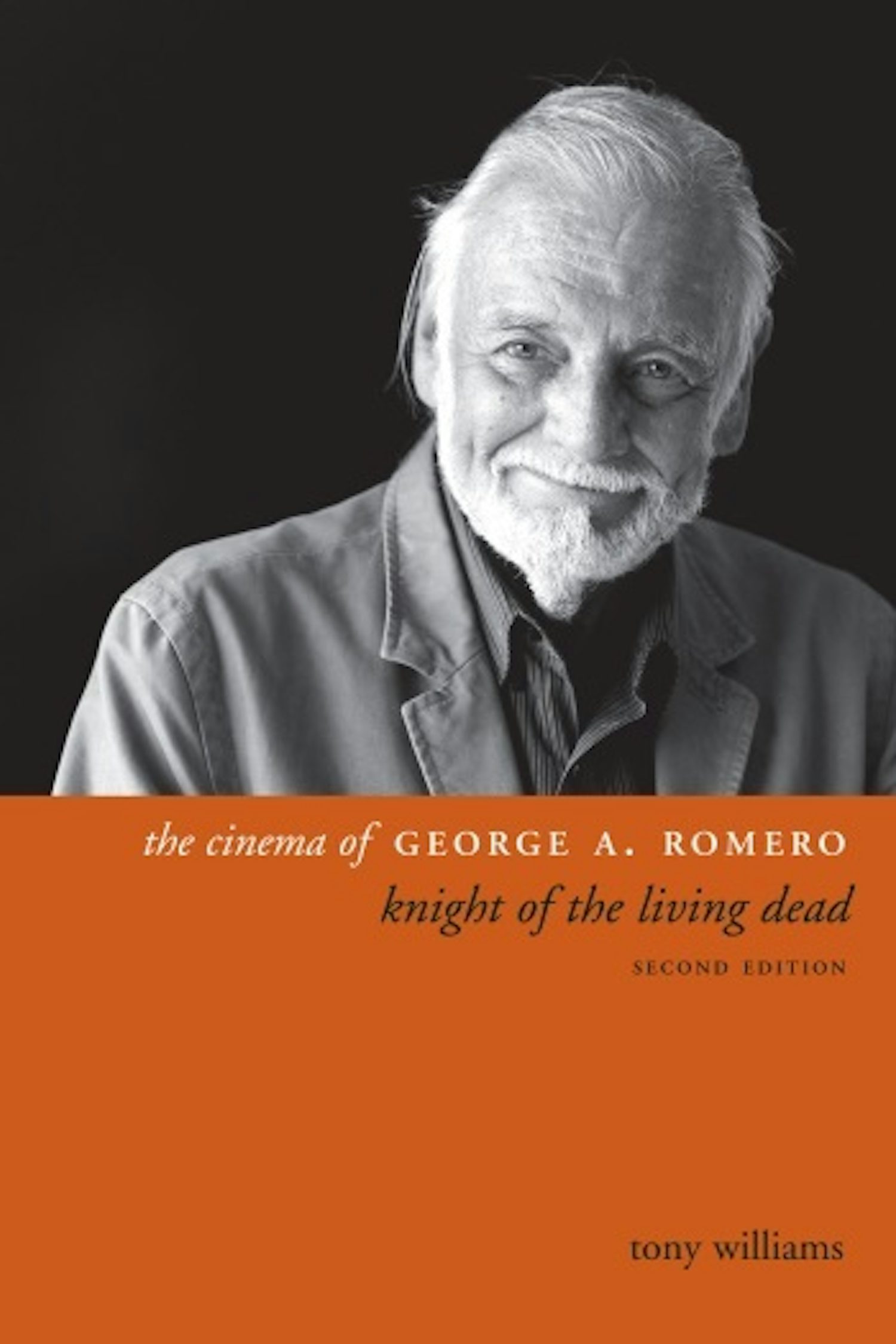
Williams was very private about his personal life. Born in South Wales in 1946, he moved to Manchester, England in 1967 to pursue his education at the University of Manchester. Despite his lifetime devotion to film, his first formal area of study was theology, in which he earned a Ph.D. in 1973. Two years after graduation, in 1975, he co-authored his first book, Italian Western: The Opera of Violence, with his friend and University of Manchester classmate Laurence Staig.
The following year, in 1976, Williams moved to Coventry, where he enrolled in the M.A. in Film Studies program at the University of Warwick under legendary film critic Robin Wood. The time he spent under Wood’s tutelage was a pivotal turning point in his critical development. Not only would Williams learn a considerable amount from Wood’s approach to analyzing the films of classical Hollywood directors such as Howard Hawks and Alfred Hitchcock, but he would also cultivate a greater attention to marginalized voices operating within American and international cinema. Williams’ film criticism rarely exhibited the autobiographical tendencies seen in Wood’s influential body of work, but, nonetheless, he always regarded this mentorship as one of the most important chapters of his life.
During this period, Williams published multiple articles in the British journal Movie alongside such prominent critics as Ian Cameron, V.F. Perkins, and Warwick classmate Andrew Britton. He was also invited by Wood, Britton, and Richard Lippe to participate in one of the first major horror film retrospectives at the Toronto International Film Festival in September 1979. Following the festival, Williams contributed “Assault on Precinct 13: The Mechanics of Repression” to The American Nightmare: Essays on the Horror Film (edited by Wood and Richard Lippe).
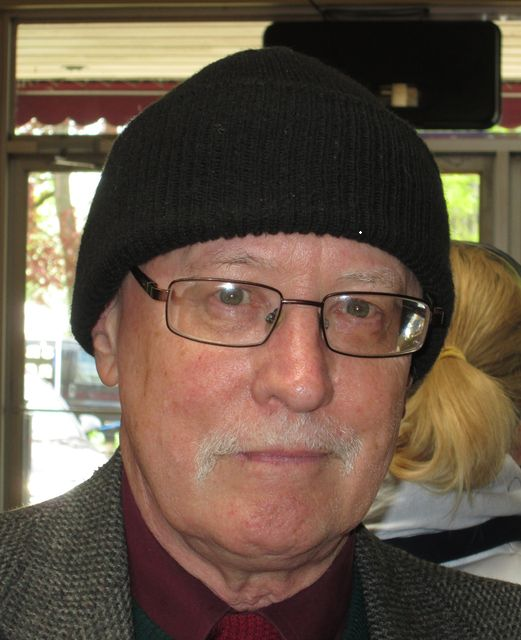
Williams relocated to the United States in 1984, finding a home at Southern Illinois University, Carbondale (SIUC). He spent a decade in SIUC’s Department of Cinema and Photography, before later moving to the Department of English, where he remained a strong presence until the day he died.
His interests were eclectic, ranging from the literary naturalism of Émile Zola and Jack London to opera to the zombie films of George A. Romero. He could speak as fluently about Korean horror or Russian silent cinema as he could about Sam Peckinpah or Stanley Kubrick. During his life, he published literally hundreds of essays and wrote or edited more than a dozen books, with topics including representations of Vietnam in literature and film, Hong Kong cinema, classical Hollywood, and the role of the family in the American horror film. Fittingly, Williams’ final book comes full circle, a revisiting of the Italian Western film. It will be published by BearManor Media later this year.
Tony Williams could be a difficult person to get to know personally. He was deeply passionate in his interests and never shied away from a good-natured polemic. Nevertheless, Williams also forged deep connections with many of the creative people in his life.
We have invited several of those who knew him to share their memories as well as pay tribute to his formidable body of scholarship.
Tony Williams: A Select Bibliography
Books and Edited Works
Italian Western: The Opera of Violence. Co-written with Laurence Staig. London: Lorrimer, 1975.
American Nightmare: Essays on the Horror Film. Co-written with Andrew Britton, Richard Lippe, and Robin Wood. Edited by Robin Wood and Richard Lippe. Toronto: Festival of Festivals, 1979.
Jack London, The Movies: An Historical Survey. Los Angeles: David Rejl, 1992.
Vietnam War Films: Over 600 Feature, Made-for-T.V., Pilot and Short Movies, 1939-1992, from the United States, Vietnam, France, Belgium, Australia, Hong Kong, South Africa, Great Britain, and Other Countries. Co-edited with Jean-Jacques Malo. Jefferson, NC: McFarland, 1994. [Reprinted in 2012 as Vietnam War Films, Vol. 1 and 2.]

Hearths of Darkness: The Family in the American Horror Film. Madison, NJ: Fairleigh Dickinson University Press, 1996. [An updated edition was published in 2014 by University of Mississippi Press.]
Larry Cohen: The Radical Allegories of an Independent Filmmaker. Jefferson NC: McFarland, 1997. [A revised edition was published in 2014 by McFarland.]
Jack London’s The Sea Wolf: A Screenplay by Robert Rossen. Co-edited with Rocco Fumento. Carbondale: Southern Illinois University Press, 1998.
Video Versions: Film Adaptations of Plays on Video. Co-edited with Thomas L. Erskine, James M. Welsh, and John C. Tibbetts. Westport, CT: Greenwood Press, 2000.
Structures of Desire: British Cinema 1939-1955. Albany: State University of New York Press, 2000.
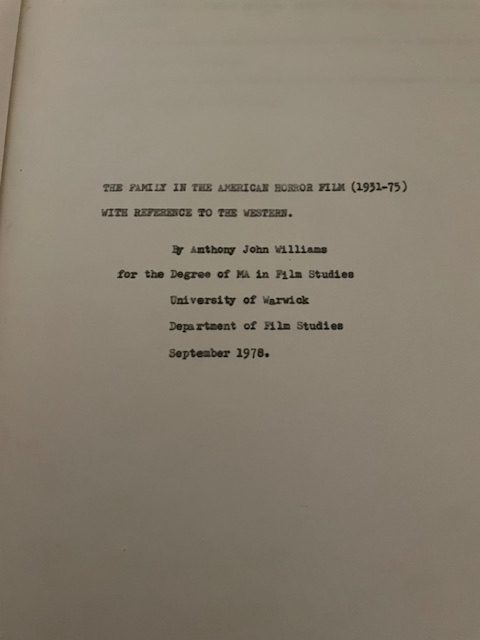
The Cinema of George A. Romero: Knight of the Living Dead. London: Wallflower Press, 2003. [An updated second edition was published in 2015 by Columbia University Press.]
Body and Soul: The Cinematic Vision of Robert Aldrich. Lanham, MD: Scarecrow Press, 2004.
Horror International. Co-edited with Steven Jay Schneider. Detroit: Wayne State University Press, 2005.
John Woo’s Bullet in the Head. Hong Kong: Hong Kong University Press, 2009.
George A. Romero: Interviews (edited). Jackson: University of Mississippi Press, 2011.
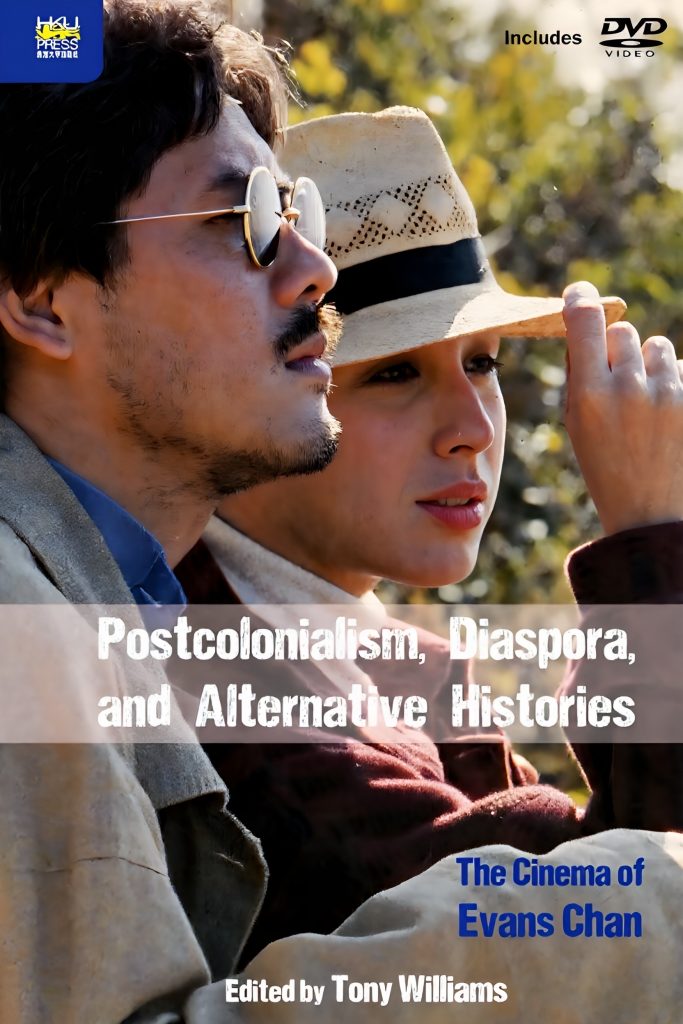
Postcolonialism, Diaspora, and Alternative Histories: The Cinema of Evans Chan (edited). Hong Kong: Hong Kong University Press, 2015.
James Jones: The Limits of Eternity. Lanham, MD: Rowman and Littlefield, 2016.
Hong Kong Neo-Noir. Co-edited with Esther C.M. Yau. Edinburgh: Edinburgh University Press, 2017.
Gothic Peckinpah. Liverpool: Liverpool University Press, 2024.
Italian Western: Rounding the Circle. Orlando: BearManor Media (forthcoming, 2026).
FilmInt Editors:
Matthew Sorrento, Editor, FilmInt Online
Of my many interactions with Tony Williams, as his editor at FilmInt Online and the print version for years, one stands out in memory. When republishing an excerpt from his 2016/1997 study, Larry Cohen: The Radical Allegories of an Independent Filmmaker, after Cohen’s passing in 2019, over email Tony and I stumbled across the topic of Harlan Ellison®. As Tony recounted, when his book on Cohen was first published, he received a surprise request from his publisher to speak with the author. Harlan greeted Tony on the phone with heartfelt thanks for writing the first book on his dear friend, Larry. Tony’s description of the talk sounded much like what other authors, both established and aspiring, have received from the short story master. And true to form, Harlan didn’t come just for the pleasantries – he had some concerns with the accuracy of a few passages. It sounded like the close reading he would give to any work of interest.

I found the anecdote intriguing, since I had a similar experience with Harlan, when I wrote about Erik Nelson’s 2008 documentary Dreams with Sharp Teeth (named after one of Ellison’s omnibus collections). Harlan asked me to call him and went over my review, published at Identity Theory, to correct some points and boost the style of some others. Normally I wouldn’t let a subject mold a piece like this, but as he said, it was his life, and as much as he loved the review, he wanted it to be in top form. I was even more shocked when Harlan called me unexpectedly six months later, after I published a review of a reprint of his film criticism collection, Harlan Ellison’s Watching, offering nothing but adulations.
I often think of the spirit of Harlan when Tony comes to mind. Though not working in fiction, Tony had the same burning passion for the arts, sharing an encyclopedic knowledge and perception. My countless email exchanges with Tony reveal such insight and passion. And like Harlan, Tony wouldn’t hold back from conflict, as I had experienced personally on a few occasions. Most of the time it was in pursuit of the truth, and for that and his countless contributions to cinema scholarship, we honor one of the last Brit film studies expats. Quite a legacy.
Matthew Sorrento is editor of FilmInt Online and The Journal of NoirCon, and he teaches film studies at Rutgers-Camden. He regularly contributes to NOIR CITYMagazine, Film Quarterly, Nightmare Magazine, and other publications, along with introductions for Stark House Press crime classics and booklet essays for Arrow Video. His latest books are Becoming Nosferatu: Stories Inspired by Silent German Horror and David Fincher’s Zodiac. He is editorial director of Channel Academic Publishing, a scholarly imprint of BearManor Media, which launched in Summer 2026.
Alexandra Heller-Nicholas, Contributing Editor
Like a good little feminist horror scholar, I came of critical age at university with now-canonical staples like Carol J. Clover’s Men, Women and Chain Saws: Gender in the Modern Horror Film (1992) and Julia Kristeva’s Powers of Horror: An Essay on Abjection (1980). But Tony Williams’ 1996 book Hearths of Darkness: The Family in the American Horror Film will always – appropriately – have a special place in my heart. Much of my early academic research was a feminist approach to horror through the lens of Peter Brooks’ melodramatic imagination, which inescapably put the domestic sphere well and truly in my critical line of fire. And along with Vivian Sobchack’s 1996 essay “Bringing It All Back Home: Family Economy and Generic Exchange,” Tony’s book became a sturdy, trusty and oft visited and revisited primary text. It became an old friend, and – through his confident yet engaging writing voice – in a way, so did he. Flipping through my very well-worn (and well-loved) copy with the sad news of Tony’s passing, I can’t help but be struck by how relevant and contemporary it still feels. As he noted, the family horror movie is “a warning” that “reflects the world outside,” and “it maintains its role as a symbolic alarm bell of our era’s internal and external problems.” In a time where it often feels like the only sounds we hear are alarm bells – day in, day out – Tony’s work in general and Hearths of Darkness in particular is a poignant reminder that horror has always been a space where the micro-reality of living in interesting times can play out in the most compelling, challenging, and confronting of ways.
Alexandra Heller-Nicholas is a contributing editor at FilmInt and is the author of ten books on cult, horror, and exploitation cinema and winner of the 2024 Rondo Hatton Classic Horror Writer of the Year Award. Her 2020 book 1000 Women in Horror (BearManor Media) was adapted in 2025 into a feature documentary from Shudder of the same name (directed by Donna Davies), and Heller-Nicholas also appears in Alexandre O. Philippe’s documentary Chain Reactions alongside Stephen King, Karyn Kusama, Takashi Miike, and Patton Oswalt, which won the Best Documentary on Cinema Award at the 2024 Venice Film Festival. Her monograph The Blair Witch Project: Josh’s Blair Witch Mix – An Absent Soundtrack Found is forthcoming from Channel Academic Publishing.
Robert K. Lightning, Contributing Editor
Although we never met (we were primarily social-media friends), I developed a strong personal connection with Tony Williams over a number of years. I first became aware of Tony through his writing in the Canadian film journal CineAction, to which he was a regular contributor and to which I too would become a regular contributor. Judging from his articles, it was easy to discern that he (like me) was a disciple of such scholars as Robin Wood and Andrew Britton, both members of the magazine’s editorial board or (as they identified themselves) collective, this acknowledgement of their allegiance to Marxist ideology doubtless appealing as much to Tony as it did to me. Later when I began to write for Film International, I discovered Tony was a contributing editor.
It was during this period that I got to know Tony better. (We also had a mutual friend, film scholar Christopher Sharrett.) He was a far more assured leftist than I was, and a far more knowledgeable film historian. He was also knowledgeable about all kinds of cultural ephemera, particularly British, and would share that knowledge in communications as if I had equal knowledge. (I hadn’t.) He seemed also to possess a gift for forming alliances and an equal tendency to alienate. I am happy to say that I was fortunate to remain in the former category.
There is not one acquaintance of his to whom I have spoken who has not mentioned his quixotic temperament. He often shared stories of his battles with both colleagues in academia as well as academic institutions. I can say with complete honesty that he never directed his anger toward me. In fact, his attitude regarding me was quite the opposite. Case in point: an essay of mine was once published in Film International (online) that gained some attention and a little praise. I was flattered but (very conscious of the essay’s flaws) reserved. Not Tony. His response (published in the comments section) was so enthusiastic it was more akin to cheerleading than scholarly contemplation. I was both embarrassed and deeply touched.
A final story will perhaps make clearer why I feel this loss very deeply. (For my ego’s sake, I have conveniently forgotten some of the details.) One of Tony’s books was about to be reprinted, and I was approached to review it. I embraced this assignment and looked forward to reading the book when it arrived. Unfortunately, when I had, I found it not to be one of Tony’s better efforts, both in terms of writing and scholarship. I fretted about what to do for a long time (it was too late to refuse the assignment, but I did not feel I could go forward with it without hurting Tony) until in a haze of subsequent chores my prior commitment faded from my mind. A long time later, the book’s editor reminded me of this episode of unprofessional behavior, and I decided to approach Tony with an explanation and an apology. But when I did, Tony (who seemed perfectly aware of the situation) essentially blew it off. If he had ever been offended, he had long ago digested those feelings and moved on. I was grateful that among his eccentricities was the ability to not hold a grudge. I’ll miss him.
Robert K. Lightning is a lecturer and media critic who resides in New York City. His monograph, Brokeback Mountain: History through Genre is forthcoming from Channel Academic Publishing.
Christopher Sharrett
Illness has prevented me from offering a fuller tribute to Tony Williams, a person of uncommon erudition. His accomplishments have been thoughtfully noted here by the people who knew him.
I am proud to say that he was my friend for almost forty years. We shared many interests: Dickens, the horror film, Sam Peckinpah among them. We also shared a contempt for the current manifestation of academe, now little more than an attachment to business. Tony could be hot headed—I was often a “Tony negotiator.” But as a Peckinpah character said, “II wouldn’t have it any other way.”
Christopher Sharrett is a professor emeritus in film studies at Seton Hall University.
Film International Contributors and Correspondents
Richmond B. Adams
The first occasion I had to be in Tony’s company was the opening reception for the English Department at Southern Illinois University, Carbondale during August of 2004. As he came to stand beside me, I introduced myself even as I was unsure of who was whom. In a smiling demeanor, Tony told me that he had “liked” my application, which indicated his role in my acceptance into the department’s doctoral program. From that moment until Tony’s death in April of 2026, I experienced what many of his other students have felt: unending support of my work while continuing to prod me toward broader analyses as to how a film portrays the cultural concerns of its period. Such prodding, however, often brought Tony into tension with those who did not grasp how, one might say, the aesthetic demeanor of a well-constructed argument constitutes the root of academic inquiry. While Tony exposed such disguised envy, he maintained the desire for students to develop comprehensive insights beyond our first assumptions. In doing so, he expressed a deep moral principle about the nature of intellectual life.
As some of his other students have indicated, it was Tony’s belief that films needed to be viewed as a multi-layered process which expressed cultural circumstances within a more traditional historical setting. Tony’s way of presentation, however, did not stop at the end of a given class period. By persevering with “the work,” Tony moved his students toward an understanding of our means of expressing those same moral principles, even while pushing us away from the all-too-real tendency among graduate students to develop a hero-worshipping academic cult of conformity that he absolutely despised.
I felt such a moral approach, or more accurately, his sense of vocational calling, during the fall semester of 2007 when I took Tony’s class concerning some of the films directed by John Ford. Not only did he schedule the class at my request, but he chose a text that scrutinized Ford’s underestimated 1953 film, The Sun Shines Bright. Tony never would have admitted it, but by choosing that particular film and text, he probably realized that when I watched Ford’s exposition of post bellum Fairfield (Paducah) Kentucky, a border city within a border state and only fifty or so miles from where I graduated from high school, its cultural complexities and codes would help to push my own burgeoning scholarship toward, as he said, a deeper and more “creative” means of understanding. In doing so, Tony’s quiet prodding has centrally shaped all my scholarly work over these last nineteen years. With Tony’s passing, I will greatly miss our conversations, and his non-stop prodding that were a part of them. I will also very much feel the absence of his British refinement, his defense of academic freedom, and his fundamental human decency toward myself along with others of us who fell among his orbit. Rest in peace, Tony.
Richmond B. Adams received his initial levels of education at the University of Memphis in 1984 and Vanderbilt University Divinity School in 1988. His first emphases on American history and its multi-faceted church movements enabled him to be admitted into the English doctoral program at Southern Illinois University, Carbondale, where he studied nineteenth-century American literature and graduated with a Ph.D. in 2011. With the encouragement of Dr. Tony Williams and his other university colleagues, he drew upon both his background in Protestant (Judeo) Christian faith and interest in American literature and culture to build a methodology that informs his scholarship in Film International and other publications as well as the book Harold Frederic’s Social Drama and the Crisis of 1890s Evangelical Protestant Culture (Edwin Mellen, 2013). He will always be grateful to Dr. Williams and his colleagues for their impact on his scholarship and what that has meant to him the past almost twenty-three years.
Max Alvarez
I had just presented an online cinema lecture on April 16th when I noticed a message in my email inbox from Tony Williams. This was, I assumed, Tony’s reply to my note from the previous week in which I shared a website review of Gore Verbinski’s Good Luck, Have Fun, Don’t Die, a dark sci-fi comedy satirizing AI technology. Tony and other academics had seen their works plagiarized by so-called “artificial intelligence” systems, so this sounded like a movie Tony would truly appreciate.
To my shock and dismay, the email was not from Tony but instead from his beloved wife Kathleen, informing me of the tragic news that Tony Williams, the brilliant film scholar whom I proudly counted as a friend and comrade-in-cinematic-arms for fourteen turbulent years, had passed away six days previously.
In a society where intellectual dissent is discouraged, ridiculed, and violently suppressed, Tony Williams was an oasis of humane historic reasoning. I could always count on him to lend a sympathetic ear or share an unsparing anecdote on matters related to twenty-first century political and cultural ignorance – particularly when it came to cinema studies. And Tony always dispensed his refreshingly radical and deeply courageous views with that trademark British wit of his.
My correspondence from Tony over the years included his delightful reminiscences of the historic cinemas of Aberdeen: attending Circus of Horrors at the Regal when he was fourteen-years-old because the nearby Gaumont would not allow him entry to the newly released Psycho. Attending (“at the ripe old age of 15”) a City Cinema double-feature of Fiend Without a Face and The Brain from Planet Arous. Clearly these and other Aberdeen viewings nourished Tony’s lifelong scholarly passion for horror/sci-fi films.
Tony had many a bloody tale to recount about mercenary university politics, but there were occasional rewards for his tireless dedication to cinema, especially when film anniversaries rolled around. At a 2024 Birmingham UK conference, Tony presented a keynote address celebrating the fiftieth anniversary of The Texas Chain Saw Massacre. And during Spring Break 2018, he contributed an article for a Wild Bunch anthology to acknowledge that masterwork’s fiftieth as well.
I shall miss Tony terribly but find some solace in the fact that his memory lives on through superb books and essays on subjects ranging from Robert Aldrich and Sam Peckinpah to Robert Rossen and George A. Romero.
Max Alvarez is a film historian who lectures for Smithsonian Associates and other cultural organizations. He is author of The Crime Films of Anthony Mann (University Press of Mississippi, 2022) and contributed an essay on Hitchcock’s Shadow of a Doubt for Thornton Wilder: New Perspectives (Northwestern University Press, 2013).
Tom Betts
I knew Tony Williams for forty years. His spaghetti westerns book Italian Western: The Opera of Violence along with co-author Laurence Staig was the first book on the genre in English I ever bought and, a few weeks later, I picked up Sir Christopher Fraylings’ Spaghetti Westerns – Cowboys and Europeans from Karl May to Sergio Leone as well.
In 1986, I became involved with a fanzine called Westerns… All Italiana with Tim Ferrante. Tony was one of the subscribers and we began to correspond by letter. When the Internet came into play, we then used email and eventually Facebook to keep in touch.
A few years ago, Jay Jennings and I began a YouTube podcast called appropriately The Spaghetti Westerns Podcast and Tony was a faithful viewer and often commented in the chat. He was always adding bits of information and I always picked up bits and pieces of things I was unaware of or felt were helpful. We had Tony on along with three other authors in an “Authors Roundtable” (episode #79).
Earlier this year, I was humbled when he asked if he could dedicate his latest book Italian Western: Rounding the Circle to me. I’m glad to see it will be published and released next year. I feel deeply honored even more now since he’s passed on.
Tony is six months older than me, so we had similar backgrounds in viewing films, videos, and later DVDs and Blu-rays. I was so grateful to him and Laurence for their book not only for covering the films but also the composers, which was right up my alley as I collected the soundtracks for the spaghetti westerns then and do to this day. I appreciated his view of the genre not only as an academic but as a fan. A genre that suffered so much criticism over the years from film critics and cinema snobs. Thanks to guys like Tony, Laurence, Chris Frayling, and hopefully me in some small way were able to share our enjoyment and appreciation of the adventure, fun, and great music this genre brought to us. I feel we were able to keep the genre alive and finally get some respect for their creativity and how they influenced film making and future directors after all these years.
Tony’s knowledge and humor will be missed but most of all a friendship of over forty years will be deeply cherished and never forgotten.
Rest in peace, old chap. I’ll catch up with you down the trail.
Tom Betts operates the film blog Westerns…All’Italiana! and previously was the co-editor and later editor of its preceding fanzine from 1985-2010. He contributed the audio commentary to the Blu-ray release of Sergio Leone’s Once Upon a Time in the West (Paramount, 2025) and served as the master of ceremonies of the First Los Angeles Spaghetti Western Festival in 2007. He has contributed forwards to several books, including Thomas Weisser’s Spaghetti Westerns: The Good, the Bad, and the Violent (McFarland, 1992).
James Bogdanski
Few film scholars can claim to be “foundational” to their discipline. After nearly a century of sustained critical attention, cinema has seen its topography mapped extensively. Little remains terra incognita. And yet Tony Williams’s book Hearths of Darkness: The Family in the American Horror Film feels foundational. Like the work of his contemporary Robin Wood, Tony’s book holds a mirror to the surface of 1970s American society — namely, the family, an institution outwardly benign but internally rife with the very monstrous forces it claims to repel. But Tony’s ambitions extended beyond social critique. Following the example of Leslie Fiedler, that great chronicler of American letters, he sought to locate the family horror film within a larger literary and cultural tradition. His work bore the markings of genealogy – an undertaking not merely to comprehend but also to be comprehensive of film genres and their literary antecedents.

On a personal level, Tony possessed a scholarly generosity. While he and I never met beyond a few pleasant exchanges on social media, he freely offered himself and his writings as resources. To this junior scholar just starting in the field of film studies, his reputation carried an intimidating weight (it certainly did not help that his profile photo was Orson Welles!). Yet his insights were always delivered with a gentlemanly grace devoid of airs. It is those brief but illuminating dialogues, coupled with his erudite corpus, that I shall cherish most in honor of his memory.
James Bogdanski teaches film studies in the Visual and Media Arts department at Long Beach City College and the Fine Arts department at El Camino College in southern California. He holds an MFA in Screenwriting from Loyola Marymount University. He has published on the Gothic and queer authorship in the anthology Penny Dreadful and Adaptation: Reanimating and Transforming the Monster (Palgrave Macmillan, 2023). As an invited speaker, he has presented his research at the “Alfred Hitchcock and I Confess” conference at University College London and during Bergmanveckan (Bergman Week) on the island of Fårö, Sweden.
Michael Butterworth
What can I say except that Tony’s loss is great. He was a loyal friend and always made sure to visit me in my office at Savoy Books when he was in England, often with his wife Kathleen and once with his daughter Natalie as well. We would go for a meal or a drink at some stage during his visit, and I always enjoyed his friendly and erudite company and listening to news about his books. We communicated mostly by emails, the last time in early December when he was checking our home address – clarification of some “illegible scrawl” he’d made of it was urgently needed! He also had cause to mention to me that he’d heard the “Chimes at midnight,” which I had to look up, as I hadn’t come across the phrase before. AI informed me that “it is a famous quote from William Shakespeare’s play Henry IV, Part II, used as a metaphor for wild, rebellious, and carefree youth, signifying that a person once stayed up late drinking, carousing, and living life to the fullest.” Doh, why didn’t I realise that?
There are few left here in Manchester to pass along this sad news – Dave (David Britton), Chaz (Chuck/Charles Partington), John (John Muir), Biroo (Brian Robinson) – all members of the MaD (Manchester and District) SF Group, which is how I first met Tony, are gone. Harry Nadler and Ramsey Campbell, the horror writer, were friends of theirs, possibly through the Manchester-based Festival of Fantastic Films, which Harry co-founded. John Mottershead, the Manchester and Liverpool bookseller, and member of MaD is still alive. I will let him know. Ramsey is another of those left who will have known Tony, but alas, we are not in touch.
It is now really the end of a very vibrant creative era that grew out of Manchester in the seventies.
Tony was one of two of my friends who took the adventurous step of making America their home, where they found the freedom for their talents to flower.
We will think of Tony often. Though they met only once, my wife Moksavadini (Sara) remembers him very vividly and thought of him as a most interesting and loving, kind-hearted man. She was as saddened as I to read the news this morning.
Rest in peace, Tony.
Michael Butterworth is a UK author, publisher, and editor. He was a key figure among the younger writers of the UK New Wave of Science Fiction in the 1960s. This led to him in 1975 co-founding Savoy Books publishers. In 2009, he launched the contemporary visual art and writing journal, Corridor8. He is the author of twenty books.
Evans Chan
Tony Williams – A Welshman in America who Loved Movies and Hong Kong
There had been two Tonys, both Britons, who were indispensable and affirming forces in my filmmaking journey. They died only months apart this year.
They were Tony Rayns (1948–2026) and Tony Williams (1946–2026) – the former a renowned London-based critic and programmer, the latter a distinguished professor at an American university whose scholarly interests ranged across genre cinema, especially horror and the Western. Yet both became active champions of Hong Kong cinema.
Did the colonial connection partly account for their interest in the region? Perhaps. In any case, Rayns was the more difficult and mercurial Tony. I remember him writing in a private letter that my directorial debut, To Liv(e) (1991), made him feel as though he were “being lectured,” whereas our Tony (Williams) – the beloved friend we are honouring in this special tribute – explicitly described one of its key scenes as “moving.” The scene depicts Elsie Tu (formerly Elsie Elliott, 1913–2015), the British missionary turned indigenized social activist and politician in colonial Hong Kong, in conversation with the film’s fictional Rubie. Elsie expresses her anguish over Hong Kong’s imminent reabsorption into China in 1997.
I suspected that Rayns was offended by the film’s criticism of Britain – its forcing Hong Kong to become the first asylum for Vietnamese boat people in the 1980s, and its callousness toward Hong Kongers who felt threatened during the 1989 Tiananmen crackdown. Our Tony, by contrast, a Welshman who had transplanted himself to the United States, was more attuned to and critical of both Britain’s colonial shortcomings and America’s imperial policies in Asia.
In fact, Tony and I began corresponding while he was developing a paper on To Liv(e). He first presented it as “Representations of the Vietnamese in ‘80s and ‘90s Hong Kong Cinema” at a conference before publishing it as “Hong Kong Cinema, the Boat People, and To Liv(e)” in Asian Cinema (Spring/Summer 2000). At a time when a flurry of American and Hong Kong films were othering the Vietnamese as little more than a menacing presence, his sympathetic reading of my film and its complex political positions was deeply consoling. It has remained so, especially after all the water that has flowed under the bridge of Hong Kong’s history in the ensuing years.
Come to think of it, alas, the only time I met Tony in person was when he came to Manhattan to deliver that conference paper in the early 2000s. Afterwards, I happily hosted a party for him.
Not long after his “Boat People” article, Tony wrote a paper on Crossings (1994), my sequel to To Liv(e). When the University of Hong Kong Press expressed an interest in publishing a critical anthology on my work, Tony immediately became our first choice as editor. Without hesitation, he agreed. For that volume, he contributed not only his essay on Crossings but also another on my two-part China Decolonized documentaries – Journey to Beijing (1999) and Adeus Macau (2000). Also included were Tony’s introduction and an interview he conducted with me. Not wanting to take up too much space, he chose not to reprint his earlier essay on To Liv(e). While I respected his editorial decision and appreciated Amy Lee’s article on that film, I couldn’t help feeling that it was a missed opportunity for his essay to find its rightful home in the anthology. I have read few essays on To Liv(e) that match his sensitivity to the film’s political context and historical moment.
Anyhow, at some point, it was Tony who, thankfully, told me that Time Out had included To Liv(e) in its list of “The 100 Best Hong Kong Movies.”
Tony’s interest in my work extended far beyond the anthology itself. For example, he conducted an interview with me about my docu-drama – originally titled Two or Three Things about Kang Youwei and later retitled Chinatopia – on China’s pioneering constitutional reformer. In fact, a quick perusal of our email exchanges reminded me of his ongoing concern for Hong Kong.
Just last year, he forwarded me a newspaper article about the UK Labour Party opening “the door to extraditing Hong Kongers for the first time in more than five years [after the passage of Hong Kong’s draconian National Security Law to quash dissent in 2020]. The Home Office has said it is amending legislation to ‘enable cooperation’ between the UK and Hong Kong on matters of extradition.” Tony’s accompanying comment was blunt: “Another example of my total disgust with the UK!”
Always present were his generosity and unwavering critical support. The last email I received from him was dated 25 May 2025, after he had read my contribution to the forthcoming Oxford Handbook of Chinese American Cinema. He wrote:
Articulate, intelligent, and soul searching, a creative synthesis far transcending any vulgar definition of ADHD [as I disclosed in my paper about my mental disorder].
Yet all your work is like that, making you very special as an artist and independent filmmaker, so inspiring and reaching many audiences.
The ‘exilic’ aspect [of my career] is challenging and demanding, but think of James Joyce, who left Ireland but used its complex significance in all his work.”
That is why films such as [my 2019 documentary about the suicide of the Taiwanese lesbian novelist Qiu Miaojin, Love and Death in] Montmartre are so important, evoking a touching emotionality (in me, at least) far removed from their local concerns, while inspiring both sympathy and the cosmopolitan sensibility so necessary today.
His reference to the complex significance of exile in Joyce’s work seems overly flattering when applied to my own career, or perhaps even to that of the twenty-six-year-old Qiu Miaojin – the subject of my Montmartre film – who took her own life in Paris in 1995 after completing two deeply influential novels. Yet Tony may well have seen, in that hall of exilic mirrors, reflections of his own life journey: teaching at Carbondale, Southern Illinois, so far from Swansea, his hometown in south Wales.
It is especially poignant now to reread the closing paragraphs of Tony’s email:
I still enjoy teaching, as long as I don’t have to deal with “difficult” students (who need coaching before they do challenging classes.)
However, [American] universities [under Trump] are becoming so authoritarian, violating the First Amendment, that my time may be limited here.
I will exit when I’m ready to.
Very best wishes to you and future creative endeavors.”
The word “exit” has now acquired a very different connotation.
Despite having written about and programmed my films over the decades, Tony Rayns ultimately came to believe that I had betrayed him. Yet he never told me how, nor did he respond to my last emails. It pained me to learn of his death – after he fell down the stairs in his London apartment, his lifeless body discovered only later. For someone who was older, single, and queer, as Rayns was, life was never easy, and the global crisis in elder care has only made it more difficult. Yet fortune has always been distributed unevenly.
Although the news of our Tony’s death came with shocking suddenness, I found some consolation in an email from Kathleen, Tony’s wife. She told me that, apart from a decline in his energy level, he had remained remarkably active – even holding office hours the week before he died – and had been able to finish his latest book, The Italian Western: Rounding the Circle. Yay!!!
As I may teach a class on the Western next year, I’m looking forward to reading The Italian Western, as well as his Peckinpah book, which I now realize was published not long ago, in 2024. Two years later, another book is done, another project devoted to gun-toting cowboys. Our Tony truly – almost literally – rode into the sunset.
As I pulled from my shelf the Tony-edited volume Postcolonialism, Diaspora, and Alternative Histories: The Cinema of Evans Chan (Hong Kong University Press, 2015) to write this tribute, I found myself grateful for the ways in which the two Tonys enriched both my life and my career. Rayns’ endorsement on the book reads:
Evans Chan has made a singular contribution to Hong Kong cinema and at the same time a major contribution to the whole spectrum of contemporary film-making. His work achieves a seamless blend of fact and fiction to produce an innovative kind of essayistic cinema, driven equally by issues and by his own experiences and perceptions…”
Of course, it was thanks to our Tony’s dedication that this book saw the light of day, thereby providing the occasion for Rayns’ endorsement — an accolade that, in its own way, deeply humbled me.
Unfortunately, when Rayns’ text arrived, it was too late for it to be printed on the book jacket; it could only be included on the Hong Kong University Press webpage.
I asked Rayns whether that was the reason he had become so angry with me – because, feeling embarrassed, I never sent him the book. He replied that he would not be upset over something so trivial, yet left me to imagine the terrible offense I must have committed.
My relationship with Rayns ended sorrowfully. That is why I am especially grateful that my friendship with our Tony was always warm, uncomplicated, and mutually nourishing. Our Tony probably never imagined that he was saying goodbye to the world. Perhaps that was all for the better. Those last emails from him are enough to leave me with joy and a sense of closure.
Missing you, Tony. RIP.
– Evans Chan, July 28th, 2026
Evans Chan is a New York–based filmmaker whose fifteen fiction and documentary films — including Crossings (1994), Journey to Beijing (1998), The Map of Sex and Love (2001), The Life and Times of Wu Zhongxian (2003), and Sorceress of the New Piano (2004) — have been screened at Berlin, Rotterdam, London, Moscow, Vancouver, AFI Docs, Seattle, and Taiwan’s Golden Horse filmfests, among others. His directorial debut, To Liv(e) (1991), was named one of the 100 Best Hong Kong Films by Time Out. More recently, he made two films about the political upheaval in the Hong Kong SAR: Raise the Umbrellas (2016) and We Have Boots (2020).
Cynthia Costas Cohen
My husband Larry Cohen loved his conversations with Tony while Tony was interviewing him for Larry Cohen: The Radical Allegories of an Independent Filmmaker. There were hours and hours of these warm, thoughtful exchanges, and I can still picture Larry leaning back in his chair, smiling as he reminisced about his films, his experiences, and the stories behind his work.
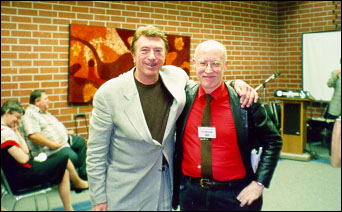
He truly cherished those calls. It was wonderful for me to see my husband so happy and so deeply pleased that Tony valued his body of work and understood it with such insight and care.
After the book was completed, Larry said to me, “You know, this guy sees motivations in my films that even I was never aware of. He’s a genius – and the sweetest guy. I love talking to him. He’s an encyclopedia of film history.”
Cynthia Costas Cohen (M.A., M.F.T.) is the Founder and CEO of Skingoo, a science-backed skincare company. She is also a New York Times bestselling author with degrees in cellular biology and clinical psychology. She loved being married to the crazy and wild auteur Larry Cohen as they had an incredible adventure together for over thirty years, and she often enjoys rereading Tony Williams’ epic book to feel close to Larry.
Roberto Curti
To me, Tony was the man with Robert Ryan’s face, as per his profile avatar on Facebook. Previously, though, he had opted for Orson Welles (Harry Lime, from The Third Man) but had been kicked off the platform and returned with a new look. “I still find my old image but am scared of befriending it in case I vanish like some time-warp narrative,” he once quipped. Tony’s pen could be sharp as a razor, and he had an amazing British sense of humor that his years overseas had not affected. And he couldn’t stand the ongoing descending slope of social networks’ AI-driven censorship algorithms, which, in his own words, were to “eliminate critical thinking and develop their own version of Orwell’s Newspeak.” That’s why we soon moved far from the mad social crowd for our conversations, and whenever I got an email from him, it was like Robert Ryan knocked on my door. And there are few things better in life than Robert Ryan movies.
I knew that Tony’s interests and fields of study were varied, as his books proved, ranging from his pioneering first study on Italian Westerns, made at a time most Italian critics were still spewing bile at them, to American horror filmmakers and Hong Kong cinema; still, he often managed to surprise me for his breadth of vision. Furthermore, not only were his works informed by a vast web of cultural references that made his analyses stimulating and thought-provoking but never gratuitous, but during our email chats he often took me off-guard with some unexpected and pointed references to recent viewings. I recall an especially amusing debate on an obscure Franco & Ciccio Western spoof, Franco e Ciccio sul sentiero di guerra/Oaths of War, where he came up with an intriguing, albeit a little perplexing, theory. Not having watched that movie in decades, I went for a quick review and realized Tony’s interpretation was spot-on, down to the oft-overlooked historical details he had mentioned. This led to an exhilarating discussion that moved from Franco & Ciccio to the actors and filmmakers that had embraced the fascist Salò regime after the 1943 armistice and up to the political nuances of Italian comedies and Leonardo Sciascia’s novels. Finding a whole chapter on Franco & Ciccio’s spoofs in Tony’s sadly posthumous final book on the Western – a rounding of the circle in every way – was like discovering one last, unexpected gift. Not to me, but to all those who love cinema without prejudice or boundaries.
Roberto Curti is an Italian film historian and the author of numerous published books and articles, with a study on Stanley Kubrick’s The Killing forthcoming from Channel Academic/BearManor. He lives in Cortona, Italy.
Adrian Danks
I never met Tony in person, but had many interactions with him online over the last twenty or so years. I had the privilege of editing and publishing twenty-four of his articles for “CTEQ: Annotations on Film” in Senses of Cinema from October 2003 until November 2014. The last of these pieces, a typically astute, contextually rich, and pleasingly accessible piece on Jacques Becker’s neglected Goupi mains rouges (1943) was the last I edited for the journal and I couldn’t imagine a better way to go out. It was a true pleasure working with Tony and trying to guess what film he might elect to write on from amongst the offerings screening across the following months at, for him, the very distant Melbourne Cinémathèque. Always generous and supportive, Tony’s last message to me in this role was typical: “Hope your replacement is nearly as good as you. Best wishes with all your projects.” That said, when things didn’t work out quite so well with my replacement, Tony was quickly in my ear about what to do. Although Tony professed to being technologically incompetent – at least to me – he fully embraced the online world and the opportunities it afforded him and us. He was also an extremely loyal and trusting collaborator. Once he found a place he liked to write and publish, he seemed to stick with it. I felt privileged that I was the editor of one of those places. Four times a year I always looked forward to receiving his requests and the ensuing correspondence, and then seeing what he came up with on a startling array of films and filmmakers including Ken Loach’s Days of Hope (1975), King Vidor’s The Big Parade (1925), Stanley Kwan’s Centre Stage (1991), Robert Aldrich’s Emperor of the North (1973), Michael’s Powell’s obscure An Airman’s Letter to His Mother (1941), Sam Peckinpah’s Ride the High Country (1962), and King Hu’s A Touch of Zen (1971). I regret not continuing as editor just to see what he would have picked from the hundreds of films we have screened since, including seasons devoted to some of his great passions like the spaghetti western. Tony was a great model for how to write a lot and always to your interests and obsessions. But he was still open to new suggestions and opportunities. The last piece of Tony’s I worked on was his contribution to the Companion to Robert Altman I edited for Wiley-Blackwell. I needed someone to do the difficult job of providing a fairly comprehensive critical account of Altman’s vast work in television. Tony quickly agreed, but only if he could get to see as much of the work across dozens of now obscure shows of the 1950s and 1960s. After sending several parcels with DVDs myself, and relying upon colleagues in the US, Tony came up with an incredibly thoughtful, expansive and detailed account across 9,000 words (he liked to be expansive, where at all possible). To quote the laconic but deeply felt final exchange between Randolph Scott and the dying Joel McCrea in Ride the High Country, “I’ll see you later,” Tony.
Adrian Danks is an Associate Professor in Media and Cinema Studies at RMIT University, and President and co-curator of the Melbourne Cinematheque. He had the great pleasure and privilege of commissioning and editing two dozen articles by Tony Williams while editor of Senses of Cinema between 2003 and 2014.
Will Dodson
Tony Williams’ recent death marks another generational passing for film studies, as he was one of the first significant scholars to take genre filmmaking and filmmakers seriously. Hearths of Darkness was among my introductions to psychoanalytic perspectives on horror, and he, along with Christopher Sharrett, influenced not only my own scholarship but the very idea that I could be a scholar.
Our paths crossed personally only once, during the assembly of a collection of essays that I co-edited with Kristopher Woofter, American Twilight: The Cinema of Tobe Hooper. Our idea (to which, as it happens, Sharrett gave the title) was to bring together a group of critics interested in examining Hooper’s entire body of work and putting his films and television productions into conversation as a whole, rather than, as had often been the case, focusing on two or three iconic titles and dismissing the rest. Tony was a dream participant, both in the chapter he contributed and, frankly, in lending his name to the project. He chose Hooper’s 1979 television miniseries adaptation of Salem’s Lot, and in his resulting essay Tony did what he does best, he peeled back layers of small-town decay and institutional failure with sharp eye and sharper wit.
I recall sitting in an Austin café on a sweltering July afternoon with Kristopher, going line by line through Tony’s draft essay, adding footnotes, doing a little copyediting, and jotting down a few questions. I was nervous even to suggest a few alterations and additions to the piece, but Tony took every note seriously and in good cheer, agreeing to most, pushing back against a few, and being about as easygoing as any editor could dream.
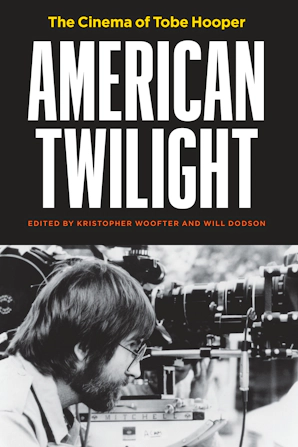
To have Tony contribute to the American Twilight project remains a highlight of my career. I’m well into middle age now, but I still get excited and sheepish when I get a chance to work with a scholar I admire, one who I can say directly influenced me. And Tony, who as some reading this may know was not afraid to be prickly when the situation called for it, was unfailingly self-deprecating, funny, warm, and remarkably generous.
My last conversation with Tony was in August of 2024, when I recorded a video chat about his essay for a short documentary to accompany the release of the paperback edition. We had scheduled a twenty-minute chat but went about forty-five because he kept making jokes, ranging from canards about having a face for radio to claiming that if he turned the camera about I’d see that his office resembled the Marsten House from Salem’s Lot. It was a thoroughly amusing chat, and I’m glad it will be my lasting memory of him. (You can see the documentary here; Tony’s comments begin at 10:47, and his face is in fact quite pleasant.)
Will Dodson is an Adjunct Assistant Professor of Media Studies at University of North Carolina at Greensboro and the co-editor of American Twilight: The Cinema of Tobe Hooper (University of Texas Press, 2021).
Tony Williams is a genius [and] an encyclopedia of film history.”
–Larry Cohen
Susan Felleman
Some know-it-alls know next to nothing. They accumulate information and know things just for the sake of knowing and wielding their knowledge. They can be so tiresome. Tony Williams was a know-it-all but not of this sort. Tony was a sort of colleague; we both taught film studies, in different departments at the same university – for about fourteen years before I moved on – and sat on a couple of graduate committees together. He was frighteningly well-read, had seen an impossible number of movies, and had knowledge both broad and deep, especially of film, but of much more, too. Tony could recount the contributions of casts and crews of more films than most people have seen. He knew biography, history, aesthetics, and theory. This active and almost encyclopedic knowledge allowed him to draw connections that were really astute. My own research benefited from his expertise more than once. He was dauntingly prolific. I have sometimes wondered if he did anything other than read, write, and watch films. But I know he did, because he was active on Facebook.
His death has left a weird gap in my online life: a silence that saddens and surprises me at the same time. I have a Facebook habit – a daily morning post: a birthday gift for friends about the artists and other notables who share their birthday – and I have occasionally had to worry about what Tony might say. He would almost always say something. Tony paid attention and was alternately witty, judgy, cryptic, polemical, appreciative, and impolitic. Sometimes I had to research his comments to get them. Sometimes I had to cringe. Now I don’t have to worry about what Tony will say or whom he might offend. I have to resign myself to the diminishing number of people who really pay attention at all, who know anything at all.
Susan Felleman is Distinguished Professor Emerita of Art History and Film and Media at the University of South Carolina. She is the author of four books: Botticelli in Hollywood: The Films of Albert Lewin (Twayne Publishers, 1997), Art in the Cinematic Imagination (University of Texas Press, 2006), Real Objects in Unreal Situations: Modern Art in Fiction Films (Intellect, 2014), and Screening Statues: Sculpture and Cinema, co-authored with Steven Jacobs, Vito Adriaensens, and Lisa Colbert (Edinburgh University Press, 2017). Among her other publications are numerous articles and book chapters, two video essays, “Four Ways to Be a Woman Artist… According to the Movies,” co-authored with Hannah Shikle ([in]Transition, 2022) and “Hiding in Plain Sight: Blackamoors in Classical Hollywood Cinema” (In Media Res, 2024), and written and co-directed (with Hannah Shikle) a feature-length, personal essay film, In Production: the Life and Career of George Justin, an official selection of four film festivals in 2024-25.
Susan Irvin Gatti
It is hard to imagine a world without Tony Williams. I met Tony at the Jack London Bookstore in Glen Ellen, California. He, too, was attending the annual London Birthday Banquet. I already knew his scholarly work. Naturally, I was captivated by his Welsh accent, his lively personality, and insights into London scholarship. At the time, London studies were getting off the ground, due in part to Tony’s work. Most of my encounters with him took place at scholarly conferences or London-themed events. On one visit to the Jack London State Park, Tony introduced me to his wife Kathleen — whom I instantly liked. They were a perfect couple.
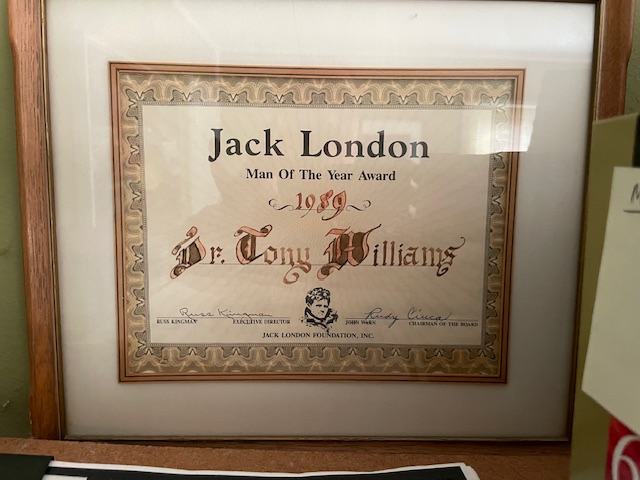
Over the years, Tony and I kept up a lively email correspondence. Scholarly coteries can be cliquish, if not exclusive. But, Tony maintained a firm policy of openness. He welcomed and encouraged new scholars and maintained warm ties with longtime associates. He was an independent thinker whose wide span of interests – especially those linked to film studies – never failed to surprise and intrigue. His scholarly writing offered readers consistently fresh perspectives and thought-provoking arguments.
But, my greatest insight into Tony’s genuineness and concern for others occurred when I visited Louisville, Kentucky, to present a paper at a literature conference. Tony arranged for me to stay with him and Kathleen at her parents’ home. The Ensors were wonderful hosts. I was a total stranger to them, but they made me feel welcome and comfortable. Tony and I were able to catch up and run through some ideas for the conference. Tony was that kind of person – willing to support the efforts of scholars and to extend a hand of friendship. I am devastated by his loss. Tony’s quick mind and caring spirit will never be forgotten.
Dr. Susan Irvin Gatti is a retired professor of English who taught courses in American and British literature at Indiana University of Pennsylvania in Indiana, PA. She has published articles on American literature and specialized in the works of Jack London.
David Greven
Tony Williams, whom I never met in person, was a generous mentor from afar. He supported my early work with kindness and critical acuity. When writing my book Psycho-Sexual, on Hitchcock, the New Hollywood, and new forms of male sexual representation, he pointed me in the direction of Amy Lawrence’s work on Rope and the nascent Cold War-era culture of codes and secrecy regarding queer issues. I could always count on Tony to have read and engaged with my work and to provide insightful feedback. These are certainly not gestures one can take for granted in academe.
I greatly benefited from Tony’s rigorous, probing work as a critic, especially of the horror film. His book on Larry Cohen is not only a classic but also an exhilarating read. His comprehensive knowledge of cinema history was passionately maintained but never gushing or idolatory. He required, from himself and others, a level of serious commitment to film knowledge and the practice of film analysis. He was an intimidating but also inspiring model.
I wasn’t always comfortable with that seriousness, and we had moments of friction. When he disliked someone, he didn’t hold back, which meant that my qualified appreciation for Pauline Kael’s gifts was met with unmitigated disapproval, to offer one example of the kinds of tensions that cropped up at times.
In the end, those uncomfortable moments seem fairly inconsequential in light of his generosity, his fierce commitment to film study and to mentoring, and his own critical example. He will be missed.
There’s one American scholar whose work I’m deeply indebted to, and that’s David Greven at the University of South Carolina.”
– Williams, On James Jones and the Limits of “Eternity”: An Interview with Tony Williams
David Greven is Professor of English at the University of South Carolina. Greven specializes in both nineteenth-century American literature and Hollywood film. His books include All the Devils Are Here: American Romanticism and Literary Influence (University of Virginia Press, 2024), Intimate Violence: Hitchcock, Sex, and Queer Theory (Oxford University Press, 2017), Gender Protest and Same-Sex Desire in Antebellum American Literature (Routledge, 2016), Psycho-Sexual: Male Desire in Hitchcock, De Palma, Scorsese, and Friedkin (The University of Texas Press, 2013), The Fragility of Manhood: Hawthorne, Freud, and the Politics of Gender (The Ohio State University Press, 2012), Representations of Femininity in American Genre Cinema (Palgrave, 2011), and Men Beyond Desire: Manhood, Sex, and Violation in American Literature (Palgrave, 2005), the second edition of which was published in 2025.
Kenneth E. Hall
Tony was my friend and unofficial mentor for many years. We maintained long-distance contact as members of the faculties of different universities.
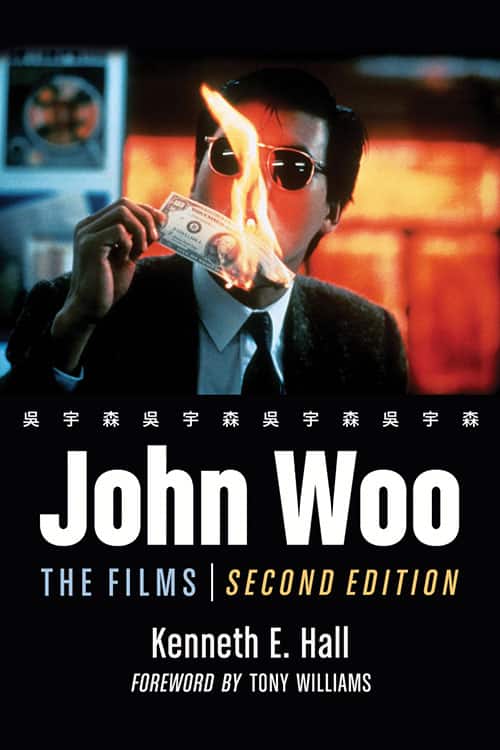
My correspondence with Tony began in the mid-1990s when I was working on John Woo: The Films. He assisted me very graciously in the process of publication, and we continued our email correspondence about Asian films and other mutual interests. Our long-distance friendship benefited greatly from his generous sharing of information and opinions about films.
I met with Tony in person only once, when we both participated in the 1997 Asian Cinema Society conference in Peterborough, Ontario. Our numerous subsequent virtual contacts included not only conversations about Asian and international film, the state of university bureaucracy (a favorite topic for Tony’s sometimes bitter witticisms), and more specialized concerns such as the work of the famed author and film critic Guillermo Cabrera Infante (1929-2005), not all of which is available in English.
Tony was always forthcoming with responses to my queries and with suggestions for projects and research approaches. Despite his full teaching and research schedule, he generously agreed to read drafts of my work and to offer very helpful guidance. Tony provided a nicely crafted foreword for the second edition of my John Woo: The Films (McFarland, 2012).
Tony Williams was a superlative scholar and a valued friend. I will miss his unstinting generosity, his piercing wit, and his often unique perspective on film and literature.
Kenneth E. Hall (Ph.D., University of Arizona, 1986; MA, University of North Carolina at Chapel Hill, 1978) is professor emeritus of Spanish at East Tennessee State University, where he had taught since 1999. His publications include Professionals in Western Film and Fiction (McFarland, 2019), John Woo: The Films (McFarland, [1999] 2012), John Woo’s The Killer (Hong Kong University Press, 2009), Stonewall Jackson and Religious Faith in Military Command (McFarland, 2005), and Guillermo Cabrera Infante and the Cinema (Juan de la Cuesta Hispanic Monographs, 1989). His monograph on the series Line of Duty is forthcoming from Channel Academic Publishing.
Reynold Humphries
Unfortunately, I have no memory of when and under what circumstances Tony Williams and I started to exchange emails. It was many years ago and certainly concerned an article he or I had written on the Hollywood horror film, our common passion. Our mutual interest in the political dimension of the horror film led both of us to accord particular importance to films dating from the seminal Night of the Living Dead through to important films by Craven, Cohen, Hooper, and Dante (apart from the brilliant and influential Halloween, Carpenter is far less important, showing little interest in the ideological dimension that most concerned us). Because of the exceptional importance and quality of his zombie films, Romero was the writer/director who both interested us and, I believe, influenced our research.
Tony’s essential article, printed in Jump Cut, on White Zombie reinforced that interest in zombie movies, of which Tourneur’s exceptional I Walked with a Zombie was a touchstone for me. So readers can imagine my pleasure at receiving from Tony a dedicated copy of the book he edited on the various interviews Romero had given over the years, which enabled me to write a review of the book, where I brought together many aspects of the topic and which I published in Horror Studies (vol. 3, no. 1) on the Editorial Board of which I served for some years. I had just read a remarkable book, Zombie Economics: How Dead Ideas Still Walk Among Us, the title and content of which perfectly summed up the neo-liberal mantras Tony and I wish to draw attention to and which we strove to deconstruct by foregrounding the various sub-texts at work.
This, of course, was the core of his extended writing, notably in his study, for which no praise is too high, Hearths of Darkness, in which he most generously called attention to my own writings on the Hollywood horror film, even putting me in the same category as the late Robin Wood. Robin had been a mentor of mine (a role played later by Roland Barthes and my thesis director Christian Metz) since his path-breaking book Hitchcock’s Films which brought to his films a commitment to criticism which set Robin apart. It was Robin who burst through the reinforced concrete wall of crass critical ignorance to champion the Hollywood horror film and who played for Tony a role similar to that Tony was to play for his future students.
Those with knowledge of Tony’s work will be aware that his interests did not stop with horror: film noir played an important role in his research and we exchanged frequent messages on this topic, including discussions on his and my publications. And let us not forget his other impressive contribution to Hollywood: Body and Soul, his study of the cinema of Robert Aldrich. If Aldrich must definitely be added to that illustrious list of directors who distinguished themselves by bringing new blood to Hollywood in that politically disastrous decade, the 1950s – Fuller, Ray, Sirk, and Anthony Mann (not to mention the radical and mind-boggling evolution of Hitchcock from Rear Window on) – his work after this was far more uneven.
And talking of forgetting, let us give a thought to another labour of love, Tony’s dauntingly ambitious study of the work of Larry Cohen. As Cohen once said, quoted by Tony, “where chaos reigns, I shine.” This would fit Tony and his work down to the ground.
What else can one say to give some idea of the scope, quality, and rigour of Tony’s articles and books, not to mention his enthusiasm? I count on his students – and their future students – to continue the good fight as a fitting tribute to him.
Reynold Humphries has now retired from his post as Professor of Film Studies, University of Lille 3. He has published two books on the American films of Fritz Lang, the first a version of his French thesis and the other an extended and rewritten version published by Johns Hopkins University Press. He has published two books on the American horror film: The American Horror Film: An Introduction (Edinburgh University Press, 2002) and The Hollywood Horror Film, 1931-1941: Madness in a Social Landscape (Scarecrow Press, 2006). He has contributed articles to specialised journals and collective volumes, one of which was a review of Tony Williams’ George A. Romero: Interviews (University Press of Mississippi, 2011), which appeared in Horror Studies (3:1) where he was on the Editorial Board. His latest book is on Hollywood’s blacklists.
Ray Kelly
I knew Tony Williams for years before I ever shook his hand. That is one of the strange gifts of online communities. Tony and I shared a passion for the films of Orson Welles, and first encountered each other on the long-forgotten Orson Welles Web Board at tierranet.com in the late 1990s, and later on Wellesnet.com. In my mind’s eye, Tony looked like his avatar: the devilish Harry Lime from The Third Man.
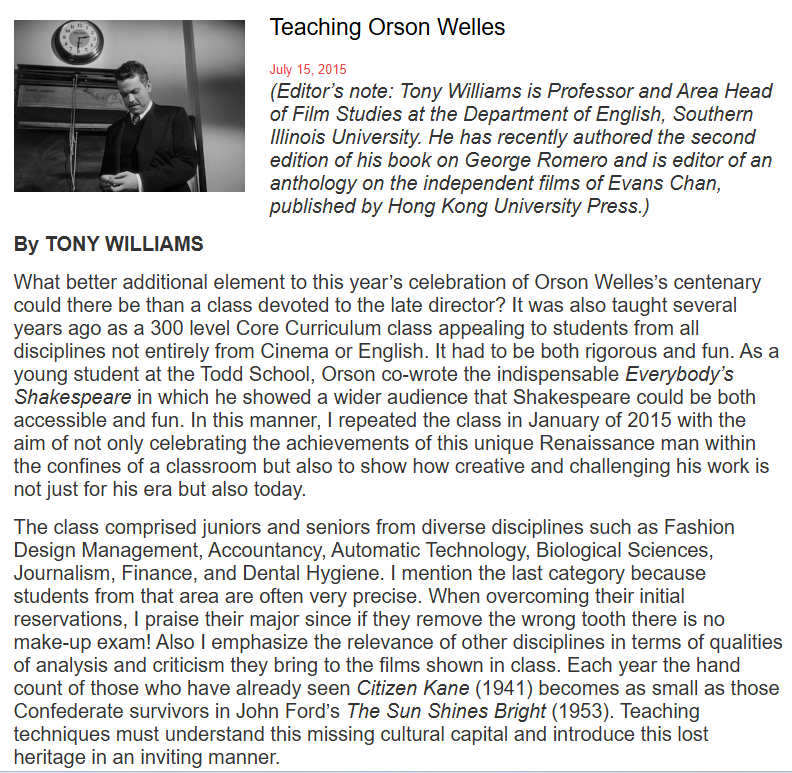
When we finally met at a Welles symposium in Woodstock, Illinois, in May 2014, I was taken aback to discover that he looked nothing like a young Orson Welles — and he was British to boot. Yet Tony was every bit as sharp, insightful, and witty as his hundreds of online postings had suggested. We enjoyed breakfast together at a Super 8 hotel and talked nonstop about classic movies. Like me, Tony loved to talk. As Sydney Greenstreet says in The Maltese Falcon, “I’ll tell you right out, I am a man who likes talking to a man who likes to talk.”
After I took over Wellesnet from founder Jeff Wilson, Tony became an unfailing source of encouragement, tips, corrections, and spirited opinions on all things Welles. I invited him to contribute more than forum posts and asked whether he would consider writing full articles for the site.
Though academic and personal commitments limited his time, he still gave Wellesnet three substantial essays. Tony had that rare gift of combining scholarship with mischief. He could cite chapter and verse, then puncture pomposity with a single line.
His final posting on the Wellesnet Message Board came on March 4, 2026. It was a personal note responding to the news that the Library of Congress would archive all past and future articles on Wellesnet:
This is very excellent news, Ray, a great tribute to the teamwork you have done with your colleagues, often with no sense of recognition and reward. Let us hope that other discoveries are on the way so the site is not just an ‘archive.’”
Don’t worry, Tony. We will continue the scholarship, the discoveries, and the enthusiasm. But the conversation – so much richer for your contributions – will never sound quite the same. Until we meet again, your fellow Wellesians remain, obediently yours.
Ray Kelly is the owner of Wellesnet. He is an award-winning journalist with four decades of experience in broadcast, print, and online reporting, including managing editor of The Republican (Springfield, MA).
John Lewis-Stempel
When I learned of Tony’s death, I paid him homage by watching The Good, The Bad, and The Ugly. It was Tony’s (and Laurence Staig’s) book on spaghetti Westerns, The Italian Western, that opened my eyes to this “lowly” cinematic genre. He saw its art and its politics, its potentialities and its resonances, and I was, on reading it, reminded immediately of George Orwell and his democratic appreciation of popular culture. Not a bad sentence to find yourself in, George Orwell, there alongside Tony Williams.
John Lewis-Stempel is a writer on nature and military history. A British magazine columnist of the year, he is the only person to have won the Wainwright Prize for Nature Writing twice. His books include the Sunday Times top-five bestsellers The Running Hare (Doubleday, 2016) and The Wood (Doubleday, 2018). He is currently writing a history of Paris for Penguin Random House with Penny Lewis-Stempel.
Penelope Lewis-Stempel
I first met Tony Williams in Swansea, Wales in the late 1970s. I had moved there after leaving university and joined the Swansea Film Club to find like-minded people. The film club, it turned out, met in the front room of a very nice couple’s house and enjoyed a repertoire of classic French films. Only one member pushed for something a bit different, Tobe Hooper’s 1974 The Texas Chain Saw Massacre. This was Tony who, it turned out, was working at Swansea Hospital as a hospital porter while, in his spare time, writing groundbreaking, inspirational articles on film. Tony became a much loved friend and as I moved into a career in media and film we enjoyed a common interest in cinema and popular culture. Tony’s radical analysis – whether of the Italian Western, John Woo, Larry Cohen, film noir, Chinese, Korean, Vietnam War films – was always fresh, profound, original and delivered with infectious enthusiasm. It was the perfect outcome when – out of the blue – he was headhunted from the USA and flown to Illinois to teach film at the University. Tony must have been such an interesting teacher. And he was as loyal and committed as a friend as he was to his politics. After he moved to the USA, he kept in touch and kept us up to date on his work, new ideas, books, publications, and his many and inevitable battles with authorities! We had the great pleasure of welcoming him and his wife Kathleen (and her family) and later their daughter Natalie, to our homes in Wales and in rural Herefordshire. Tony was in touch with us recently, still committed, still moving on, still fighting (and winning) battles, and busy celebrating his influential work of fifty years ago. Tony was a rare friend who leaves a rare legacy of original, uncompromised, and uncompromising thought. It was such a privilege to know him.
Penny Lewis-Stempel has worked as a producer/director in independent film, in commercial and BBC Radio, as producer/director for Channel 4 TV, and was a founder member of Channel 4 TV’s franchised film workshop Red Flannel Films. She is currently writing a history of Paris for Penguin Random House with John Lewis-Stempel.
Adam Lowenstein
“Do you know Tony Williams?”
The question, put to me one day by George A. Romero’s widow Suzanne Desrocher-Romero, was difficult for me to answer. Of course I knew Tony Williams, as anyone working in horror studies over the past five decades would. He was always there when I needed him, reassuring me I was not alone when I grew fascinated with offbeat films like Assault on Precinct 13, quirky filmmakers like Larry Cohen, and essential yet underappreciated themes like the family in the horror film.
But at the same time, I didn’t really know Tony Williams at all. I knew him through his work, not through his person. And even in terms of his work I was really only familiar with one small corner of his astonishing range of scholarly interests. So I answered Suz Romero like this:
“Tony has been with me every time I teach a course about George, because his book on him [The Cinema of George A. Romero: Knight of the Living Dead] is so foundational. But no, I’ve never met him.”
“Oh, he’s just wonderful! We have to get you two together,” Suz replied.
And so she did. Tony and I had a lovely, expansive, and long overdue conversation that Suz arranged for us in 2021. My only regret is that it was over Zoom rather than in person. But just like his work, my talk with Tony proved delightful in that there was no such thing as a topic he was not curious about; and more often than not, he had already published on it or planned to do so.
Since I was then working on a book engaged with the towering critical legacy of Robin Wood for horror studies (eventually published as Horror Film and Otherness), I asked Tony about his professional relationship with him. Tony was very open about Robin’s impact on him: he was his most important mentor, and he could still remember, even many years later, the details of his lectures on cinema. For Tony, Robin’s work was always an anchor for his own. So I feel grateful that I was able to tell Tony, like I was able to tell Robin, that their work opened a path for me and so many others to follow. Without their work, there would be no such thing as horror studies.
Today, we no longer have George, or Robin, or Suz, or Tony with us. That saddens me immensely. But it also inspires me to work hard on connecting with as many kindred spirits of theirs as I can to make sure that the Horror Studies Center at the University of Pittsburgh is as ambitious as they would want it to be. And of course, one of its missions will be to invite many future generations of students to get to know Tony Williams.
Adam Lowenstein is the director of the Horror Studies Center at the University of Pittsburgh and is the author of Horror Film and Otherness (Columbia University Press, 2022).
Jean-Jacques Malo
As a young Frenchman I was curious to discover the USA. I also had an interest in films since my teens. In 1985, I got a job teaching French at the University of Washington in Seattle. For the past few years before I moved to the Pacific Northwest, I had been interested in Viet Nam War films which had become the topic of my master’s thesis. In the Emerald City I met Viet Nam veterans, including David A. Willson who had a tremendous knowledge in books and pictures about this war. David encouraged me to further my research and basically took me to Popular Culture Association conferences. Consequently, I met Tony Williams at one of those meetings dedicated to the Viet Nam War in the late 1980s, and we got on right away.
I had a particular connection with Tony, partly because we were both foreigners living in the American culture; we could be spotted by our European accents. He was Welsh and I am a Breton (France is made up of multiple peoples), hence also of Celtic culture like him, but also because I lived in Cardiff for a couple of years in the early 1980s, and that we had found out that a few years apart we had frequented the same cultural places in the Welsh capital. However, that was not the only reason I liked the guy right away: he was a smart guy to talk to, any discussion would be interesting and stimulating intellectually. He was outspoken and brilliant.
At the time I had been working on an encyclopaedia of reviews of movies on the Southeast Asian War from around the world, and McFarland had given me a contract to publish it. The project was getting bigger and bigger, so I put together a team of reviewers including Tony. Then with a list of about six hundred films to be dealt with, the venture turned out to be a bit too gigantic for just one man. So, I invited Tony to co-edit Vietnam War Films (McFarland, 1994), and I was glad he accepted as his knowledge in the field was vast. Our collaboration was smooth and easy. He took charge of editing about one hundred short entries of North Vietnamese movies I had found thanks to the Vietnamese Filmmakers’ Association. These reviews had been written in English by Vietnamese but they definitely needed polishing. That was a fairly big job, which Tony managed very well and on time. Our exchanges on the publication were always fruitful. As I had started and organised this project when he came on, my Welsh friend offered to take no royalties; that was extremely gracious of him. The work we did together was most satisfying for both of us, especially as it turned out to be seminal.
When it came to academia, Tony was a very hard-working scholar; his interests were extremely varied. He could have breakfast whilst reading an article on the Italian Western, Jack London, Asian cinema, Larry Cohen, or George A. Romero. They would feed his intellect as his very long and impressive list of publications shows: dozens of articles, papers, reviews, and books of course. He always had ideas for topics to be studied.
I was not the only person to truly appreciate Tony, so here I will quote some of our mutual acquaintances who knew him and who reacted to his passing. W.D. Ehrhart (poet and essayist): “Tony was a very decent guy.” John Baky (former director of Philadelphia’s La Salle University’s Connelly Library and founder of the Imaginative Representations of the Vietnam War Collection): “A fine man with an astounding knowledge of a truly bizarre mix of genres.” Steve Wilson (McFarland & Co. Publishers): “His incisive intellect and clear writing put him in a rarefied class.”
Jean-Jacques Malo taught at three universities in three different countries: University College, Cardiff in Wales, the University of Washington in Seattle, and the Université de Nantes in France. His research interests revolve around the Viet Nam War. With Tony Williams, he co-edited Vietnam War Films (McFarland, 1994). He also edited two books on W.D. Ehrhart (2014 and 2017), and translated poetry by American Viet Nam veterans into French that were published in French and Belgian journals.
Gina Marchetti
Tony Williams impressed me as a lion in cinema studies who fiercely came to the defense of films at the cultural margins considered too radical for mainstream scholarship. In addition to his wide-ranging interest in Hollywood and British popular film, Tony championed maligned cinemas, including Hong Kong action, Asian neo-noir, B-movie horror, Vietnam War dramas, and spaghetti westerns. Rather than simply celebrating the exotic, transgressive, and excessive, Tony probed the depths of cult films in order to highlight their critiques of capitalist exploitation and colonial corruption. He celebrated filmmakers’ justified anger against racism, sexism, and other forms of social injustice. Tony called out British colonialism in Hong Kong cinema, American imperialism in Vietnam films, and capitalist terror seen in movies by George Romero and Sergio Leone, among many others.
At a time when few scholars took Hong Kong cinema seriously, Tony published groundbreaking articles and books on figures as diverse as John Woo, Fruit Chan, Tsui Hark, Ann Hui, Evans Chan, Michelle Yeoh, and the “other” Tony Leung Ka-Fai. His sensitivity to the political vicissitudes of the territory made his research stand out at a time when others dismissed Hong Kong as a “cultural desert” with a “chop-socky” cinema beneath contempt.
Tony took all cinema seriously and displayed a genuine respect for screen treasures that had been treated as trash. He was a generous collaborator, a sensitive editor, and a courageous scholar. Tony expanded the field and opened a path for many others to follow. His sharp intellect, sense of justice, and critical acumen will be sorely missed.
Gina Marchetti serves as Chair of Humanities and Media Studies at Pratt Institute. Her books include Romance and the “Yellow Peril”: Race, Sex and Discursive Strategies in Hollywood Fiction (University of California Press, 1993), Citing China: Politics, Postmodernism, and World Cinema (University of Hawai’i Press, 2018), and Women Filmmakers and the Visual Politics of Transnational China in the #MeToo Era (Amsterdam University Press, 2024).
Joseph McBride
Tony Williams was a dedicated film maven and scholar whose passionate concern for the art form and over the work of fellow critics was unbounded. I came to know him personally when he invited me to Southern Illinois University, Carbondale to speak about my 2013 book Into the Nightmare: My Search for the Killers of President John F. Kennedy and Officer J. D. Tippit, the result of many years of groundbreaking research. So you see that Tony’s interests ranged broadly into history and daringly into controversial scholarship on historical subjects. I admired Tony’s combative side in dealing with his complaints about flaws in academia and some misguided practitioners of film studies; I shared those concerns even if I disagreed with him occasionally. That’s what intellectual debate is all about. We both greatly admired his mentor and mine in film studies, the late Robin Wood.
Tony was a good old-fashioned contrarian, an independent thinker, an increasingly rare breed in today’s fearful, conformist culture. So I appreciated his feisty personality and his stubbornness in holding to his principles and admired his highly individualistic approach to film studies, which led him to championing some unfashionable filmmakers and fighting to expand the canon. Tony set an example of free-thinking expertise for his students and readers, and it was always good to read his erudite and highly accessible prose in FilmInt.
Joseph McBride is the author of many books on film, including the recent interview book I Loved Movies, But . . ., Conversations with Danny Peary (Sticking Place Books, 2025).
Murray Pomerance
I don’t believe it could be said that I knew Tony Williams, although we worked very productively together on one piece at one time, more than twenty years ago. For some reason and by some person – both unremembered now – his name was suggested to me as a contributor for my book Bad: Infamy, Darkness, Evil, and Slime on Screen, and I suspect I must have written to invite him. He was very eager indeed to do something about an actor of whom I knew quite little at the time, while he, Tony, seemed both very fond and very knowledgeable about the man. This was Eric Portman, known to many, I suspect, from The Forsyte Saga and featured with stunning clarity in Michael Powell and Emeric Pressburger’s The 49th Parallel. We had a small impasse, Tony and I, over my, at the time, youthful editorial style that I suspect irritated him some; but he struck me as a rather formal British man with very set tastes, and I do recollect that the issue almost always rode upon the subtle secondary meaning of a word of phrase as it might have described a moment of Portman’s work; he wanted to be very careful, Tony Williams, about what he did and did not mean to say about Eric Portman, which attitude is, of course, not only the author’s right but a most admirable way of conducting one’s affairs wording one’s ideas in text. I thus came to have considerable respect for this man I’d never set eyes upon, to whom I believe I may have spoken once by telephone, and whose face I did not know. It’s one of the pities, I feel, that I can’t say a very friendly hello to him now.
Murray Pomerance is an independent scholar living in Toronto and Adjunct Professor in the School of Media and Communications at RMIT University, Melbourne. His most recent book is Light Thoughts: Image, Reverie, Memory (Bloomsbury, 2026).
Jake Rutkowski

I met Tony Williams in November of 2016, at a time when all historical analysis, cultural criticism, news hooks, casual conversations, sleep paralysis episodes, and paranoid fantasies seemed to arc toward Donald Trump. In that context speaking with Tony, about his study James Jones: The Limits of Eternity – an author whom Tony described as having a “very perceptive view of American society in wartime and beyond…and was badly categorized as a war novelist” – felt like respite, despite the fact that our conversation didn’t exactly shy away from any grim, pervasive realities. His wit and his resolve engendered in me an esprit de corps for a community of rabble-rousing cognitarians that at the time I hadn’t even realized I had joined. However ephemeral our connection, it has stuck with me and remained a light in dark places, especially as the long tail of November 2016 seems to stretch on in perpetuity. Look for the helpers, sure, but if your helpers look like Tony you’ll have a much better go of it.
Jake Rutkowski is a writing administrator at the University of Pennsylvania and has published on genre cinema at FilmInt Online and elsewhere.
Steven Jay Schneider

As a recovering film scholar, I apologize in advance for having to rely more on impression than substance here. But the impression Tony made on me was profound, and has had a meaningful impact on my life — for which I will always be grateful. I first came to know Tony through his seminal writings on 1970s horror cinema following the work of legendary film theorist, Robin Wood. I was so enthralled by the insight and ingenuity of their analyses that I literally devoted myself to studying the genre for a living – first as an academic, and then (and still) as a producer of horror movies myself. Once I started publishing on the genre, Tony and I developed a fast friendship. He was always incredibly responsive, collaborative, and kind. He was also truly encyclopedic in his knowledge of film history and theory. And he was, pardon my French, fucking brilliant. I couldn’t believe it when he agreed to co-edit a collection of essays on global horror cinema with me, Horror International, while I was still in graduate school. Even now I am taken aback by what an incredibly cool and generous thing that was for him to do. Tony was an inspiration, an influence, and a role model for me. I’m honored to have known him, and I celebrate his legacy.
Steven Jay Schneider is a former film critic with graduate degrees in philosophy and cinema studies from Harvard University, New York University, and the University of London. Schneider quickly rose the ranks in Hollywood to become one of the industry’s most sought-after genre producers. After publishing numerous books on horror and world cinema, including the international bestseller 1001 Movies You Must See Before You Die (currently in its 10th edition, translated in over twenty languages), Schneider moved to Los Angeles to pursue a career in producing. On the heels of 2009’s record-breaking Paranormal Activity, a film he found and helped usher to the big screen, Schneider has amassed a slate of impressive feature and TV projects with top filmmakers at the helm. Producing credits include The Devil Inside (2012), “The River” (ABC, 2012), The Visit (2015), Blair Witch (2016), Split (2017), Pet Sematary (2019), Glass (2019), His House (2020), Old (2022), Watcher (2022), Strange Darling (2023), Late Night With The Devil (2023), Knock At The Cabin (2023), V/H/S/Beyond (2024), The Plague (2025), Hokum (2026), The Undertone (2026), and the various installments of Paranormal Activity and Insidious – a number of which are micro-budgeted horror movies that have smashed box-office records both domestically and around the world.
Alain Silver
I never met Tony Williams in person. He was somewhere in Illinois and I was in Santa Monica, California, so there was no meeting for coffee somewhere halfway in between. In fact, in the era before WhatsApp or Zoom, none of our communications ever had a video component. Still, what struck me when we did speak over a landline was that, even without seeing his face, I could tell that Tony was paying close attention. In his casual conversations as in his critical writing, Tony was a keen observer of detail. Although his range of interests over the span of motion picture history was quite wide, most of our discussions were about film noir or Robert Aldrich with an occasional foray into Hong Kong gangster films or the horror genre, especially zombies. Starting with the first Film Noir Reader and over the course of more than three decades and almost a dozen more books, Tony could always be counted on for a cogent contribution on a particular aspect of a volume’s subject. Late last year, we asked Tony if he wanted to select any titles from our list of classic period outliers to be added in the fifth edition of Film Noir: The Encyclopedia. In the blink of an eye a dozen entries arrived. We are honored to have had so many opportunities to include Tony’s writing in our anthologies. Sadly, when that newest writing is published, Tony’s most recent bio will have been amended to the past tense and his name added to the list of encyclopedia contributors who are now also dedicatees.
Alain Silver is the author/editor of thirty-plus books about movies from samurais to vampires but most notably film noir. He has also worked on forty independent features as writer, producer, and/or director.
Philip L. Simpson
Tony Williams was much more than a mentor to me. It is no exaggeration to say that, shortly after he moved to the English Department at Southern Illinois University, Carbondale (SIUC), he single-handedly saved not only my dissertation but also established the future direction of my scholarly career. I admired Tony greatly from the beginning, finding it nothing short of wondrous that he had studied with Robin Wood and published on American horror films (including the cinema of George Romero). Simply put, I wanted to grow up to be him, or if not him, at least someone who had the same kind of knowledge and freedom to write about the same kinds of things he did.
I first encountered Tony (or Professor Williams as he was known to me then) in August of 1992, at a time when I was nearing the end of my coursework in the modern American literature track in a very traditional literature department. I registered for his Contemporary Theory of Cinema course for three specific reasons: always drawn to movies as much as to books (maybe even more so) I had declared Cinema Theory as one of my two required research tools to complete my doctorate; I saw that the special topic of the cinema theory course was the director Alfred Hitchcock (whose films I was introduced to early in life by my mother and had always loved); and, candidly, I was starting to question why I had ever gone into American literature studies in the first place. Tony’s course, built around the early-, mid-, and late-career films of Hitchcock, completely galvanized me back into the intellectual thrill and challenge of scholarly life. More accurately, Tony did.
As I suspect most students did, I found Tony at once quite intimidating because of his breadth of cinematic and scholarly knowledge and a tendency to strongly stated opinions that not one of us in class wished to end up on the wrong side of. Thus, when one of the papers I completed for him in the class (based on “Jack the Ripper” allusions in the 1943 film Shadow of a Doubt) drew high marks and praise from Tony, I was elated. He then encouraged me to seek out venues for both presenting the paper at a conference and publishing it. Specifically, Tony encouraged me to submit the paper to the national Popular Culture Conference in Chicago, to which I was accepted. Concurrently, I also submitted the paper to Clues: A Journal of Detection, which subsequently accepted it. Thus, my scholarly career as a published author began, all due to Tony’s mentorship and encouragement.
Fast forward a few years: as I finished my formal classwork in the program and passed the departmental preliminary exams, I needed a dissertation director. Every professor I approached in the department who specialized in modern American literature, not surprisingly, turned me down once I told them the subject: popular culture representations of serial killers in film and literature (the latter of which I defined so broadly as to incorporate both literary and more mainstream writers in a way that I suspected offended one of these professors in the mere act of asking them to take on the directorship). Emboldened by my experience in Tony’s class, I had turned the Shadow of a Doubt paper into a full-fledged dissertation outline with sample chapters, ranging across decades of American cinematic and literary history to find other examples of how the phenomenon of serial murder had been portrayed in fiction and film. I had a couple of professor allies in other adjacent departments who agreed to be on the committee, but no director. With some trepidation, then, I approached Tony to take on me and my foundering project. It was common knowledge among the grad students that Tony had not yet directed a dissertation and further had no particular interest in doing so. I had already convinced myself he was going to say “no” and I would be forced to find a more traditional literature department subject. To my surprise (and great relief), he agreed to be my dissertation director. (Only recently did I learn that he only directed one other dissertation in his career at SIUC, that of Dr. Christopher Weedman, whose own tribute to Tony is also included in this journal issue. I now feel even more fortunate than I did before to be a member of such a small but elite group that Tony deemed worthy of mentoring in such a way.)
As a director, he showed incredible patience with reining in my written digressions and a master scholar’s sense of how to hone my argument. More importantly, he never tried to make the dissertation into his project rather than mine. He knew when to challenge an idea, when to press for greater precision, and when to let me follow an intellectual path that he trusted I could justify. He also stood up for me when one of the dissertation panel professors wanted me to revise the project substantially to align with their critical perspective; he pushed back and I was free to continue as Tony and I had agreed. By the time I reached the dissertation defense, the project had become something I could scarcely have imagined producing when I first nervously walked into his Hitchcock seminar a few years before.
One memory remains especially vivid. After the committee retired to deliberate following my dissertation defense, I waited outside wondering whether what I had produced and argued had been enough. Tony was the first to emerge from the room. Looking directly at me, he smiled (for someone who could be so intimidating with a single glance or scalpel-pointed word, he had such an engaging smile) and greeted me with two simple words: “Congratulations, Doctor.” That moment, simple as it was, remains one of the most gratifying of my professional life because I knew how much of that accomplishment belonged to his guidance. When I then turned the dissertation into my first published book with Southern Illinois University Press, Tony’s influence could still be discerned in every word, every chapter.
Our relationship did not end after I left SIUC. Over the years we stayed in touch primarily through email and, later, through social media, where conversations that might begin with “how have you been” pleasantries quickly evolved into spirited debates over whatever films had most recently provoked us. One late 1990s exchange I remember with particular fondness was our mutual insistence that Saving Private Ryan was perhaps the most pro-war anti-war film to emerge in recent memory.
Tony also did something for me that no graduate curriculum alone could have accomplished. He introduced me to a wider community of scholars working in film theory, horror studies, and popular culture, making connections that opened doors to collaborations, conferences, publications, and friendships that have shaped my career ever since. Through those introductions, his influence extended well beyond his own classroom and into the broader scholarly world that I eventually came to inhabit.
Looking back over more than three decades, I realize that it is impossible to separate my own identity as an educator and scholar from Tony’s influence. The questions I ask, the subjects I pursue, the confidence to take seriously forms of culture that others in my field have dismissed, and my own commitment to encouraging students and colleagues alike to pursue unconventional intellectual paths all bear his imprint. Whatever successes I have enjoyed, I owe an incalculable debt to his example.
I am deeply saddened that Tony has passed away. At the same time, I remain profoundly grateful that our paths crossed when they did and that I had the privilege of learning from him, working with him, and knowing him over so many years. My life and career are immeasurably richer, as many others can also say, because of him.
Philip L. Simpson is the author of two books, Psycho Paths: Tracking the Serial Killer through Contemporary American Film and Fiction (Southern Illinois University Press, 2000) and Making Murder: The Fiction of Thomas Harris (Praeger, 2010), as well as co-author of Manhunter (PS Publishing, 2022), a scene-by-scene analysis of Michael Mann’s film adaptation of Thomas Harris’s novel Red Dragon. He co-edited “‘All I wanna do is go the distance’: Essays on the Rocky Franchise and Its Enduring Cultural Impact (McFarland, 2025), “‘This shark, swallow you whole’: Essays on the Cultural Influence of Jaws (McFarland, 2023), Stephen King’s Contemporary Classics: Reflections on the Modern Master of Horror (Lexington Books, 2015), The Walking Dead Live! Essays on the Television Show (Rowman & Littlefield, 2016), and The Modern Stephen King Canon: Beyond Horror (Lexington Books, 2019). He has published numerous journal articles and book chapters on film, literature, popular culture, and horror, as well as short stories for fiction anthologies.
Anthony Slide
In my career, I have trod a line that teeters between film buff and film scholar/academic. I am never really totally willing to accept that I am either, and I have generally expressed a healthy contempt for both professions, keeping most of my disgust for the academic film community. There are few film academics for whom I have respect – but there is one whom I have always liked, always admired, and I have always looked upon as an ardent supporter of my cause and my work. And that man is Tony Williams.
And now Tony is gone. No more will I get those calls from him and have the pleasure of listening to that lilting Welsh accent, happily never bastardized by any American infiltration. No more will I listen to his long litany of complaints about the quality of academia and the level of incompetence of the students he was teaching. He was never one to compromise or to embrace a reasonable approach to an issue. He was right. They were wrong. And, quite frankly, he was usually, if not always, right in his assessment.
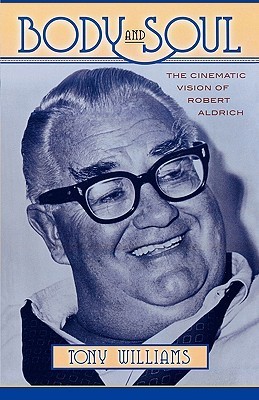
Tony’s books on film were always awe-inspiring in their detail and carefully considered critical approach to the subject. I had the great good fortune to welcome him as a contributor of a volume on Robert Aldrich to the Filmmakers Series that I edited for many years for Scarecrow Press. As I was writing this tribute to Tony, I took down his book from the shelf. And I am amazed at the attention to detail, the care and attention he devoted to his subject.
I suppose one might say that it was good of me to encourage Tony to write the book and to ensure its publication. But I owe a similar debt of gratitude to Tony for the many enthusiastic reviews he has written of my books through the years, some published in Film International. I remember he wrote a long and well-considered review essay on my 2004 book, American Racist: The Life and Films of Thomas Dixon for publication in Film Quarterly. The editor didn’t like Tony’s favorable response to my treatment of Dixon, but Tony stood firm, refused to change or edit his essay, and then published it, in its lengthy entirety, as a review for Amazon.
From one Tony to another, let me tell you how much I miss you and how much I have admired you through the years. You were not only one of my few favorite academics, but also a good and true friend.
Anthony Slide is the author or editor of more than 200 books on the history of popular entertainment. He has worked as resident film historian of the Academy of Motion Picture Arts and Sciences and associate archivist of the American Film Institute. In 1990, he received an honorary doctorate of letters from Bowling Green University, and at that time he was hailed by Lillian Gish as “our pre-eminent historian of the silent film.”
Thomas Sorlie
“You are the young gun slinger in town out to shoot this old gun slinger down!”
In the spring 1987 semester at Southern Illinois University, I enrolled in an advanced Film Theory class. I was one of three students who dared (crazy enough?) to take this challenging course offered once every two years.
The semester was focused on three areas of film theory – Feminist theory, Lacanian psychoanalysis, and Marxist theory applied to the films of Alfred Hitchcock.
Throughout the semester, I argued vehemently with the course instructor, Dr. Tony Williams, about film theorists’ use of Lacan. So much so that I wrote my thesis paper for the course arguing against the use of Lacan in film theory. The above quote was his retort when I proposed my thesis topic.
Although Lacanian film theory was not for me, I was (and am) deeply impacted by the Marxist theory I studied in the course. Challenging the dominant ideology of sources (in this case, film directors, writers, and producers) was the theory’s core approach. When applied more broadly, Marxist theory has been an invaluable tool (to me) for engaging with all aspects of media and interpersonal interactions throughout my life.
Dr. Tony Williams hailed from Manchester, England. His Ph.D. was in theology, and during the 1970s and 1980s, he worked on a council for interfaith communication in the city, even though he was not religious himself. I think because of this background, Dr. Williams reached out to me a few months ago to tell me that I was one of the students he was most proud of, not because I had graduated and worked in the film business, but because I had left a successful career in the film industry in my forties in order to pursue a path where I could focus my life mission on dispelling ignorance and facilitating understanding. It was deeply touching for him to tell me that.
I cannot overstate the impact that Dr. Williams had on my life. I rarely watch a film without referencing what I learned from him. He sharpened my mind, and I am a better person for having had the good fortune of crossing his path.
Thank you, Tony. Here’s to hoping there is a shot of Wild Turkey waiting for us on the other side if our paths should ever cross again.
Rest in Peace, my friend.
Thomas Sorlie is a former Focus Puller (IATSE Local 600) whose credits include National Geographic, PBS’s American Experience, NOVA, and the BBC. He now works as an academic writing advisor and as an independent analyst of the Middle East and Africa, with commentary appearing on al-Hurra TV and VOA and in Today’s Zaman, and lectures delivered at the Department of Defense as well as Emory University.
Laurence Staig
The Unknown Tony Williams: The Early Years Remembered
Tony was an absolute “one off.” We first met at Manchester University where he was doing a Ph.D. in theology – the Serpent in the Old Testament, I seem to recall. I was an undergraduate in English and American Literature. So nothing in common academically, except our passion for cinema. We both belonged to the University Film Society, I had a love of film music and in particular Ennio Morricone and the films of Sergio Leone, and Tony felt the same. That was unusual at this time. We became close friends, especially as I was able to source rare Morricone records for him.
He was first and foremost an academic and whilst many tributes may be referencing this aspect of his career, I would like to remember the more humane and sometimes excruciatingly funny side of his character. There are several memories that stand out.
We both became members of the Film Society committee whose task, as well as running the Society, was to choose each term’s programme of films. This could become heated, with debates and arguments and I remember him absolutely insisting that we screen Taking Tiger Mountain by Strategy – although nobody had ever heard of it. In the end, I think he did a tactical trade of one Tiger Mountain for Get Carter.
At this time, Tony had long hair, a beard, and a significant love of peas. I recall he was a fan of Van Der Graff Generator and had a huge interest in the work of H.P. Lovecraft. And, of course, the music of Morricone, which he found via Leone’s films.
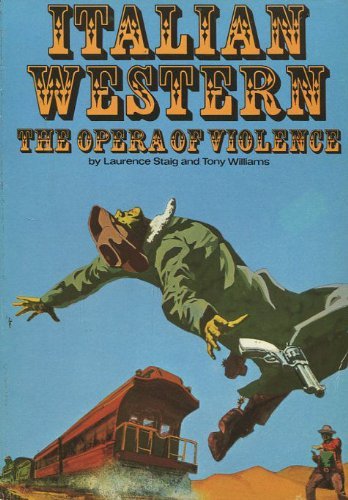
His ingrained determination permeated his character for as long as I can remember. We both once went on a march in opposition to the Manchester Festival of Light demonstration, led by the God-Fearing right wing Chief Constable Anderton and campaigner Mary Whitehouse. Upon being handed a leaflet by one of the Festival of Light people, Tony grabbed it and set fire to it, proceeding to dance around the flames. He was grabbed by a couple of police officers and marched off to the police station. I followed and waited outside – for an hour or more. One of the station officers came out and asked if I was waiting for him. When I said I was, he said, “Can you take him away please, we can’t take anymore, there’s no charge!”
I moved back to London after graduation, first to do a post grad and then as a lecturer in a London College. Tony remained in Manchester. When at Manchester I had suggested to Tony that he might collaborate with me on writing a book about the Italian Western, with an emphasis on the importance of the music. After gaining his Ph.D., he was finding getting work difficult. Tony never interviewed well and the job market was tricky. So he contacted me suggesting we write the book, which we did. Italian Western: The Opera of Violence was our first published book, and I had no problem getting it published as it was the first ever written on the subject. It was very well received. Tony went on for a career in film criticism and I a career in fiction.
I remember on one occasion he came down to London for an interview. I invited him over to my flat in south London, where, in the evening, I was having a get together with some Manchester student friends.
There was much alcohol, and my flat mate had invited his friend Graham, who was one of London’s leading criminal barristers. The Plague of the Zombies was the late-night TV movie and Graham was looking forward to watching this. Tony persistently interrupted our viewing, declaring this was not a horror movie but an examination of parasitic capitalist exploitation of local labour, and was in fact a Marxist dialogue. Graham was becoming irritated insisting it was just a (expletive) Zombie Movie! Tony insisted, “NO, it is much more!” The argument became hilariously heated. A top barrister versus Tony Williams’ academic analysis. Beer cans were thrown, language was rich. Graham threatened to throw Tony off the balcony if he continued, and chased him out of the house. I was in hysterics, I couldn’t stand, my flat mate was on the floor rolling with laughter. To this day, it’s one of the funniest episodes I remember about Tony. He had been taking an M.A. in Film Studies at Warwick University at the time, studying under Robin Wood and I think it showed!
I will gloss over the occasion I had to transport a large Afghan Hound dog to its owner, in a sports car, with Tony sat in the back trying to calm Khan (the dog) down. But I can’t overlook his enthusiastic accompaniment of my friend Malcolm’s late night ghost hunting expeditions in the woods in Surrey. We were often accompanied by a similar group of enthusiasts including the actress Jane Jordan (Rogers) Horsfall, wife of Bernard Horsfall (frequently seen on screen, including Bond films).
I briefly moved from London leaving teaching, and I returned to Manchester as Head of Arts and Events for the Manchester Borough of Bury. We needed to appoint a researcher and gave Tony his first proper job in my department. I was only there for a while as I moved to Cambridge working for the Arts Council. Tony’s tenure in Manchester was only for two years and then he was job hunting once again.
Film Studies was a very new subject in the UK in the late 1970s. It became clear to me that Tony’s future lay in academia in the USA which had a much more liberal curriculum. Before I knew it he had moved to Southern Illinois, to take up a post at SIU Carbondale. Following this we lost contact with one another, initially corresponding and then not at all.
He was a character, could be difficult and stubborn and often seen as an outsider, which he was. Extraordinarily widely read with interests you would never have guessed. Going through his record collection on one occasion I had a mutual friend with me and we were surprised to find several Village People albums. Tony couldn’t stop laughing and pointed at me declaring blusteringly, “They’re not mine, they’re his!”
He sometimes stayed at my mother’s house in London on the occasional visit. My mother liked him a lot, as she told me once that he left giving her some money, saying “Times are tough, it must be difficult for you as a pensioner Mrs. Staig.” I’ll certainly never forget such a character, who played a part in my early life. Adios Amigo.
Laurence Staig’s career has spanned the Arts as a Manager, author and Artistic Director of many UK Festivals, including the Bath Literature Festival for five years. He was Head of Film for seven years in Cambridge where he also taught summer schools in International Cinema. His most recent book is a collection of short stories Told at Dusk, Remembered at Dawn (Brooligan Press, 2022). He is the co-author of the first ever book about the Italian Western, and the creator of the much used descript of the genre: “The Opera of Violence.”
Clarice Stasz
When I dove into Jack London scholarship, I did not realize how English literary scholars formed into cliques. I was an historian writing biographies, and historians are notably polite through collegial disagreements. But once I participated in Jack London conferences, I learned I was for many persona non grata, and overheard personal attacks on me for invading “their space.” Then I met Tony Williams.
Being a film scholar, Tony also did not obtain the ruling clique’s approval. One advantage of being outcast is the freedom to speak one’s mind, and the two of us did so, along with a couple of other scholarly eccentrics who entered our tiny circle.
I could not understand why people were not collegial with someone who offered such deep and nuanced studies of Jack London’s career with the movies. London was among the first writers to embrace cinema, working directly with Hollywood producers and directors. We would not have live footage of London without this connection.
Tony’s Jack London, the Movies: An Historical Survey is a comprehensive overview of the writer’s adaptations available until the early 1990s, along with Tony’s incisive critical commentary. Unfortunately, Tony chose to go with an unconventional publisher, a Jack London associate who was not situated to produce and market the book properly. As a result, it did not receive the distribution it deserved. Consequently, the book is not available, being rare and expensive (if found at all) or in special collections. The best memorial for Tony now would be for someone to gain copyright and bring the book into print again, perhaps on demand, and in an eBook version, with royalties to his family.
Clarice Stasz is History emerita, Sonoma State University. She has written many articles about Jack London, as well as two biographies incorporating the women in his life.
Dan Van Neste
When I think of Tony Williams, the words scholarship, hard work, passion and friendship come to mind. As an author/biographer, I was in awe of his scholarship and all the hard work he put in during the years I knew him. In a career spanning many decades, he devoted much of his working life to the appreciation of film and filmmakers both as an author/historian and as a teacher and expert. His books covered a wide range of topics reflecting his wide-ranging interests from Italian westerns, to films about the Vietnam War, to George Romero’s horror movies, to the cinema of Robert Aldrich. Although I have not read them all, the ones I have read were each lifted by his thorough knowledge of the subject matter, his dedicated research, and by his infectious enthusiasm for the topics he wrote about. I also remember Tony for his great passion. He was an extremely opinionated individual, and was not about to back off his views easily. I admired that, but of all the things I recall about Tony, his friendship and support were the most important. I was terribly flattered he admired my work as an author and championed it whenever he could. I think, because he was a scholar and author, he understood better than most all the challenges associated with writing historical works about people who are long deceased. In short, Tony was a unique person, one who I had great respect for and one who I will never forget.
Dan Van Neste is an American film historian and biographer, the author of innumerable in-depth articles and books on classic cinema, including The Magnificent Heel: The Life and Films of Ricardo Cortez (BearManor Media, 2017), The Whistler: Stepping Into the Shadows (BearManor Media, 2023), and The Accidental Star: The Life and Films of Warner Baxter (BearManor Media, 2024).
David Walsh
I’m not certain precisely when I first began corresponding with Tony. It’s been twenty years at least. Unfortunately, in those days, when a computer of mine died, its contents often died with it, so I don’t have a record of emails from the early or mid-2000s. The earliest communication I have is from 2006.
In any case, there were so many emails and it became such a regular part of my life to hear from or write to Tony that it’s difficult to say when the communication began. It’s possible it commenced after I interviewed Robin Wood in October 2000, someone he much admired. At a certain point, it simply seemed that the relationship had always been there, it was that natural and organic. He wrote into the World Socialist Web Site (WSWS) countless times. He was one of our most prolific commentators.
Our relations began with politics, or the link between film and politics. Tony was a socialist and followed the WSWS for years. We interviewed him several times (on Orson Welles, on George Romero, on James Jones), he wrote a review for us, he supported us in various campaigns and projects. I met him at a diner in Carbondale, in Woodstock, Illinois (for a Welles event), and most recently, in Detroit, when he spoke at the Detroit Film Theater in October 2022 on the films of King Hu.
Tony was a working class socialist, deeply concerned about the condition and fate of broad masses of the population. It was in this regard that he took film and art seriously, as phenomena that either led to the enlightenment and growing self-awareness of the population or deadened and deluded it. The condition of filmmaking was not an academic or inconsequential matter to him, and he treated it with great urgency.
Looking over the correspondence and his online responses to various WSWS articles, he wrote about a myriad of subjects — attacks on social programs by Republicans and Democrats alike, the Obama hysteria affecting the middle class, on Mike Leigh’s Peterloo, on various professional and ideological atrocities on his own campus (“It gets worse and worse” was a typical subject line), on his hatred of the tech giants, on Robert Aldrich, on John Garfield, on horror films, on East Asian cinema, on the statue of Engels in Manchester, and hundreds of other subjects. Each email or comment brims with energy, often outrage and an interest in the mobility and complexity of life and art.
“Am I wrong to see the implications in this? Some FB [Facebook] people have accused me of hijacking for political reasons when I try to bring in the broader picture.”
Always a concern for the “broader picture.” Tony was outspoken and honest. We didn’t agree on everything. He had a sharp public conversation with the WSWS, one of our last ones, on the issue of AI. But he was not a prima donna, who got his feelings hurt. After that disagreement, we heard from him again, just before his death. He was one of the few people, frankly, writing about cinema that one could learn from, who took everything seriously. He will be sorely missed.
David Walsh is from New York City and has been the arts editor of the World Socialist Web Site in January 1998 (on which website he has posted 2,400 articles). He has been a full-time socialist journalist since 1991, writing extensively about films and filmmakers. He is the author of The Sky Between the Leaves: Film Reviews, Essays, and Interviews 1992-2012 (Mehring Books, 2013); French Workers in Revolt: A New Stage in the Class Struggle, November-December 1995 (Mehring Books, 1996); Hollywood Honors Elia Kazan: Filmmaker and Informer (Mehring Books, 1999); The Aesthetic Component of Socialism; Art, Culture, and Socialism (Mehring Books, 1998); The Detroit Symphony Strike & the Defense of Culture in the US (Mehring Books, 2010); and editor of Art and the Influence of Revolution (Mehring Books, 2026).
Editorial Note: FilmInt Online also strongly opposes the use of generative AI, in its pages and elsewhere.
Christopher Weedman
This tribute is a sort-of companion piece to an invited preface that I recently wrote chronicling Tony’s career and the impact of his vast body of critical work, which will be published in a forthcoming special issue of Cine-Excess.
Alternatively, here I would like to instead focus exclusively on my time working with Tony as a Ph.D. graduate student at Southern Illinois University, Carbondale (SIUC), where he served as my professor and dissertation director from 2005 to 2011. Always highly particular about the graduate students he officially mentored, Tony gave me the rewarding opportunity to be one of only two Ph.D. students whose dissertations he agreed to direct during his remarkable forty-one years as a faculty member at SIUC — the other being Philip L. Simpson, who is also a contributor to this collective tribute.
Admittedly, this exclusivity was, in part, due to the fact that Tony considered himself a scholar above all else. He was uninterested in taking on many graduate student projects. Nevertheless, it was also due to the fact that he believed being a dissertation director was a highly important responsibility (informed by his own rich experience studying under Robin Wood at the University of Warwick from 1976-77) warranting faculty members willing to fully commit themselves to the student’s intellectual and professional growth. In other words, he was not a professor looking for a large number of groupies, nor was he out to pad his own yearly productivity numbers within the department by mentoring any student who came rapping at his office door in Faner Hall. That being said, Tony could be a most generous and supportive professor, but you had to earn his respect and make him want to work with you.
I first met Tony at a symposium celebrating the centenary of classical Hollywood cinematographer Gregg Toland, which was organized by Eastern Illinois University in Charleston, Illinois in September 2004. At the time, I was a twenty-eight-year-old master’s student participating in my first academic symposium. In addition to having the responsibility of operating the audio/visual equipment for the event’s keynote speaker, the late Robert L. Carringer (1942-2023, the author of the pioneering study The Making of Citizen Kane; University of California Press, 1985), I was slated to deliver a presentation on Toland’s collaboration with director William Wyler on the melodrama These Three (1936, based on the play The Children’s Hour by Lillian Hellman) on a panel with Tony. Tony had been invited to EIU to read his paper on baroque noir expressionism in the films of Toland, Orson Welles, and Robert Aldrich — later reworked and published in Alain Silver and James Ursini’s edited collection Film Noir: Light and Shadow (Limelight Editions, 2017). Despite the intimidation of presenting my first formal paper in front of these two prodigious film scholars, the experience was positive and afterwards, at a reception held at EIU’s Tarble Arts Center, I worked up the courage to walk up and talk to Tony. Despite an awkward first couple of minutes, we ended up having a good conversation, particularly when I told him about my (still ongoing) research into the life and career of British actor Donald Pleasence, whose voluminous body of work in film and television we both admired.
A few months later, I applied and was later accepted into the English Ph.D. program at SIUC with the specific intention of studying under Tony. However, shortly after I started the program in the fall of 2005, I was advised by the departmental powers that be to give serious consideration to changing my area of specialization to a more traditional literary period and, in turn, make film studies one of my two required secondary areas. The rationale given to me was twofold. Not only was I told that it would open me up to more academic job opportunities, but also, perhaps more importantly, it would increase my likelihood of getting through the program. In a tactful manner, it was suggested to me that Tony was a highly demanding professor and did not work with many graduate students. Consequently, only a month or so into the program, I found myself at a pivotal academic crossroads, where I needed to decide whether to heed to the well-intended advice of others or, instead, follow my own passions with the knowledge that it might be the more difficult and, perhaps, less successful path. Due to the fact that my love of film was the only reason I went to graduate school in the first place, it did not take me long to make my decision. Shortly thereafter, I enrolled in my first class with Tony (an examination of “The British Gangster Film”), which began the following semester.
When I started taking classes with him, I quickly discovered that Tony’s reputation for being demanding was not unwarranted. He was an old-school, lecture-centered professor, who read from his notes at a podium in a lecture hall and exuded an intimidating classroom presence that could rival John Houseman’s Professor Kingsfield in the film and television series spin-off The Paper Chase (1973 and CBS, 1978-79 and Showtime, 1983-86). Tony not only expected you to produce your best work, but he would also push you even harder if he felt you possessed true potential.
I found this out firsthand when I received a “B” on my first paper, which a friend in the master’s program, who received an “A,” freely admitted was much better written and argued than his. In retrospect, I now recognize it was partially a test to see whether I was receptive to taking constructive feedback and, in turn, would rise to the challenge of producing better work. Unlike most of my other professors who tended to ask for one twenty-page seminar paper at the end of the semester, Tony required me to write two papers of this length every semester: one by the midterm and one by the last week of classes. To his credit, despite this heavy writing load, Tony always provided detailed feedback with additional ideas and references to other films and critical readings that he felt I needed to consult to bolster my argument.
By fully committing myself to my studies and accepting the challenge to produce good “scholarship” and not simply good “course work” (an important distinction that is not always made clear to graduate students), I soon found myself producing work at the level he expected and, as a reward at the end of my first class with him, he took me out to lunch at a local hole-in-the-wall Mexican restaurant. Over a highly enjoyable but unassuming meal, we chatted about my academic plans as well as a wide-variety of films. I remember him being particularly enthused that I owned a widescreen Region 2 UK DVD of director Anthony Mann’s dark Western Man of the West (1958), which he later asked to borrow when he screened the film in his class on the Western genre the following semester. While he was always an intense person to have a conversation with due to his intellect, strong views, and reticence to talk about anything that did not involve film, academia, and politics, we both shared eclectic film interests and could have discussions on everything ranging from directors Alfred Hitchcock and Howard Hawks to postwar British crime films and 1980s action films starring Charles Bronson, Chuck Norris, and Arnold Schwarzenegger. I still remember Tony chuckling about how he did not understand why his mentor Robin Wood could find so little humor in director John Milius’ Conan the Barbarian (1982). “I told Robin, ‘it is not a film to take seriously,’” he said with a huge smile.
Over the next few years, I continued to take courses with Tony on the Western, Hitchcock, and, at my request, an independent study on director Joseph Losey, whose collaboration with screenwriter Harold Pinter on the British arthouse films The Servant (1963), Accident (1967), and The Go-Between (1971) later became the focus of my dissertation. Not only did Tony take me completely under this tutelage, but he generously gave me opportunities that few, if any, other professors would have offered their graduate students. In the fall of 2006 (while only in the middle of my second class with him), he invited me to deliver a guest lecture on Orson Welles’ adaptation of Macbeth (1948) in his undergraduate course on Welles, which he did as an audition to gauge whether I could be trusted to teach his 3000-level film class the following semester when he went on sabbatical to conduct research for his book James Jones: The Limits of Eternity – a project he started, shelved for almost a decade, later returned to, and eventually published through Rowman & Littlefield in 2016.
Impressed with my lecture material and discussion of the film’s connection to Welles’ prior Shakespearean stage adaptations and experimental radio plays (the latter in the film’s expressionistic use of sound), Tony obtained special permission from SIUC’s College of Liberal Arts for me to teach his class as the “instructor of record” in the spring of 2007 (a survey of Hitchcock’s British and American films). In his letter of support for a graduate teaching award (that I did not receive) the same year, Tony wrote:
During the times I have been unable to teach classes my concern is that a qualified and serious representative take over so that I do not have to cope later with the damaging aftermath left by self-styled “film experts.” Chris is one of the few graduate students I would trust to teach any of my classes due to his dedication to the subject and the responsible manner in which he undertakes any assignment…His role as a class teacher [is] really inspiring and reflects credit upon the preparation this Department undertakes to prepare graduate students for this very demanding activity.”
As you can imagine, this vote of confidence, especially from someone like Tony, meant the world to me. Looking back, I cannot adequately express how much this opportunity to teach my first upper-level film class benefitted me, since it enabled me to be more competitive on the job market, particularly in a highly competitive academic field where positions are so far and few between. During my years at SIUC, I continued to periodically serve as a substitute instructor in his 3000- and 4000-level undergraduate courses on directors Hawks, Hitchcock, Anthony Mann, and Nicholas Ray, particularly when he was out for over three weeks with health issues in the spring of 2011.
After successfully completing my preliminary exams where Tony asked me to read works by film theorists ranging from Sergei Eisenstein and Jean Mitry to Dudley Andrew, David Bordwell, John Caughie, and Ernst Gombrich, I embarked on proposing and writing my dissertation on conceptions of exile in Losey and Pinter’s three film collaborations. This was, undoubtedly, the period of my time at SIUC where I owe Tony my greatest debt of gratitude. Amid the usual difficulties of learning how to structure and sustain an academic argument, I went through a complicated situation in my personal life early on in the project that, for a time, was preventing me from moving forward with my work. For someone who could be hard to approach, Tony was very sympathetic to the life challenges I was experiencing and, to his credit, he took me out for lunch at a local restaurant, the Mississippi Flyway, to show me support during this sad time.
However, after two to three months of producing little substantial work, Tony grew concerned that the project would get derailed and I might never finish, particularly considering that I had to get a year extension in assistantship funding to stay at SIUC and complete my dissertation. Recognizing that I needed pushing, I received a short and stern ultimatum email from him that I was expected to send him a completed chapter draft on The Servant (at the time only about half finished) within a fortnight. As difficult as it was to read his words, this email, as I’m sure he expected, lit a fire in me to finish this chapter – a piece that I eventually reworked into a peer-reviewed article and published years later, in 2019, in the Journal of Cinema and Media Studies. Tony’s willingness to prod me when other professors would have tried a gentler approach (or, alternatively, not cared at all) is one of the biggest reasons why I ultimately finished my Ph.D. and have the privilege of being a teacher-scholar in film studies today.
After successfully defending my dissertation on August 2, 2011 (less than two weeks before starting the Marion L. Brittain Postdoctoral Fellowship at Georgia Tech in Atlanta), we continued to stay in regular contact through email and Facebook, where he would regularly comment on my posts. Immediately upon graduation, Tony insisted I start calling him by his first name (instead of Dr. Williams) and, when he would put me in touch with his various film contacts, he tended to refer to me as a colleague as opposed to one of his former graduate students — a gesture I always admired and, in many respects, was reflective of his desire not to want to take credit for his students’ accomplishments.
Regrettably, I only saw Tony twice afterward: once at my graduation in December 2011 and one more time to introduce him to my wife Eudora (who I was then married to less than a year) in August 2015. I never had the good fortune of telling him directly how much his mentorship and support over the years meant to me, since he was always hard pressed to take a compliment and would always find some way to change the subject. Nevertheless, from what I was told recently by his wife Kathleen, he knew. She confessed that I was one of a small coterie of students (also including Richmond B. Adams, Philip L. Simpson, and Brian Wilson, all of whom have honored Tony in this collective tribute) who were “household names” in their home in Carbondale, Illinois.
Due to his never-ending battles with university administration and the fact that we were first introduced to each other through the work of Donald Pleasence, Tony would sometimes, in his last years, joke with me sarcastically that he would soon be entering into the “Changing of the Guard” phase of his career – a reference to the actor’s memorable performance in this 1962 Rod Serling-scripted episode of the original Twilight Zone television series (CBS, 1959-64). In this tender installment, Pleasence’s elderly character, Professor Ellis Fowler, is forced into retirement by the school’s ageist administration and, ultimately, finds himself visited by the ghosts of his former (deceased) students, who make him recognize that his life’s work was meaningful. Even though Tony later clarified that he was actually more like the rebellious British director “Lindsay Anderson than Donald in ‘The Changing of the Guard,’” I hope my words as well as those of his many other students, colleagues, friends, and admirers in this collective tribute show that Tony’s contributions to film studies as both a teacher and a scholar have had, and will continue to have, long-lasting reverberations.
Christopher Weedman is Associate Professor of English at Middle Tennessee State University, where he serves as both director of the General Education English program and faculty advisor of the Film Studies minor. He is co-editor of the collections Adult Themes: British Cinema and the X Certificate in the Long 1960s (Bloomsbury, 2023) and Liminal Noir in Classical World Cinema (Edinburgh University Press, 2023). In addition to currently co-editing the collection Re-Focus: The Films of Michael Cimino (Edinburgh University Press, forthcoming 2027), he recently contributed a chapter, “Reflections on The Man with the Hypnotic Eye: Donald Pleasence and Fan Websites at the Turn of the Twenty-First Century,” which will appear in Dark and Lonely Waters: Donald Pleasence and His Career in Horror, edited by Steven Gerrard and Renée Middlemost (Liverpool University Press, forthcoming).
Brian Wilson
I was Tony’s student twenty-five-years ago at Southern Illinois University. At that time I was a young filmmaker, obsessed with Brakhage, and just at the cusp of my artistic and academic journey. Tony was a teacher unlike any I’d ever encountered. He commanded the room with a presence that revealed academic discipline, a profound intelligence, and a tremendous wit. Tony was different from me, or so it seemed at first. I was a daydreamer, an artist who could get lost in abstractions and philosophical wanderings. Tony seemed so structured, and that appealed to me a great deal. I wasn’t a great student initially. My first paper in his Howard Hawks course earned a “C,” but I was determined to learn from him. By the end of the course, through a lot of hard work and listening to his feedback, I’d earned an “A.”
I respected Tony a great deal back then, and I think he recognized that. I took more classes with him including one on Kubrick, as well as a couple of independent studies. I emailed him drafts of articles I wrote when I was first trying to get published, and he was highly supportive. We started going out for the occasional meal, where we would talk about films and books and music. Tony always pushed me a bit further than I knew I could go. He always had another director to recommend, another book he felt I should read.
At times I wanted to emulate Tony, being guilty of the anxiety of influence so many young scholars face. When I told Tony I considered him a mentor, he was flattered, but responded with, “be your own mentor.” In the years since, I’ve come to understand this wasn’t a gesture of rejection, but rather a push for me to embrace my own individuality. I couldn’t ultimately ever really be like him, and that was the point.
Over the years I got married, became a father, and at times drifted away from my academic studies. Tony, however, never gave up on me. He would reach out every couple of months if he hadn’t heard from me, and suggest a day to have dinner or coffee. There we would meet somewhere locally. In the beginning it was a hunting-themed restaurant called the Mississippi Flyway. In later years it became the Barnes & Noble Cafe. Tony would always bring me a small gift of sorts, a DVD or a book or an interesting article he’d printed out at his office. I took those gestures as a gentle reminder to me to never give up on my scholarship, and I never did.
I last saw Tony in January of this year. We met for one of our usual coffee dates. Tony had been telling me for a while about the book he had been working on, a study of the Italian western, a meaningful return to the subject matter of his first book. More than once during this last meeting, Tony referred to it as “my final book.” I wasn’t sure what he meant, and didn’t press the issue. We had a nice conversation, always deep and without a bit of small talk. For some reason I was motivated to tell him how much he meant to me. I told him how much I owed to him, how much he had changed my life, how he had inspired me to become a teacher, to write and publish, how he had pushed me and encouraged me when I needed it most. He was never good at taking compliments in that way, but I could tell he appreciated my words.
Tony Williams was my teacher, my mentor, and my friend. His great gift was to inspire his students to be endlessly curious and fearlessly individualistic. A part of the Knight of Film Criticism lives on in me as it does in all of his students who chose to listen.
Brian Wilson is an experimental filmmaker and scholar who has published widely in the area of film studies. His writing has appeared in journals such as Senses of Cinema, Film International, and Cineaction. Wilson lives in southern Illinois but works as remote faculty at Northern Virginia Community College, where he teaches courses on animation, video editing, and film history.
Kristopher Woofter
I first worked with Tony Williams on the inaugural issue of the journal Monstrum, which came out in April 2018. I was putting together a retrospective dossier on George A. Romero, who had passed away in July of the previous year, and Tony was one of the few scholars whose work had addressed Romero’s films at length. I asked Tony to write on Romero’s odd, hybrid, unsettling character study There’s Always Vanilla (1972), which he described as “an important record of the decline of the 60s optimistic aspirations into the dead-end of conformity and its associated emotional wastelands.” Tony saw both that film and Romero in general as indebted to the spirit of independent experimentation that characterized another courageous artist who worked against the grain, Orson Welles. (Tony’s call for future research on a Welles-Romero connection has gone unheeded … so far.) I later worked with Tony on American Twilight, the volume of essays on Tobe Hooper’s work that I co-edited with Will Dodson. This close second collaboration (Tony wrote about Hooper’s 1979 TV miniseries Salem’s Lot) created something of an affinity between us, and from that point on Tony would frequently send me messages alerting me to things that might be of interest to me, and would reach out on occasion to ask how I was doing, what things I was working on, or to wish me a happy birthday. I was thrilled (though not surprised) to learn that he was interested in Shirley Jackson. Tony is one of the heroes of horror studies, but he was also a gentle and generous soul. I am lucky to have known him.
Kristopher Woofter is a faculty member in the English Department at Dawson College, in Tio’tia:ke (Montréal, Québec). He edits the peer-reviewed journal Monstrum, and is co-founder of the Montréal Monstrum Society.
Esther C. M. Yau
Professor Tony Williams was deep in his own book manuscript when I invited him to co-edit a volume of essays on Hong Kong Neo-Noir cinema in 2015. He kindly agreed to participate and contributed an incisive essay on Shinjuku Incident (2009). To the introduction, which had been shaped by my primary research and editorial reading, he provided the vital intellectual bookends that connected the project to the larger historical and national noir traditions. Throughout this process, Professor Williams remained wonderfully receptive to dialogue, generously sharing his recent publication experiences with me. Following the publication of Hong Kong Neo-Noir (Edinburgh University Press, 2017) and in our editor’s interview with Film International, he was quick to highlight the value of a PRC neo-noir film suggested to him that he tracked its mixed stylistic development of Italian neorealism and classical film noir.
In his final valediction to the project, he spoke with genuine warmth of the solidarity he felt from colleagues in Hong Kong, writing that he was truly honored to be a partner on this venture. For a scholar of his immense standing, it was an elegant gesture that validated the project’s worth. I join the volume’s contributors, his colleagues, and friends in honoring Professor Williams’ unique voice and lasting intellectual legacy.
Written on Memorial Day – 25 May 2026
Dr. Esther C. M. Yau is Professor Emeritus of Occidental College, USA, and Honorary Associate Professor of the University of Hong Kong. She co-edited Hong Kong Neo-Noir (Edinburgh University Press, 2017) with Professor Tony Williams. She also co-edited A Companion to Hong Kong Cinema with Gina Marchetti and Esther Cheung (Wiley-Blackwell, 2015) that has published Professor Williams’ chapter on “Transitional Stardom: The Case of Jimmy Wang Yu.”
FilmInt Online welcomes tributes from other colleagues, friends, and readers in the comments below….
Authors’ Note (14 September 2026): The subtitle of this collective tribute is an allusion to Don Siegel’s 1973 neo-noir crime film Charley Varrick, whose working title, “The Last of the Independents,” Tony enjoyed referencing from time to time, in various contexts. Used playfully here, the subtitle is not intended to be absolute.