

By Leo Collis.
“I really wanted to give the audience the feeling that they were entering the Stephen King universe.”
The chances are, whether knowingly or not, you’ve seen a Stephen King adaptation on screen. The prolific author from Portland, Maine, has written over 50 books, and he has inspired numerous filmmakers to bring his work to a wider audience through the power of film. Director Daphné Baiwir has examined those adaptations in her documentary King on Screen, in which she has tracked down the people behind the camera and asked them to share their love of his work and the thrill of bringing his stories and characters to life.
“I’ve always loved Stephen King,” Baiwir began. “I discovered him as a child. It was true literature. The first book I read was The Shining. I was completely hooked. I think I was 10 years old. After that, I read all of his books and watched a lot of the movie adaptations.”
“I thought it would be great to ask the directors themselves how they worked with the great source material that is Stephen King.”

Among the greats giving their insight into the filming process are director Frank Darabont (The Shawshank Redemption, The Green Mile), television director Mick Garris (The Shining [1997], Tales from the Crypt), director Taylor Hackford (Delores Claiborne), director Mike Flanagan (Doctor Sleep), and directors Kevin Kolsch and Dennis Widmyer (Pet Sematary [2019]).
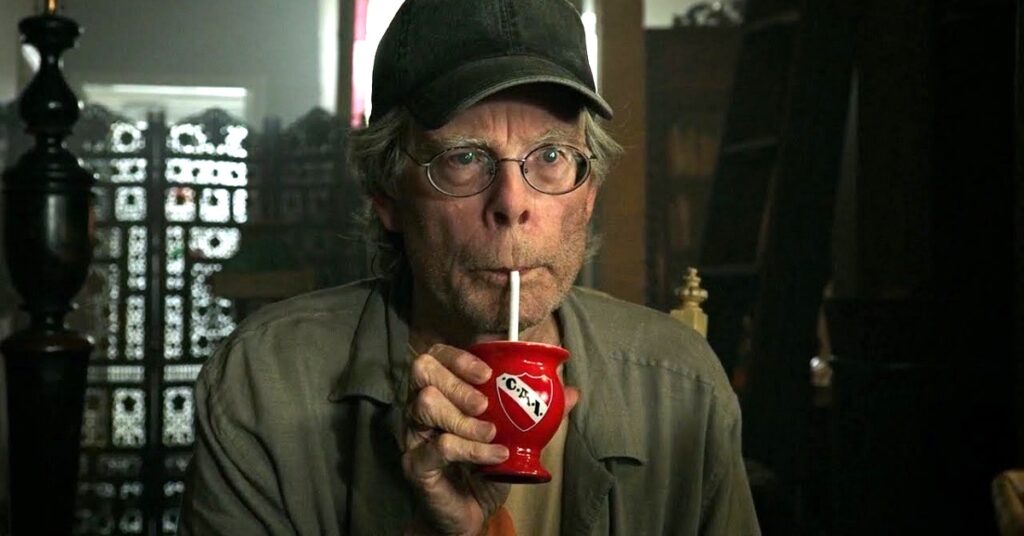
But it all begins with a little story of its own. The documentary opens with footage of something that looks familiar but is difficult to place. It has all the hallmarks of Stephen King’s narrative style, and the aesthetics and locales that would be familiar to King film adaptations, but you can’t quite put your finger on where you’ve seen it before.
That’s because you haven’t.
Baiwir created narrative bookends for the documentary, placing yourself in King’s world before you even get a chance to get comfortable.
“I really wanted to give the audience the feeling that they were entering the Stephen King universe. We shot in Bangor [Maine], which is his hometown. We really wanted something that would really go deep.”
And not only does the setting give you an innate sense of King’s hallmarks, but a couple of cameos enhance that feeling.
“We were blessed to have great actors who played in previous adaptations, like Jeffrey DeMunn, Alexandra Paul and Miko Hughes. It was very exciting to have all those kinds of references and to create some small, strange universe.”
I didn’t want it to stop me from finding out more about women’s place in Stephen King’s works, because there are a lot of great woman characters.”
With such close attention to detail, it feels like Baiwir knows everything there is to know about King, and that knowledge and the creation of the documentary allowed her to enter what felt like an exclusive club.
“One of the things that surprised me was how nice the directors were and how they were willing to help to make this film happen. I’ve made films and documentaries before, but this time it was like entering into a family. Sometimes I didn’t get the email address of one of the directors, but every time I had great help from the directors. It was amazing, really.”
In the documentary, one quote really stuck out. Discussing his film Delores Claiborne, director Taylor Hackford said: “Stephen King can write women, he really can.” But King on Screen doesn’t feature any women directors talking about King’s film adaptations. Was this a difficult reality to accept for Baiwir?
“There are only two women who adapted Stephen King on screen. It’s something that really troubles me, but it’s really something that went on for years in Hollywood. Not only in Hollywood, in cinema everywhere. I tried to have those directors in the documentary, but I couldn’t reach Mary Lambert.
“As a woman, it felt really frustrating. But I didn’t want it to stop me from finding out more about women’s place in Stephen King’s works, because there are a lot of great woman characters. Kathy Bates, for example, played one of the greatest female characters in cinema history in Misery, and Delores Claiborne has three main female characters.
“It was something I really wanted to talk about, but I didn’t want to just find an actress to talk about that just because she was a woman. It was the director’s point of view I wanted. But, fortunately, Taylor Hackford was just the best person to talk about that with.”
So what is Baiwir’s favorite adaptation of King’s work in cinema?
“For me, it would be The Green Mile. This is my favorite movie. I think it’s so interesting. It’s very human. I really appreciated that one a lot.”
King on Screen is in theaters on August 11, 2023 and available On Demand and on Blu-Ray on September 8, 2023. Daphne Baiwir’s next project, Le Film Pro Nazi d’Hitchcock, will premiere at the Venice International Film Festival.
Leo Collis is a Film, Media and Journalism graduate from The University of Stirling.