

By Alex Ramon.
That’s why it’s a masterpiece – it escapes one interpretation. So I decided to accept the fact that this is my interpretation of the novel and hoped that it would touch other people too. Compared to other adaptations I’ve made of more ‘minor’ or lesser known works, it was a risk but I knew it was necessary to develop my own vision.”
–François Ozon
From plays (8 Women, In the House) to novels (Angel) to short stories (Ricky) to other films (Peter von Kant), the varied work of François Ozon has quite often taken inspiration from existing texts, adapting them freely and creatively. And Ozon’s latest project is one of his most ambitious adaptations yet: a vivid black-and-white rendering of Albert Camus’s 1942 existentialist classic L’Étranger (translated as The Stranger or The Outsider). In many ways it’s Ozon’s most “faithful” adaptation to date, but one that still develops a distinctive, fresh take on the material – particularly in its very deliberate placing of the story within its historical context and its subtle expansion of the female characters’ roles.
The first-person narrative of an affectless young Frenchman, Meursault, in 1930s Algeria is infused, in Ozon’s version, with an awareness of the complexities of Franco-Algerian colonial relations. The Stranger also resonates with Ozon’s cinema in aspects ranging from its stubbornly enigmatic protagonist to its demonstration of the life-altering encounters and events that can happen at the beach. The result is one of Ozon’s most gleamingly accomplished features.
Following our interviews about Double Lover (2017), By the Grace of God (2019) and When Fall is Coming (2024), we caught up again with the ever-prolific filmmaker to talk about the challenges and pleasures of adapting Camus to the screen, his work with collaborators both established and new, and “bringing viewers back to themselves.”
Alex Ramon: You’ve adapted a variety of texts over the years but The Stranger is undoubtedly the most iconic. How did the project come about?

François Ozon: A film I’d planned to make couldn’t be financed. The screenplay was structured in a triptych form and one of the stories focused on a young man who was alienated and disenchanted with life. When the financing stalled, I was advised to develop that strand as a feature. For inspiration I went back to The Stranger and was amazed that it resonated with many things I wanted to explore. I discovered that the rights were available – and began work on the adaptation, still with Benjamin Voisin in mind to play the lead role.
What were the particular challenges, pressures or pleasures of adapting such a well-known work?
It’s a big challenge when it’s a masterpiece that everyone knows. There are so many readers of the book, and everyone has their own vision of the story. Each reader is a potential director in a way: you imagine the faces, the locations, the situations, so much so that when you see a film version you can feel a sense of betrayal by the vision of the director. I knew all that, which is why I felt a bit afraid of the project.
But I was excited too. It’s a very mysterious book that can be interpreted in many ways. I read many analyses and spoke to Camus specialists and soon realised that there are multiple perspectives on the text, reflecting readers’ own positions and values. That’s why it’s a masterpiece – it escapes one interpretation. So I decided to accept the fact that this is my interpretation of the novel and hoped that it would touch other people too. Compared to other adaptations I’ve made of more “minor” or lesser known works, it was a risk but I knew it was necessary to develop my own vision.
You open the film with archive footage of colonial Algeria and have said that it wasn’t the book’s famous opening lines but rather Meursault’s later remark, “I killed an Arab”, that was key for your adaptation.
This was very important for me. Re-reading the book, 40 years after my first encounter with it as a student, I was quite shocked by the invisibilisation of the Arab characters. I didn’t remember that, and from today’s perspective it’s very disturbing. Reading more, I realised that this aspect had often been misinterpreted – that it wasn’t simply evidence of Camus’s racism, and there were reasons why this choice was made. He was fully aware of the unease between the two groups.
So I made some historical research into the situation, which remains quite a taboo period for the French. Between Algeria and France there’s still a wound. But that history also explains certain things about the political context of France today. So it was important for me to use these archive images to show the audience the French propaganda about colonialism and the “ideal” image that was being promoted at the time.
And I understand that there’s a personal element there too?
Yes, my grandfather worked as a magistrate in Algeria and my mother lived there for a while. They came back to France following a terrorist attack. Actually, you soon realise that many French families have these connections. It was a complicated position: so many French people were born in Algeria – Camus, among them – and loved the country. But the reality was that there was a kind of apartheid system, based on inequality under the code de l’indigénat, and the two communities lived parallel existences. That was the context I wanted to highlight for the film.
I couldn’t help thinking of an earlier film of yours which pivoted around the murder of an Arab character, and that was accused by some critics of “postcolonial unawareness”: Criminal Lovers [1999]. Did you have that film, or those criticisms, in mind when embarking on this new project?
You know, I didn’t but you’re right. I have to say I think these issues are part of the French unconscious. The relation with Arab countries, especially Algeria, is a deep part of our history; it’s inside us, and the tensions are still there.
Michael Haneke’s Hidden also comes to mind.
That title is so appropriate when thinking about the relation between France and Algeria. And it took an Austrian director to make that film. In France filmmakers are sometimes reluctant to address these issues.
About Meursault, Camus wrote: “The hero of my book is foreign to the society in which he lives; he wanders, on the fringe, in the suburbs of a private, solitary, sensual life.” The description fits some of your characters, with their tendency towards set-apartness and refusal to respond to events as society dictates. Were you conscious of that connection?
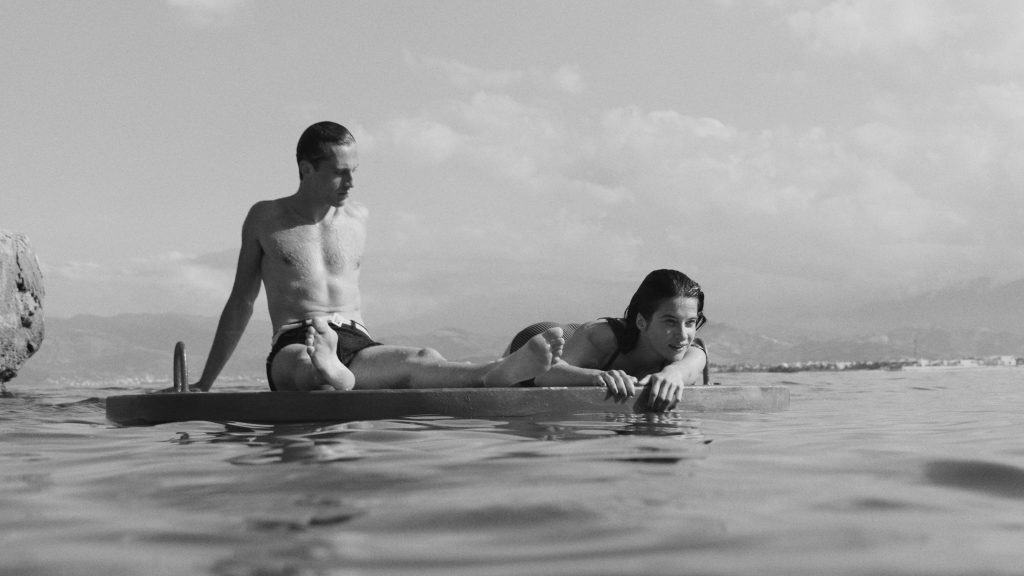
I’ve always been drawn to enigmatic characters who can’t be easily explained, and who there’s not one way of interpreting. It brings viewers back to themselves. When I worked on the adaptation I wasn’t interested in making psychological explanations: that’s not what Camus does. Meursault is like a blank page on which the reader or viewer can project many feelings.
Did you rewatch Visconti’s 1967 version? What’s your opinion of it?
It has some strong points. But Visconti admitted that it hadn’t turned out as the film he wanted to make, and you can feel that some significant compromises were made. For instance, Visconti wanted Alain Delon rather than Mastroianni for Meursault, and I think that casting would have worked better.
In terms of your casting, you have several reunions: Benjamin Voisin, as you mentioned, who you worked with on Summer of 85, and also Rebecca Marder (The Crime is Mine), Pierre Lottin (By the Grace of God, When Fall is Coming), and Swann Arlaud (By the Grace of God) What motivated your choices?
The film was complicated and hard to finance. I needed actors who knew and trusted me, and who accepted the economic conditions of the project. In addition, I enjoy working again with actors I like, and giving them the opportunity to show their skills with a different kind of character. After Summer of 85, the part of Meursault was a big challenge for Benjamin, requiring him to suppress his extrovert tendencies. He’s maturing into a great actor and it was wonderful to reunite with him after 6 years.
It was very important for me that the two female characters, Marie and Djemila, the Arab’s sister, played by Hajar Bouzaouit, are more present in the film than in the novel. When it came to Rebecca Marder as Marie, I wanted her to go beyond playing the character as naive and simple, and rather to show her insights and sensuality, and for the audience to fall in love with her – in contrast to Meursault’s indifference.
Pierre Lottin is not always easy to direct but he rewards with a great performance every time. Here, as Raymond Sintès he conveys both charm and danger. And I was very happy that Swann Arlaud accepted the part of the priest and came on board for two days. The scene is so important it needed an actor as strong as him.
I was quite shocked by the invisibilisation of the Arab characters…. Reading more, I realised that this aspect had often been misinterpreted – that it wasn’t simply evidence of Camus’s racism, and there were reasons why this choice was made. He was fully aware of the unease between the two groups.”
By contrast, this is your first collaboration with Denis Lavant. How was the work with him?
Great! He’s a legend in France due to Beau Travail and his work with Leos Carax. But he’s not easy to cast and you don’t see him so often in movies. When I read the character of Salamano in the novel I immediately thought of Denis and I was very happy that he agreed to play the part. He also has experience with Camus texts, and knows the writer’s world very well.
Where did you shoot the film?
In Morocco. I would have loved to shoot in Algeria but it’s not possible. So we decided on Tangier, which has some similarities in terms of architecture and the port.
Tell me about reuniting with the cinematographer Manu Dacosse and the decision to shoot in black-and-white.
Manu is a great DP and I’ve enjoyed our several collaborations since Double Lover. He’s Belgian, and easier than the French – there’s less ego, which is good because on the set I’m always the one behind the camera and he accepts that! We made a lot of tests in black-and-white to find what we wanted. We really wanted to push the white very strongly in the images to give that feeling of the sun’s glare, the heat… I think you can also feel more intensely the distanciation of Meursault in the world, as we’re less used to black-and-white today. And on a practical level the recreation of 1930s Algeria was easier this way.
There’s a certain silent cinema power to the first half, in particular…the images and the rhythms.
When I started the adaptation, all the first scenes could have been silent. I even considered that but then I realised that the second half is a kind of interior monologue full of Camus’s philosophical ideas, which it would have been impossible to convey silently. So many intertitles would have been necessary that the viewer might as well have just read the book!
Voiceover is used only twice, which feels very strategic. What motivated this?
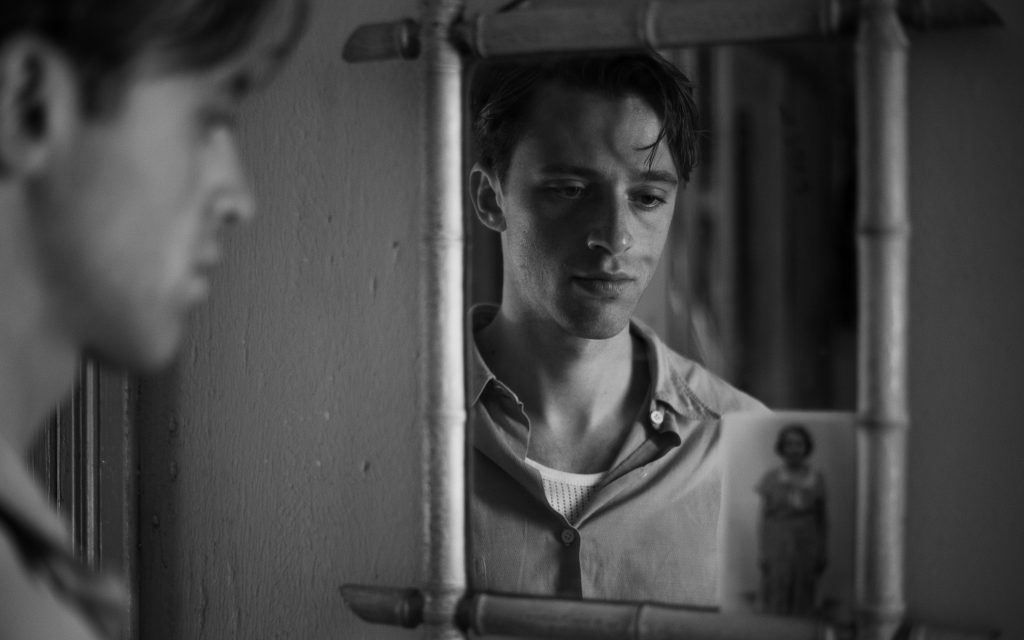
Overall I felt that voiceover would be too easy an option. I preferred to keep the mystery of the situations and give the viewer more of a chance to work. Reading and watching are not the same, of course, but there’s a complementarity – one doesn’t have to be in opposition to the other.
I used voiceover for what are, for me, the book’s most vital and beautiful lines. It’s very poetic in French and hopefully translates well in English too. It’s two key moments in the book but what’s important is that it’s not a description of acts, but more about sensations.
How was your collaboration with Fatima Al Qadiri on the score?
I had loved her work on Mati Diop’s film Atlantics, so I contacted her. As a Kuwaiti artist she was particularly curious to know what the adaptation would be like. I reassured her, and she accepted to collaborate. She was very inspired, and used traditional Arabic elements mixed with electronics, so the score is quite distinctive.
The use of The Cure’s “Killing an Arab”, which was directly inspired by the book, also gives the viewer a more contemporary jolt at the end.
It was very important to feature this track. Robert Smith had allowed me to use The Cure’s song “In Between Days” in Summer of 85 after I changed the original title (“Summer of 84”) to reflect the release date of the song. So I contacted him again and this time he agreed right away. It turned out the he had recently re-watched Visconti’s film of The Stranger. The song has been controversial and sometimes misunderstood, so I think he was glad that the film brings it back to the Camus book that inspired it.
The film won several prizes at the Lumière Awards in January. Did anything surprise you about the French response?
I was moved by the fact that the Algerian community in France was touched by the film. After one Q&A, an older Algerian woman came up to me. She confessed that she’d felt hurt by the book, which is of course not surprising: after all, there the character is just “the Arab”, with no name or history. She said that, due to the last scene of the film, she felt closer to understanding what Camus might have wanted to say. “It reconciled me with Camus,” were her words.
Returning to awards, do you have any opinion about this year’s Oscars?
When is the ceremony?
It was yesterday.
(laughs) Oh!
Your response shows perfectly how invested you are in that! So tell me about a recent film that you liked instead.
I discovered a small British film that opened in France a couple of weeks ago: Harry Lighton’s Pillion. It surprised me a lot. For a first feature, it’s confident and also brave. I liked the fact that it started out with a very specific relationship and then gradually moved into something more universal about a couple. The director takes some risks in terms of mise en scène, and I loved the performances of Harry Melling and Alexander Skarsgård.
Finally, are you willing to reveal anything about your next project?
Not a lot, but I can tell you that it’s an original script about a 12-year-old boy. He’s kind of a young Meursault in a way.
A Stranger origin story, perhaps?
(laughs) Exactly!
The Stranger is released in the UK on 10 April 2026, distributed by Curzon. It will be released in the US later this year.
Alex Ramon is a critic and programmer from London, who is currently based in Łódź, Poland. He contributes to Sight and Sound, BFI online, Cineaste, and Film International Online, among other outlets.