

By Jeremy Carr.
If there is a lesson to be learned from noir stories, be they in print or filmed, it is that the past never stays in the past for long, and the inevitably ill-fated future closes in faster than expected.
This formula has been the underlying core of countless novels and movies, but when it comes to Build My Gallows High, the 1946 novel by Daniel Mainwaring (writing as Geoffrey Homes), and the 1947 Hollywood adaptation, Out of the Past, this fundamental pattern is front and center, menacingly acknowledged and slowly but steadily eating away at everyone involved.
But Mainwaring’s novel, like the film, begins in the present, as former private investigator “Red” Bailey (Jeff in the movie, Robert Mitchum) has contentedly withdrawn to the small town of Bridgeport, California, where he runs a gas station, assisted by “The Kid,” and woos a young woman named Ann. How he arrived in Bridgeport and what he did before remains a mystery until his past comes calling and he is beckoned by an unsavory former associate. Left with little choice (a deployed enforcer makes sure of that), Red departs as requested and relates to Ann his hitherto shrouded backstory, including his real last name. To get too far into the weeds of the Gallows/Past plot would be to reveal its numerous twists and turns and the duplicitous actions that make it the engaging, endlessly coiling noir that it is. Suffice it to say, however, that behind all that transpired—and will transpire—is a woman: Mumsie McGonigle in the book, Kathie Moffat (Jane Greer) in the film. It was she who shot gambling kingpin Whit Sterling, leaving him with a bullet in the chest and without a bundle of cash, which she took when she fled. In the past, Red’s assignment was to track her and the money down; in the present, he must make amends for what he did and didn’t do before. Several key characters come and go in the story’s elliptical narrative, including Red’s old partner, a crooked lawyer, sundry henchmen, and a suspect secretary, but while there is a “plethora of crime and murder in Gallows,” as author Curtis Evans remarks in a newly published edition of the book from Stark House Press’s Film Noir Classics series, “at its heart the book concerns the tragedy of a man trying ‘against all odds’ to elude the dead clutching hand of his past.”

Mainwaring, whose English-born father migrated to California from London in 1892, was born July 22, 1902. He became a prodigious writer, with Gallows being the last of his 12 crime novels published from 1936 to 1946. After that, he decided to move away from tired detective stories, having declared them a “bore” and complaining, “You’ve got to figure out ‘whodunit.’” “I’d get to the end and have to say whodunit and be so mixed up I couldn’t decide myself,” he stated. With relative ease, Mainwaring thus became a remarkably versatile and rather underrated screenwriter. He worked at Pine-Thomas, the B-picture unit of Paramount Pictures, and penned six scripts earlier in 1946 before adapting Gallows for RKO, which paid $25,000 for the film rights, plus another $11,000 to Mainwaring to write the script. Warner Bros., which had Humphrey Bogart in mind for the lead, had lost the bidding war to RKO, where such names as Dick Powell and John Garfield were bandied about before Mitchum entered the picture and was cast in the lead. Kirk Douglas was engaged as the criminal mastermind Whit and Jane Greer was signed on to star as Kathie. To direct, RKO stuck with one of its prized filmmakers, Jacques Tourneur, who previously established himself as an innovative stylist with such features as Cat People (1942), I Walked with a Zombie (1943), and Leopard Man (1943), low-budget but extremely competent horror films made with producer Val Lewton. He was a natural fit, as author Chris Fujiwara explains: “If Out of the Past seems in some ways like a typical film noir, this is only because Tourneur’s constant preoccupations—the unreliability of appearances, the helplessness of people to resist their obsessions and avoid becoming the victims of an apparently impersonal fate—are also those of the genre.”
Although Mainwaring had been tasked with adapting his own novel, the studio enlisted seasoned crime writers James M. Cain and Frank Fenton to contribute to the script; Fenton, according to Evans, is “believed to have crafted much of the film’s original dialogue and snappy one-liners.” It was a sour experience for Mainwaring, seeing others dabble in the material he originated, but to overly credit Fenton, or Cain, with the crackling dialogue (and Out of the Past indeed has some of the best) is to take away Mainwaring’s own capacity for biting, brilliantly executed banter and description, of which the novel is overflowing. Pages throughout the book are filled with terse exchanges, self-possessed discourse, and coarse passages like a “sharp glance [that] killed the unborn speech,” to say nothing of the book’s phenomenally blunt last line (spoilers: “He didn’t hear the gun when Guy shot him because he was dead”). Of course, some of Mainwaring’s more salacious scenes and phrasing wouldn’t make it past the movie censors, so several scenes were excised—it’s hard to imagine anyone in 1940s Hollywood getting away with the author’s skeptical view of law enforcement or attempting to depict Red’s rough handling of one female character (reminiscent of Cain’s The Postman Always Rings Twice, 1934, and cut from that novel’s adaptation): “He flicked her mouth with his knuckles and then she was on him, clawing at him, slashing at his eyes with fingernails that were red daggers. His fingers dug into her right breast. She moaned and dropped her hands.”
There were, as there always are with book-to-film adaptations, numerous other alterations along the way, some quite considerable and some rather reasonable. Having been deemed too “grim” by the public (studio heads thought it was great), the title of Build My Gallows High was itself changed to the more appealing, and admittedly still appropriate, Out of the Past. (Curiously, the original title would be retained in the UK.) The script drastically trims down the present-day manhunt for Jeff from its prolonged state in the novel, with no real damage done, and the love triangle between Red, Ann, and her local, safer suiter Jim is, while kept intact, far less substantive in the final film. A pivotal antagonist in the book, Guy, is deleted altogether while Whit becomes the central amalgam of Jeff’s cinematic adversaries. The time constraints of a standard motion picture obviously played a part in the varied changes and deletions, and most are done in an effective manner with no real degradation of the source. However, one unfortunate variation is the limited impression made by The Kid, Red/Jeff’s deaf-mute employee and, apparently, his closest friend. Played by Dickie Moore of Our Gang fame, he has his gallant and sympathetic moments in the movie, but he is an impressively shrewd, capable, and unfailingly heroic figure in the book.

The primary rural setting for Out of the Past remained Bridgeport, and in fact the real town of that name would also serve as a key shooting location. While this fiction-to-real-world authenticity was something of a rarity, it was also significant, for the small town plays a crucial role in establishing the opposing tones of the text and film, as well as the two conflicting, quarrelling sides of Red/Jeff. Be it San Francisco or New York City, the Depression-era cities of Mainwaring’s Gallows are presented as cold and dark and ugly, with signs of impoverishment, violence, and despair at nearly every turn. It’s a stark contrast to the (fleetingly) idyllic and tranquil town of Bridgeport. The same applies in Out of the Past. Here, though, rather than have the two diametric settings described and meditated upon by Red and others, Tourneur and cinematographer Nicholas Musuraca use the visuals of the picture to draw the disparity, which they do admirably. The town and its surroundings are bathed in light, open to foliage and forest, while the urban centers are murky, cramped, and ominously obscured. They also imply the tonal break in peace by the preliminary presence of Joe Stefanos, Whit’s enforcer, early in the picture. His foreboding entrance is an immediate and pronounced blight on the otherwise serene situation of Jeff’s respite. The only negative of the town, notably mentioned in the book but merely hinted at in the film by the skepticism of Kathie’s parents and a waitress who makes it her business to know the business of every other resident, is the small settlement’s partiality for gossip, speculation, and insinuation.
Otherwise, however, it’s clear why Red/Jeff finds such solace in Bridgeport, even if it is a consolation built on a lie. The expediency of the movie’s plot prevented the filmmakers from dwelling too much on this fabrication, but it lingers longer in the book, where the first line of the novel—“Red Baily didn’t see her coming”—indicates just how much he has settled and let down his guard. He believes he’s safe and, unlike the film, where Ann (Virginia Huston) simply asks if Jeff has ever been married before and wonders where he came from, seeming to ponder such questions for the very first time and innocently asserting, “You sure are a secret man,” in the book, Red’s falsified predicament is considerable. Ann refers to him as “Bailey the mysterious” and, as if it had been a topic of some prior discission, states, “I don’t care what you’ve done, or what you are,” though that doesn’t prevent her from wondering about his past…“A black past. And maybe a wife somewhere.” For his part, Red is done with whatever happened before (or so he thinks): “I’ve decided—to hell with the past. To hell with everything but us.” “The past was dead. Ten years dead, and buried deep,” Mainwaring writes. Alas, in the noir tradition, such optimism is not to be.
Mitchum, just a year removed from his Oscar-nominated turn in William A. Wellman’s The Story of G.I. Joe (1946), was an inspired choice to step in as Jeff (the name change from Red being, some have argued, simply because the actor wasn’t a redhead, a trait often mentioned in the text). The narration of the book conveys much of Red’s inner conflict: “It wasn’t good. It wasn’t good at all. He wasn’t coming out of this untouched. That was certain. For the first time in his life he felt helpless. Not afraid—because he couldn’t find anything to be afraid of,” and, “He had killed a man and if it didn’t catch up to him now it might someday.” One likewise follows his disjointed train of thought as he tries to piece together the intricate puzzle of which he has become the essential piece, particularly considering Whit’s faculty for revenge and the looming shadow that now hangs over his head: “From now on there would be someone forever at his heels.” But Mitchum voices little of this outright. Instead, he relies on his soon-to-be trademark laconicism and mannered coolness to be less overtly revealing and, at the same time, casually confident. Although he relates to Ann his feelings about what had happened before, in the film’s single early flashback (the book skips through time more frequently), he from then on keeps his views and musings either in check, lest anyone else grow wise to his intentions, or suggests them only in sarcastic retorts.
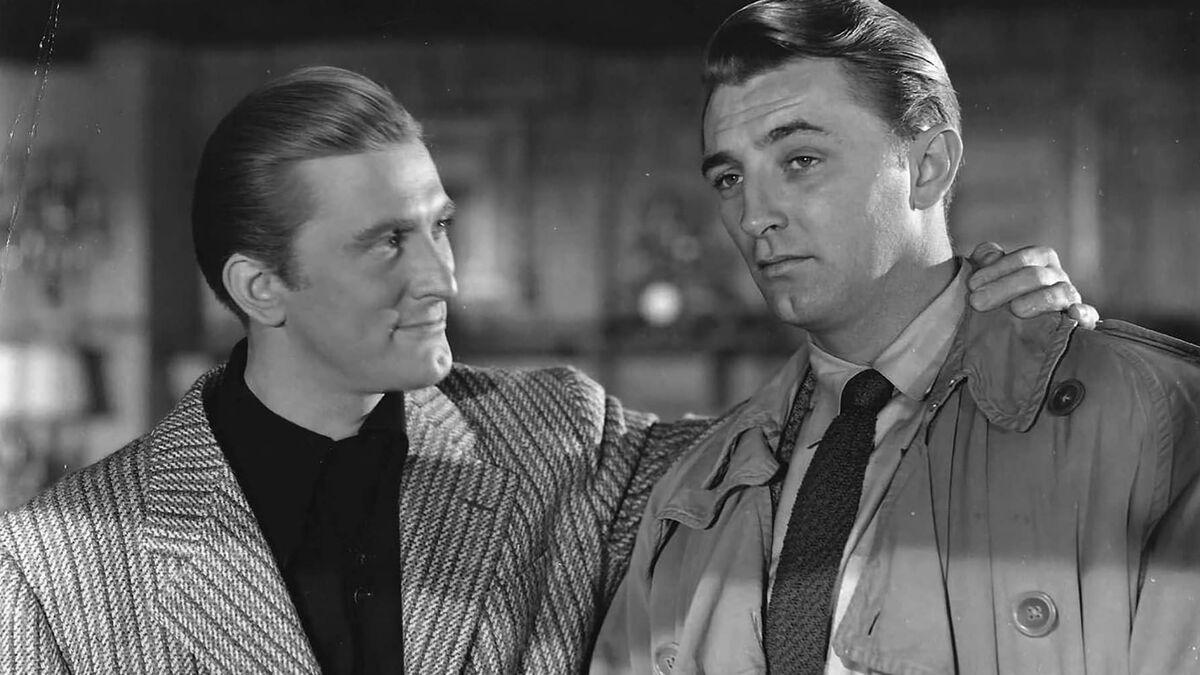
Compared to this, Douglas’s bald-faced bravado serves as the perfect counterpoint to Mitchum’s brooding reserve. A relative newcomer to the movies (it was just his third feature), Douglas, like Mitchum, cements much of his ensuing screen persona in Out of the Past, where he was now afforded the ability to encompass nearly all that works against Jeff, as opposed to the assorted parties conspiring against Red in the book. Though rarely portraying such an utter villain, Douglas nevertheless maintained the sharp gusto and slyness seen here. He’s suave, convincing with a killer(s) smile, and sure in his means for vengeance and violence. He still plays the long game with Jeff, but it’s nothing like the manifold web in which Red is caught, which Red acknowledges in the book while also acknowledging the text’s complex narrative: “But why so devious? … You went at it in such a roundabout way. Getting back at me, I mean.”
Unlike Mitchum and Douglas, who capitalized on key deviations from their text inspirations, Jane Greer as Kathie Moffat (not quite as memorable a moniker as Mumsie McGonigle) is a pitch perfect incarnation of this quintessential femme fatale. Kathie/Mumsie takes a perverse delight in her misdeeds and embodies the conniving, underhanded women so often central to noir conflict. Her rapid courtship with Jeff/Red is too good, too easy, and he should surely know better. “I like to pry into your past,” he tells her in the book. “It excites me.” “Someday it won’t,” she returns. “Someday you’ll start seeing ghosts.” Yes, he should certainly see what’s coming, as Mainwaring alludes to: “He took bits of her life and put them together—bits whispered to him in the night. Yet there were not enough to round it out. So he made up the rest.” That’s a risky gambit with someone like Kathie/Mumsie, and yet, it’s perfectly understandable. This is where Greer excels. She superbly plays the type of woman men want to get involved with despite all signs pointing to getting out, and getting out quickly. Even when Kathie appears to wither under Whit’s thumb in the film, Greer expresses an acquiescence that is hardly persuasive, much to her credit. As Fujiwara notes, Greer’s “great” performance gives Kathie “warmth, sensuality, and spontaneity…,” an appealing but dangerous combination.
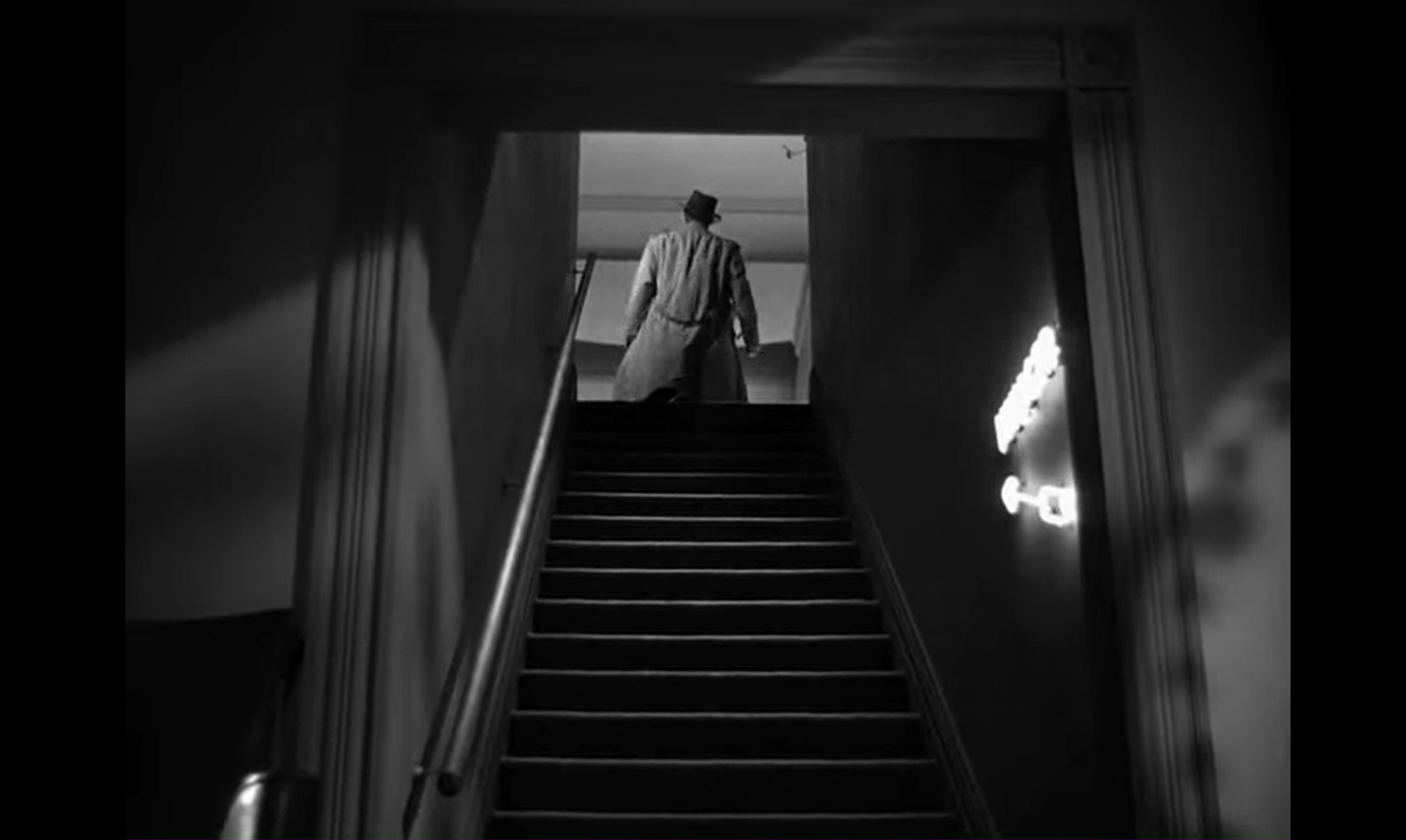
As for Tourneur and Mainwaring, while the former may be the more familiar name for moviegoers, the latter’s contributions to cinema history would be equally important. His left-leaning politics were precarious at the time and it seems he narrowly avoided the dreaded and in some cases career-killing blacklist, but post-Out of the Past Mainwaring wrote a number of fascinating motion pictures, including The Big Steal (released in 1949, also with Mitchum and Greer), The Tall Target (1952), The Phenix City Story (1955), and (carefully showing those politics) Invasion of the Body Snatchers (1956). Following the success of the aforementioned Lewton horror pictures and Out of the Past, Tourneur, on the other hand, should have been on top of the world, but unfortunately, despite his evinced skill and efficiency, his best years were behind him. He became a freelance director and aside from certain sequences in a few entertaining Westerns with Joel McCrea, he never again achieved such artistic heights.
“I’m a realist, Guy. Whit’s a realist. Hell, we’re all realists. Particularly Mumsie.” Red says this near the end of Build My Gallows High. It’s a line easy to overlook after everything else that happened in the story and what is rapidly coming in its denouement, but the observation is not only crucial to the book (and film) but to the nature of noir storytelling generally. The genre has always been very much about accepting a situation and acting accordingly, to know what’s been done and what will likely ensue: “You can’t touch pitch forever and stay clean,” Red thinks in the book. “You can’t muck around in sewers.” That situation is usually dire and dramatic, but a noir character moves along as best they can under the circumstances. They may question why such and such is happening, especially if they’re in the guise of the “wrong man,” but they never give up and lie down. They push forward toward an inescapable fate with a sense of dread, sure, but also a sense of acceptance, confidence even, looking, like Red/Jeff, for the potential redemption that is just within reach. Unless, that is, the past gets there first.
Jeremy Carr is a Contributing Editor at Film International and teaches film studies at Arizona State University. He is the author of Kubrick and Control from Liverpool University Press and Repulsion (1965) from Auteur Publishing and a contributor to the collections ReFocus: The Films of Elaine May, from Edinburgh University Press, David Fincher’s Zodiac: Cinema of Investigation and (Mis)Interpretation, from Fairleigh Dickinson University Press, and Something Wicked: Witchcraft in Movies, Television, and Popular Culture, from Bloomsbury Academic. He writes for the publications Cineaste, Senses of Cinema, MUBI/Notebook, Cinema Retro, Vague Visages, The Retro Set, The Moving Image, Diabolique Magazine and Fandor.