

By Gary D. Rhodes.
Peter Lorre’s flair for black comedy shines brightly, like a harvest moon casting dark shadows on All Hallow’s Eve…. Lorre lives, even in death.”
What a wonderfully paradoxical title: The Comedy of Terrors (1963), one of Peter Lorre’s last films, and the very last to be released before his death on March 23, 1964. Vincent Price, his costar in Comedy of Terrors, gave the eulogy at his funeral.
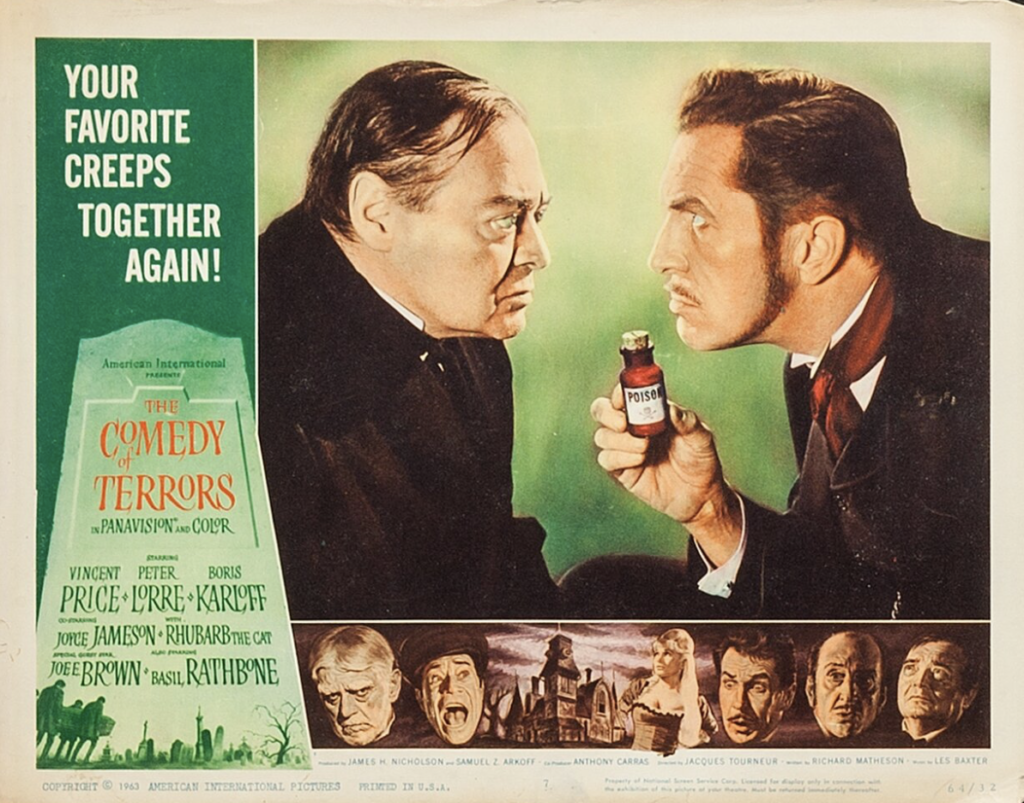
In that movie, Price owns a funeral home, with sidekick Lorre digging the graves. When business gets bad, the duo murders the locals to increase trade. Lorre’s flair for black comedy shines brightly, like a harvest moon casting dark shadows on All Hallow’s Eve.
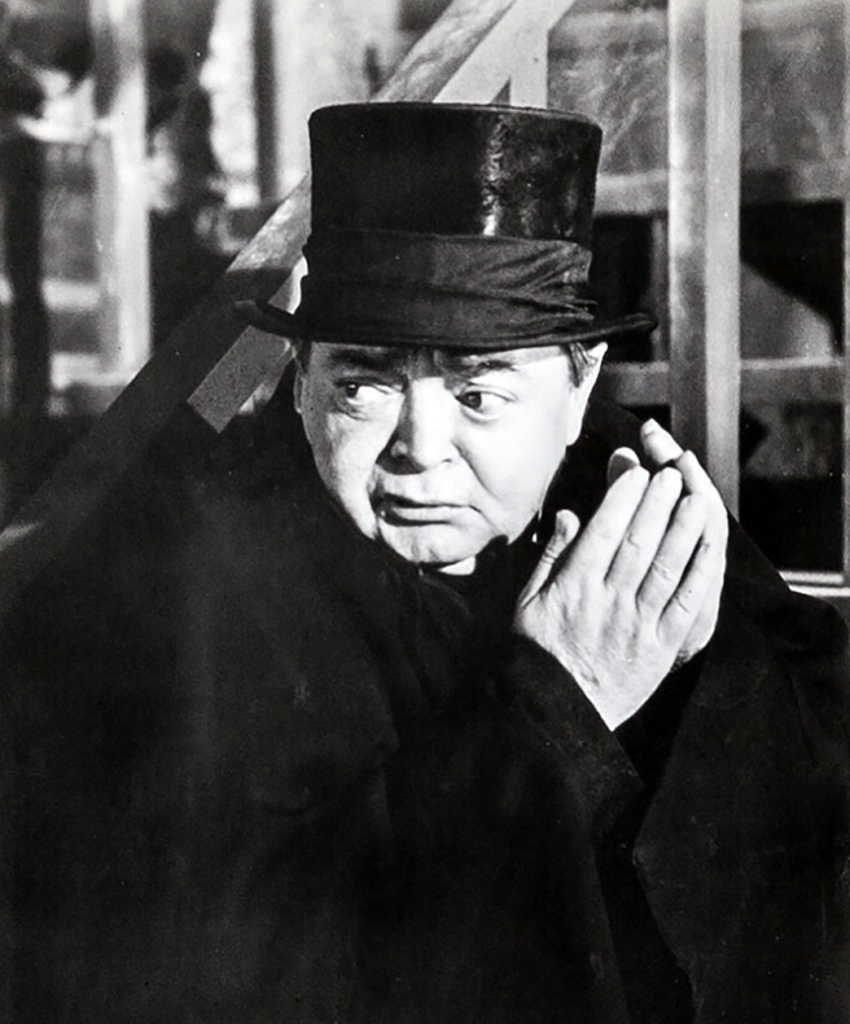
Lorre’s talents were many: the realistic horror of his serial killer in Fritz Lang’s M (1931), the cold calculations of his international criminal in Alfred Hitchcock’s The Man Who Knew Too Much (1934), his mysterious murderer in Boris Ingster’s Stranger on the Third Floor (1940), his shady, effeminate collector in John Huston’s The Maltese Falcon (1941), and his petty crook in Michael Curtiz’s Casablanca (1942). The list truly goes on and on.
So too does Peter Lorre, on and on, his persona, long after his death, thanks to imitations like General Mills Booberry Cereal (introduced in 1972) and Maggot, the worm character in Tim Burton’s The Corpse Bride (released in 2005). Peter Lorre lives, even in death.
It is for that reason that the sixties beckon us, the year in which a real-life Satanic cult in Oklahoma plotted to bring him back to life.
The story broke in Oklahoma newspapers on June 24, 1964, the same week that the Daily Oklahoman advertised a rebroadcast of one of Lorre’s final TV shows, The Kraft Suspense Theatre.
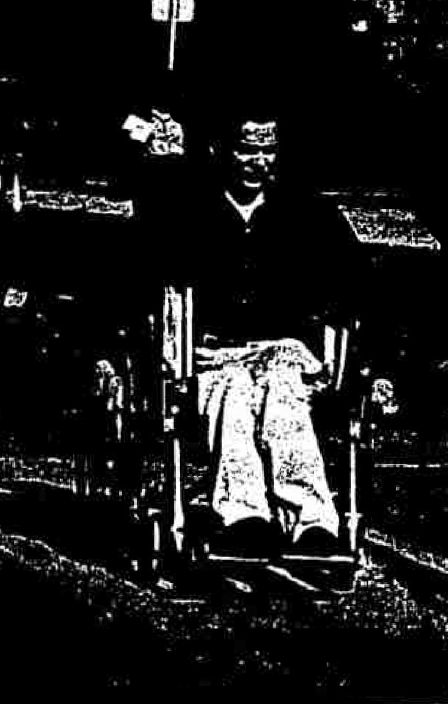
Larry McLean, a twenty-year-old law student at the University of Oklahoma, spearheaded the tiny cabal, known as the Covenant of the Seventy-Third Demon, the number declaring their independence from the Ars Goetia, that grimoire mythology in which King Solomon summoned and then bound seventy-two demons into a large brass vessel.
McLean said he was from England; he was actually from Elk City. Calling him their “counselor,” a relatively small number of sixteen- and seventeen-year-old adherents signed a contract “pledging their souls to the Prince of Darkness, Satan.” At midnight rituals, they sacrificed animals.
To give the devil his due, McLean formed his little group prior to Anton LaVey’s Church of Satan (1966), the Manson Family Murders (1969), Roman Polanski’s Rosemary’s Baby (1968), William Friedkin’s The Exorcist (1973), and the Son of Sam (1977), to say nothing of the Satanic Panic of the 1980s.
McLean demanded his young adherents ridicule and desecrate symbols of Christianity, which led them to vandalize at least four churches in the university city of Norman, the first in September 1963. A later report described the hoodlums as “turning crosses upside down, ransacking church premises, tearing Bibles apart, and desecrating baptistries.” They also looted whatever church property they thought had monetary value.
After receiving an advance tip, police caught six of McLean’s followers sneaking out of a church at 4 a.m. on June 25, 1964, but only arrested four of them, letting the other two go because they were merely “apprentices.” Police also recovered looted church property, as well as daggers and books on black magic.
Their parents had no idea the teens had been sneaking out of their houses, let alone selling their everlasting souls to Old Scratch. Before being released on $3,000 bonds, one or more of the culprits revealed McLean’s darkest secrets, as unexpected as they were bizarre.
It seems McLean idolized Peter Lorre, so much so that he intended to dig up his body and hold a black mass that would revive the famous actor and his famous lisp. Later, one of culprits claimed they considered restoring his life from afar, from the Sooner state, meaning that Zombie Lorre would have had to climb out of his California grave without on-the-ground assistance.
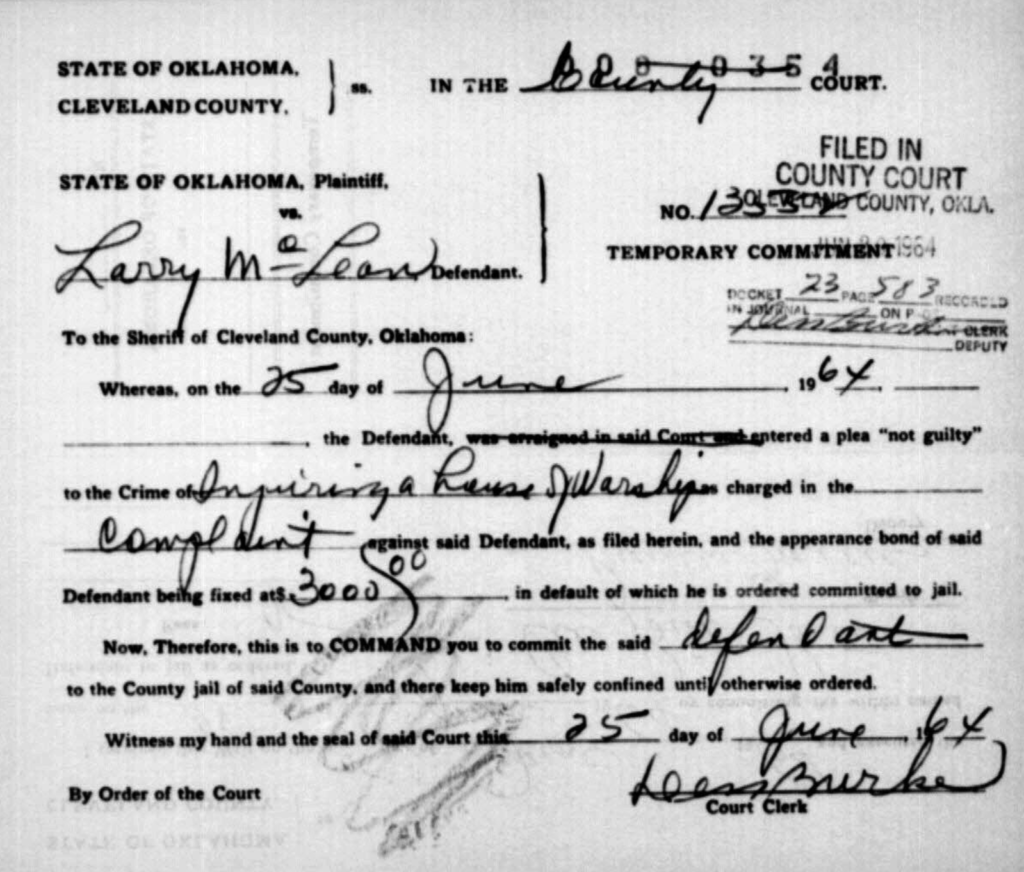
It didn’t take long for police to find McLean, who faced a felony charge not for graverobbing or animal cruelty, but for “injuring a house of worship” on May 27, 1964. When arraigned, the once-prideful Counselor pleaded innocent.
Judge David Rambo remanded McLean to ninety days under mental observation before any trial. The evidence trail becomes fuzzy after that, but the court eventually dismissed the case in April 1967. What the judge specifically said that day is unknown. The number seventy-three, in Morse Code circles, means “best regards.” McLean probably needed it.
The name Lucifer translates as “light-bringer,” but McLean seems to have been quite dim, despite his aspirations towards lawyerdom. Whether near or far, the Seventy-Third Covenant could never have reanimated Lorre’s body, and not just because they possessed no occult power.
Peter Lorre was cremated.
As for the rest of McLean’s life, nothing is known. Hopefully he took solace and advice from Lorre’s dialogue in the Kraft Suspense Theatre: “No hysterics, please. No hysterics.” In the same episode, Lorre tells a mediocre sculptor to “stop ruining perfectly good stone.”
By contrast, Lorre does live on, his stone continuing to roll due to the power that his persona still commands in pop culture. After sixty-two years in his urn, he returned to the global silver screen in 2026 as a cartoon character in Dave Green’s Coyote vs. Acme.
The Comedy of Terrors makes for a good description of McLean and his felonious nonsense. After all, Peter Lorre played a gravedigger in that film, not the other way around.
Gary D. Rhodes, Ph.D., filmmaker, poet and Full Professor of Media Production at Oklahoma Baptist University, is the author of Weirdumentary: Ancient Aliens, Fallacious Prophecies, and Mysterious Monsters from 1970s Documentaries (Boswell Books, forthcoming), Vampires in Silent Cinema (Edinburgh University Press, 2024), Becoming Dracula – Vols. 1 and 2 (with William M. [Bill] Kaffenberger, BearManor Media), Consuming Images: Film Art and the American Television Commercial (co-authored with Robert Singer, Edinburgh University Press, 2020), Emerald Illusions: The Irish in Early American Cinema (IAP, 2012), The Perils of Moviegoing in America (Bloomsbury, 2012) and The Birth of the American Horror Film (Edinburgh University Press, 2018), as well as the editor of such anthologies as Becoming Nosferatu: Stories Inspired by Silent German Horror (BearManor Media, forthcoming), Film by Design: The Art of the Movie Poster (University of Mississippi Press, 2024), The Films of Wallace Fox (Edinburgh University Press, 2024), The Films of Joseph H. Lewis (Wayne State University Press, 2012) and The Films of Budd Boetticher (Edinburgh University Press, 2017). Rhodes is also the writer-director of such documentary films as Lugosi: Hollywood’s Dracula (1997) and Banned in Oklahoma (2004).