

By Robert Guffey.
When one is most concerned with telling an entertaining story rather than fashioning a persuasive speech or an opaque legal document that will resist the scrutiny of a battery of attorneys, one tends to relax and let one’s guard down. And the truth, often by accident, will shine through….”
The secret history of the world can be decoded through film. More so than any other medium, perhaps due to its populist roots, film records the cultural taboos of the day in such a way that any future sociologist/psychologist/archaeologist/anthropologist can easily view a random film from generations before and gain important insights into the unique mores of the society that produced it. That film does this unintentionally, more often than not, is an added bonus to the future scholar. After all, the primary concern of any filmmaker, even those with hidden agendas, is to tell an entertaining story that will be embraced by the masses. This is why studying films can tell us more about history than pouring over the minutia of a thousand presidential speeches. When one is most concerned with telling an entertaining story rather than fashioning a persuasive speech or an opaque legal document that will resist the scrutiny of a battery of attorneys, one tends to relax and let one’s guard down. And the truth, often by accident, will shine through.
Paleontologists are always pleased to discover a new prehistoric insect preserved in amber. Celluloid is a medium tantamount to amber, but instead of preserving ancient insects it preserves taboos. The true shape, the true shadow, of any culture can best be defined by knowing—and, hopefully, understanding—what that culture deems to be unacceptable to discuss or even think about in polite society. Taboos have always been dark mirrors that reflect the hidden face of society, the Dorian Gray monstrosity lurking just beneath the surface.
What you refuse to face defines you; it can even destroy you. This is why popular art so often functions as a safety valve, creating temporary autonomous zones in which taboos can be contemplated within an acceptable context—a context that’s so seemingly innocuous that even the most staid, church-going senior citizen wouldn’t even realize (at a conscious level) that potentially mind-shattering taboos are being broached. Film allows one to have a brief dance with taboos without needing to feel the lingering shame of having wallowed in the filth of the forbidden.
Some early cultures believe that the spirits of the dead surround us all the time, influencing our paths through life, the decisions that we make, our attitudes toward the nature of existence itself. Since we don’t consider ourselves to be “primitive” or “superstitious,” however, such beliefs have never been popular in Western culture. And yet we most certainly are influenced by insubstantial phantoms that co-exist with us on a daily basis, and these phantoms are called films: poltergeists produced by the off-kilter minds and wild talents of modern day druids living in a sacred grove called “Hollywood,” angelic thought forms and demonic ghosts that are projected out into the ether of the real world to wreak havoc—or bring psychic balance—to a spiritually starved culture. In the early 1900s, movie palaces replaced churches and cathedrals as the spiritual centers of the world. For a long time now Hollywood has functioned as the Vatican of the twentieth and twenty-first centuries. Just as a papal decree could influence the thoughts of millions in the medieval world, the ghosts of Hollywood often slip into the neural pathways of the masses and slowly—imperceptibly—alter human consciousness itself.
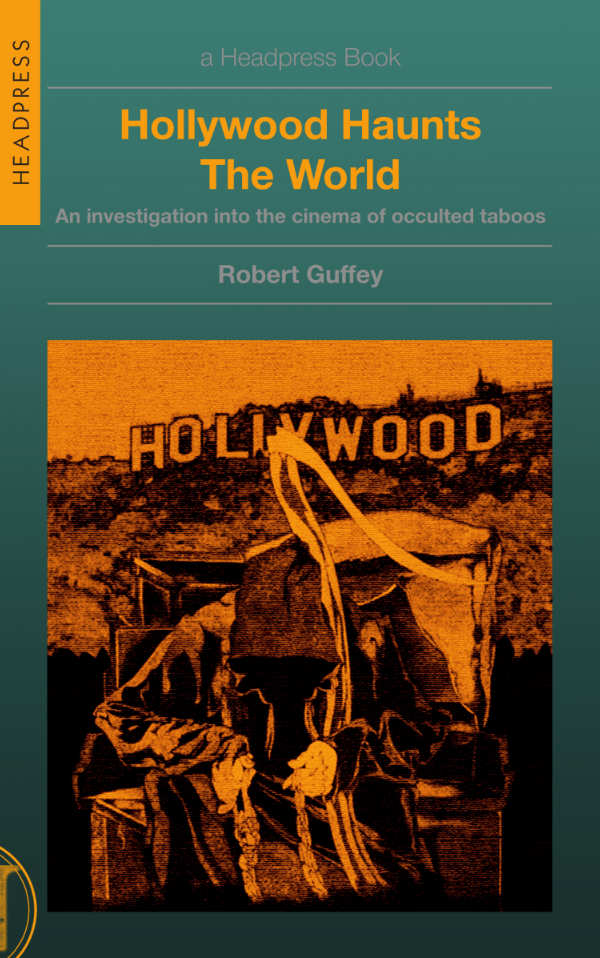
In the twenty-first century Hollywood haunts the world; it’s done so ever since its inception. The ghosts that Hollywood produces on a daily basis are undoubtedly the most important exports produced by the United States. Why? Because, unlike drugs and guns and bombs, they don’t seem subversive or dangerous in any way. Because they are welcomed with open arms even by fanatically religious regimes in the Middle East who don’t admit to indulging in such evil Western decadence—in public, that is. Because they are time-released thought-bombs that are eagerly sought out by their intended targets. After all, one needn’t waste millions of black budget dollars on covertly smoking out one’s enemies when the enemies themselves insist on inviting the fatal bombs into the back rooms of their own opulent palaces where said infernal devices are detonated within the context of their own lavish entertainment systems. Why do any work when the enemy can do it for you and even more enthusiastically than you can?
Cultural landscapes are shifting all around the globe, but this process is happening so gradually that most people are unaware of it and often see no hope for a better future in certain authoritarian areas of the world. But the future is only brought about by dreams. Dreams can change the attitudes of a culture far more effectively than official sanctions or “uffish thoughts” (as Lewis Carroll might have said) or orders-from-on-high. People change only if they want to change. And sometimes only the military-industrial-entertainment complex can spark that desire for change. One might call this process cultural osmosis, or mass thought control, or one might be so bold as to see it from the perspective of early man: In the long run, invisible entities guide our destinies. The ghosts decide. Dreams point the way.
This book is a map by which one can trace these cultural shifts throughout the twentieth century—as well as the beginning of the twenty-first century—via the etheric medium of film. Each chapter explores a different cultural taboo and how society’s collective attitude toward that taboo is reflected in the frozen amber known as celluloid—sometimes through only a single film, sometimes through multiple films over the course of many years or decades.
Chapter One, “What’s at the End of Main Street?,” analyzes the increasing ascendency of “Gnostic cinema” in both American and foreign films beginning as far back as the silent movies of the 1920s, such as Buster Keaton’s Sherlock Jr., and progressing all the way to the final years of the twentieth century (e.g., Alex Proyas’ Dark City [see top image], Peter Weir’s The Truman Show, Gary Ross’ Pleasantville, the Wachowskis’ The Matrix, David Cronenberg’s eXistenZ, Josef Rusnak’s The Thirteenth Floor, Tom Tykwer’s Run Lola Run, Stanley Kubrick’s Eyes Wide Shut) and the first years of the twenty-first century (e.g., Cameron Crowe’s Vanilla Sky, Mark Pellington’s The Mothman Prophecies, Francisco Athié’s Vera, M. Night Shyamalan’s The Village, Christopher Nolan’s Inception, Jennifer Kent’s The Babadook, Scott Derrickson’s Dr. Strange, Steven Spielberg’s Ready Player One, Anthony and Joe Russo’s Avengers: Infinity War, Matt Shakman’s WandaVision, Larry Wade Carrell’s Girl Next, and Guillermo del Toro’s Nightmare Alley).
In Chapter Two, “The Box in the Desert: Budd Boetticher, Breaking Bad, and the Twenty-first-century Western,” I unveil the highest hopes of the past and the worst fears of the present by juxtaposing Budd Boetticher’s subtly subversive Westerns of the 1950s with Vince Gilligan’s iconoclastic television series, Breaking Bad.
Chapter Three, “The Brain(s) that Killed Kennedy,” digs deep into the world of interconnected conspiracy theories with a comprehensive analysis of the John F. Kennedy assassination (as well as the related subject of illicit U.S. government mind control programs) as seen through a series of disparate American films, some of which predict the assassination, many of which comment retroactively on the crime. The films under discussion include Edward L. Cahn’s The Creature with the Atom Brain, John Gillig’s The Gamma People, John Frankenheimer’s The Manchurian Candidate, Alan Pakula’s The Parallax View, William Richert’s Winter Kills, John Carpenter’s They Live, Oliver Stone’s JFK, and Jonathan Demme’s reimagined version of The Manchurian Candidate. This analysis begins in the 1950s and takes us all the way forward to the first decade of the twenty-first century.
In Chapter Four, “One Chants Out Between Two Worlds: It Came from Outer Space, Twin Peaks, and the Legacy of Jack Parsons,” we examine the considerable—though little known—influence rocket scientist/ceremonial magician Jack Whiteside Parsons exerted upon the books and films of writers and directors such as Jack Arnold, Ray Bradbury, Mark Frost, and David Lynch.
In Chapter Five, “The Man from Planet X,” we examine a cultural taboo that’s alive and well today (that of the subject of Unidentified Flying Objects and extraterrestrial visitors) in the form of Edgar G. Ulmer’s groundbreaking 1951 science fiction film, The Man from Planet X. Sometimes, taboos disguise themselves in seemingly innocuous forms. To the comfortable, to the privileged, taboos can be utterly invisible. It’s very easy—from the perspective of the present—to look back at the nineteenth century and understand that one of the most controversial cultural taboos at that time was, just as an example, the women’s suffrage movement; however, it’s far more difficult to identify the most sensitive taboos of the society in which you yourself live.
Back in 2002-03, while ensconced in the MFA program at CSU Long Beach, one of my fellow creative writing students turned to me one day and said, “You know, I’d like to write some cutting-edge stuff, but all the big taboos have already been broken. All the important fights were fought and won in the ‘60s. There’s nowhere else to go.” My tongue and eyeballs almost tumbled out of my skull. My colleague’s naivety was charming but mindboggling. Needless to say, the idea that there are no more taboos in the world is laughable, and yet my colleague’s bizarre lament is evidence that this does indeed need to be said. If there were truly no more cultural taboos, if all the barriers of pure rational thought had been obliterated by the cultural revolution of the 1960s, then I certainly wouldn’t get into quite as much trouble as I tend to do with my own writing.
This book is a map by which one can trace these cultural shifts throughout the twentieth century—as well as the beginning of the twenty-first century—via the etheric medium of film.”
Media theorist Marshall McLuhan once said, “We don’t know who discovered water, but we know it wasn’t a fish. A pervasive medium, a pervasive environment, is always beyond perception.”[1] Because fish are surrounded by water all the time, they are not even aware of its existence. Similarly, we are surrounded by the effects of a thousand cultural taboos every single day, but those of us who are unaware of our surroundings tend to assume that the major strictures limiting freedom of expression somehow magically disappeared after the advent of the civil rights movement in the 1960s. Taboos, however, are not only political in nature. They don’t begin and end with the admittedly serious issue of human rights (violations of which still occur on a daily basis in this and many other countries, despite the utopian world view of my colleague).
The fact is that the most important taboos today are exopolitical in nature, and UFOs represent a perfect example of this. Just because UFOs are a common topic of endless cable documentaries, some people might suggest that the issue is not in any way taboo. They would be incorrect. Just bring up the topic of UFOs at a cocktail party, or at an academic conference, or at a random business meeting, and watch almost everyone in the room grow increasingly uncomfortable, as if one had insulted the recently deceased grandmothers of every individual within hearing range.
If, on the other hand, you bring up the subject on a metropolitan bus, you might very well find several average people who are more than willing to discuss the subject of UFOs without any qualms whatsoever. Is this because people who ride buses are subnormal? No, it’s because people who ride buses aren’t quite as invested in the official narrative of how the world is supposed to operate and function. I’ve noticed, for example, that the people most ill-equipped to deal with genuinely taboo subjects are those whose lives are most dependent on the perpetuation of the American university system, i.e, college professors.
A story: One day, in the midst of a conversation about cultural taboos, I brought up the topic of UFOs in a literature class during my final semester in the MFA program at CSU Long Beach. Within seconds the professor was clearly writhing in discomfort and wished to either A) teleport out of the room or B) move on to a whole new topic. Unbidden, a fellow student chose this moment as an opportunity to ask everybody in the class how many of them believed that UFOs existed and might be vehicles from another planet. Slowly, somewhat reluctantly (as if trained to keep this belief to themselves their entire lives), almost every single student in that classroom raised his or her hand. The professor was nonplussed, to say the least. The thought balloon floating above the learned professor’s head was self-evident: Can such things be? In a college classroom such as this? Are these the dark depths to which American culture has sunk? It was quite fascinating watching an entire world view crash down around someone’s head within a matter of seconds. Such ruptures of the solipsistic thought patterns instilled in academicians will occur more and more frequently as we move further and further into the twenty-first century, as technology advances to the point where we ourselves become the very extraterrestrials we’re so concerned about. Chapter Five of this book, “The Man from Planet X,” documents the very beginnings of the paradigm shift that so traumatized the professor on that spring day over twenty years ago.
In Chapter Six, “Golden the Film Was—Oh! Oh! Oh!: Cinema and the Art of Perception Management,” we investigate the documented links between Hollywood and a plethora of American intelligence agencies going at least as far back as World War II.
In Chapter Seven, “Invisible Ghosts,” we examine the intangible (and yet very real) impact that André Breton’s revolutionary theories of Surrealism and Dadaism had on the twentieth century thanks to Breton’s innumerable unwitting accomplices—i.e., screenwriters, directors, cinematographers, actors, etc.—toiling on the fringes of the Hollywood mainstream at the same time that the central tenets of Surrealism were also impacting the culture of America through far more respectable venues. This chapter focuses in particular on a disconnected series of accidentally avant-garde B-films starring the Hungarian actor Bela Lugosi throughout the 1930s, ‘40s, and ‘50s.
It should be noted that Bela Lugosi casts a powerful shadow over this peripatetic investigation. The film historian Dr. Gary D. Rhodes once suggested that the history of Lugosi represents the history of Hollywood itself:
If Francis Ford Coppola once likened Bram Stoker’s novel Dracula (1897) to the history of cinema, I believe much the same could be said of Lugosi. An investigation into his career yields insight into early narrative film, Germany’s Weimar period, and the transition the cinema made from the stage. Lugosi represents the genre-specific nature of the classical Hollywood paradigm, as well as the fickle qualities of the public that consumes it. The tragic aspects of his life and career highlight the inevitability of the star system: the dark spaces of silence between the frames.[2]
The more I’ve studied Hollywood, and the career of Lugosi, the more I’m convinced that this is true. If any film icon encompasses the bipolar extremes of success and failure, artistic triumph and public humiliation, pathetic desperation and unearthly perseverance so interwoven in the enduring myth that is Hollywood, it is Lugosi. Over the course of this investigation, Lugosi emerged as my familiar—the otherworldly guide leading me on to deeper insights into the cinematic world of the occulted taboo. Since Lugosi’s most famous role was that of a Faustian, demonic prince who hypnotically led the naive and the curious into a web from which they could never escape, it seemed appropriate somehow that he became my Virgil pointing me in the direction of the amorphous cobwebs and shadows lurking in the hidden corners of Hollywood history and thus bringing further occulted taboos to my attention. It turns out that some webs are not necessarily traps, but labyrinths that require careful navigation on the part of the explorer. (Bela, therefore, deserves thanks for not leading me astray as he has so many other unwary victims.)
In Chapter Eight, “The Suppressed Science of Dr. Mirakle,” we trace the public’s incrementally shifting attitudes towards Charles Darwin’s Theory of Evolution through an analysis of wildly diverse horror films—ranging from highbrow German Expressionism to bottom-of-the-barrel giant monster flicks—beginning in the 1920s and culminating in the early 1960s.

Chapter Nine, “Here Among the Dead,” focuses on the 1920s when the medium of film began to crawl out of its infant stage. The dream I’ve chosen to conclude our journey is Victor Sjöström’s little known—but extremely influential—film from 1921 titled The Phantom Carriage. Masquerading as a Christian parable, this film dares to explore the ultimate taboo—the question of what awaits us after death—through the transgressive metaphysics of Theosophy and related fringe philosophies that took advantage of Victorian millennialism to begin challenging the Judeo-Christian ethos that had dominated the Western mind for so long. This challenge was still progressing in the early 1920s, and the nascent medium of film was the perfect vehicle by which to deliver an alternative message of Theosophical universalism over autocratic monotheism. These metaphysical, Gnostic quandaries lead us all the way to our present time….
…a time in which the secret history of the world is at last decodable through film. Anyone with eyes and ears and a working medulla oblongata can easily see through the opaque veil Hollywood casts over its sacred grove to protect its magicians from the merely curious who wish to gawk in awe and fear at the strange nature of the rituals performed within. But rest assured, folks, there’s nothing to be afraid of here. These illusionists are Wizard-of-Oz-like mountebanks, and their ghosts aren’t real at all. But that doesn’t mean these cleverly constructed phantoms will not have an effect on you, your life, your future.
Perhaps it’s not a bad thing that these celluloid spirits carry such a heavy burden on their insubstantial shoulders—the Promethean/Herculean burden of remaking the world, of softening the blow of successive paradigm shifts, of reordering the cultural landscape in this dimension and the next.
After all, somebody has to do the dirty work. No living being wants the job. So the magicians conjure up their little ghosts to float out into the night and work their magic on the slumbering hordes.
Let’s just hope these ghosts are friendly and wise. Let’s hope they know what they’re doing when they take it upon themselves to haunt the subconscious of the world.
And if not… well, then, perhaps it’s time we make some ghosts of our own.
After all, this whole magician-business is open to anybody with the proper tools.
The proper wand.
The proper dreams.
Welcome, initiates, to the sacred grove that lies behind the flickering, silver veil… and the beginning of our investigation into a century (or more) of occulted taboos….
The above is excerpted from Hollywood Haunts The World: An Investigation into the Cinema of Occulted Taboos (Headpress, 2025) by Robert Guffey. All right reserved.
Endnotes
[1] McLuhan’s Wake (DVD, The Disinformation Company, 2006).
[2] Gary Don Rhodes, Lugosi (Jefferson, NC: McFarland, 1997), p. xiii.
Robert Guffey is a lecturer in the Department of English at California State University, Long Beach. His most recent books include the novel Dead Monkey Rum (Planet Bizarro Press, 2023), which master painter Robert Williams praised as “a mental gymnasium” and award-winning filmmaker Irek Dobrowolski described as “addictive like a heavy drug,” the Wonderland Award-nominated collection, Widow of the Amputation and Other Weird Crimes (Eraserhead Press, 2021), the Rondo Award-nominated novel, Bela Lugosi’s Dead (Crossroad Press, 2021), and Operation Mindfuck: QAnon & the Cult of Donald Trump (OR Books, 2022), which Alan Moore described as “jaw-dropping and essential.” Guffey’s previous books include the darkly satirical, apocalyptic novel Until the Last Dog Dies (Night Shade/Skyhorse, 2017), which bestselling novelist Adam-Troy Castro called “one of the great books of the year,” the journalistic memoir Chameleo: A Strange but True Story of Invisible Spies, Heroin Addiction, and Homeland Security (OR Books, 2015), which Flavorwire called, “By many miles, the weirdest and funniest book of [the year],” the novella collection Spies & Saucers (PS Publishing, 2014), and Cryptoscatology: Conspiracy Theory as Art Form (TrineDay, 2012). A graduate of the famed Clarion Writers Workshop in Seattle, he has written for numerous publications, among them The Believer, The Evergreen Review, The Los Angeles Review of Books, The Mailer Review, Phantom Drift, Postscripts, Rosebud, Salon, and TOR.com. He lives in Long Beach, California with his wife and daughter.