

By Jackson Diianni.
A landmark of Dumont’s career, and one of modern history’s most incredible films.”
Bruno Dumont’s Hadewijch, released 16 years ago, was, until recently, unavailable to stream in the U.S., but has now become available on Amazon Prime, Apple TV and several other services, where it can hopefully reach a wider audience. The sidelining of this unique gem, which was reviewed at the time by a handful of critics, but has since fallen into semi-obscurity, is difficult to explain. It ranks as not just a landmark of Dumont’s career, but as one of modern history’s most incredible films – shattering and viscerally poignant.
Hadewijch premiered at the Toronto International Film Festival in 2009, where it won the FIPRESCI prize. It was also screened that year at the San Sebastian Film Festival and the New York Film Festival. It wasn’t a commercial success, grossing just $5,006 domestically and $74,586 worldwide. It was reviewed in publications like The Guardian and Salon and the reception was positive, but after making the rounds on the international circuit, it more or less disappeared from public view. Today, it’s often overshadowed in Dumont’s filmography by Cannes award-winners (L’Humanité, Flandres) and more current entries starring higher-profile stars (France, Camille Claudel 1915). It’s a rarefied project which doesn’t fit neatly into the market.

The story concerns an aspirant nun named Céline who engages in a process of self-inflicted religious ascesis (not eating, standing in the rain) until her convent expels her and she forms a relationship with a radical Islamic militant. The cast featured no big names, and was, in fact, composed largely of non-professional actors. Céline was played by Julie Sokolowski in her first role and the part of the Islamic cleric was played by French philosopher Karl Sarafidis. Dumont himself began his career as a philosophy professor, but gave this up to pursue filmmaking. His films often deal with complex philosophical issues and contain an intense psychological dimension, but this, to my knowledge, is the most prominently he has ever addressed a religious subject matter in his work.
In the beginning of the film, Céline is a theology student studying to become a nun, but her Mother Superior feels she is too extreme in her acts of self-denial, so she expels her from the order. Céline then befriends an Arab boy named Yassine (Yassine Chikh), whom she meets at a cafe, and they become friends. Yassine develops a romantic interest in Céline, but she insists she is not interested in a relationship. She loves only God. She later becomes close with Yassine’s brother, Nassir, a devout Muslim and a political radical engaged in an unspecified struggle.
The film is named after the 13th-century mystic Hadewijch of Antwerp, who wrote a number of well-regarded religious texts, visions, poems and letters. Almost no biographical details about her life are known. She is believed to have lived in the Duchy of Brabant, a state of the Holy Roman Empire covering the modern-day Netherlands. There was a theory at one point that she may have been a nun, but modern scholars appear to have abandoned this idea for lack of evidence. The meaning of the reference isn’t immediately clear, but the identification with the main character is. In interviews, Dumont refers to Céline by the name Hadewijch, even though, to my knowledge, she is never addressed this way in the film.
Dumont seems to enjoy giving his films mysterious titles. His 1997 debut feature about an unemployed epileptic who gets roped into carrying out a series of acts of brutal violence was named, somewhat tantalizingly, La Vie de Jesus. The story wasn’t written as a Biblical allegory and the titular words were never spoken in dialogue. Apparently, it was a reference to an 1863 biography by Ernest Renan, in which Christ was depicted not as a divinely-perfect saint, but as an ordinary human being. Another of his early films, L’Humanite, shares its name with a French left-wing daily newspaper. It tells the story of a police detective investigating the rape and murder of a schoolgirl in a small town. Again, this title is never explained within the world of the story. One of Dumont’s most recent films, a satire of the French news system, was called simply France, a reference not to the country, but to the main character – a broadcaster named France de Meurs.
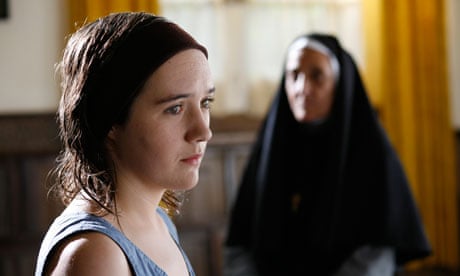
This is the world of Bruno Dumont. He doesn’t supply ready-made interpretations. He has more of a poet’s sensibility and his films flow with a life of their own. He has said of his writing process that he writes his scripts as novels first, but prefers to simply leave them unpublished. In Hadewijch, he approaches the story with a modernist slant, letting intuitive feelings guide the narrative, not plot conventions. It’s hard to find pure logic in the film. It goes beyond realism. There is development of the main character, the inner conflict, but the bare episodes of the story are enigmatic, their meaning indirect. The character of Céline is the only thing that ties them together, as the film follows the phases of her spiritual rhythms. Events do not precede or follow one another according to a straightforward dramatic continuity and the ending is ambiguous, leaving itself open to a number of possible readings.
Hadewijch focuses singularly on its main character, who appears in every moment and in every scene of the film. Céline’s dominant trait is the way she treats others – her infinite compassion, empathy for everyone and everything. Her psychological makeup is left ambiguous. She’s shown to be a person of great conviction, although there are hints that her faith may be an unhealthy tendency for martyrdom. However, Dumont privileges the character with a sensitivity and a humanism that supersedes this. There’s nothing sensationalist or exploitative in his treatment of the story or Céline’s eccentricity, which is part of what gives the film its emotional power.
The other portraits run from stubborn orthodoxy (Mother Superior) to boyish impetuousness (Yassine) and righteous self-assurance (Nassir). The ancillary characters are explored cursorily (Céline’s father is a politician of some sort). Dumont depicts this rich gallery of characters and the settings in which they live (Paris, then later, the French countryside), but makes no effort to moralize their actions. He doesn’t sanctify Céline and he is non-judgemental about Yassine stealing a motorcycle and Nassir planting a bomb in a public square. He doesn’t seem to expect the audience to judge the film on morality or message and Céline mirrors this non-judgemental stance within the world of the story.
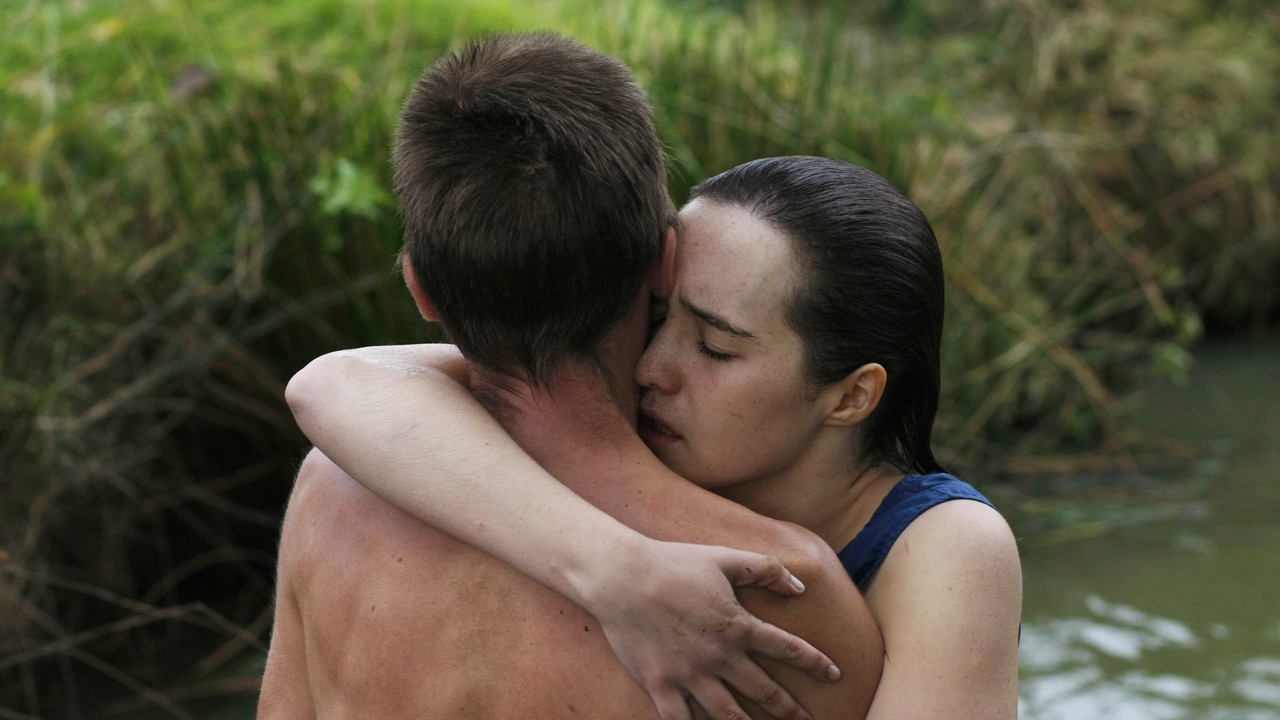
Dumont shoots the film using a slow, deliberate style. He and cinematographer Yves Cape do an excellent job structuring the frames, favoring simple medium shots with minimal camera movement and few intense angles. Like a gallery of portraits. They impose long silences on the viewer and seem to be concerned with how far they can spread a single moment or image. We lose a sense of time as we pass through these moments and interactions. The lack of music and dry color scheme go a long way to reinforcing the quiet, restrained atmosphere. The film is shot on un-glossy stock with soft lighting and a dim, muted palette. All the colors are soft and toned-down, save for the very intense greens/blues, which glow with a sort of aquarium-cool color temperature (noticeable in the exteriors).
Sokolowski, who plays Céline, has a very captivating presence onscreen. She almost doesn’t appear to be acting at all. Even though her expressions throughout the film are very slight, she never appears neutral or remote. She’s a good choice for the character – she has the look of a medieval saint – and gives a very strong performance, especially considering she was a non-professional actress at the time. She portrays the character’s vulnerability, grace and elegance very convincingly. The rest of the cast, who Dumont directs expertly, rounds out the film with excellent supporting performances.
In conversation with Michael Guillen for MUBI in 2009, Dumont elaborated on his approach:
These days I am very interested in mysticism because it goes way beyond philosophy. Mysticism takes us to areas that are beyond questions of reason, beyond speech, and beyond our comprehension of the world. It takes us to an area that is very close to cinema, and I think that cinema is capable of exploring that area and expressing it. That’s why, necessarily, I am attracted to mysticism. At the same time, it’s a complex area. I’m not myself religious – I’m not a believer – but, I do believe in grace and the holy and the sacred. I’m interested in them as human values. I place The Bible alongside Shakespeare, for example; not as a religious work, but as a work of art. The Bible has the definite values of a work of art.”
Dumont himself is not a religious believer, but often speaks of cinema’s spiritual nature, of the mystery of art. He’s interested in the form’s ability to evoke poetry. I consider him one of the most talented filmmakers working today, a superb craftsman of impeccable taste, and I hope one day he will be recognized as an equal to Rossellini, Ozu, Dreyer, Bresson, Renoir and Vigo. Hadewijch is one of his greatest works and contains all the best qualities of this artistry. I like it for its mystery, its unique presentation of imagery and the way it chooses to tell its story. It has stayed in my mind for years and is one of the films that I continually (sometimes obsessively) go back to.
At its core, it concerns the progression of Céline’s soul through a series of trials. By practicing self-discipline and avoiding forms of indulgence (leading an abstinent life), Céline hopes to achieve a spiritual state, but what begins as a parable about asceticism – the notion that salvation comes from denial of will – becomes distorted, as she is drawn deeper and deeper into acts of sabotage and rebellion against the institutions that governed her old life, in search of something she can’t fully comprehend.
Céline’s expulsion from the convent sends her on a mission to redefine her faith, and she does so through a series of relationships. It’s fitting that the final act of the film is an embrace. For the Mother Superior, God means strict devotion to a religious doctrine. For Nassir, it means “a sword against injustice”. For Céline, it means love. There’s a current of unrestrained compassion which runs throughout Hadewijch, but only makes itself explicit at the very end, much like in Carl Theodor Dreyer’s Ordet (another compact masterpiece). Having reached the point of spiritual exhaustion, Céline is saved by an act of caring by a stranger, and the film positions this as the conclusion of her spiritual journey. Breaking the unemotional barrier which separates this world from the other, this final act of the heart finds expression in the real world. Dumont presents this as a form of the Holy.
Jackson Diianni is a freelance writer of cultural criticism and prose fiction living in Brookline, Massachusetts. He graduated from Ithaca College in 2020 with a degree in writing for film/TV and has written screenplays, short stories, political essays, and music/film criticism.
This analysis offers a thoughtful and nuanced exploration of Hadewijch and Bruno Dumont’s cinematic approach. Your reflections on the soul’s journey through trials are both insightful and engaging, providing readers with a deeper understanding of the film’s spiritual and emotional layers. Thank you for sharing such a careful and well-articulated interpretation—it encourages thoughtful reflection and enriches appreciation of the work.
An amazingly in-depth and through analysis. A reader cannot help being aided in his viewing with this insightful analysis in hand.