

A Book Review by William Blick.
In addition to offering a production history, Stewart revisits an underseen and underappreciated contribution to the horror genre, in the military horror tradition.”
Niche-genre critic and historian Danny Stewart explores the hybrid-genre entry Hellraiser III: Hell on Earth, produced by Clive Barker with Anthony Hickox in the director’s chair and Hellraiser II screenwriter Peter Atkins returning, with a story by Atkins and Tony Randel. Like other horror/sci-films that blend genres and feature war such as Dog Soldiers or Predator, Hellraiser III explores the horror of war, but unlike the usual tropes of this genre, the film reminds viewer of the scars on humanity that war can leave. In this sense, there is an underlying morality that makes the third film more unique. It has been several decades since Barker revolutionized the horror genre with the first film in the Hellraiser series. With an underseen, but decent sequel, Hellbound, and then followed up with the film being discussed herein, Hell on Earth; Pinhead and the Cenobites are still raising hell. This time we get to see Pinhead’s good half and whole other aspect of the Hellraiser multi-verse.
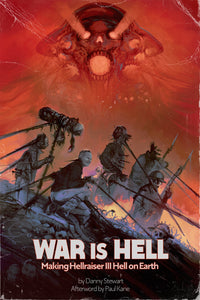
Stewart’s book is full of the usual colorful illustrations, crackerjack investigations, dozens of in-depth interviews, fascinating anecdotes and facts, and trivia that made his previous books on genre films so memorable. There can be no question that the Hellraiser III needs a reevaluation. With a lower budget and lesser-known actors, Hellraiser III still takes the genre to uncharted territories as brought to light by Stewart.
Throughout War is Hell, Stewart discusses the piece in the context of what the film means in terms of the horror canon, as well as some of the challenges and controversy surrounding its initial production stages. The book leads off with a chapter written by the film’s screenwriter, Peter Atkins titled, “Building the Beast (in stages) The Hidden Histories of Hell on Earth”. Atkins reveals the various scenarios that were discussed for the third film in the trilogy and how other names in horror were initially interested in making it, including horror maestro, Mick Garris. Eventually, Hickox reveals that in the final story the film’s associates agreed on “clicked” and the film was born.
Early on the first 15-20 minutes of film, a human head explodes. Several famous horror films are known for exploding heads. Those that come to mind include Bill Lustig’s Maniac (1980) and David Cronenberg’s cranium busting Scanners (1981). After the initial shock of this visceral scene in Hellraiser III, one can easily see how it fits right in with the classic tropes of horror. With its fair share of shocks and gore, but not sacrificing suspense, Hellraiser III marks a new frontier in the trilogy, as Stewart asserts, by bringing in a war subplot. Without spoiling too much of the plot, which Stewart details, the film surrounds an S/M club, Pinhead’s good half, a battled hardened veteran, and a snooping reporter who needs to send Pinhead and the Cenobites back to hell.
Of particular note is the memorable and in-depth interview Stewart conducts early on in his book with director Anthony Hickcox, to whom the book is dedicated. As usual, Stewart offers diligent interviews with almost everyone involved. This includes everyone from directors, writers, all the actors, camera operators, costume designers, and makeup and SFX experts.

Stewart explains in Chapter IV that “Horror and military films evoke intense emotional reactions—fear and adrenaline—through distinct storytelling frameworks. Military films often depict the harsh realities of war, highlighting themes like survival, camaraderie, and the psychological toll on soldiers. In contrast, horror delves into the terror of the unknown exploring monstrous entities and inescapable dread.” Over the years there have been intersecting hybrids of films that juxtapose the horror of war and the horror embedded in humanity. Adrian Lyne’s provocative Jacob’s Ladder comes to mind. Like that film, Hellraiser III blends the horrors of humanity, real and imagined, to evoke a hybrid war/horror film.
Stewart asserts that, “among these hybrids, Hellraiser III: Hell on Earth stands out for its significant contribution to the genre. The film merges the grotesque and psychological terror of the Hellraiser series with elements of human conflict, crafting a layered narrative that explores deep philosophical and metaphorical themes.” In addition to offering a production history, Stewart revisits an underseen and underappreciated contribution to the horror genre, in the military horror tradition. Stewart’s work reveals quite a lot of legwork and research combined with elaborate cinematic analysis.
Hellraiser III: Hell on Earth may not be for everyone’s taste, especially not for the squeamish. However, as Stewart reveals, there are nuances in the film that elevate it above your average franchise exploitation film including metaphorical evocations and more complex characters than one might expect from the third in the installment.
What is quite significant, as aforementioned in other reviews of Stewart’s books, is the zeal, enthusiasm and sheer reverence for the filmmaking process and for niche genre films that author displays. Hellraiser III is not a masterpiece, but as explored in the many facets of this book, it offers more than many contemporary horror entries in the genre. War is Hell: The Making of Hellraiser III: Hell on Earth offers fascinating insight into the filmmaking process as well as a look at an unappreciated horror flick.
William Blick is a literary/crime fiction and film critic, a librarian, and an academic scholar. He is contributing editor to Retreats from Oblivion: The Journal of Noircon and has published work in Senses of Cinema, Film Threat, Cinema Retro, Cineaction, and Film International Online, where he frequently contributes. He is also an Associate Professor/Librarian for Queensborough Community College of CUNY.