

By Robert Guffey.
For no matter who eats who first, the grave swallows both father and son in time….”
What follows is a brief excerpt from my latest book, Hollywood Haunts the World: An Investigation into the Cinema of Occulted Taboos (Headpress, 2025). This analysis of William Richert’s Winter Kills (1979) appears in the middle of Chapter Three, “The Brain(s) that Killed Kennedy: The JFK Assassination as Seen Through Film,” which includes in-depth examinations of eight conspiracy-tinged American films: Edward L. Cahn’s Creature with the Atom Brain (1955), John Gillig’s The Gamma People (1956), John Frankenheimer’s The Manchurian Candidate (1962), Alan J. Pakula’s The Parallax View (1974), William Richert’s Winter Kills (1979), John Carpenter’s They Live (1988), Oliver Stone’s JFK (1991), and Jonathan Demme’s remake of The Manchurian Candidate (2004).
* * *
Unlike Curt Siodmak [writer of Creature with the Atom Brain (1955)] and Loren Singer [writer of the novel upon which The Parallax View (1974) is based], Richard Condon could not be considered a genuine “insider” in the sense that he was most definitely not a member of any particular intelligence organization; however, he did have inside knowledge of the Kennedy family, as he’d had personal dealings with them long before he wrote even The Manchurian Candidate. I suspect it was this firsthand knowledge of “Camelot” (the term the mainstream press began to use in reference to the Kennedy administration, further solidifying JFK’s ascendance into the realm of mythology) that inspired Condon’s 1974 novel, Winter Kills, fated to be adapted to the screen as a very peculiar dark comedy that boasts a background story with as many strange twists and turns as the film’s labyrinthine plot itself. The protagonist of Condon’s novel is Nick Kegan (Jeff Bridges), clearly based on Ted Kennedy, the younger brother of a popular President, Tim Kegan, who was assassinated several years before. Evidence emerges suggesting that President Kegan was not killed by a lone gunman. Nick is given evidence that leads him to a horrifying conclusion: the President was assassinated by a conspiracy engineered by his own father.

William Richert’s Winter Kills began shooting in 1976 but was not released in theatres until 1979. Its production history truly does read like a Richard Condon novel. The production was shut down three times due to financial problems. It was the first major film to declare bankruptcy. Before the shooting could be completed, one of the producers of the movie would be murdered and the other thrown in prison. Producer Leonard J. Goldberg was handcuffed to his bed in his Murray Hill district Manhattan apartment and shot through the head while producer Robert Stirling was sentenced to forty years on a marijuana conviction. According to Richert, Stirling believes to this day that one of the reasons for his imprisonment was his role in making Winter Kills. He told Richert that his ambition was to follow Winter Kills with other conspiracy-themed films. Obviously, none of those pictures were ever made.
And Winter Kills was almost never completed. One thing working in its favor, perhaps the only element keeping the production afloat, was Richert’s youthful enthusiasm and the unusual willingness of the cast and crew to work for free. This was a film originally budgeted at six million dollars, no small amount in 1976. It was being shot on six different sound stages at MGM. Richert, a first-time director, had managed to attract an incredibly impressive cast including Jeff Bridges (who was just beginning his rise to stardom at that time), John Huston, Elizabeth Taylor, Anthony Perkins (who turns in the very best performance in a film loaded with terrific performances), Toshiro Mifune, Eli Wallach, Ralph Meeker, and Richard Boone.
The film was based on a bestselling novel. All the stars in the heavens seemed to be lining up over this production. In the eleventh week of shooting, however, the ceiling caved in. The production was halted by the unions whose workers had not been paid by the producers. The soundstages at MGM were suddenly off-limits. After one week, the entire production moved to Philadelphia (where the same cast and crew agreed to work for free). After a week’s worth of work, the union shut down the production again. In a 2003 documentary about the making of the film, titled “Who Killed Winter Kills?”, Richert and other cast and crew members relate examples of the outrageous drama that occurred behind the scenes. According to Richert, at this point in the production “one of the guys who hadn’t been paid caught up with John Starke, our production manager. He came with a sawed off shotgun and put it to John’s neck until John came up with the cash for his generator.” After that the producers began paying the crew with cash, apparently money raised through the dealing of illegal drugs. Vilmos Zsigmond, the cinematographer, commented years later with a smile on his face, “Where that money came from, I have no idea. Nobody ever answered me. I don’t know.”
Richert had about two weeks’ worth of shooting left when the production was shut down for the third time. The production was now four million dollars in debt to four hundred different creditors. It was at this point that producer Leonard J. Goldberg was found murdered in his New York apartment. According to Richert, “That shook us all up,” no doubt an understatement. A month later Richert had regained his bearing and came up with a scheme to finish the picture. He co-wrote a screenplay with Larry Cohen for a completely unrelated film, a light comedy titled American Success Company (one wonders if the title didn’t contain a hint of wish fulfillment on Richert’s part), and arranged to shoot this new picture in Germany with some of the same cast and crew from Winter Kills, including Jeff Bridges and his co-star, Belinda Bauer. Somehow, the profit generated by American Success Company managed to raise enough money to pull Winter Kills out of bankruptcy. After a two year hiatus, Richert reassembled his cast and completed the film. After this Herculean effort, despite the fact that the film was very well received by critics, Winter Kills was pulled from the theatres after a single weekend. Around this time Richard Condon wrote an article for Harper’s Magazine titled “Who Killed Winter Kills?” in which he speculated that the film’s theatrical release was purposely sabotaged by Avco Embassy, the film’s distributor. According to Richert, “Avco Embassy had major defense contracts and […] the Kennedys somehow were involved in those contracts or business dealings, and Ted Kennedy was going to run for President during that time, so they didn’t want that movie around, and it wasn’t around. So once you start thinking conspiracies and connections, they’re everywhere.”
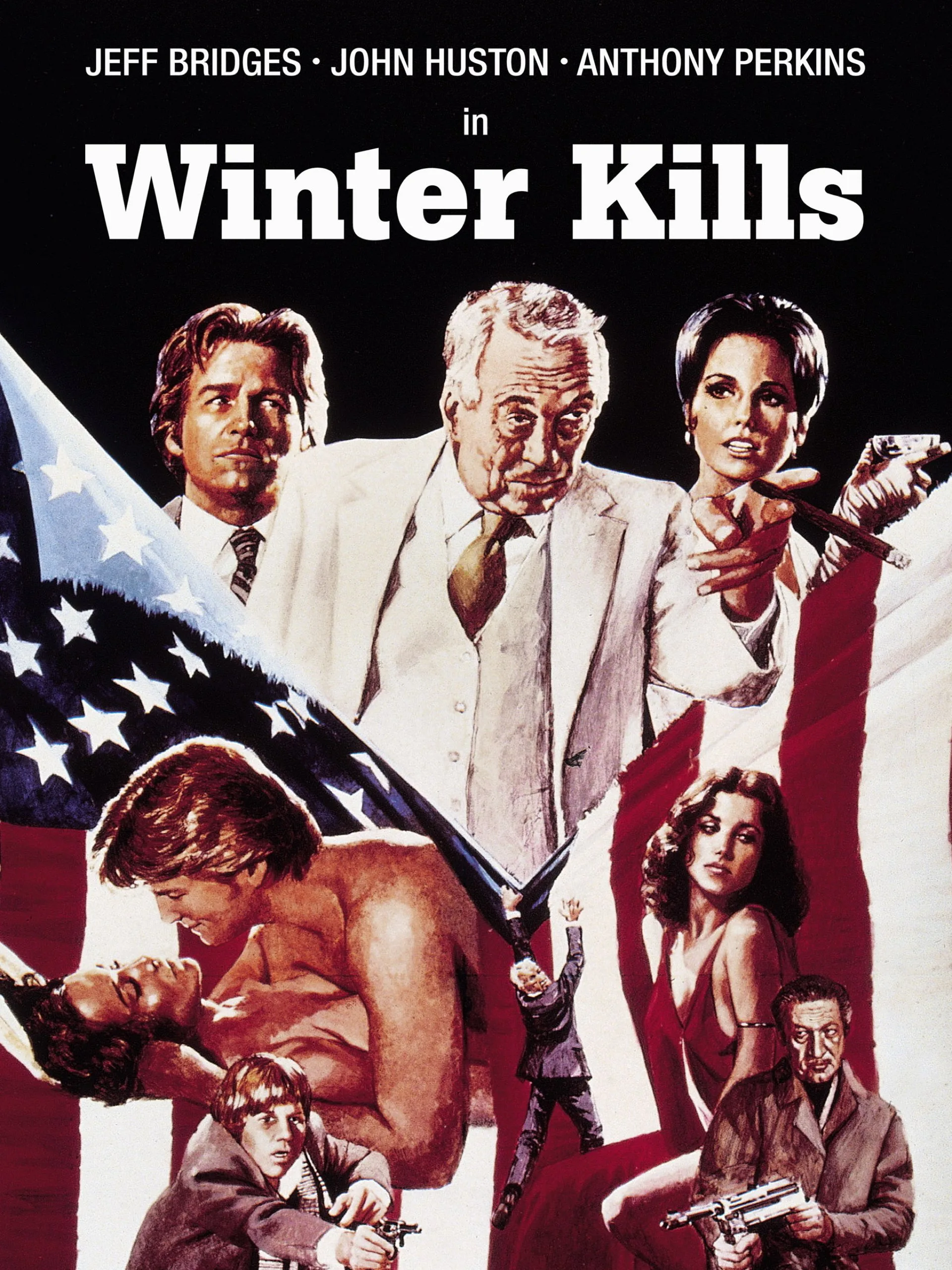
Richert, who began the production with a rather skeptical viewpoint regarding the reality of the conspiracy theories around which Condon’s plot revolves, ended his journey with a broader knowledge of the power these conspiratorial forces have over the lives of others.
Oddly, Richert’s own mythological journey from innocence to awareness mirrors the cinematic journey taken by Winter Kills’ protagonist, Nick Kegan. Richert conceived of the film’s structure as an Alice-in-Wonderland-like fairy tale in which Nick equals Alice. Indeed, film critic Vincent Canby of the New York Times called the film “a funny, paranoid fable….” A fable it is, but all fables have a dash of truth in them, just as all myths have a dash of truth in them. Let’s examine the truth that underlies this particular myth.
Winter Kills, at its core, is a cinematic updating of the ancient Greek myth of Cronus, the titan, forced by his own fears and insecurities to eat his son, a terrifying scene so brilliantly realized in Goya’s painting titled “Cronus Devouring His Children” (c. 1819-1823). In Goya’s painting we can see the forlorn expression in Cronus’ eyes as he begins to thrust his son into his own mouth. He doesn’t want to eat his son, but he knows he must lest he himself be destroyed. Instinctually, we know this action is contrary to the natural order. Most parents would, without hesitating, sacrifice themselves for their children. To do the opposite is so repellant that we want to shrink away from Goya’s painting in utter disgust and fascination. And yet we keep looking.
Just as we keep looking at the evidence swirling around the events in Dallas on November 22, 1963.
Was Cronus to blame for Kennedy’s death? According to Condon, yes.
The scenario Condon lays out in fictional form is not difficult to swallow. According to Condon, Kennedy’s father, Joseph Kennedy, pulled a lot of strings and promised a lot of favors in order to push his son into the White House. The second JFK took office, however, the new President turned his back on his father’s advice and began “going rogue,” as they say in the military. Kennedy immediately reneged on the promises to the Mafia and the military-industrial-complex his father had pledged on his behalf and began creating his own policies. Because he genuinely wanted to make decisions that would help his fellow Americans and the citizens of Earth, or because he was just an arrogant son of a bitch who felt he needed to make his own mark on the world? The film is not clear on this point.
To what extent did Condon believe in the veracity of his own conspiracy theory? It’s possible that Condon intended this scenario to be taken as pure metaphor….”
Either way, the end was the same. Kennedy’s father was forced to order the hit on his own son, otherwise he himself would have been destroyed. Eat or be eaten. Joseph, according to Condon, chose the former strategy.
Condon based his characterization on his firsthand knowledge of the Kennedys. According to Richert, Condon observed up-close how Joseph Kennedy would treat his son. Joseph was in the habit of forcing JFK to wait outside his office until he was ready to speak to his dutiful son. One time Condon approached the office and saw JFK sleeping in a chair out in the hall; that’s how long Joseph had kept him waiting. It’s not surprising, therefore, that JFK would take the first opportunity he could to turn his back on his father. No doubt, he assumed the office of the Presidency trumped the power of his father. Perhaps he was wrong.
To what extent did Condon believe in the veracity of his own conspiracy theory? It’s possible that Condon intended this scenario to be taken as pure metaphor. In a sense, Joseph Kennedy was indeed responsible for his son’s death simply because he spent every waking moment engineering JFK’s ascendency into the Oval Office and everything that came with the position—including that fateful limo ride through Dallas in 1963.
The film alludes to this interpretation at one point. Nick Kegan is in his father’s office discussing new evidence he’s uncovered that strongly suggests the President’s death was the result of a conspiracy. Kegan’s father (John Huston) turns to look at old photographs of his late son hanging on his wall and says, “All that time, after and before and during, everything I did, every dime I spent, I was just leading Tim further along the road to meet that bullet.”
Nick replies, quietly, “Sounds like that’s just what you were doing, Pop.”
“What?” asks the elder Kegan, as if unsure he’s heard his son correctly.
Nick says, with a more positive tone of voice this time, “Leading Tim along.”
The same sentence, depending on the delivery, can either be an accusation or a compliment. Buried beneath the compliment lies the accusation. And the truth.

For this scene is a foreshadowing of the revelation to come. Near the end of the film, Nick interrogates his father’s right hand man, John Cerruti (Anthony Perkins), inside a subterranean chamber that’s so vast it looks like it’s been transplanted from the 1950s science fiction extravaganza, Forbidden Planet. It’s an intelligence depot that contains all the dirt on almost every important statesman and businessman in the world. Because he’s the keeper of the secrets, Cerruti is the brains behind the elder Kegan’s entire empire. It’s Cerruti who tells Nick that his father was responsible for the President’s death. Perkins was the perfect actor to play this part. Essentially, he’s the opposite of Franz Kafka’s Joseph K (a role Perkins played in Orson Welles’ 1962 film adaptation of The Trial); he’s the omnipotent all-seeing eye, what Frank Zappa called “the Central Scrutinizer” in his 1979 rock opera, Joe’s Garage. Cerruti is the guy who frames the Joseph K’s of the world and enjoys it. Nick doesn’t want to believe Cerruti and yet a part of him has known this obvious truth all along.
Later, when Nick confronts his father, the elder Kegan blames it all on Cerruti. He claims Cerruti is the one who’s really in charge and ordered the death of the President in order to keep the Kegan empire running smoothly. There was little the elder Kegan could do to stop him. Do we believe Kegan? The film leaves a slight room for doubt. It’s possible Nick’s father is telling the truth. This might explain the otherwise uncharacteristic action that the elder Kegan takes at the end of the film when he’s cornered by Nick, with nowhere left to turn: He commits suicide. Nick, however, does not appear to believe his father.
Condon’s theory was considered blasphemy by some. Richert reports being spit on by some moviegoers who couldn’t stand the fact that an American filmmaker would defame American royalty in this way. And yet Condon’s theory, as outrageous as it seemed in the late ‘70s, would soon be outstripped by the truth.
The protagonist of Jack Womack’s 1996 novel, Let’s Put the Future Behind Us, is a Russian named Max Alexich Borodin whose job is to fabricate documents for various high-paying clients. At one point he manages to forge a document proving that JFK ordered a hit on himself. Womack, of course, intended this to be the ultimate in absurdist revisionism—far stranger even than claiming that JFK’s father was responsible for his assassination.
Surprisingly, government documents released in the wake of Oliver Stone’s 1991 JFK film might have proven Womack to be more correct than he could possibly ever have imagined.
But we’ll have to delay that analysis until a little later….
For now, let’s leave Cronus and his son resting (peacefully?) in their graves. For no matter who eats who first, the grave swallows both father and son in time.
The above is excerpted from Hollywood Haunts The World: An Investigation into the Cinema of Occulted Taboos (Headpress, 2025) by Robert Guffey. All right reserved.
Robert Guffey is a lecturer in the Department of English at California State University, Long Beach. His most recent books include the novel Dead Monkey Rum (Planet Bizarro Press, 2023), which master painter Robert Williams praised as “a mental gymnasium” and award-winning filmmaker Irek Dobrowolski described as “addictive like a heavy drug”; the Wonderland Award-nominated collection, Widow of the Amputation and Other Weird Crimes (Eraserhead Press, 2021); the Rondo Award-nominated novel, Bela Lugosi’s Dead (Crossroad Press, 2021), and Operation Mindfuck: QAnon & the Cult of Donald Trump (OR Books, 2022), which Alan Moore described as “jaw-dropping and essential.”