

A Book Review by William Blick.
The last word on this niche genre, with a dense amount of information….”
No genre of film is more subdivided and diverse than the horror genre. Over the years, this form of cinema has radically morphed into myriad subgenres that reflect the most primal fears facing our society, and no fear is more primal than the invasion of one’s living space. Home Invasion Horrors (McFarland), a fantastic study by Ryan Izay, joins the ranks as an indispensable part of the canon of horror texts, which should be essential reading for horror academics and fans alike.
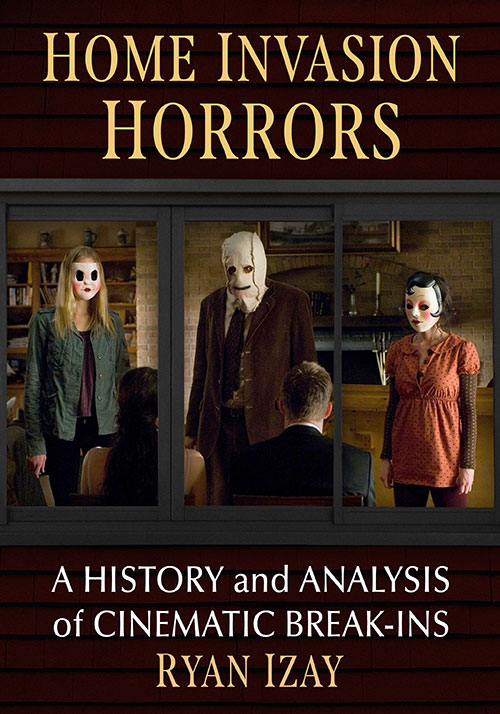
Izay utilizes Matthew Sorrento’s definition of the home invasion film (from Monsters, Law, Crime) wherein: “a middle-class home, as an example of complacent modern family values, is violated by a break-in/takeover.” As the author progresses in this text, he identifies early manifestations of this genre in films as early as the Griffith films in 1900s and traces them through noir titles such as Sorry, Wrong Number (1948) or Hitchcock’s Dial M for Murder (1954). Furthermore, Izay brings the study up to date, tracing the current uptick in home invasion horror films through the Covid-19 pandemic and horror cinema in the various forms as it exists today. Films like The Purge franchise, or The Strangers continue to try to push viewers comfort zones.
Izay organizes the structure of the book into 6 sections with an additional Introduction and Conclusion. Chapter 1 establishes the key elements that make up the sub-genre including setting, characters, plot, and themes, while Chapter 2 discusses the cinematic history of the films. In Chapter 3, one of the most timely and engaging sections of the book, the author addresses how the sub-genre has manifested itself in the 21st century. Izay attributes the proliferation of home invasion films, particularly from 2010 until the present to coincide with the housing bubble fiasco of mid 2000s, ever imminent immigration anxieties, and of course, the Covid pandemic. Izay establishes that just as the violent horror of the 1970s were reflective of the Vietnam war and political upheaval, that the surge of the genre in the 21st century so mirrors current political, social, and cultural changes.
One of the most fascinating aspects of this text is Izay’s delineation between the “criminal invasion” film and the “psychopath invasion film” in Chapters 4 and 5. The film version of Capote’s book, In Cold Blood (1967) or Wait Until Dark (1978) are classic examples of the criminal invasion film, whereas Funny Games (1997) or When a Stranger Calls (1978) explores sadistic psychopathic transgressions with no relatable motive, representative of the psychopathic invasion film. Along the way, Izay also narrows the genres down to multiple or single intruders and is inclusive of “stalker”-like home invasion films, basically nailing down everything there is to say about the genre(s) and then some

In Section 6, Izay discusses something the author identifies as the “Inverted home invasion” film wherein perpetrators enter a wrong house, or what is an identified as a “terrible” house as in You’re Next (2011) and there is an empathetic bond between viewer and intruders. This reviewer found this chapter to be more fringe, and less cohesive and engaging than the previous 5 chapters but still manages to rough out some of the edges in Izay’s arguments.
Horror films are no stranger to reflecting cultural aberrations and primal fear. From their cinematic origins to their current circumstance today, home invasion films are here to stay, as horror films will continue to evolve or morph into other forms. Home Invasion Horrors is essential reading for those who have a keen eye on film trends. Ryan Izay’s book is filled with allusions to a catalog of films that is simply staggering. There are some memorable films, but some so obscure in which readers may not seem to care. However, whether some of the films leave a lasting impact or have been of lesser quality is not the central focus of this book. Rather, the book emphasizes how the home invasion genre like the trend of “body horror” somehow acts as a form of mimesis. Horror films mimic reality and hold up a mirror image of society, allowing it to examine itself for its inner and outermost anxieties and dysfunctions. In some cases, the films are fine art, and in other cases just exploitation of a genre. From any perspective, Home Invasion Horrors has the last word on this niche genre, with a dense amount of information to glean and for anyone teaching or studying horror films.
William Blick is a literary/crime fiction and film critic, a librarian, and an academic scholar. He is contributing editor to Retreats from Oblivion: The Journal of Noircon and has published work in Senses of Cinema, Film Threat, Cinema Retro, Cineaction, and Film International Online, where he frequently contributes. He is also an Associate Professor/Librarian for Queensborough Community College of CUNY.