

By Thomas M. Puhr.
A true lost classic, one which should find the wider audience it so richly deserves.”
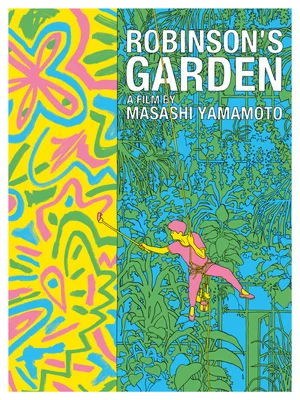
Kani Releasing’s best offering to date, Masashi Yamamoto’s Robinson’s Garden (Robinson no niwa, 1987) is a revelation, the type of overlooked gem that blasts any modest expectations you might have for it out of the water. The boutique label has been consistently releasing films little seen by Western audiences – a great service to cinema in and of itself – but this is the first one to leave me with no doubt that I’ve just seen a true lost classic, one which should find the wider audience it so richly deserves.
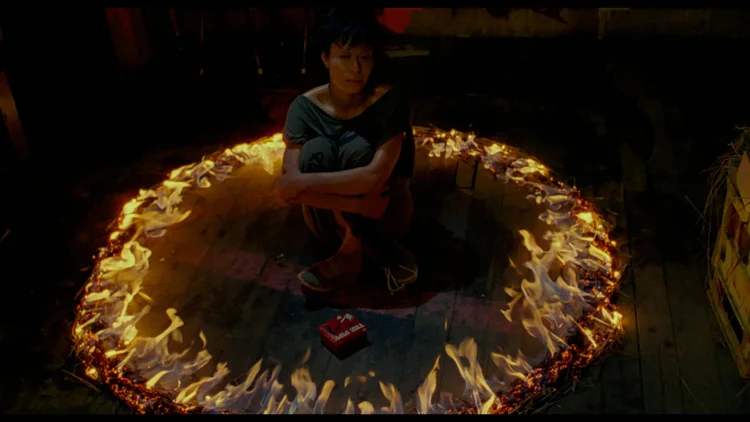
Kumiko Ota stars as Kumi, a twentysomething eking out a living as a small-time drug dealer in price bubble-era Japan. Everything changes for her when she drunkenly stumbles over a garden wall late one night and discovers an abandoned warehouse fringed by a great expanse of greenery. Without thinking twice, she sells or gives away all of her belongings (save for a moped), gets a book called Even Morons Grow Vegetables, and moves into this untapped oasis in a seeming effort to return to the earth and live off the grid.
As far as plot goes, that’s about it. With his rotating cast of characters (people come and go, including his protagonist), loosely connected vignettes, and creeping tracking shots of the sumptuous land, Yamamoto is more interested in mood and feeling than conventional storytelling. His leisurely, contemplative pacing reminded me more than once of Richard Linklater or Jim Jarmusch; imagine my surprise, then, to learn that none other than Tom DiCillo was the cinematographer. In an interview included in the new release, DiCillo recalls getting the unexpected offer to shoot a project in Japan after his success with Stranger Than Paradise (1984). The films indeed share a similar rebelliousness, their marginalized characters striving to live meaningfully on their own terms.
A curious early scene establishes Yamamoto’s thematic concerns. While speaking with her friend Maki, Kumi turns a corner and suddenly finds herself alone. Maki seems to have vanished into thin air. Kumi wanders; she listens to the wind and seems at peace. This is the first (but not the last) time that a character will inexplicably disappear, and it signals the writer-director’s overarching interest in nature: not just humanity’s place in it, but also what it “is” when no one is around to perceive (or exploit) it. In a sense, the warehouse and surrounding land are the true protagonists of Robinson’s Garden.
Though Ota is a likeable lead, we get the sense that her character’s efforts to leave her mark on the land are somewhat futile. She paints elaborate murals on the walls, but the rain washes them away; she establishes sleeping quarters in the warehouse, but the room is flooded. Nature always reasserts its dominance. This isn’t to say that Yamamoto is a nihilist; he simply acknowledges that the world would continue to spin just fine without human interference.

It’s during its quietest moments of contemplation that Robinson’s Garden soars. One beautifully constructed time lapse shot observes Kumi as she reads on the floor; the lights dim into the purplish glow of early evening and brighten back into morning light. A long shot of Kumi on the warehouse roof slowly tilts upward until an imposing moon rests over her. A couple exploring an underground bunker on the property stare in awe at a tree’s gnarled roots, which have grown through the concrete ceiling. On more than one occasion a character will pause and simply stare at a tree, mesmerized.
These moments are juxtaposed with scenes bursting with conversation. One virtuoso sequence, accomplished in a single take, weaves through a crowded restaurant, the camera pausing at different tables as if eavesdropping. This moment’s implications – in a big city teeming with countless stories, here’s one or two we’re lucky enough to listen in on – reminded me of a similar restaurant-set encounter in Before Sunset (1995). Since Robinson’s Garden predates Slacker by three years, I can’t help but wonder if Linklater ever got around to seeing this one; he and Yamamoto seem like kindred spirits.
The images Yamamoto and DiCillo conjure are often breathtaking, and their shared poetic eye is on full display in the film’s bravura penultimate sequence. In it, footage of a trash-strewn alleyway precedes a painterly montage of the land: water floods the warehouse and spills over the windowsills; a wild garden bursts with multi-colored flowers; and, of course, we see the central tree which has time and again fascinated its human observers.
These rhythms – their careful interplay of sound and image – are closer in spirit to music than film; it comes as no surprise to hear Yamamoto, in one of two supplemental interviews included in the new release, claim that “the structure of my brain is similar to that of musicians.” The interview, nearly half an hour in length, sheds light on his unique background and influences. His work documenting the punk scene in Berlin – where he encountered rockers living in abandoned industrial buildings – may have inspired the unconventional central location of Robinson’s Garden. It’s also fun to hear the writer-director – clearly still a punk at heart – rip into Cannes, which he likens to a “dog show.”
The DiCillo interview paints a picture of an exciting – and linguistically challenging – creative partnership with Yamamoto. Neither spoke the other’s language, and DiCillo describes the strange experience of “understand[ing] what was happening, what he wanted…even though practically no words were ever really understood between us.”
It’s a fitting commentary on watching Robinson’s Garden itself, an experience which goes beyond language, beyond logic. Some things are better understood through feeling or intuition. Perhaps this is why Yamamoto keeps returning to the image of the tree, or why my thoughts keep returning to this beautiful film. I’m grateful to Kani for sharing it.
Thomas Puhr lives in Chicago, where he teaches English and language arts. A regular contributor to Bright Lights Film Journal, he has published “‘Mysterious Appearances’ in Jonathan Glazer’s Identity Trilogy: Sexy Beast, Birth and Under the Skin” in issue 15.2 of Film International. His book Fate in Film: A Deterministic Approach to Cinema is available from Wallflower Press.
I love this film!!! Thanks for the article.