

By Andrew Kolarik.
Something that has grown organically over the last few years from quiet beginnings rooted in internet memes and computer gaming…and is startlingly effective at evoking a kind of nameless dread….
The weird netherworld of Backrooms might be what Purgatory is like. Endless repetition of places and memories that only serve to deaden the soul. Unpleasant and hostile, with geometry that makes no sense, a place that makes you long for home. It’s the nothingness, the endless illogical room layouts with glimpses or sounds that imply something unfriendly has made this place its lair, that serves to shred your nerves and play on your anxieties. Everything works to get under your skin, by taking reliable and familiar forms and functions, and twisting them.
What sets the film apart is not just its uncanny visual and auditory aesthetics, but also its ability to weave a coherent and compelling narrative while teasing its viewers into wanting to find out more. Weirdly, the film is like a like a breath of fresh air, avoiding the black morass of recent horror films that succumb to the temptation to recycle the same formulas where characters get picked off by evil forces, or films that seem desperate to have something important to say about the human condition and risk coming across as cloyingly pretentious, falling apart under closer scrutiny because the storytelling elements don’t gel or make sense. Backrooms is not a response to these sorts of movies, rather it is something that has grown organically over the last few years from quiet beginnings rooted in internet memes and computer gaming. It just quietly goes about its business, and is startlingly effective at evoking the kind of nameless dread beloved of H.P. Lovecraft, although using the novel and unique nature of the backrooms to show us something cripplingly terrifying that we haven’t seen in a mainstream film before.
Written by Will Soodik, and directed by 20-year-old Kane Parsons in his debut feature-length film, Backrooms introduces us to Clark (Chiwetel Ejiofor), an alcoholic, divorced furniture store owner. He is having therapy sessions with Mary (Renate Reinsve), with whom he roleplays to work through his failed marriage, crap job, and aspirations to be an architect. One night he sees a dim light through the walls, and steps into it to find a complex of seemingly endless interconnected yellow rooms. He returns and blurts out his discovery to Mary, but finding her unreceptive, he press-gangs his assistants Bobby (Finn Bennett) and Kat (Lukita Maxwell) to come and explore the impossible maze. Both perish at the hands of the denizens of the place, and Clark disappears. Mary receives an enigmatic answerphone message from Clark, and goes looking for him in his furniture store. She finds the gateway to the extradimensional labyrinth, and is taken prisoner by Clark, who has lost his mind and found solace in the empty wastes of the complex. He continues his roleplaying with Mary bound and helpless, surrounded by simulacra of people that he once knew, including his ex-wife. When Mary confronts him with his constant whining and refusal to face up to his decisions, Clark releases her, only to be fatally chewed on by a monstrous version of his darker aspects. Mary fights the beast and runs through the hellish labyrinth of the backrooms, to eventually be taken in by the scientists of the Async company, who are investigating the backrooms for their own hidden motives.
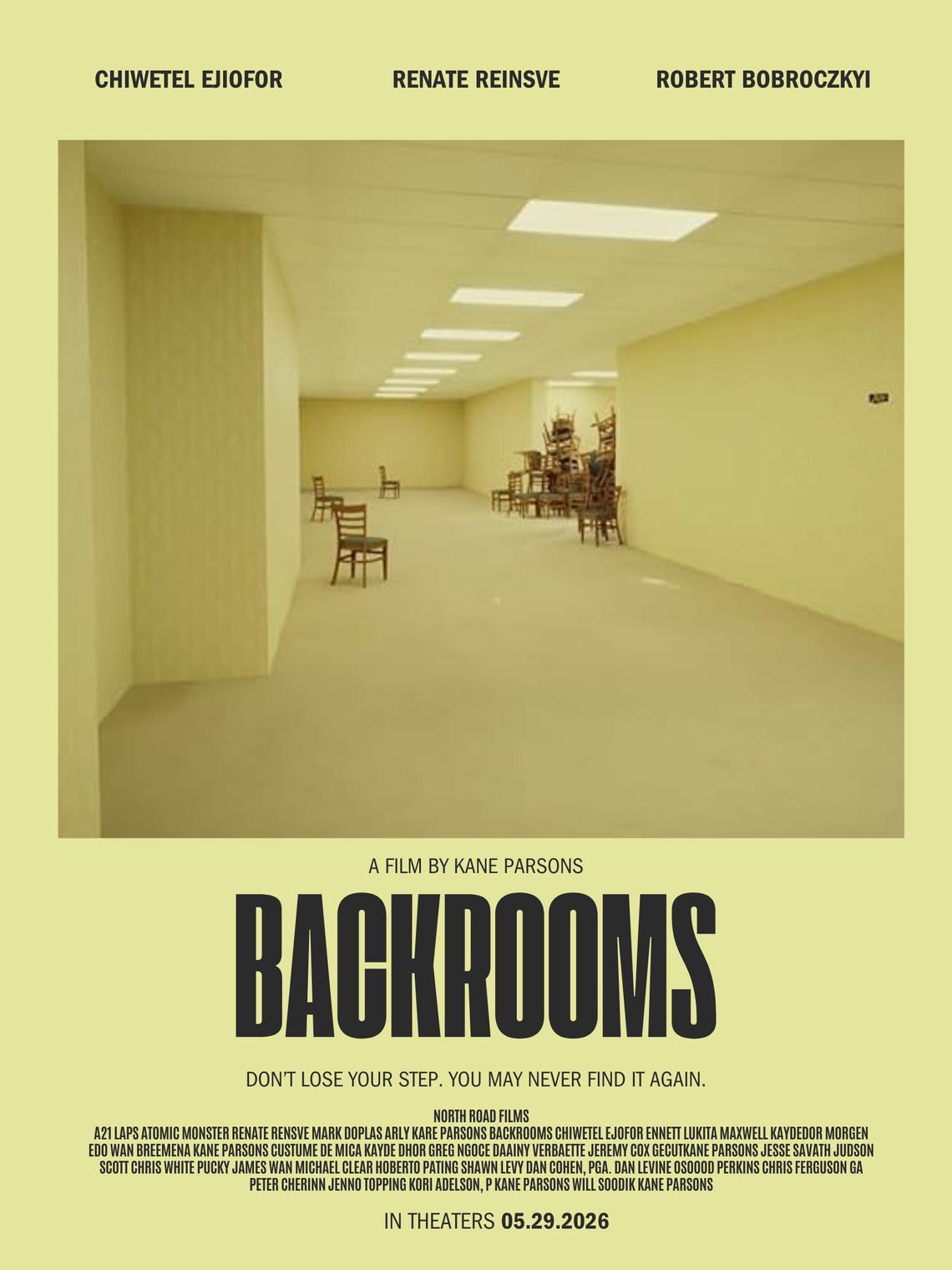
Backrooms excels at unsettling you. Rather than evoking straight up terror or focusing on jump scares, it wants you to feel uneasy. It understands the effectiveness of the uncanny, the subtle shifts that make the world feel wrong. Architecture is a touchstone. In our world, places are designed with human comfort in mind whatever the environment, whether it be houses, shops, or restaurants. They have symmetry, the correct dimensions, easy accessibility and layouts that make sense. Small adjustments to this, which the film loves, are striking in making you feel uncomfortable and unhappy. Characters find themselves inexplicably alone in a maze of empty rooms laid out in a series of endless, meandering paths, with cold yellow wallpaper and glaring electric light that eliminates shadows and renders everything dull and lifeless. There are ramps leading downwards that are too steep, without handholds to allow you to come back up, trapping you below. There are narrow, claustrophobic paths like The Descent (2005), only in something resembling a derelict or unfinished hotel rather than a cave system, with lurkers snuffling around on unknown errands. As people descend further into the backrooms, the environment goes haywire. Pits appear that seem to be bottomless. An abyss yawns beneath endless stories of rooms with a narrow staircase hovering over it, like an evil M.C. Escher painting. Where objects are present, they tend to be tired junk lying around haphazardly, like old tables or traffic signs, with never any view to comfort or aesthetics. Objects and people seep into the ground at strange angles, and the place seems like a nightmare that you can’t wake up from.
In aspect, the film appears strikingly modern and original. It appears to have coalesced from a number of sources that have been bubbling up in various arenas, including films, television, literature, internet threads, and gaming. The scenes and settings of Backrooms‘ liminal, transitory places evoke a rush of memories as the viewer searches for familiar touchstones to cling onto, such as the Stephen King novella and TV miniseries The Langoliers (1995). This told a story where characters fell into a world between moments, where now becomes yesterday, a faded, doomed world munched up by horrible monsters that seem to enjoy their duties. The found footage style of The Blair Witch Project (1999) jumps up, with our viewpoint seamlessly switching to the camera carried by our intrepid explorers of the backrooms. There is a large dollop of Eternal Sunshine of the Spotless Mind (2004), with its scenes of houses and rooms decaying and losing cohesion as memory falters and gets erased. The sense of being trapped and desperate also evokes the excellent Cube (1997), although with its inclusion of impossible spatial shifts and shadowy corporations emerging from the shadows near the end, Backrooms is closer to Cube 2: Hypercube (2002), where physical laws start to alter as the characters progress through endless identical (and deadly) rooms.
Gaming has heavily influenced the film, and the notion of the backrooms themselves. Kane Parsons has spoken of Valve software’s Half-Life (1998) as an influence, a game with an emphasis on crossing dimensions and strong narrative drive. The yellow color of the backrooms is unpleasant, pervasive and triggering, something used to great effect to torture a trauma survivor in Harlan Ellison’s I Have No Mouth, and I Must Scream (1995) point-and-click computer game, that effectively blended misery and moral growth. There are parallels aplenty between Backrooms and the Doom II (1994)mod MyHouse.WAD, which caused a stir in the gaming community by going beyond the already wonderful Doom gaming experience of exploring enclosed environments and hunting demons with your shotgun. What seemed to tickle people and gain their admiration was MyHouse.WAD’s way of constantly making small changes, just enough to unsettle and throw people with a sense that something was off, that evolved into ever weirder, uncanny places with impossible transitions and astute auditory contrasts designed to disorient you. In particular, you could “noclip” beyond the boundaries of the walls and out of reality, and find yourself punished by the game by being stuck in the backrooms, with something lurking around the corners making scary noises, just like in the film[i].
Backrooms strikes back at safe nostalgia-baiting and recycling old horror tropes….”
But the roots of Backrooms go back much further, to fears of being lost and alone and hunted, terrified of the unknown. Stories of being trapped in an endless maze, stalked by terrible foes goes back to Theseus roaming the Labyrinth, trying not to get murdered by the fucking Minotaur. Backrooms embraces these inspirations and tropes, puts them in a blender and dishes out a distillation of the best elements to make something striking and novel.
Is fear of the uncanny enough, or is it just a gimmick, designed to cash in on the interest in backrooms-related media currently floating around in various subcultures? The film makes a case for the worth of exploring liminal spaces, and the fear it evokes. And there is a hunger for this kind of film, which challenges you with mystery but maintains a firm hand over its pacing, atmosphere and narrative. Especially in the wake of the emergence of movies over the last decade or so that seemed content to be weird, look cool and have big ideas, but sometimes forgot that storytelling and a consistent, compelling narrative arc have to be present to make the film invigorating.
A few years ago, Christopher Nolan was the posterchild for smart, intelligent screenwork that didn’t patronize the audience, but a few too many overly cerebral contortions of works such as Tenet (2020) and plot contrivance in The Dark Knight Rises (2012) started to fray the audience’s collective patience (it is questionable whether even Batman’s constitution could stand up to swimming clear of an atomic bomb, having just been stabbed up). Annihilation (2018) had an interesting premise and creepy visuals, but politely declined to cough up coherent explanations for its ground rules (viewers were left scratching their heads wondering why the characters succumbed to such a wide variety of different flavors of mutation, while Natalie Portman’s character conveniently avoided all of this). Fabulous performances and interesting themes exploring contemporary issues in Jordan Peele’s Us (2019) and Nope (2022) were overshadowed by scripts crammed full of so many exciting ideas that narrative logic was forced to take a back seat, and the confusing explanations for what was going on had a hard time standing up to closer scrutiny. While all these films were likeable and still had a vast amount to commend them, more problematic films like Alien: Covenant (2017) represent an apogee in problematic, highhanded quasi-intellectualism. Wonderful to look at, it also drove a large chunk of the audience batshit with its utter refusal to answer just about any of its questions and plot threads, be they larger in scope (does a creator of living beings have to an obligation to look after what they have created?) or lesser (is it inadvisable to put your face into a pulsating alien egg?)[ii]. Quite often, the answers to burning questions or strange plot developments can be found by researching the internet, reading source material from books or interviews, watching the film several times, or through coming up with your own convoluted explanations. But it was hard to shake the feeling that a film should be able to tell its own story, without needing the viewer to go away and do some homework.
Such films can still be thoroughly enjoyable (watching the characters of Alien: Covenant making the absolutely worst decisions of their lives is especially fun, and Us and Nope are admirable for reaching as far as they do and are creepy as hell), but something tangible was missing. What came across more than anything was that the writers and directors of such films could fall into the trap of posing big questions and wanting to give the appearance of depth, but frustratingly failing to deliver because they became enmeshed in a web of ideas that was too complex to convey through a workable plot, or they seemingly had no answers themselves. It is exciting to have films that are imaginative and bend natural laws, but they still need to make sense on their own terms, and the explanations given in such films need to stand up, otherwise you run the risk of the audience just feeling jerked around. In essence, good storytelling needs to take precedence over themes and ideas to avoid this.

In contrast, Backrooms does provide clues regarding the nature of the world it inhabits, and its internal logic. The creatures seem to be some kind of construct that the Backrooms create in response to those who enter, like half-finished echoes of old memories and feelings. Clark encounters apparitions of his ex-wife, and a monstrous version of himself as the somewhat pathetic pirate character he dressed up as to promote his furniture store. Time is taken to weave Clark and Mary’s backgrounds into the story, explaining what drives them and gives them motivation. When they get confronted and challenged with the decisions and experiences that have led them to become the people they are, they either submit to their darker impulses, as Clark does when he ties up Mary and continues their roleplaying, refusing to take responsibility for his failed marriage, alcoholism and boring job. Or they fight their way out, as Mary does. In contrast to the fading, already dead world of The Langoliers, when Mary asks what the backrooms are, Clark replies “It’s every place that ever was,” a kind of cosmic echo chamber of half-remembered places and moments[iii]. The film also preserves its larger mysteries, such as the organic, changing nature of the backrooms, or their higher purpose, trusting viewers to explore their own interpretations.
Despite its strengths, there are still issues with Backrooms. The great American film critic Roger Ebert raised the issue of internal logic with Labyrinth (1986), complaining that anything could be behind a locked door, killing the suspense because the rules keep changing. As mentioned above, Backrooms carefully avoids this, following its own rules and avoiding straying too far into obscure lore that would alienate the viewer. But Labyrinth also had a lot of warmth, and it had Jennifer Connelly and David Bowie. A bit more of that would be welcome in Backrooms. Chiwetel Ejiofor is sympathetic and acts his socks off, portraying every emotion under the sun and giving a sense of someone faltering under the pressure of divorce and unfulfilled dreams. Finn Bennett and Lukita Maxwell’s Bobby and Kat provide welcome flashes of color, but are on screen all too briefly. Renate Reinsve’s Mary tends towards being cold and emotionless (apart from one welcome bit where she loses her shit), shaped by a horrible childhood. A little bit more occasional brightness in the film would have helped contrast with the miasma of despair in the backrooms themselves, and helped drive home the horrible situation the characters find themselves trapped in.
Some films have a knack for tapping into the mood of the nation at the time of their release. It may be that Backrooms has already garnered so much interest because it has keyed in on the psychoses of living in a world where control and security seems to have been taken from us completely, where fashions and media are recycled from older, seemingly better times in a welter of nostalgia, where everyday existence so often seems hostile and uncomfortably brightly lit up, mediated by soulless digital screens. The film itself strikes back at safe nostalgia-baiting and recycling old horror tropes, in favor of exploring a darker, inner world. Backrooms may be the start of a sea change, with a director who has a grasp on how to tell a tale that is clever, logical, and entertaining, that challenges the audience to enjoy things they haven’t seen before in settings tailor-made to make them anxious. It is intelligent in its design and execution, and the way it has of stoking our fears of uncanny horror, of sad, hollow places, but crucially it never disappears up its own backside. There is a lot more to explore here, and we should expect great things to come from Kane Parsons.
Notes
[i] It is worth checking out Power Pak’s YouTube video about MyHouse.WAD and liminal spaces, for which Mr. Pak was recognized by the British Film Institute for producing one of the best video essays of 2023. MyHouse.WAD – Inside Doom’s Most Terrifying Mod
[ii] One of the standout criticisms of the film came from the English naturalist Chris Packham. Less bothered about the characters appalling choices and the film’s narrative incoherence, Packham was affronted by the alien planet’s lack of insects, leading to the question of just how it would be possible to pollinate all the plants, and questioning the lack of diversity in an apparently functional ecosystem. All this contributes to the sense that a film will have a hard task asking big, serious questions, if care is not taken with foundational details that drive the audience up the wall.
[iii] There is a nice little touch where the family of the Async company chap are watching The NeverEnding Story (1984) on TV. This may be a nudge regarding the nature of the backrooms, as the events of The NeverEnding Story are shaped by the little boy reading it, similar to how the backrooms create people and environments shaped by those unlucky enough to enter them.
Andrew Kolarik is a Lecturer at University of East Anglia and has previously worked at Cambridge University, University of London, and Anglia Ruskin University. His criticism, poetry, and fiction have appeared in Pulp Metal Magazine, Supernatural Tales, Carillon, Eunoia Review, Horla, Yellow Mama, and Between These Shores Literary and Arts Annual.