

By James Morrison.
Every admirer of Welles – that is, every lover of cinema – will find endless fascination in perusing the point of origin of one of his greatest films.”
Touch of Evil (1958) starts with the most famous shot in Orson Welles’s work and one of the most famous in American movies. In a single take, the camera follows a time bomb planted in the trunk of a car through the busy streets of a shadowy border town until the bomb’s detonation three minutes and twenty seconds later, when the first cut of the film synchs with the explosion. Following the car, the camera skitters up a wall and over a rooftop, sharply defining parallel lines of action as it weaves among pedestrians in an off-kilter backward-tracking motion, with unexpected figures springing from behind the camera into view from the flaring fringes of the wide-angled frame, from a scurrying pushcart vendor to a passel of bleating goats.
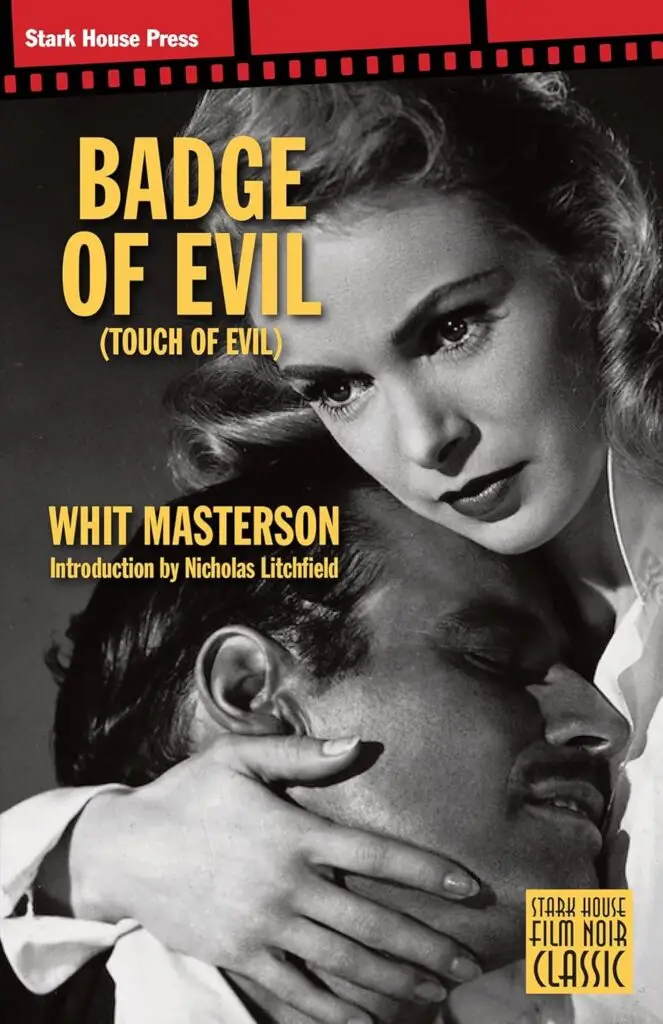
The same basic action begins Badge of Evil, the 1956 novel by Whit Masterson, just released in a new edition by Stark House Press (with an introduction by Nicholas Litchfield), that Welles adapted for his film. It occupies a few lines on the first page:
Rudy Linneker heard the package thump on the woven-grass carpet. He turned in his chair and saw it, the bound cluster of things like thick red fingers, and the short sparking fuse. He rose uncertainly, not comprehending. He was destroyed as the yellow blast flashed through the cabaña. (18)
This stark, straightforward opening is as characteristic of the book as Welles’s virtuosic exercise is of the prodigiously inventive film that follows it. The bravura formal feat Welles harvests from the kernel of this event encapsulates much of his approach to adaptation and illuminates key elements of his profile as one of the most audacious stylists in cinema history.
American pulp fiction in its first generation boasts more than its own share of literary stylists, from James M. Cain and Dashiell Hammett to Raymond Chandler or John Fante. Others like Paul Cain (no relation to James) or Cornell Woolrich eschewed literary pretension or aspiration in favor of an unadorned, brutalist mode to put the story across like a punch with little concern for footwork or other niceties. The next generation on the whole was more beholden to this model, from Mickey Spillane to Lawrence Block, Joe Gores, and Donald E. Westlake.
First publishing in 1947, Masterson too – actually a pseudonym for the writing team of Robert Wade and Bill Miller – elected a bare, neutral approach, a procession of simple declarative sentences designed to convey little more than what happens next, with the emphasis on the simplicity rather than the declarative-ness. As the passage above indicates, this transparent style allows a certain flatness to creep in, as well as more-than-occasional awkwardness – as in the description of the bomb’s trigger-whips as “the bound cluster of things.” Plotting is the main event here, compensating in its over-complications for what the prose may lack in the complexity it shuns. Though Welles more or less follows the plot as Masterson lays it out, he also efficiently streamlines it, eliminating a subplot involving a false confession, for example, that only serves to muddle the narrative momentum.
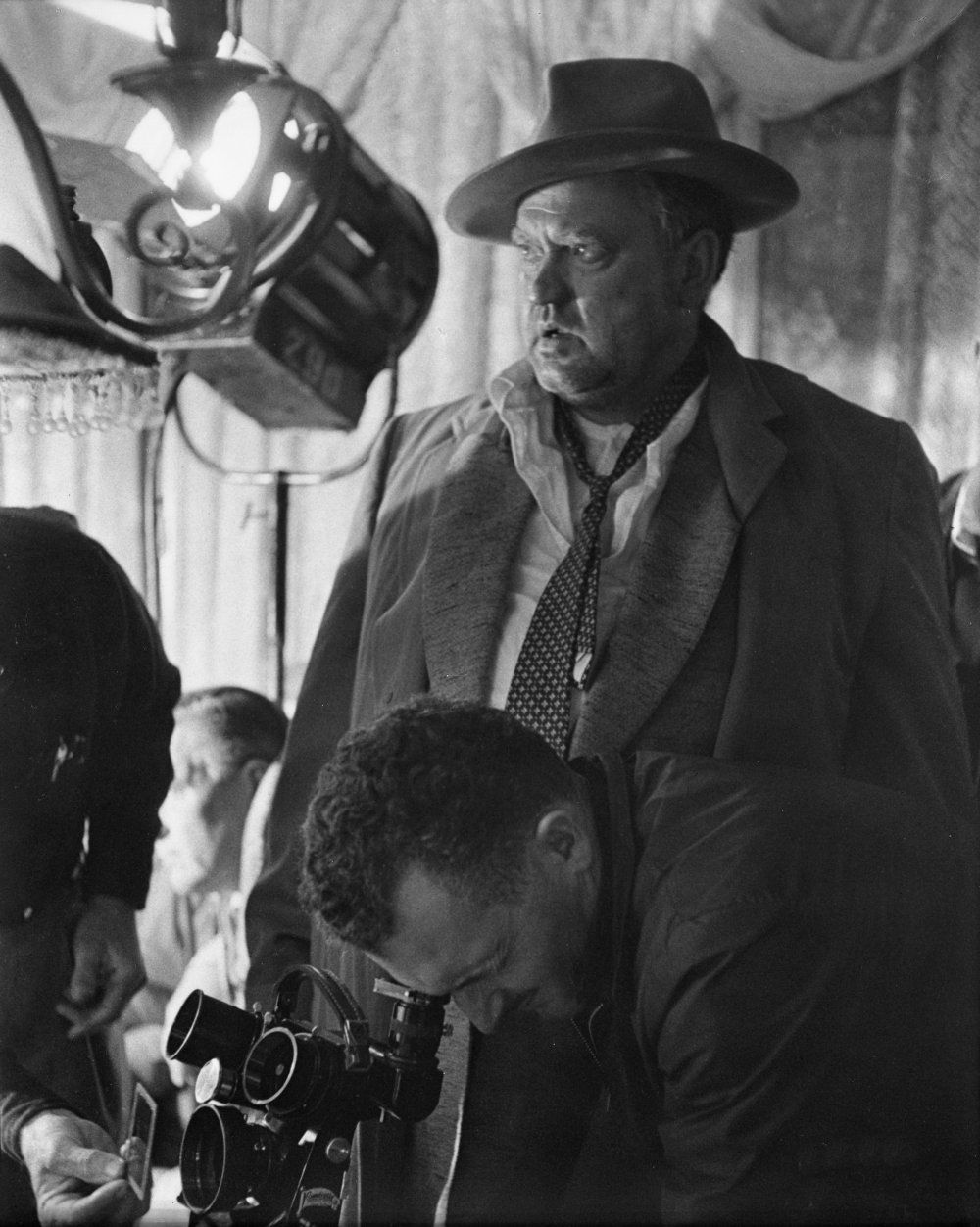
Welles’s most impressive achievement as adaptor in Touch of Evil is this infusion into Masterson’s zero-degree writing of a richly distinctive cinematic style, beginning with his transporting the bomb from Linneker’s immobile cabaña to the trunk of the car, a shift that integrates movement with the action and also enables from the start an intricate exploration of the setting, which Masterson alludes to only in cursory fashion, without significant description. Welles also seizes the opportunity to introduce concurrent bits of business like the pathetic, high-pitched whimper of Linneker’s companion, unheard except by us: “I got this ticking…there’s this ticking in my head!” Not only do such additions establish the film’s mordant tone right out of the gate, this one tells us more about Linneker’s character than we ever learn in the novel. He’s a Citizen Kane wannabe, callously deaf to the shrill complaints of the cut-rate Susan Alexander stuck in his passenger-seat.
Welles also decks out Masterson’s skillfully engineered plot with strains of social commentary nowhere to be found in the book. There, the protagonist is Mitch Holt, a WASP-y Assistant District Attorney fresh off his triumphant prosecution of the Buccios, a crime family that had long exerted pernicious influence on the town’s business sector. The Italian surname may imply Mafia ties, but Masterson makes nothing of this. Holt is married to a Mexican woman who flees to her family home south of the border when the Linneker case heats up as Holt investigates police corruption surrounding it, with the crooked cop – McCoy in the book – framing her for a drug crime in a turn leading to the climax. That plot-point has much greater resonance in the film, as Welles transforms Holt into the Mexican prosecutor Miguel Vargas (Charlton Heston), and the Buccios into the Grandis, a family cartel specializing in smuggling drugs across the Mexico/U.S. border. This alteration is Welles’s masterstroke, along with the relocation from a generic Californian “county” to the seedy border town that gives the movie its most pungent overtones.

These transformations raise the stakes substantially, and Welles, reversing Masterson’s marital arrangement, turns the screw further by making Vargas’s wife, Suzy, a white woman, played by the same Janet Leigh who had risen to fame not ten years before playing one of the maidenly sisters in the 1949 Little Women. A subplot finds Vargas comically negligent of this long-suffering wife, who ends up stranded in a remote fleapit hotel on the American side of the border tended by a neurotic proprietor, terrorized by a gang of Grandi thugs who dose her against her will with their own illicit wares. As the centerpiece in his conversion of Masterson’s competent mystery into an incisive probing of American racism, Welles boots McCoy from the premises and makes his lieutenant Quinlan the nefarious evidence-planting captain, adding a dose of racism to the character more noxious than the drugs the Grandis foist on Suzy – considerably more than the “touch” of evil the title ironically understates. This change can be traced to the first version of the script by Paul Monash, but Welles adds details such as Quinlan’s alcoholism and his wife’s death years before at the hands of a “half-breed,” these embellishments incrementally amplifying Quinlan into an almost Shakespearean figure.
The key precedent for Touch of Evil in Welles’s corpus is The Lady from Shanghai (1947), his earlier venture into film noir, also adapted from a pulp mystery, Sherwood King’s If I Die Before I Wake (1939), a considerably less distinguished entry in the genre than Badge of Evil. There too, Welles finds in King’s unpromising conceptions many occasions for cinematic set-pieces, exporting a proficient plot, jettisoning its sillier encumbrances or making them part of a fabric of parody, and adding dimensions the original could never dream of. In this case, that includes a subplot involving atomic anxiety, a character in the film seeking to fake his own death in a staged murder so he can escape to a safe bunker in case of a nuclear holocaust. As in Touch of Evil, Welles excavates the basic outlines of the source, mines them for cinematic possibilities, and integrates the elements of social critique that defined his work from beginning to end. As John C. Stubbs remarks in the definitive tracking of the film’s development, however, Welles’s treatment “does not so much ‘ennoble’ the work with a social purpose as it does put it on a more visceral level of social-sexual antagonism” (183).
Badge of Evil is an extraordinary artifact in this history. Though its main point of interest remains its status as the source for Welles’s film, the book is not without interest in its own right. As Litchfield points out in his astute introduction to the new edition, it is one of the first examples of crime fiction to explore police corruption….”
Touch of Evil culminates Welles’s treatment of crime in his Hollywood films. Though Lady from Shanghai is much more than a dry-run for Touch, its fervid atmosphere of total corruption, shot through with antic absurdist touches, certainly anticipates the later work. In these two films, Welles pioneered the tradition of tapping into American pulp fiction for material in films with more serious artistic designs. Among the key filmmakers who tried to introduce strains of modernism into the Hollywood system, Welles gravitated to pulp and noir believing they channeled the existentialist attitudes of more “serious” art of the era while being fully compatible with products of the institution in which he found himself. Welles’s translation of a novel of such dubious quality into the brilliant miscellany that is The Lady from Shanghai might have been the first exercise of its kind, as Welles’s prior sources had run to the higher modernisms or proto-modernisms (his unmade adaptation of Conrad’s Heart of Darkness) or the respectably middlebrow (Booth Tarkington’s The Magnificent Ambersons). A certain conceptual indifference about the provenance or prestige of the source material in this case surely reflected his confidence that in the realm of noirish cinema, on the cusp of mass culture and modernism, he could weave a silk purse out of any old sow’s ear without too much trouble so long as he had the resources of his unstoppable cinematic inventiveness to hand.

Whether under Welles’s influence or not, Alfred Hitchcock too turned to the pulps in mid-career, adapting a story by Cornell Woolrich originally published in 1941 in Dime Detective Magazine into Rear Window (1954). By the time of Psycho (1960), Hitchcock seemed positively addicted to pulp and to the regenerative alchemy that could turn it into film art. In that film, of course, Janet Leigh spends another night in a cheap hotel overseen by a jittery clerk – one of the most uncanny parallels in cinema, with Hitchcock surely recalling Welles’s excursion into the B-movie territory he now hoped to explore. From the shower scene in Robert Bloch’s 1959 source novel, Hitchcock follows Welles’s lead from Touch of Evil in building one of his most remarkable set-pieces on Bloch’s inauspicious setup: “Mary started to scream, and then the curtains parted further and a hand appeared, holding a butcher knife. It was the knife that, a moment later, cut off her scream. And her head.”
In all these cases, an enterprising filmmaker transmuted a less creditable work of literature into a film of great cinematic worth – a model that endured over decades, encompassing Akira Kurosawa’s High and Low (1963), adapted from an entry in Ed McBain’s 87th Precinct series of crime thrillers, and the French New Wave’s repeated recourse through the ‘60s to American pulp fiction for material. In these explorations, filmmakers tested the limits of evolving popular tastes with and against the grains of higher brows, betting that in the cross-grained contexts of ‘40s-‘50s Hollywood and ‘50s-‘60s art cinema and beyond, a great movie could be fashioned from an inferior book through the not-so-simple expedient of cinematic mastery.
Badge of Evil is an extraordinary artifact in this history. Though its main point of interest remains its status as the source for Welles’s film, the book is not without interest in its own right. As Litchfield points out in his astute introduction to the new edition, it is one of the first examples of crime fiction to explore police corruption, with only a few precursors like Gerald Butler’s Mad with Much Heart (1945), the source of Nicholas Ray’s On Dangerous Ground (1951). Well-reviewed on its first release but since overshadowed by Welles’s film, the book is a more-than-serviceable entry in the prolific Masterson team’s bibliography, its variations on their formulae more surprising than usual and its relative freedom from the misogyny that haunts its genre bracing. Indeed, its casual treatment of interracial marriage itself gives the book a certain social conscience that sets it apart, and a scene in which Holt defends his spirited and supportive wife from implicit racism is genuinely moving.
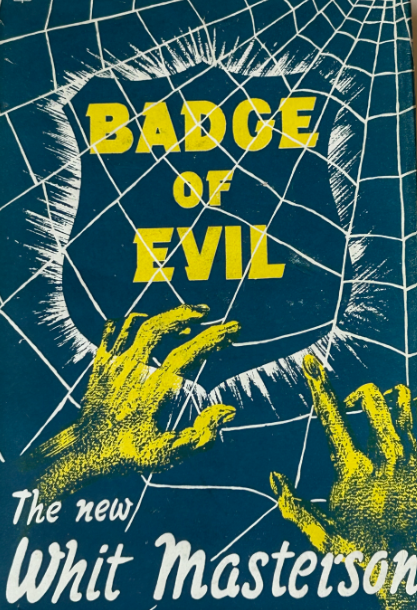
Every admirer of Welles – that is, every lover of cinema – will find endless fascination in perusing the point of origin of one of his greatest films. Every devotee of film noir should be grateful to Stark House Press for their judicious and varied curation of a series of books from which some of the classics derived. Mad with Much Heart has also been reprinted in the series, a crucial re-discovery. Other highlights of the list are another Butler title, Kiss the Blood off My Hands (1940), the source for Norman Foster’s unjustly neglected 1948 film of that title, with Burt Lancaster and Joan Fontaine; or Jay Dratler’s The Pitfall (1947), the source of Andre de Toth’s 1948 Pitfall, a case study in the cinematic softening of a nihilistic source along the lines of In a Lonely Place (1947 novel by Dorothy Hughes/1950 film by Nicholas Ray). Despite that softening, de Toth’s film remains one of the most trenchant of noirs, and because of it, one of the most humane and poignant.
Charles Einstein’s The Bloody Spur (1943) is perhaps the greatest find of the series, as it inspired Fritz Lang’s While the City Sleeps. The comparisons are if anything more telling about Lang’s process than the adaptation of Badge is of Welles’s, closing the circle insofar as Lang’s film showcases another world-class filmmaker remaking a pulp crime tale as a socially-conscious and self-conscious semi-satire, with explicit reverberations of Citizen Kane – including the encircled “K” of that film recycled in Lang from the RKO props department. Together with Badge of Honor, this is one of the most welcome entries in a most welcome series.
Works Cited
Masterson, Whit. Badge of Evil. Stark House Publishing, 2026. (Originally published by Dodd, Mead, and Company, New York City, 1956.)
Stubbs, John C. “The Evolution of Orson Welles’s Touch of Evil from Novel to Film.” In Touch of Evil: Rutgers Films in Print, ed. Terry Comito. Rutgers University Press, 1985.
James Morrison is Professor of Literature and Film at Claremont McKenna College. He has published books on the films of Todd Haynes, Terrence Malick, and Roman Polanski, as well as on emigre directors in Hollywood, auteur theory, and queer educations. He is currently working on a book on Orson Welles’s film The Lady from Shanghai (Channel Academic, an imprint of BearManor Media).
Even though I’m not as enamored with Welles’ Touch of Evil as I once was, I enjoyed reading your article. I especially enjoyed your capsule history of pulp fiction’s impact on Hollywood. (So, you’re a fan of Kiss the Blood Off My Hands!)