

By James Morrison.
My films are meant as polemical statements against the American ‘barrel-down’ cinema and its dis-empowerment of the spectator. They are an appeal for a cinema of insistent questions instead of false (because too quick) answers, for clarifying distance instead of violating closeness, for provocation and dialogue instead of consumption and consensus.”
– Michael Haneke, “Film as Catharsis,” 1991
Has the art cinema become “global”? It would be surprising if not, given the shape of world culture in the digital age. In an essay on the subject, Dudley Andrew muses that “[since] the 1980s, VHS tapes and then DVDs have made every ambitious filmmaker perforce a global artist.” This implies a definition of globalism in terms of a theoretical capacity tied to the production of portable copies able to be disseminated across the world, an option long available for adjacent media forms like books or records. The rise of the World Wide Web led to the proliferation of copies so abundant as to abrogate the basis of reproduction in some point of origin. One can easily imagine the eight-year-old girl Francis Coppola envisioned in 1990 as the filmmaker of the future, renewing the medium with readily available technologies of production and, through means of circulation not just convenient but all but essential to modern life, reaching viewers from her base in Ohio as far flung as Outer Mongolia or the Arctic Circle.

Surely, however, the old poli-sci definition of globalism as pertaining to the increasing interconnectedness of the modern world, and the tools that make that possible, still applies. This would entail the study of messages received as much as enhanced possibilities for their transmission. In their introduction to Global Art Cinema, a definitive anthology that put the subject on the map in 2010 – with Andrew’s essay serving as the book’s foreword – Rosalind Galt and Karl Schoonover note that art cinema, “international” virtually by definition, “instantiates an optimism about speaking across cultures.” The 21st century mode, they go on, stands to “dash that optimism” in the “post 9/11 world of anxious globalization, economic recession, and environmental crisis, where cultural transits are something to fear and the doctrine of infinite expansion is finally reaching a breaking point.”
Michael Haneke’s Code Unknown (2000) is among the films that most eloquently articulate this aspect of the 21st century art film in its expanding global contexts. In conception, it is virtually an allegory of these issues, as a multi-track narrative that follows characters of various backgrounds and typologies in a series of diverging and intersecting episodes that anatomize and crystallize pressures on human experience in a globalizing world. Though hardly calling for a revival of optimism – it is a Haneke film, after all, fraught with his characteristic austere severity – the film attests powerfully to emerging conditions of geopolitical interconnectedness that could unite, or could estrange, those who live in those conditions.
*
Recent decades have undeniably seen an expansion of dissemination of films from across the world, not only via internet circulation but through traditional channels of distribution from multinational corporate networks to international film festivals. The latter, as early as the 1940s, served as a vehicle for the establishment of the art cinema as a category years before anyone named it that, a point we could date to the portfolio on the “art film” in Robert Warshow’s The Immediate Experience (1962). Largely a Euro-American phenomenon itself, the festival circuit has remained perhaps the dominant platform in the decades since, especially as international festival culture has increasingly fused with corporate interests, many of the most celebrated festivals now serving not only as showcases but also as markets for the purchase of distribution rights.
To speak of a global art cinema would presumably mean to remark the expansion of the category beyond an exclusively European or national provenance. For decades commentators wrote world film history around a matrix of Hollywood and Europe, the former cast as the haven of mass-market entertainment, the latter as the source of “serious” work more in keeping with the traditional canons of high art. Though such a neat binary insupportably denies the complexities of that history, it is certainly true that most of the national cinemas consolidating around art movements from the 1920s on, from German Expressionism to Soviet Montage, French Impressionism, and Italian Neo-Realism, defined themselves at least in part against the domination of Hollywood in the world market. In that sense, despite crucial differences among these movements, they made up something of a unified front. The seemingly impregnable sovereignty over decades of this dual matrix by definition cast every film made outside of it – that is to say, most films everywhere, from Latin America and Canada to Africa, Australia, Asia and South Asia – as somehow marginal on the world stage.

That first wave of European art films was defined insistently around national cultures but always sustained by international trade. In nearly every case, the films we now think of as the classics of the art film from the 20s through the 60s represented a small percentage of the output of a given nation in a given year, but were selected or, in some cases, pre-selected for export by ministers of culture in the nations in question. As the festival circuit gained in power through the 1960s, the canons of the art cinema opened slightly due to the fact that the films were chosen for inclusion (or not) by festival committees rather than cabals driven exclusively by their own national interests. By the eighties, the small number of filmmakers from outside Europe who had managed to get themselves enshrined over the years – India’s Satayajit Ray, Japan’s Akira Kurosawa – were increasingly, gradually joined by others from more various locations globally.
One could map the shift, for instance, around such landmark moments as the festival triumphs of Hong Kong’s Wong Kar-wai with As Tears Go By in 1989, Iran’s Abbas Kiarostami with Through the Olive Trees in 1994, or Taiwan’s Edward Yang with Yi Yi in 2000, all at the Cannes Film Festival. Yet a survey of recent fare at major festivals suggests that the matrix remains in place, if less securely than in former times. Of forty-one films in competition at Cannes 2025, only two originated outside the U.S. or Europe (one from Egypt and one from India), another eight with dominant European investment co-produced with other nations, namely Brazil, Chile, China, Columbia, Japan, Iran, Palestine, and Tunisia – alliances that render the films’ provenances somewhat indeterminate. Another key development of the same period is the entry of a larger number of American films than previously into the international festival market, including occasional “blockbuster” entries, somewhat eroding the festivals’ role as custodians of a more high-minded film art.
One explanation for this state of affairs was the emergence of the European Union Media Program among the most powerful institutions worldwide dedicated to the propagation of art cinema. Established in 1991 – two years before the EU itself officially existed – the Program promoted European cinema mainly by aiding in its global dissemination. Of its yearly budget – then the equivalent of a billion dollars in US funds – more than half was given to assisting filmmakers in pre-selling world rights, especially outside Europe, in order to support production. In a literal sense, then, this organization ensured the globalization of the art cinema while maintaining its European basis.
Reflecting the supranational nature of this funding, projects were typically international in nature – including in the early years of the program films like Zentropa/Europa (1991), Delicatessen (1991), Orlando (1992), Il Postino (1994) – but the program tried to strike something of the same balance as the EU itself between forming an extended power-bloc and respecting national heritages. Though these goals may have mitigated the program’s global commitments, they were supplemented by smaller outreach programs, EUROMED and Outside Media, in support of filmmaking outside Europe, especially in Mediterranean basin locations and sub-Saharan Africa. In an essay included in Global Art Cinema, Randall Halle suggests that “[one] is incited to wonder whether the films [produced by these programs] are inevitably neo-colonialist or if these programs are simply facilitating the production of films in countries that would not otherwise have the resources.” His conclusions tilt toward the former judgment, as the unequivocal title of his article portends: “Transnational European Film Funding as Neo-Orientalism.”
*
It is within and against this context that Michael Haneke’s Code Unknown, released in 2000, reveals much about the possibilities and limits of a global art cinema in the 21st century. It exemplifies the category in a number of ways, as the first of Haneke’s films to be shot outside his native Austria and the last (through Amour in 2012) to be made without assistance from the European Union Media Program; in a sense, it presented itself as a virtual audition for such support. As a pivot-point in Haneke’s work, it marks a decisive turn from the national standing that marked earlier phases of the art cinema to the global models of recent decades. From its narrative vantage point on a multicultural Paris, the film manages to encompass a strikingly wide geopolitical scope, from Europe’s colonial past to crises of contemporary Africa, African and Middle-Eastern immigration, the war in Kosovo of the late 90s, and the general economic precarity of modern Europe, especially outside the European Union. No viewer of Haneke’s previous work would be surprised to find that his emergence into the global art cinema hardly qualifies as an instance of EU boosterism. In fact, though, Code Unknown is the self-conscious product of an art cinema that is not-yet-global, so to speak, an especially suggestive test-case because it questions so caustically the very category in which it places itself so willfully.

An opening scene stringently depicts the hostile encounter that spurs the diverging lines of the film’s multi-track plot. (Its subtitle translates as “Incomplete Tales of Several Journeys.”) Two young men face off in a Paris street. Jean (Alexandre Hamidi), who has come from the country in search of a domicile in the city, drops a piece of detritus into the lap of a homeless woman sitting on the pavement in the entrance to an arcade. Amadou (Ona Lu Yenke), the son of West African immigrants, happens to witness this gesture of what he takes to be casual contempt, and he confronts Jean, demanding an apology on the woman’s behalf. When Jean refuses, their hostilities escalate into a physical clash, whereupon the police intervene. Anne (Juliette Binoche) – the lover of Jean’s older brother Georges (Thierry Neuvic), whom he hopes to stay with in the city – enters the fray. The homeless woman, Maria (Luminita Gheorgiu), is intercepted as she tries to leave the scene unobtrusively. Then, abruptly, in mid-stream, the scene is cut off, without even a provisional sense of closure. A silent, assertive black-screen interlude intrudes, like those that divide each of the film’s sequences. The scene seems willfully suspended rather than resolved or concluded, and the rest of the film, in one way or another, explores the implications of this initial collision.
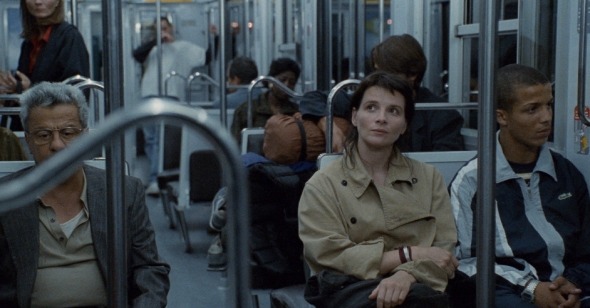
Many of these implications turn on problems of intervention. In perhaps the simplest sense, the film registers pressures of contemporary urban experience in a globalizing world. Anne lives in an apartment in a crowded building where she hears what may be signs of child abuse from a neighboring apartment, but in the hue and cry of the city, she is uncertain how to interpret this evidence, let alone whether to insinuate herself into the situation. Later, we see her in the metro, beset by a gang of young men who taunt her. While others in the train car avert their gazes or ignore the commotion, one older man stands up to Anne’s tormentors, effectively defusing the situation. Both incidents highlight the question of involvement. Anne fails to intervene, and the result – as we see later, in one of the most desolate sequences of a notably somber film – is the death of a helpless child. Her valiant protector steps in, on the other hand, and the result is the prevention of a potential assault.
Yet the film is not wholehearted in support of such interventions. Indeed, the latter case carries a disturbing, ambiguous charge of xenophobia, since the young men are Arab immigrants. Their aggressions are more boorish than directly violent, even up to the point at which Anne’s would-be savior interposes himself. The sequence carries a whiff of “Great Replacement” anxiety avant la lettre, ten years before Renaud Camus’s elaboration of a conspiracy theory involving a planned influx of Arab immigrants into Europe (read: Paris) with the alleged object of erasing the white majority. Haneke’s putative sympathy for immigrant subjects in his films provides some framing context for the sequence, and the casting of an actor of Algerian heritage (Maurice Bénachou) in the role of Anne’s rescuer, identified in the credits as “Old Arab Man,” serves as a clear strategy to offset imputations of racism. Even so, this scenario retains some ambivalence regarding racially charged clashes in a public sphere increasingly defined by human differences.
In the opening sequence, meanwhile, the racial charge is perhaps even more stark in its staging of the escalating confrontation between the two young men, one white (and French), one Black (of African descent). In this case, Amadou is clearly in the “right.” Despite Amadou’s noble intentions, however, the consequences of his intervention exceed a simple defense of Maria’s honor. As a result of his taking action, the police discover that Maria, a Romanian national, lives in France undocumented and is later deported against her wishes. Amadou himself, as we learn along the way, has grown quite assimilated into French culture, speaking fluent unaccented French and coexisting comfortably with other Europeans like the children he teaches and the white woman he dates in a rendezvous in which his comfort-level with mores and nuances of French courtship, for better or worse, are notable. As we also learn later, he is taken into custody after the initial skirmish and badly mistreated by the police, who also unjustly ransack the family apartment.
These more localized instances resonate in the context of an increasingly global world that, as the film suggests, makes the question of intervention ever more pressing, even converting it into a moral imperative of sorts, while rendering its motives and effects increasingly indeterminate, if only due to the enhanced complexity inevitably brought about by greater levels of geopolitical interrelation.
The line of the plot dealing with the war in Kosovo throws this point into relief. Anne’s lover, Georges, is a photographer who works as a correspondent in the war, his photographs serving as indices of the points of contact among remote locations that define global experience. The war itself culminates a series of conflicts through the ‘90s – in Rwanda, Somalia, Bosnia – for which world powers, the United States especially, were called to account in failing to mount humanitarian interventions, or doing so belatedly or haphazardly. Internationally, the US declared a lack of knowledge of the extent of the crises while domestically disclaiming responsibility on the grounds that intervention would not have served American national interests. As Samantha Power argues in her account of these and other conflicts, A Problem from Hell (2002), such declarations ended with Kosovo; in her chapter on that war, she demonstrates that these claims of ignorance could no longer be held tenable in a global world. Indeed, Power’s main line of inquiry investigates how it is possible that a global age of information flow could coincide with, as her subtitle has it, a new “age of genocide.”
A similar understanding informs the treatment of Kosovo in Code Unknown. Thematically, Kosovo operates alongside Romania in the film as a gauge of the state of contemporary Europe post-EU. They are portrayed along parallel lines – Kosovo as an actual war zone, Romania as a virtual one. This portrait provides an effective critique of the geopolitics of the European Union, since both the province of Kosovo and the country of Romania were deemed ineligible for entry into the union, Kosovo due to its embattled national status, and Romania on the grounds that it might prove to be a drag on the Union’s economy. (Kosovo’s status remains in question, while Romania was admitted to the Union in 2005, immediately prompting an EU Media-supported mini-renaissance in Romanian art cinema with such films as The Death of Mr. Lazarescu [2005] and 4 Months, 3 Weeks, and 2 Days [2007].) Maria’s return to her native country provides some of the most disorienting material in the film. Both sites – Romania and Kosovo – are presented in fragmented, dislocating ways. The film depends on viewers’ knowledge of contemporary Europe to recognize these locations at all; at the same time, both stand as signifiers of the exclusionary nature of the EU, against its rhetoric of “unity” and (to quote the language of the EU Media Program) of “the common roots of a single [read: European] culture.”
*
Code Unknown finally takes its place among 21st century films by European directors like Von Trier, Claire Denis, the Dardenne Brothers and others who have all depicted non-Westerners from a perspective critical of white colonial subjectivity while remaining cognizant of the liabilities of ‘speaking for’ the Other.”
Despite its global reach and aspiration, Code Unknown harks back to earlier models of art cinema in its severe formalism and its critical skepticism, both features giving it the air of an atavistic modernism. In technique and temperament, it evokes such prior auteurs as Godard and Antonioni, privileging much the same qualities of irony and self-reflexivity. The back-and-forth tracking shots that shape key sequences recall mid-career Godard, roughly from Contempt (1963) through Tout va Bien (1972), while the general atmosphere of existential portent and the structural rigor recall Antonioni. Most of the film’s sequences unfold in protracted long takes that enforce an exacting temporal schema and produce an extremely deliberate pace, while the sudden cuts and repeated black-screen interludes create an uncanny, inexorable sense of momentum.
Though these elements suggest the foreclosed structures of an already-known critique, the film also trades in a radical ambiguity that gives it an exploratory cast, uncertain if rarely tentative. Like Antonioni’s Blow Up (1966) or The Passenger (1975) – and like many of Haneke’s other films, especially Caché (2005) and The White Ribbon (2009) – the structure of Code Unknown is that of a mystery with no solution. The film’s ideological standpoints could hardly be clearer. It stands against the racism to which Amadou and his family are subject, as well as the xenophobia and classism that determine both Maria’s fate and the basic conditions of her existence, recognizing the roots of such problems in Europe’s vexed history.
Despite this seeming schematism, the film retains an enigmatic edge that further links Code Unknown to the modernist heritage of the art cinema, addressing the supposedly cosmopolitan spectator that cinema courted from its inception. In its “national” phases, the art cinema typically posited a spectator imbued simultaneously with a sophisticated aesthetic detachment and humanist empathy, the former presumably enabling engagements with “foreign” cultures and the latter ameliorating this foreignness by way of a universalizing second-order identification with putative Others. The self-reflexive energies of Code Unknown are dedicated in part to an interrogation of this very complement of attitudes. In films like Benny’s Video (1992) and Funny Games (1997), Haneke joined the ranks of contemporary art-cinema auteurs known for counterpointing an aesthetic of detachment with visceral affect, including filmmakers like Lars Von Trier and Gasper Noé, whose work routinely juxtaposes Brechtian alienation strategies against shock effects and intense, direct appeals to emotion, often knowingly provoking negative feelings like disgust or outrage. Typically, the latter overwhelm the former in an implicit rebuke to the spectator’s expectation of a comfortable distance upon the film’s materials.

In Code Unknown, the tension between distanciation and immediacy becomes an explicit subject of the film. One early sequence functions as an indirect, less graphic allusion to the murders in Benny’s Video and Funny Games. The scene depicts Anne in a vacant, dilapidated loft, facing the camera and talking to a male figure who remains off-screen, his voice issuing from behind the camera, which adopts his point-of-view. At first their interaction seems innocuous, even congenial, but in the course of the shot the feeling transmutes almost imperceptibly into an oppressive atmosphere of menace. In a calm voice the off-screen man overtly threatens Anne, telling her she will not be permitted to leave, the chamber she is trapped in to fill with poison gas unless she reveals her “true face.” Initially confused, Anne grows increasingly frightened, her affect escalating to raw terror as a single tear streams down her cheek.
The lack of editing gives the long take an unflinching quality, amplified by the prolonged duration and point-of-view framing, placing the viewer insistently in the perspective of the aggressor, Anne’s frontal position facing the camera emphasizing her vulnerability still further. Like many key sequences especially in the film’s first half, the scene is willfully shorn of narrative context; in fact, it is actually a film-within-the-film, in which Anne, an actress, is appearing. Initial casual dialogue makes this clear, yet the sequence still produces a jolting impact as it unfolds, placing it in a recent lineage of films that lay bare their theatricality and artifice yet continue to pursue the raw, direct emotion such techniques of distanciation formerly worked to undermine or forestall – the audition scene of David Lynch’s Mulholland Drive (2001), for instance, providing another roughly contemporary example.
Later sequences similarly confront the viewer with troubling imagery which is nonetheless revealed through a cool, unswerving gaze. In one shot we glimpse, as if in passing, a herd of animals inexplicably slaughtered in a barn; in a series of shots that accumulate one by one as in a horrifying slide-show, we see Georges’s photographs of atrocities from the war, as he speaks of his experience there in voice-over in a notably dispassionate tone.
In these cases, the contrast between image and affect highlights the difficulty of assimilating the sight of such images – a difficulty exacerbated, the film suggests, in a world in which expanded global awareness insures a far greater range of phenomena, from the local to the global, contending for response and, potentially, calling for action, even in the absence of viable framing contexts. That such calls for action may go unheeded fuels the film’s dominant mood of dejection; that interventions may prove useless in such a context, or produce unforeseen, destructive consequences, prompts its cool indignation. In the end, Code Unknown is something of a cautionary tale for the global age. In its call for an embrace of the global, it also warns against losing sight of the limits of individual perspective.
The film’s formal techniques stand as constant reminders of just such limits. Nearly every shot is a stubbornly fixed viewpoint that inevitably excludes far more than it shows. In many shots, the steely immobility of the camera’s prolonged gaze takes on a claustrophobic effect, making the viewer uncomfortably aware of all that is not present on screen – an effect further heightened by the narrative ellipses. Despite encompassing a wider range of characters’ viewpoints than most films, Code Unknown provides little reassurance that these multiple perspectives could be easily synthesized or reconciled. In its most sweeping gesture, in fact, the film excludes the synthesizing possibilities that film editing typically makes available, from crosscutting to punctuating edits to that most basic figure of the shot/reverse-shot.
The ban of the shot/reverse-shot is perhaps the most pointed of these exclusions, and the most telling. An opening sequence depicts a group of children – later revealed to be students at the school for the deaf where Amadou teaches – playing a game of charades, one child acting out an emotion as the others try unsuccessfully to guess what it is. The sequence is organized around sharp, incisive shot/reverse-shots, an initial strategy that highlights by contrast the almost complete absence of the technique from the rest of the film. The exclusion of the shot/reverse-shot not only limits viewers’ perspectives but denies the sense of wholeness the technique usually provides by “suturing” the viewer into the virtual space between the shot and its reverse field. Code Unknown supplants this illusionary plenitude with a bracing and rigorous lack, as befits a film largely about painfully missed connections among people trying to communicate across fractious divides and seemingly intractable differences. In the first scene, the “mystery” seems obvious enough that its solution should be graspable. In an eloquent irony, we see clearly the emotion the student is enacting – fear, in prelude to Anne’s enactment of sheer terror a few shots later – but her peers cannot guess. The code remains unknown.
Code Unknown finally takes its place among 21st century films by European directors like Von Trier, Claire Denis, the Dardenne Brothers and others who have all depicted non-Westerners from a perspective critical of white colonial subjectivity while remaining cognizant of the liabilities of “speaking for” the Other. In their strategies of critical distance, these films deny identifications with specific individuals in favor of an understanding of larger social, political and ethical questions and contexts, in the apparent hope that such an approach could hasten the emergence of a cinema truly worthy of being called global.
James Morrison is Professor of Literature and Film at Claremont McKenna College. He has published books on the films of Todd Haynes, Terrence Malick, and Roman Polanski, as well as on emigre directors in Hollywood, auteur theory, and queer educations. He is currently working on a book on Orson Welles’s film The Lady from Shanghai (Channel Academic, an imprint of BearManor Media).