

By Jeremy Carr.
I realized that anything I had ever done related to silent film had just sort of handed itself to me, and I leaned into that….”
—Ben Model
Ben Model loves silent movies. In case it isn’t obvious by his live performances, online videos and podcasts, and the library of films presented by his boutique home video label, Model has now written a book to reinforce his abiding passion, knowledge, and unique insight regarding cinema’s earliest incarnation.

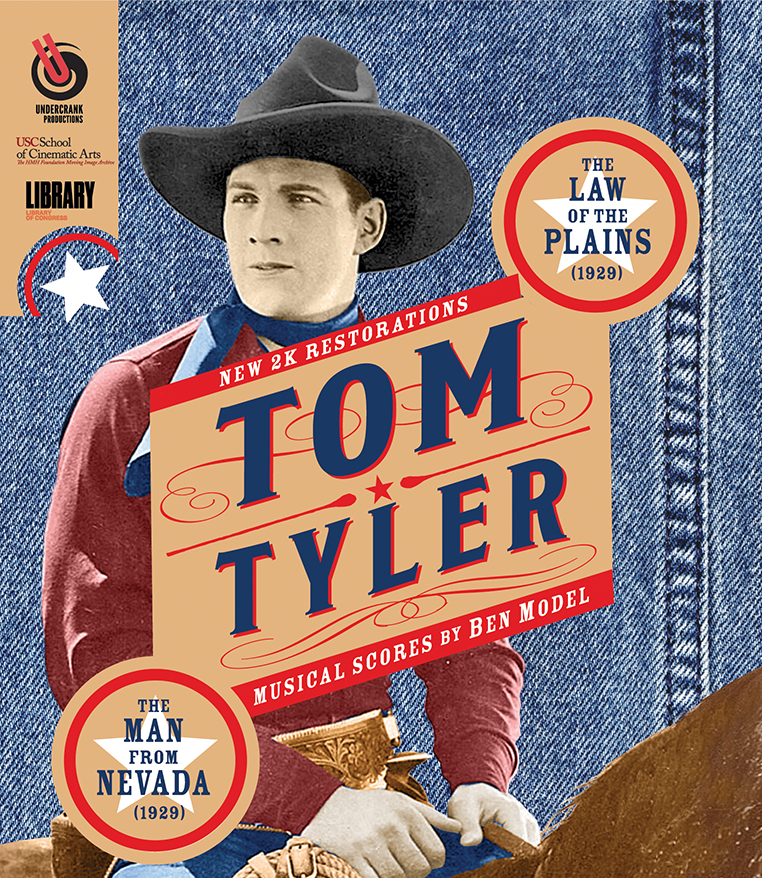
Also obvious: Model keeps very busy. In recent months he entertained audiences at the 2025 Turner Classic Movies Classic Film Festival and his Undercrank Productions released on Blu-ray two of Tom Tyler’s last silent features: The Man from Nevada (1929) and Law of the Plains (1929). This in addition to the release of his book, The Silent Film Universe. According to Model’s website, this text has allowed him to take his Wesleyan University course on the history and storytelling language of silent cinema (yes, he also teaches) and to “crystallize [his] ideas about the medium.” It’s an absorbing, earnest, and enthusiastic read, and on the heels of the Tyler disc—to say nothing of Model’s preceding output—it’s a valuable companion for those who, like Model, have an affinity for the silent era and want to understand why these pictures have never been lacking, but are actually rich with cinematic additives.
Model’s interest in silent film began early in life, but as he told Film International, the prospect of turning this interest into a career came around 25 or 30 years ago.
“I was feeling burnt out from my efforts to get a career going as an independent filmmaker slash comedy writer-performer,” Model states. “After a period of reflection, I realized that anything I had ever done related to silent film had just sort of handed itself to me, and I leaned into that. It does sound kind of strange to say that the thing I had the easiest time getting work doing was silent film accompaniment, and not office temping or piano tuning, which I was doing as a day-job.”
Cut to 2025 and Model is bringing that lifetime of experience to readers with “a new appreciation of silent film.” There is, to begin with, an unaffected appeal to Model’s writing in The Silent Film Universe. It’s something Jeanine Basinger gets absolutely right in her introduction: “As Ben ‘speaks’ in the book, he is a musician. A scholar. An historian. A visual analyst. A theorist. A member of the audience. A critic. But always, always, he is a fan.” In other words, as she concludes, this is “a book written by a man who lives in that universe on a daily basis, but not as a scholar alone in an ivory tower.”
Model’s approach is thus personal and personable. As seen in the final paragraph of his introduction, his use of “we” continues a penchant for audience identification and relatability. He makes no attempt to hide the partly subjective nature of The Silent Film Universe, but he also provides some irrefutable evidence to support his assertions, even going so far as to include a link for readers to view corresponding clips online.
Model sings the praises of the unique properties and processes of silent film and argues that “the makers of screen entertainment appear to have been spurred on by the limitations of silent cinema.” The perceived disadvantages of silent cinema were anything but, as he explains; rather, the sheer novelty of the medium unshackled the nascent filmmakers from conventional artistic binds and likewise allowed for audiences, who admittedly didn’t know any better, to engage with the medium in a truly distinct fashion, which has perhaps gone out of fashion today. Several times Model writes about how audience participation was “activated” by what they had to fill in (sound, color), which set the experience apart from current spectator practices.
“It could very easily be the reason people are on their phones in a movie theatre,” he told Film International. “No matter how much the Marvel Universe movies depict things that cannot happen in real life, they can do so with such precision and detail—including things like Dolby Atmos sound—so you feel like you’re really there.”
The engagement level is different, Model says, which is why he thinks video games and VR have been and continue to take viewership away from moviegoing: “I tell my silent film students at Wesleyan on the last day of class to take what they’ve learned from the course and apply it to films they make in the future—and to ask themselves: do we really need this dialogue, or is there a way this part of the story can be shown instead of explained in dialogue?
“It is because the audience’s imagination is a component of this screen entertainment that jumps in story and logic can be deliberately placed by the maker(s) and accepted by the viewer,” Model writes in his book. The Silent Film Universe is consequently a collective sphere, with commonly seen and implicitly understood modes of storytelling and illustration. This universe, he writes, “inhabits an alternate plane of existence, one that is similar to the one we know from the realm outside of silent movies, but which is more plastic, elastic, and expressive.” It was therefore “liberating,” Model notes, for these pioneers to play with the suggestion of sound as needed; for instance, as a freethinking means of narrative that vanished with the later expectations of reality as color and actual sound entered the picture.
Many of the movies mentioned in The Silent Film Universe will be familiar to silent film aficionados, and not only are they likewise favorites for Model, they’re also exemplary of the techniques discussed.

“I’m always finding new moments in films that I get to accompany at shows that are excellent examples of the Silent Film Universe,” Model states. “So there’s a mix of things that I know very, very well and which I show to my students every year—and new discoveries. For instance, I recently got to accompany Forgotten Faces (1928) and there’s a moment in it that indicates the passage of about 20 years that is so creative and imaginative that I was blown away by it. My deconstructions of some of the comedy sequences that I’ve done on YouTube are from films I know very, very well.”
The films discussed largely lean toward those produced in America, save for a few passages concerning some of the more influential Soviet films of the era. For Model, this selection comes down to fondness and familiarity, not necessarily a comprehensive approach to global silent film history.
“I’m not a scholar or an academic, and I mainly stuck to films that I knew well—primarily from presenting and accompanying them at shows over and over,” he states. “For many years, a film would have a sequence that stuck out in my mind, and then it became one of the examples I chose. I wasn’t aiming for a survey of world cinema. I just know what I know, and I’m always open to new discoveries when they can happen.”
There’s also something almost dreamlike and otherworldly about the movement. The reason we’ve never really caught on to what was happening on set is that the physical compensation actors were doing for the speed-up worked so well that we are not even aware that it’s there.”
Model divides The Silent Film Universe into well-defined, yet often overlapping chapters covering a handful of central facets concerning silent film. He explores silent cinema’s unique capacity for multiple perspective shifts—again, seamless and understood, in a way sound pictures could never be—and relatedly examines the defining characteristics of intertitle writing and silent film acting. Most prominent, however, is an extended section (a “mega-chapter”) on “The Speed(s) of Silent Film,” in which Model discusses in specific, fascinating detail how variances in projection speeds could drastically alter the perception and effectiveness of a given film. And he makes quite the convincing case. It’s a previously underdiscussed aspect of silent cinema, but Model provides a strong argument for its overlooked importance.
“I’m not sure why the ubiquitous use of undercranking throughout the silent era is such a key ingredient, except that it allows for things to happen and occur that cannot happen in real life,” he states. “There’s also something almost dreamlike and otherworldly about the movement. The reason we’ve never really caught on to what was happening on set is that the physical compensation actors were doing for the speed-up worked so well that we are not even aware that it’s there.”
Model contends he is likely the first person to “really dig in and investigate this” and believes “it is one of the main reasons that new attempts at silent film can come close, but are not quite right.” Not that he places blame with anyone, “because nobody knew about this practice until I began studying it and talking about it.”
“Hopefully,” he adds, this chapter “will help fans understand this better—and anyone interested in making new silent movies will be able to make films that more thoroughly inhabit the silent film universe, rather than merely look like tributes to silent movies.”
Nearly everything covered in The Silent Film Universe can conveniently be applied to the two aforementioned Tyler films from Undercrank Productions, which has released 30 DVDs and Blu-rays of rare/lost silent films, many produced as part of Model’s co-branding arrangement with the Library of Congress. Produced by J. P. McGowan and distributed by Syndicate Pictures, these two movies have been essentially unseen for over 90 years and they provide a snapshot of a relatively unfamiliar big screen cowboy.
Law of the Plains begins as a South American revolution is underway. It’s a time of upheaval and warring factions, with firing fighters peppering the landscape and nefarious outlaws running roughshod over the local populace. Led by McGowan, who gets the suitably unflattering intertitle description of being “deformed in mind and body,” these villains are also responsible for the death of Tyler’s father, which, as the films jumps to years later and the peripheral climate has calmed somewhat, positions Tyler’s character in the path of vengeance. Like Law of the Plains where she was the staple damsel in distress, The Man From Nevada also stars the striking Natalie Joyce, and here Tyler is protecting a group of threatened settlers, including some precocious, freckled faced children. Tyler is again the prototypical man’s man, encouraging others to fight for what’s right while doing his own part to stand up for the vulnerable. But while The Man From Nevada has its fair share of fisticuffs and horseback action, there’s more comic relief than Law of the Plains, though Tyler remains the effectively dashing do-gooder, persuasively gallant and intrepid in the face of any and all obstacles.

A brief slideshow on the disc surveys Tyler’s career, from his early stunt work (in the 1925 Ben-Hur’s famed chariot race, for example), to his eight films with producer/director/actor McGowan (just some of the 29 films he made from 1925 to 1929). He was an amateur weightlifter, appeared in several B-Westerns of the 1930s, showed up in John Ford’s Stagecoach (1939) as John Wayne’s nemesis, and later starred in his best-known roles as Captain Marvel (1941) and The Phantom (1943). Even with that, however, Tyler is today a rather obscure figure, and the same could be said about several of the individuals and films boosted by Undercrank’s distribution. In many cases, it seems, this is by design.
“My main radar is tuned to look for silent films that are not only overlooked, but were also very successful or popular during the silent era, and which have not been available for fans who want to see them,” Model states. “Sometimes I discover a film or a performer from having been booked to play for one of these at a show. Sometimes these are comedians or stars that my friend Steve Massa has told me about, and sometimes our projects are brought to us by other historians or fans the way our Francis Ford, Tom Tyler, and Frank Borzage projects were—by Kathy Fuller Seeley, Mary Della Valle and Andrew Simpson, respectively.”
With Tom Tyler, Model was drawn to these two films simply because “they survived and were available.” As he points out, “much of Tyler’s output is missing, survives incomplete, or is just inaccessible. And Mary was able to track down two of his films that survive at two different archives—archives that we work with. And so, it was just a matter of working out the logistics, funding and getting files. As it turns out, they’re both excellent films.”

Up next for Undercrank is a two-disc set of rare films starring and/or directed by Roscoe Arbuckle. This, Model notes, is a project Steve Massa Kickstarted earlier this year and is slated to be released in the beginning of 2026.
“We’re also just beginning work on the Marion Davies feature The Cardboard Lover (1928),” Model continues. “I ran a Kickstarter for this in May, which was successfully funded, and I’m really excited about getting this film out to fans. I discovered it by playing for it and hearing the audience scream with laughter at each show I’ve done with it. That was one of the reasons I felt it was an excellent candidate for an Undercrank project.”
Given the distinct disparities between modern movies and the films discussed in The Silent Film Universe, as well as those thankfully now available for viewing courtesy of Undercrank Productions, it may be somewhat surprising to find Model is mostly positive about recent attempts to emulate silent film—in whole, in part, or in principle—citing examples such as The Artist (2011), A Quiet Place (2018), and the work of Jerry Lewis and Mel Brooks. Model’s contention is not that such movies shouldn’t have been attempted, but that they could have benefited from the undercranking techniques outlined in the book. Model humorously suggests the reasoning for this optimistic attitude is because he “wanted to be polite and respectful about silent films that have been made in the last number of decades.” “After all,” he states, “the people who made them—including Mel Brooks—are still around and can find me!”
But Model does genuinely believe silent film is not a dead language and can still work today, “as long as you really understand the language and how it works—and not that you’re just compensating for the fact that there’s no recorded sound.” Also, he adds, “that you do not just continue to use the stereotypes about silent films that were invented in the 1930s, ’40s, and ’50s (which I also outline in the book). I myself am really interested in trying to make new silent films and to see how this can work. I hope people interested in making silent films use The Silent Film Universe as a handbook.”
He may have a point. After all, forgiving such things as “stock plots,” Model hits on a crucial fact about silent movies in his book—no matter when they were produced—and why they still apply to today’s cinema culture, and more specifically to today’s audiences: “The conflicts, frustrations, and desires we possess as humans still hold.”
Jeremy Carr is a Contributing Editor at Film International and teaches film studies at Arizona State University. He writes for the publications Cineaste, Senses of Cinema, MUBI/Notebook, Cinema Retro, Vague Visages, The Retro Set, The Moving Image, Diabolique Magazine and Fandor. He is the author of Repulsion (1965) from Auteur Publishing and Kubrick and Control from Liverpool University Press a contributor to the collections ReFocus: The Films of Elaine May, from Edinburgh University Press, David Fincher’s Zodiac: Cinema of Investigation and (Mis)Interpretation, from Fairleigh Dickinson University Press, and Something Wicked: Witchcraft in Movies, Television, and Popular Culture, from Bloomsbury Academic.