

By Jonathan Monovich.
What makes The Miracle Club work is the film’s deliberate choice in including four very talented actresses from four different generations for its core cast. Each character brings a diverse perspective on life and a varying level of surliness that gradually increases with age.”
The Miracle Club opens along the picturesque shore of Dublin with Lily (Maggie Smith) visiting the memorial site of her deceased son. Moments later, the attention shifts to the residence of Eileen (Kathy Bates). She is applying holy water to her presumed cancerous chest, in the secrecy of her bathroom, while struggling to get ready for a big night amidst her chaotic multi-child household. Next introduced is Dolly (Agnes O’Casey), a young housewife, navigating marital troubles and a son who won’t speak. Quite quickly, director Thaddeus O’Sullivan and writers Joshua Maurer, Timothy Prager, and Jimmy Smallhorne establish that all three women are in search of a miracle of sorts.
Set in 1967, the trio of Lily, Eileen, and Dolly unite at the town talent show with matching black dresses embroidered with one of the most prominent symbols of the sixties—flowers. As a beacon of hope for the leading ladies, the objective is to win tickets to Lourdes, France (known for its track record of healing). Appropriately under the moniker of “The Miracles,” Lily, Eileen, and Dolly sing the Chiffons’ “He’s So Fine.” Though a charming rendition, it’s not their singing, but the winning child’s kind-spirited donation, that gets them their desired bus tickets. This is just one of the film’s many heartfelt moments.
The setup for the threesome’s joyous road trip is soon complicated by the arrival of Chrissie (Laura Linney) for her mother’s funeral. Though Chrissie is the daughter of Maureen, the recently deceased beloved friend of Lily, Eileen, and Dolly, the women do not share the same affection for her. Now residing in Boston, Chrissie’s arrival in Dublin marks her first time in her native land in forty years. It is mentioned that “forty years will do a lot of things,” and one thing that is for certain is that the townies’ bitter, yet unclear, resentment towards Chrissie has not changed in those years.
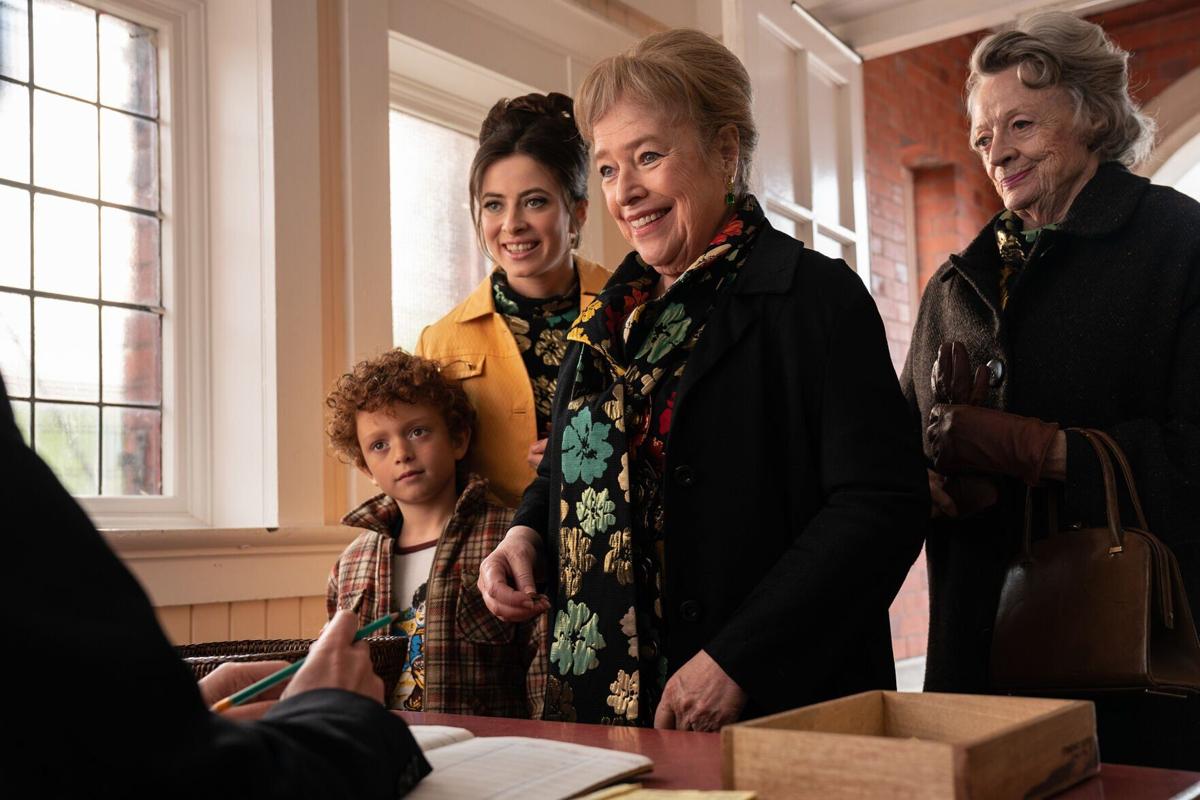
After reading a letter from her late mother enclosed with a ticket of her own, Chrissie is convinced to join the women on their voyage to Lourdes. Ignoring the overt tension she is causing, Chrissie forfeits that mothers are often times right in moments like these and casually boards the bus alongside her “enemies.” Given the ladies’ musical preferences, to quote another 60s girl group, Chrissie seemingly recalls the Shirelles’ words of wisdom that “Mama said there’ll be days like this.” What makes The Miracle Club work is the film’s deliberate choice in including four very talented actresses from four different generations for its core cast. Each character brings a diverse perspective on life and a varying level of surliness that gradually increases with age. Bringing both the comedy and the drama to The Miracle Club are the cantankerous comments of Bates and Smith. It is the contrast of Bates and Smith’s snarky antics with the generally calm and coolheaded nature of Linney and O’Casey that allow for an entertaining game of cat and mouse that trails throughout the picture.
Upon arriving at the holy site of Lourdes, The Miracle Club further succeeds in cleverly contrasting the hellishly frenzied households of the protagonists’ husbands against the heavenly location of their wives. As the women get a rare moment to themselves, their husbands comically tussle to cope with their absence due to their ignorance of the three big C’s of homemaking: cooking, cleaning, and childcare. While the men suffer, the women embrace a once in a lifetime opportunity. Unfortunately, like most “road films,” the characters’ expectations are too high and soon lead them to frustration. As time goes by, existential crises ensue, religious doubts rise, and the miracles that Lourdes was meant to solve are not immediately answered as the women had hoped. What the four travelers come to realize from the sagacious words of their town priest is that “you don’t come to Lourdes for the miracle. You come for the strength to go on when there is no miracle.” The immediacy of the women’s solutions is expected but not granted. It is through accepting that healing takes time that ultimately helps them to arrive at peace.
It’s not the shock that makes The Miracle Club worth watching. Rather, it’s the film’s unequivocal comprehension that peace is the greatest miracle of all that leaves a lasting impact.”
Though The Miracle Club has spiritual undertones, it is not a religious film. The Miracle Club is a human film that thoughtfully examines the complexity of relationships and the difficulty of forgiveness. Life’s big questions are discussed in The Miracle Club, and the most telling answer provided is that it’s ok to not have all the answers. The world works in mysterious ways, and unsurprisingly meaningful conversation often leads to meaningful results. Though discomfort and awkwardness is often felt, the on- screen reconciliation between Lily, Eileen, Dolly, and Chrissie is one of the unexpected miracles Lourdes provides them.
The film’s big reveal of the catalyst for the ladies’ dispute is quite topical and makes O’Sullivan’s cinematic vision even more relevant. Though telling of the times, it’s not the shock that makes The Miracle Club worth watching. Rather, it’s the film’s unequivocal comprehension that peace is the greatest miracle of all that leaves a lasting impact. In the case of The Miracle Club, the protagonists find peace of mind, peace in their homes, and peace with one another. The film is uncoincidentally set during the sixties as the great paradox of the decade was widespread advocacy for peace shattered by war’s inability to achieve it. O’Sullivan’s character study also analogously recounts Ireland’s long history devoid of peace, yet chooses to focus on the positive. Given that it took nearly twenty years for The Miracle Club to come to the silver screen, the film also ironically reflects that theatrically releasing a movie in itself is a miracle in today’s age.
The Miracle Club is exclusively in theaters, starting July 14, 2023, via Sony Pictures Classics.
Jonathan Monovich is a Chicago-based writer. His writing focuses on film analysis, history, and theory and has been featured in Film International, Film Matters, Bright Lights Film Journal, and PopMatters.